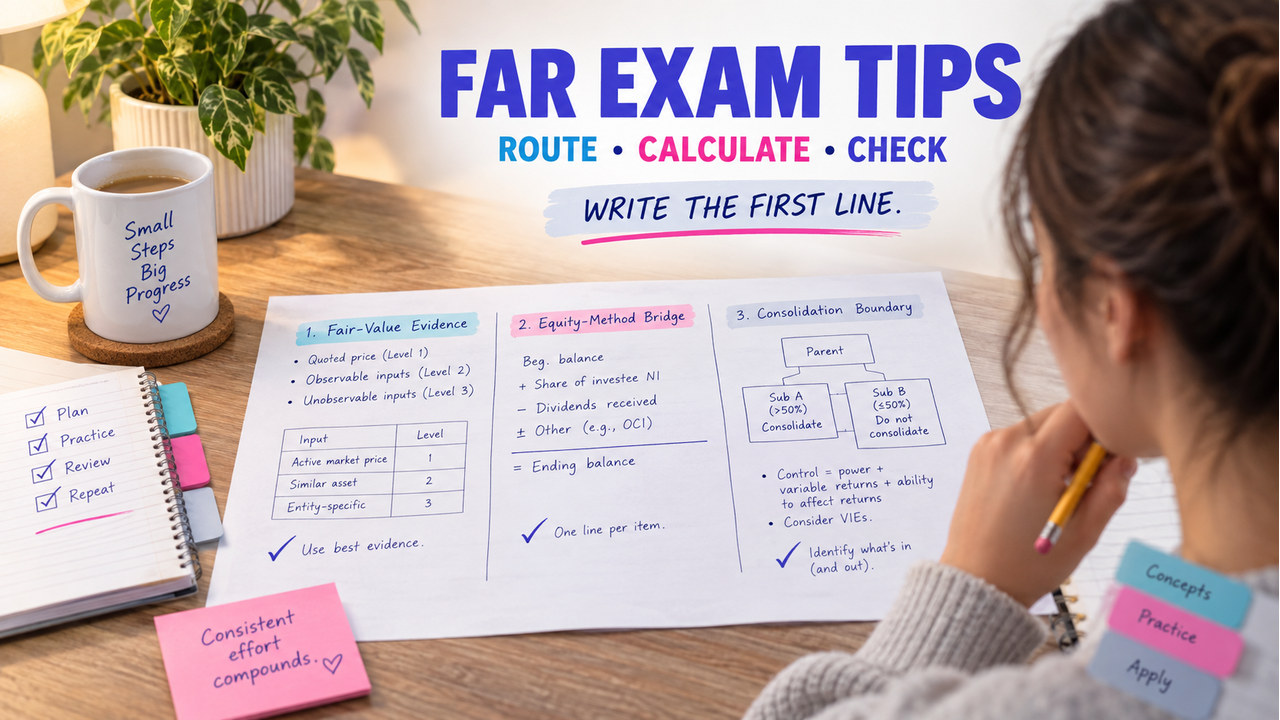

Direct answer: FAR financial instruments exam tips work best as a four-pass routine: route the question, identify the decisive input, write the shortest workpaper, and check the nearest distractor. Fair value needs measurement-date evidence. Equity method needs a signed bridge. Consolidation needs a boundary check.
Scope note: This original exam-tips guide is for US CPA candidates and uses the current AICPA Blueprint as its October 2, 2026 scope checkpoint. The prompts, amounts, answer routes, and checklists are independently authored. A live accounting conclusion still requires complete facts and current research.
For scope, reopen the AICPA CPA Exam Blueprint. Additionally, use the current FASB Accounting Standards Codification and the routes for Topic 321, Topic 323, Topic 810, and Topic 820 when a fact changes. The NASBA CPA Exam FAQ covers administration, while the FAR review hub can hold the wider study sequence.
FAR financial instruments exam tips
Exam pressure makes related topics look like one large calculation. They are easier when you force a first line. A fair-value prompt starts with evidence and date. An equity-method prompt starts with opening balance, income share, and distributions. A consolidation prompt starts with what remains inside the reporting group.
Use the FAR financial instruments exam tips routine as a writing discipline, not as a promise about an exam result. The routine gives you a short visible trail: route, decisive fact, workpaper, check. That trail makes a wrong answer easier to diagnose after the practice session.
This article uses original simplified practice facts. It is not an official, recalled, leaked, or exam-memory question bank. A local time budget is a study choice, not an official exam rule.
Use a four-pass exam routine
- Route: write FAIR VALUE, EQUITY METHOD, or CONSOLIDATION.
- Input: circle the date, quote, balance, movement, or remaining percentage.
- Workpaper: write one measurement line, signed bridge, or boundary note.
- Check: eliminate the nearest distractor and state what one changed fact would move.
In practice, this routine protects working memory. It also prevents the common mistake of calculating before deciding what the number represents. Therefore, keep the words short enough to write beside the question.
Pass 1: classify the trigger
First, look for the trigger that controls the question. A measurement date and supported quote point toward fair value. Next, an opening investment, share of income, and distribution point toward an equity-method bridge. Finally, a group diagram, internal transaction, or remaining percentage points toward consolidation.
When two triggers appear, do not combine their formulas. Put the facts under separate headings first. This keeps a fair-value input from becoming an equity-method movement and keeps an internal amount from escaping the group-boundary check.
- Circle the noun: instrument, investment, or group.
- Underline the date or period.
- Write the route in the margin before reading every distractor.
Pass 2: write the shortest workpaper
A short workpaper is more useful than a copied paragraph. For fair value, write “date → evidence → measurement input.” Meanwhile, for equity method, write “opening balance + income share − distribution.” Finally, for consolidation, write “internal amount × portion still inside,” when those are the facts supplied by the simplified case.
For example, a $300,000 opening balance, $36,000 income share, and $9,000 distribution produce $327,000 in the bounded practice bridge. Writing the signs before the amounts makes the direction visible. The same habit works when a number changes.
Pass 3: run the number or boundary
Next, apply only the calculation owned by the route. A supported $108 quote at the measurement date belongs on the fair-value line in the original practice case. Meanwhile, the equity-method bridge uses $300,000 + $36,000 − $9,000. Finally, a consolidation example with $20,000 internal profit and 25% remaining inside uses $20,000 × 25% = $5,000.
Write the unit or description beside the result. “$5,000” by itself is weak. “$5,000 tied to the portion remaining inside” tells you why the amount exists and what fact would change it.
Pass 4: check the distractor
Instead, do not check every option with equal effort. Identify the nearest wrong path. For example, a forecast may look stronger than a supported quote because it contains more detail. Likewise, a distribution may be added instead of subtracted. Finally, an outside portion may be treated as though it remains inside the group.
Write one sentence that rejects the nearest distractor. Then record one changed fact for replay. This gives the review session a target instead of a vague instruction to “study investments.”
Practice the timed decision route
Use this mixed fact pattern as a short original exercise. The case gives a supported $108 quote at the measurement date, an opening investment of $300,000, a $36,000 income share, a $9,000 distribution, and $20,000 internal profit with 25% remaining inside. Before calculating, write the route beside each fact.

First, the quote belongs to fair value. Next, the opening balance, income share, and distribution belong to the equity-method bridge. Finally, the internal profit and remaining percentage belong to the consolidation boundary. As a result, the case becomes three small workpapers, not one blended formula.
Run the timed decision route
Before opening the answer, write the lane, the decisive fact, the one calculation or boundary check, and the distractor you will eliminate.
Reveal the answer
Answer: The lane controls the first workpaper: fair value uses the measurement-date evidence, equity method uses the signed bridge, and consolidation uses the amount still inside the group.
Compare your process with the reasoning shown above.
Original practice: fair-value tip
Tested skill: routing measurement evidence. Difficulty: foundation. Assumption: an identical instrument has a supported $108 quote at the measurement date and an internal forecast is also listed. Question: What should you write first?
- A. Average both inputs
- B. Record the supported quote and date
- C. Start with the prior carrying amount
- D. Choose the forecast because it is more detailed
Reveal the explanation after your attempt
Best answer: B. The first line records the supported quote and date in this simplified case. Distractor check: detail does not replace the stated evidence, and averaging invents a method. Next action: change the measurement date and write the research question that follows.
Original practice: equity-method tip
Tested skill: writing a signed bridge. Difficulty: foundation. Assumption: opening investment is $300,000, income share is $36,000, and distribution is $9,000. Question: Which line should appear?
- A. $300,000 − $36,000 + $9,000
- B. $300,000 + $36,000 − $9,000
- C. $300,000 + $36,000 + $9,000
- D. $300,000 − $36,000 − $9,000
Reveal the explanation after your attempt
Best answer: B. The bounded practice bridge ends at $327,000. Distractor check: the wrong options reverse one or both movements. Next action: change only the distribution to $12,000 and recompute the ending balance.
Original practice: consolidation tip
Tested skill: marking the group boundary. Difficulty: intermediate. Assumption: internal profit is $20,000 and 25% remains inside the group. Question: What amount belongs on the simplified boundary line?
- A. $5,000
- B. $15,000
- C. $20,000
- D. $80,000
Reveal the explanation after your attempt
Best answer: A, $5,000. Use the portion that remains inside the group. Distractor check: $15,000 uses the outside portion, $20,000 ignores the boundary, and $80,000 reverses the relationship. Next action: change the remaining percentage and explain which group amount changes.
Use the last-minute checklist
Before committing to an answer, check ROUTE, INPUT, SIGN, BOUNDARY, and NEXT ACTION. ROUTE asks whether you selected the right lane. INPUT asks whether the decisive fact and date are copied. SIGN asks whether the bridge moves up or down. BOUNDARY asks what remains inside. NEXT ACTION asks what fact you would change for replay.

- Route: name the topic before the formula.
- Input: circle the evidence or amount that controls the line.
- Sign: write plus or minus before inserting the number.
- Boundary: mark inside or outside.
- Next action: record one changed fact.
Repair common exam failure modes
When a choice feels familiar, slow down long enough to name the failure mode. Start with “wrong lane”: the workpaper never matched the question. Next, “wrong input” means a plausible number displaced the stated evidence. Then, “wrong sign” means the bridge direction was not written. Finally, “wrong boundary” means an inside or outside amount was never marked.
The repair is deliberately small. Rewrite the route, replace the input, add the sign, or redraw the boundary. Instead of restarting a whole chapter, fix the line that explains the miss. A focused repair lets the next practice item show whether the tip worked.
Research when the facts change
These tips are bounded learning tools, not universal conclusions. Reopen the FASB Codification when the instrument, date, rights arrangement, group relationship, or applicable method changes. The AICPA page sets the exam-scope boundary; it does not replace technical research.
Write the research task in a complete sentence. “Confirm the measurement input for this date” is better than “review fair value.” “Confirm the amount still inside the reporting group” is better than “review consolidation.”
Keep the exam routine current
As a final check, reopen the AICPA CPA Exam Blueprint and the FASB Codification before reuse. Topics 321, 323, 810, and 820 are research routes, not substitutes for complete facts. This original guide does not assign official weights, predict an exam result, or replace current technical research.
Finally, review each amount, option, image label, source note, and next action. If a live fact changes the instrument, date, movement, or group boundary, pause the shortcut and reopen the current source.
FAR financial instruments exam tips FAQ
What should I write first?
Write the route: fair value, equity method, or consolidation.
How do I handle a mixed fact pattern?
Separate the facts into small route-specific workpapers.
Are these official questions?
No. They are original simplified practice cases.
What is the best review action after a miss?
Name the broken line and replay one changed fact.