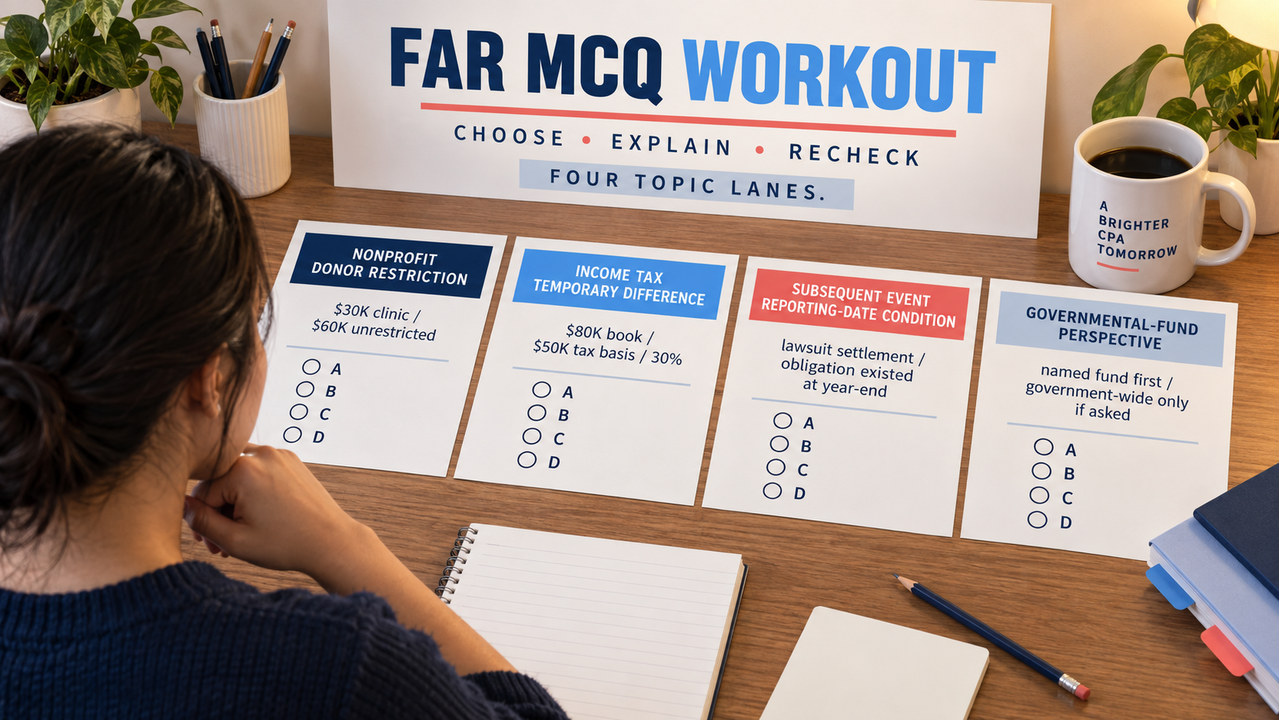

Direct answer: FAR nonprofit accounting multiple choice questions are most useful when you commit to a choice, name the fact that controls it, and read the rationale only afterward. This original set covers donor restrictions, income-tax differences, subsequent events, and governmental-fund framing. Every item is independently authored for practice.
Scope note: This page is for US CPA candidates and uses the current AICPA Blueprint as its October 2, 2026 scope checkpoint. The questions, amounts, answer choices, rationales, and mapping are independently authored. A live accounting conclusion still requires complete facts, jurisdictional context, and current research.
For scope, reopen the AICPA CPA Exam Blueprint. Use the current FASB Accounting Standards Codification, including Topics 740, 855, and 958, for the relevant research routes. Government-accounting questions require current GASB research. The NASBA CPA Exam FAQ covers administration, while the FAR review hub can hold the broader study sequence.
FAR nonprofit accounting multiple choice questions
Use the four lanes before you look at an answer: NONPROFIT, INCOME TAX, SUBSEQUENT EVENTS, and GOVERNMENT. The lane does not decide the answer. Instead, it tells you which fact deserves attention first and which authority should be reopened when the facts change.
Read each stem once. Underline the decisive fact. Select a choice. Then write one sentence explaining why the closest distractor fails. This creates a small audit trail for your reasoning. It also keeps the answer reveal from becoming a recognition exercise.
These FAR nonprofit accounting multiple choice questions use simplified assumptions so that the tested trigger stays visible. They do not assign exam weights, predict a score, or replace the Blueprint or authoritative guidance.
Use a four-step choice method
- Lane: name the accounting area.
- Fact: circle the amount, date, restriction, or reporting perspective that controls the item.
- Choice: select one answer and write why it fits.
- Replay: change one fact and predict which answer route moves.
Keep the workpaper short. On a nonprofit item, record donor language and purpose. For an income-tax item, record book carrying amount, tax basis, and rate. At a subsequent-event item, record whether the condition existed at the reporting date. In a government item, record whether the prompt names a governmental fund or a government-wide statement.
Route the choice before the answer
Before opening a rationale, write the topic lane, the fact that controls the item, and the choice you would select.
Reveal the answer
Answer: A defensible choice names a trigger first: donor language, book-versus-tax basis, reporting-date condition, or named governmental-fund perspective.
Compare your process with the reasoning shown above.
Blueprint and source boundaries
This page uses a local study map rather than a weight claim. The four lanes match the row’s reader task: nonprofit accounting, income taxes, subsequent events, and government accounting. The AICPA Blueprint supplies the exam-scope checkpoint. FASB Topics 740, 855, and 958 plus current GASB materials supply research routes.
Do not generalize a simplified answer to every entity or reporting framework. If the facts change the donor language, tax basis, event condition, fund type, or governing standard, pause the shortcut and research the changed fact.
Question 1: nonprofit donor restriction
Tested skill: separating donor restrictions. Difficulty: foundation. Assumption: a nonprofit receives $90,000 cash. The donor states that $30,000 must support a community clinic, while the remaining $60,000 has no donor-purpose restriction. Question: Which simplified classification is the best starting point?
- A. Classify all $90,000 as without donor restrictions
- B. Classify $30,000 as with donor restrictions and $60,000 as without donor restrictions
- C. Classify all $90,000 as a liability
- D. Classify $60,000 as with donor restrictions because it is the larger amount
Reveal the rationale after your attempt
Best answer: B. In this simplified case, the donor’s stated purpose attaches to $30,000. The remaining $60,000 has no stated donor-purpose restriction. Why the distractors fail: amount size does not create a restriction, and cash does not automatically become a liability. Next action: change the donor wording and explain which portion changes classification. Reopen Topic 958 for a live conclusion.
Question 2: income-tax temporary difference
Tested skill: separating a temporary difference from its tax effect. Difficulty: foundation. Assumption: an asset has an $80,000 carrying amount and a $50,000 tax basis. Use a 30% enacted rate only for this original calculation. Question: What is the starting deferred-tax amount?
- A. $9,000 before applying a rate
- B. $24,000 because the carrying amount is multiplied by 30%
- C. $9,000 after applying 30% to the $30,000 temporary difference
- D. No amount because the carrying amount is positive
Reveal the rationale after your attempt
Best answer: C. First compute the temporary difference: $80,000 minus $50,000 equals $30,000. Then apply the stated 30% rate: $30,000 times 30% equals $9,000. Why the distractors fail: A stops before the tax effect, B applies the rate to the wrong base, and D ignores the book-versus-tax comparison. Next action: change the tax basis and recompute the difference before applying the rate. Reopen Topic 740 when recognition or measurement facts become more complete.
Question 3: subsequent-event evidence
Tested skill: deciding whether later information relates to a reporting-date condition. Difficulty: intermediate. Assumption: after year-end, a customer settles a lawsuit. Available evidence shows that the underlying obligation existed before year-end. Question: What should you ask first?
- A. Whether the later information provides evidence about a condition existing at year-end
- B. Whether every event after year-end must be ignored
- C. Whether the settlement automatically becomes a donor restriction
- D. Whether the event belongs in the income-tax temporary-difference calculation
Reveal the rationale after your attempt
Best answer: A. The first route is to ask whether the later information provides evidence about a condition that existed at the reporting date. The simplified facts point to that question. Why the distractors fail: later events are not one uniform category, and the lawsuit does not become a nonprofit or tax issue merely because it occurred after year-end. Next action: move the start of the obligation to after year-end and state how your research question changes. Reopen Topic 855 for the live treatment.
Question 4: governmental-fund perspective
Tested skill: selecting the reporting perspective before analyzing the transaction. Difficulty: intermediate. Assumption: a prompt asks about a transaction in a governmental fund and does not ask for government-wide statements. Question: Which first framing is most useful?
- A. Start with the governmental-fund perspective named in the prompt
- B. Start with nonprofit donor restrictions
- C. Start with a corporate equity-method bridge
- D. Ignore the fund type because every statement uses one identical basis
Reveal the rationale after your attempt
Best answer: A. The prompt names a governmental fund and does not request government-wide statements. Start with the named fund perspective, then apply the facts supplied. Why the distractors fail: nonprofit and corporate methods answer different questions, while fund type is a routing fact. Next action: rewrite the stem so it asks for government-wide statements and note which source route changes. Reopen current GASB guidance before using a live conclusion.
Map each question to a source route
After the four attempts, compress each rationale into five fields. Start the NONPROFIT lane with donor language. In the INCOME TAX lane, compare carrying amount with tax basis before applying a rate. For SUBSEQUENT EVENTS, ask whether the later information relates to a reporting-date condition. On the GOVERNMENT lane, start with the reporting perspective named in the prompt.

The grid is a routing aid, not a replacement for a standard. It helps you reject a tempting answer that came from the wrong lane. It also makes a changed fact easier to locate on the next attempt.
Review distractors before checking
Answer letters alone do not show whether the reasoning worked. On the tax item, choice A may stop at the temporary difference and fail to apply the rate. For the nonprofit item, choice D may let the larger amount override the donor language. On the subsequent-event item, choice B may treat every later event as irrelevant. In the government item, choice D may erase the fund perspective that the stem supplied.
Write the nearest distractor beside your answer. Then name the fact that broke it. This two-line note is more useful than simply recording that the item was wrong.
Build a distractor replay board
For every missed item, record the selected choice, why it looked right, the fact that controls the answer, the source to reopen, and one changed fact for a retest. The record should tell you what to do next. “Review FAR” is too broad; “change the tax basis and recompute before applying the rate” is specific.

Replay one changed fact
Change only one variable after each rationale. Increase the restricted clinic amount, lower the tax basis, move the lawsuit obligation to after year-end, or switch the government prompt from a governmental fund to government-wide statements. Predict the result before you read any explanation.
If the answer never changes when the controlling fact changes, the learner memorized a letter instead of learning a route. Mark that item for a second pass and write the missing rule in plain language.
When a choice looks too easy
Simple numbers can still test sequence. Tax sequencing requires a difference before a rate. In the nonprofit question, donor wording comes before amount size. For subsequent events, ask about the condition at year-end before focusing on the later date. In government accounting, identify the reporting perspective before applying a transaction rule.
Therefore, slow down when one answer repeats a number from the stem or ignores the named perspective. A familiar phrase can be a distractor when it skips the trigger.
Keep the source map current
Before reusing this set, reopen the AICPA CPA Exam Blueprint, the FASB Codification, and current GASB guidance. The sources set boundaries for research. They do not turn these simplified items into a substitute for complete facts.
Finally, check every amount, answer choice, image label, source note, and rationale. If the entity, restriction, tax basis, event condition, fund type, or standard changes, pause the shortcut and reopen the current source.
FAR nonprofit accounting multiple choice questions FAQ
Are these questions copied from a provider?
No. They are independently authored, simplified practice cases.
What should I write before choosing?
Write the lane, the controlling fact, and your reason for selecting the choice.
Why delay the rationale?
Delayed review shows whether your choice came from a trigger or from recognition.
When should I research further?
Research when the entity, basis, event condition, fund perspective, or standard changes.