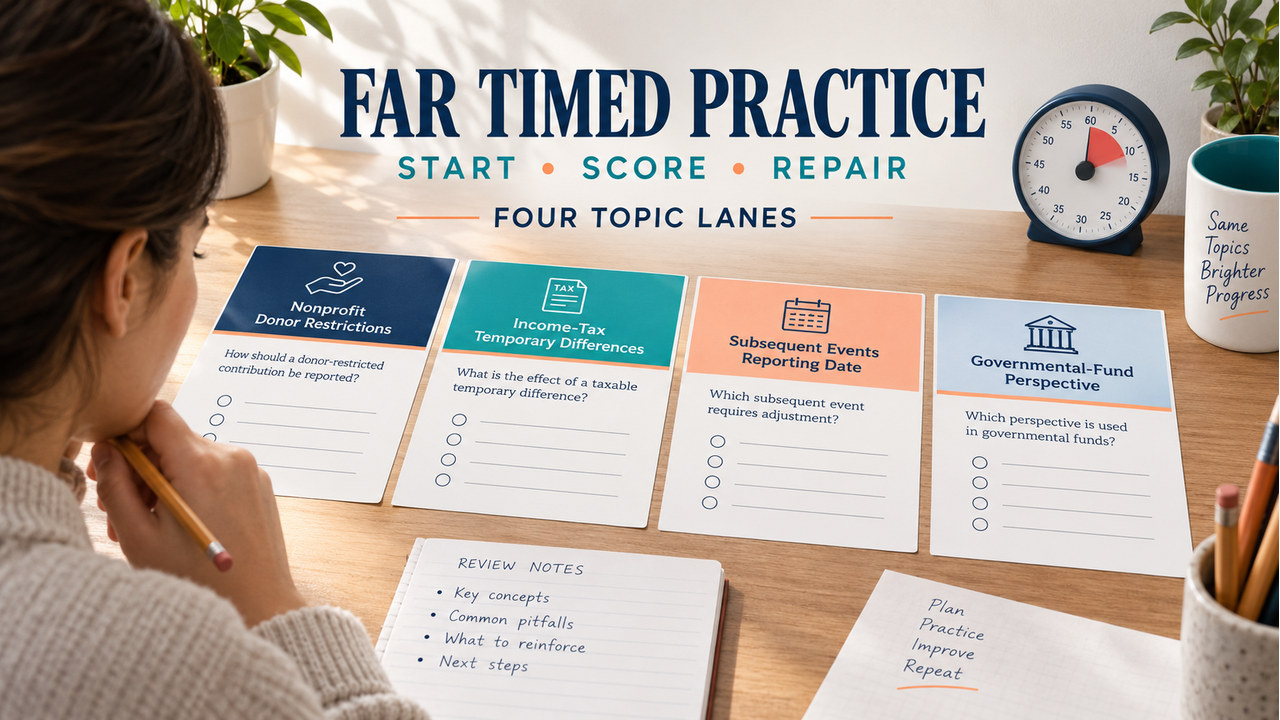

Direct answer: A useful FAR nonprofit accounting practice test should give you a fixed time box, original items, a transparent process score, and a review action for each miss. This four-item set uses four minutes per lane and a 0–12 study-routing rubric. It does not predict an exam result.
Scope note: This page is for US CPA candidates and uses the AICPA Blueprint as its October 2, 2026 scope checkpoint. The items, amounts, choices, rationales, and scoring method are independently authored. A live accounting conclusion still requires complete facts, jurisdictional context, and current research.
For scope, reopen the AICPA CPA Exam Blueprint. Use the current FASB Accounting Standards Codification, including Topics 740, 855, and 958, for the relevant research routes. Government-accounting questions require current GASB research. The NASBA CPA Exam FAQ covers administration, while the FAR review hub can hold the broader study sequence.
FAR nonprofit accounting practice test
This FAR nonprofit accounting practice test is a short timed assessment, not an answer-only page. It combines nonprofit accounting, income taxes, subsequent events, and government accounting. Each lane tests a different first move.
Use the same routine throughout. Read the assumptions. Record a choice. Write the controlling trigger. Then record the next review action. The score rewards the process, so a lucky letter does not hide a missing reason.
The four items are original practice cases. They are deliberately bounded. If a fact changes, the answer may change. Therefore, reopen the relevant source before carrying a shortcut into a live engagement or a broader study note.
Set up the timed assessment
- Prepare: use one sheet with four labeled lanes.
- Start: set a 16-minute timer.
- Work: spend four minutes on each item.
- Capture: record the choice, trigger, and next check before moving on.
Do not research while the timer runs. Mark an uncertainty with a question mark. Move to the next lane. After the timer ends, open the rationales and score the process. This creates a clean separation between assessment and review.
Blueprint and scoring boundaries
The local blueprint map has four lanes. NONPROFIT asks how donor wording routes classification. INCOME TAX asks you to separate book amount, tax basis, and tax effect. SUBSEQUENT EVENTS asks whether later information relates to a reporting-date condition. GOVERNMENT asks you to honor the reporting perspective named in the prompt.
The scoring method is also bounded. Give one point for the best choice. Next, award one point for the controlling fact or calculation. Finally, award one point for a useful next review action. Each item earns 0–3 points. The total is 0–12.
Use the total to route study work. Do not treat it as a percentage, a scaled result, or an exam prediction. The purpose is to decide what to do next while the four triggers are still clear.
Timed item 1: donor restriction
Tested skill: separating donor restrictions. Difficulty: foundation. Assumption: a nonprofit receives $84,000 cash. The donor says $24,000 must support a named youth program. The remaining $60,000 has no donor-purpose restriction. Question: Which classification is the best starting point?
- A. Classify all $84,000 as without donor restrictions.
- B. Classify $24,000 as with donor restrictions and $60,000 as without donor restrictions.
- C. Classify all $84,000 as a liability.
- D. Classify $60,000 as restricted because it is the larger amount.
Reveal the answer and rationale
Answer: B. In this simplified case, the named youth-program purpose applies to $24,000. The remaining $60,000 has no stated donor-purpose restriction. The controlling trigger is donor wording, not the relative size of the amounts. Choice A ignores the purpose. Choice C treats cash as a liability without a supporting obligation. By contrast, choice D lets amount size override the donor’s direction. For the next action: rewrite the donor sentence so that the purpose is removed, then note which classification changes. Reopen Topic 958 for a complete conclusion.
Timed item 2: temporary difference
Tested skill: separating a temporary difference from its tax effect. Difficulty: foundation. Assumption: an asset has a $132,000 carrying amount and a $92,000 tax basis. Use a 25% enacted rate only for this original calculation. Question: What is the starting tax effect?
- A. $10,000, before applying a rate.
- B. $33,000, because the carrying amount is multiplied by 25%.
- C. $10,000, after applying 25% to the $40,000 temporary difference.
- D. $0, because the carrying amount is positive.
Reveal the answer and rationale
Answer: C. First calculate $132,000 minus $92,000, which equals a $40,000 book-versus-tax difference. Then apply 25%, producing $10,000. The first distractor stops after the difference and does not apply the stated rate. Another distractor applies the rate to the carrying amount. Choice D skips the comparison entirely. For the next action: change the tax basis to $102,000 and recompute the difference before applying the rate. Reopen Topic 740 when recognition and measurement facts are complete.
Timed item 3: subsequent event
Tested skill: testing a later event against the reporting-date condition. Difficulty: intermediate. Assumption: after year-end, a customer files for bankruptcy. Evidence shows that the customer’s financial difficulty existed before year-end. Question: What should the analysis address first?
- A. Whether the later information provides evidence about a condition existing at year-end.
- B. Whether every event after year-end must be ignored.
- C. Whether the bankruptcy creates a donor restriction.
- D. Whether the event belongs in the temporary-difference calculation.
Reveal the answer and rationale
Answer: A. The first trigger is the condition at the reporting date. Later information may provide evidence about that condition. Choice B treats every later event the same. Choices C and D route the fact into unrelated lanes. Next action: move the customer’s financial difficulty to after year-end and state how the research question changes. Reopen Topic 855 for the live treatment.
Timed item 4: governmental-fund perspective
Tested skill: selecting the reporting perspective before analyzing a transaction. Difficulty: intermediate. Assumption: a prompt asks about a governmental-fund transaction and does not request government-wide statements. Question: Which first framing is most useful?
- A. Start with the governmental-fund perspective named in the prompt.
- B. Start with nonprofit donor restrictions.
- C. Start with a corporate equity-method bridge.
- D. Ignore the fund type because every statement uses one identical basis.
Reveal the answer and rationale
Answer: A. The prompt names a governmental fund and does not request government-wide statements. That named perspective is the first routing fact. Choices B and C move to different reporting problems. Choice D discards a fact that changes the analysis. Next action: rewrite the prompt to request government-wide statements, then record the new perspective before researching. Reopen current GASB guidance for the complete conclusion.
Score the process, not a pass prediction
Score each item after the timer. Award one point for the choice. Next, award one point for the trigger or calculation. Then, award one point for a specific next review action. A blank answer earns no choice point, but a clear trigger note can still show where to begin repair.
Use three internal routing bands. The 0–4 band starts a rebuild: restate the controlling rule and solve one guided example. A score of 5–8 starts a targeted repair: isolate the missed calculation, timing fact, or perspective. At 9–12, start a transfer replay: change one fact and solve the case again without the original choices.
These bands are study instructions only. They do not estimate a scaled exam score or guarantee a result. The useful signal is the missing process step. A correct answer with no trigger still needs a review note.

Run the four-lane timer
Set a 16-minute timer. Give yourself four minutes per item, record one answer and one controlling trigger, then reveal the rationale.
Reveal the answer
Answer: Use four equal four-minute blocks. Leave a blank rather than borrowing time from the next lane, and return to the trigger during review.
Compare your process with the reasoning shown above.
Turn the score into a review block
Convert the score into a short block while the mistakes are fresh. First write the missed trigger in one sentence. Next choose the source route. Then choose one new item with the same lane and a changed fact. Finally, replay the item without looking at the prior answer.
A NONPROFIT miss calls for a rewritten donor purpose. For an INCOME TAX miss, recalculate the book-versus-tax difference before the rate. With a SUBSEQUENT EVENTS miss, identify the reporting-date condition. For a GOVERNMENT miss, name the requested reporting perspective. Keep the review narrow.

Replay with one changed fact
A good replay changes one input and holds the rest steady. Change the $24,000 donor purpose to an unrestricted gift. Change the $92,000 tax basis to $102,000. Move the customer’s financial difficulty to after year-end. Or change the requested governmental-fund perspective to government-wide statements.
Write the new answer before checking the source. If the answer changes, record why. If the answer stays the same, record which trigger stayed stable. This makes the review observable instead of intuitive.
The next item should match the error. Trigger errors need a short classification prompt. Calculation errors need a fresh set of amounts. Timing errors need two dates. Perspective errors need two statement levels. Do not add unrelated topics just to make the block longer.
Keep the source map current
Before reusing this practice test, reopen the AICPA CPA Exam Blueprint, the FASB Codification, and current GASB guidance. The sources set research boundaries. They do not turn these simplified cases into a substitute for complete facts.
The FAR nonprofit accounting practice test is most useful when the score leads to a documented next item. Check every amount, choice, image label, source note, and rationale before reuse. If the entity, purpose, basis, event condition, fund type, or governing standard changes, pause the shortcut and reopen the current source.
FAR nonprofit accounting practice test FAQ
How long should this practice set take?
Use a 16-minute first pass, with four minutes for each of the four lanes. Review afterward.
What does the 0–12 score mean?
It routes study work into rebuild, targeted repair, or transfer replay. It is not an exam prediction.
What should I write for a missed item?
Write the choice, controlling trigger or calculation, missed path, source route, and next item.
What makes each item useful?
Each item has bounded assumptions, an answer reveal, a distractor explanation, and one changed-fact review action.