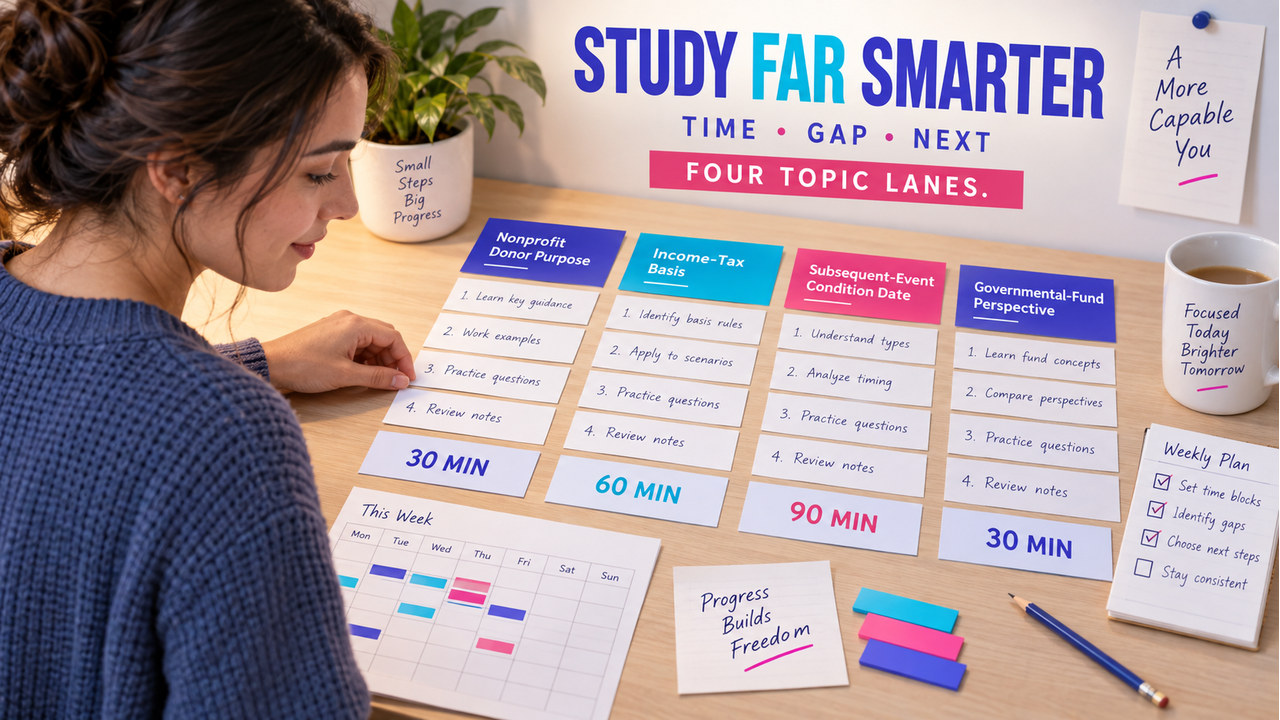

Direct answer: To study nonprofit accounting CPA FAR effectively, match the study block to the weak trigger and the time you actually have. Use 30 minutes for one narrow repair, 60 minutes for a complete topic loop, and 90 minutes for a mixed practice-and-review block. Then rotate the four lanes over 14 days.
Scope and review note: This plan is for US CPA candidates. It uses the AICPA Blueprint as its October 2, 2026 scope checkpoint. The schedule, checkpoints, amounts, and decision aid are independently authored. The editorial review role is scope mapping and source QA, not a personal licensure claim.
For scope, reopen the AICPA CPA Exam Blueprint. Use the current FASB Accounting Standards Codification, including Topics 740, 855, and 958, for the relevant research routes. Government-accounting questions require current GASB research. The NASBA CPA Exam FAQ covers administration, while the FAR review hub can hold the broader study sequence.
Study nonprofit accounting CPA FAR
This study nonprofit accounting CPA FAR plan uses a simple rule: diagnose first, choose the smallest complete block, and finish with a next check. The four lanes are nonprofit donor purpose, income-tax basis, subsequent-event condition date, and governmental-fund perspective.
Do not build a calendar around ideal hours. Build it around repeatable minutes. A short block can close one trigger. A longer block can include practice and review. Either way, record what changed.
Choose your study window
30 minutes: use one lane, one trigger, and one fresh checkpoint. Read the source route for five minutes. Work for fifteen minutes. Spend the last ten minutes writing the reason and next check.
60 minutes: use one lane deeply or two related lanes. Read the scope cue. Work two original questions. Review the nearest wrong path. Finish with a changed-fact replay.
90 minutes: use three lanes or one mixed set. Start with a short diagnostic. Next, work the weakest lane. Then rotate to a second lane. Reserve the final block for source notes and a next-session task.
Choose the window you can repeat. Consistency matters more than a heroic session that cannot fit the next day.
Diagnose the weak area before day one
Use four quick prompts. For NONPROFIT, ask what donor wording controls classification. The INCOME TAX prompt asks what comes before the tax rate. Next, ask whether the condition existed at the reporting date for SUBSEQUENT EVENTS. For GOVERNMENT, ask which reporting perspective the prompt names.
- Write one answer from memory.
- Underline the fact that controls it.
- Mark the lane as read, calculate, classify, or replay.
- Schedule the smallest block that closes the gap.
A wrong letter is useful only when it points to a trigger. If you cannot name the trigger, start with a scope-and-source block. When the trigger is known but the numbers fail, calculate. If the reporting lens is unclear, classify.
Write a four-line review note
Use the same note format after every session. Begin by naming the lane. Next, state the controlling trigger. Then record the source route. Finish by naming the changed fact and next block.
- Lane: nonprofit, income tax, subsequent events, or government.
- Trigger: donor purpose, tax basis, condition date, or fund perspective.
- Source: Topic 958, Topic 740, Topic 855, or current GASB material.
- Next: read, calculate, classify, or replay.
This note prevents vague progress claims. It also makes a short session visible. For example, “income tax — tax basis — Topic 740 — calculate with a new basis” is a usable next task. “Review taxes” is not specific enough to guide the next block.
Keep one note per lane. When a lane improves, do not delete the earlier note. Add the changed fact and compare the two attempts. The difference shows whether your method transfers beyond the original numbers or wording.
Four original diagnostic checkpoints
Nonprofit: A nonprofit receives $72,000. The donor states that $18,000 supports a food pantry. The rest has no donor-purpose restriction. Start by asking whether the donor sentence separates the two portions. Then reopen Topic 958 after the attempt.
Income tax: An asset has a $210,000 carrying amount and a $150,000 tax basis. At a stated 20% rate, the first calculation is the $60,000 temporary difference, followed by a $12,000 tax effect. Reopen Topic 740 after the calculation.
Subsequent events: A customer enters bankruptcy after year-end. Evidence shows the financial difficulty existed before year-end. The first question is the reporting-date condition. Reopen Topic 855 after writing the timing analysis.
Government: A prompt asks about a governmental-fund transaction and does not request government-wide statements. The first move is to use the named governmental-fund perspective. Reopen current GASB materials after stating the lens.
These checkpoints are intentionally bounded. Change one fact after each attempt. Then note whether the trigger, calculation, timing, or perspective changes.
Use the time-gap matrix
Match the block to the gap. Scope gaps need a short read and a written definition. Calculation gaps need a fresh set of numbers. For a timing gap, note two dates. For a perspective gap, compare two reporting lenses. The block is complete only when you can state the next item.

Run the 30-minute block
- Minutes 0–5: name the lane, trigger, and source.
- Minutes 5–20: work one original checkpoint without searching.
- Minutes 20–25: compare the rationale and identify the wrong path.
- Minutes 25–30: change one fact and write the next task.
This block is best for a narrow weakness. For example, use it to calculate carrying amount minus tax basis twice. Do not open a second topic before the next check is written.
Run the 60-minute block
- Minutes 0–10: confirm scope and source route.
- Minutes 10–35: work two checkpoints in one lane.
- Minutes 35–50: explain the distractor or error path.
- Minutes 50–60: replay the weaker checkpoint with one changed fact.
Use this window when a rule is familiar but unreliable. Keep the two checkpoints close enough to compare. Then log whether the miss was a trigger, calculation, timing, or perspective error.
Run the 90-minute block
Use the first 15 minutes for a four-lane diagnostic. Spend the next 35 minutes on the weakest lane. Take a short reset. Use the next 25 minutes for a second lane. Reserve the final 15 minutes for source notes, a changed-fact replay, and tomorrow’s first task.
A 90-minute block should not become four shallow readings. It should contain one deep repair and one shorter transfer. If the first repair is incomplete, keep the second lane for the next session.
Run the 14-day rotation
Use two-day pairs. Days 1–2 map the four triggers and work the nonprofit lane. The next pair, days 3–4, focuses on tax basis and calculation sequence. During days 5–6, focus on reporting-date conditions. Then use days 7–8 for governmental-fund perspective. By days 9–10, mix nonprofit and income tax. Next, mix subsequent events and government on days 11–12. Finally, replay the two weakest lanes on days 13–14.
Every pair has the same closeout: write the rule, name the controlling fact, change one fact, and choose the next block. If a pair is missed, do not restart the entire plan. Move the pair to the next available days.

Protect the last ten minutes
The last ten minutes are part of the study block, not spare time. Use them to check the arithmetic, confirm the date or perspective, and write the next task. Without this closeout, a long session can produce notes but no usable continuation.
When time is cut short, preserve the closeout before starting another question. Record the unfinished step. Then place it in the next available 30-minute block. This keeps the schedule flexible without losing the weak-area signal.
Use the same rule on a strong day. A completed block still needs a trigger, a source route, and a next check. That small discipline makes the plan portable when your available time changes.
Keep the plan source-aware
The AICPA Blueprint sets the study scope. FASB Topics 740, 855, and 958 guide the relevant accounting research routes. Current GASB material guides the government lane. The plan supplies practice structure. It does not replace the current literature.
Before reuse, reopen the AICPA CPA Exam Blueprint, the FASB Codification, and current GASB guidance. Refresh the schedule when standards, exam administration, or your available time changes.
The editorial review role is evidence mapping and workflow QA. It is not a personal licensure claim. For a live conclusion, use complete facts and the appropriate technical consultation.
Study nonprofit accounting CPA FAR FAQ
What if I only have 30 minutes?
Choose one lane, one trigger, one checkpoint, and one changed-fact next check.
How should I use a 90-minute session?
Use one deep repair, one shorter transfer, and a written task for tomorrow.
Which weak area should come first?
Start with the lane where you cannot state the controlling trigger. Then choose read, calculate, classify, or replay.
What belongs in the study log?
Record minutes, lane, trigger, source route, changed fact, and the next block.