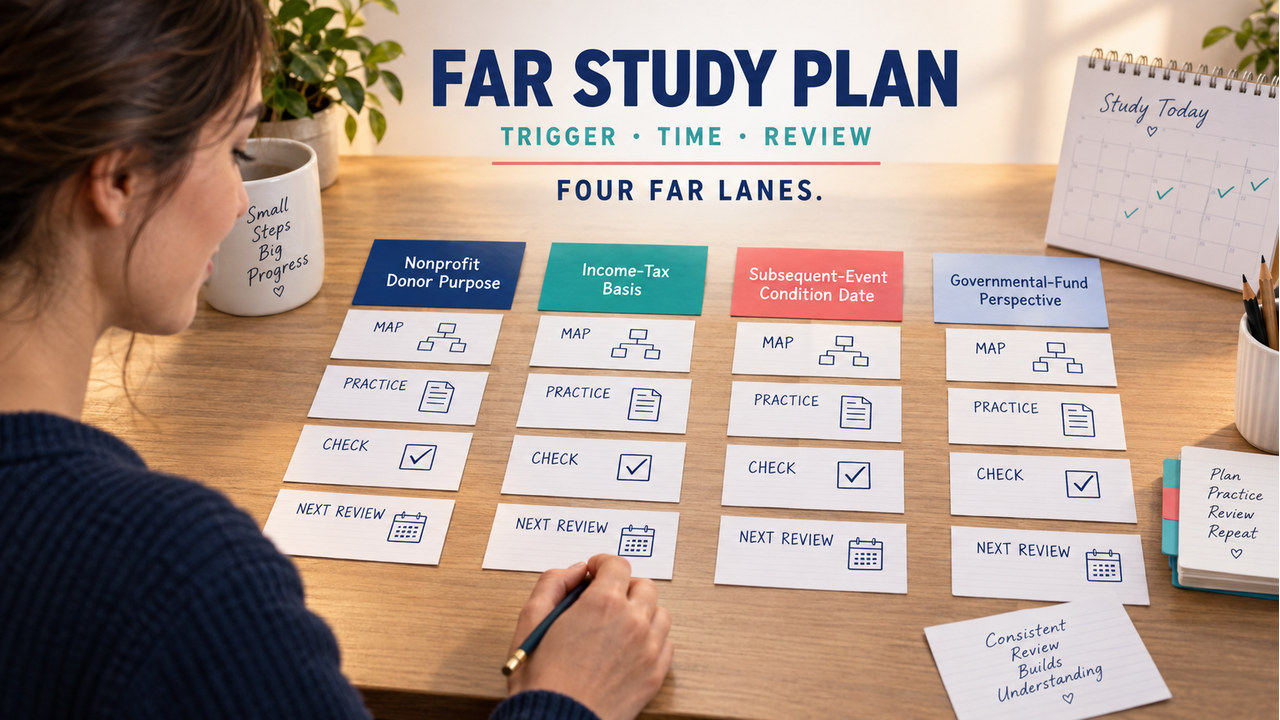

Direct answer: You cannot guarantee a CPA result with a calendar. A credible way to pass nonprofit accounting CPA FAR is to lock the current scope, find the first broken trigger in an original practice set, and turn that trigger into a short review block. Use the method below to connect donor restrictions, tax basis, subsequent-event timing, and governmental-fund perspective. The goal is a repeatable process that tells you what to do next, not a prediction.
Scope and review note: This method is written for US CPA candidates. The AICPA Blueprint is the October 3, 2026 scope checkpoint. The cases, amounts, labels, and review route are independently authored. They are not official, recalled, leaked, or score-predictive questions. The editorial review role is scope mapping and source QA, not a personal licensure claim.
Before relying on a technical conclusion, reopen the AICPA CPA Exam Blueprint and the current FASB Accounting Standards Codification. Government-accounting research belongs in current GASB guidance. The NASBA CPA Exam FAQ covers administration. The FAR review hub can hold a broader sequence, but it does not replace the source refresh.
Pass nonprofit accounting CPA FAR
The useful skill is not memorizing four topic labels. It is routing a fact pattern to the right first question. Nonprofit work starts with donor purpose. Income-tax work starts with the book-versus-tax basis difference. Subsequent-event work starts with the reporting-date condition. Government work starts with the statement level or named fund.
Set one boundary before studying: passing is an outcome you cannot promise from a web page. What you can control is the evidence trail. Name the tested skill, state the assumptions, attempt the item, explain the nearest wrong path, and schedule one changed-fact retry. That sequence exposes a weak process earlier than repeated rereading does.
Turn a pass goal into a study contract
Write a one-page contract before opening a question bank. Put the current Blueprint route at the top. Under it, list the four lanes and the output for each session. A nonprofit block should produce a classification sentence. An income-tax block should produce a basis calculation. A subsequent-event block should produce a two-date explanation. A government block should produce the requested reporting perspective.
For a learner trying to pass nonprofit accounting CPA FAR, this contract makes progress visible without turning a study day into a promise.
- Scope: record the area, group, or topic you are reviewing and the source you will reopen.
- Trigger: write the fact that changes the route, such as donor wording, tax basis, condition date, or statement level.
- Attempt: answer without looking at the rationale. Mark uncertainty instead of hiding it.
- Repair: choose read, calculate, classify, or replay based on the first broken step.
- Transfer: change one fact and explain whether the route changes.
This contract makes “study harder” measurable. A session is useful when it leaves a source route, a controlling fact, and a next task. If one field is blank, that blank is the next study action.
Diagnose the first broken trigger
Use a four-minute diagnosis before building a long schedule. Read one short prompt from each lane. Do not score only the letter. Instead, mark the first broken trigger.
- Scope: you cannot name the rule or source route.
- Restriction: you miss the wording that limits or directs use.
- Basis: you apply a rate before comparing the relevant amounts.
- Date: you treat later information as the answer without asking what existed at the reporting date.
- Perspective: you use a government-wide or fund view that the prompt did not request.
Choose the smallest repair. Scope calls for a short source map. Restriction calls for rewriting the donor sentence. Basis calls for a fresh calculation. Date calls for two timelines. Perspective calls for two reporting lenses. That choice is more useful than assigning yourself a vague “weak in FAR” label.
Attempt five original checkpoints
The five checkpoints below are original practice material. Before opening each reveal, write the tested skill, assumptions, difficulty, selected answer, and first trigger. The answer reveals come after the attempt. Each explanation names a distractor path and a changed-fact next action.
Checkpoint 1 — Donor-purpose restriction
Skill: identify the fact that controls nonprofit classification. Assumptions: the prompt supplies no additional donor agreement. Difficulty: foundational. A nonprofit receives $84,000, and the donor states that $24,000 supports a youth program. What should you identify first?
- Classify all $84,000 from the cash receipt alone.
- Separate the stated purpose from the amount with no donor-purpose direction.
- Record the full receipt as a government-fund transaction.
- Apply an income-tax rate before reading the donor sentence.
Reveal the answer and reasoning
Answer: B. The donor sentence is the controlling trigger. In this simplified case, the youth-program purpose attaches to $24,000, while the remainder has no stated donor-purpose direction. Choice A lets cash size replace the restriction. Choices C and D route the fact into unrelated lanes. Next action: remove the purpose from the wording and restate which classification changes. Reopen Topic 958 before applying the method to a complete fact pattern.
Checkpoint 2 — Book-versus-tax basis
Skill: sequence a temporary-difference calculation. Assumptions: use the stated 25% rate only after finding the difference. Difficulty: moderate. An asset has a $184,000 carrying amount and a $136,000 tax basis. What is the first calculation?
- $184,000 × 25%.
- $136,000 × 25%.
- $184,000 − $136,000.
- $184,000 + $136,000.
Reveal the answer and reasoning
Answer: C. First find the $48,000 temporary difference. Only then apply the stated rate, which would produce $12,000 in this bounded example. Applying the rate to the carrying amount creates the first error. Choice B applies it to the tax basis. The final option skips the comparison. Next action: change the tax basis to $144,000 and recompute before applying the rate. Reopen Topic 740 when recognition and measurement facts are complete.
Checkpoint 3 — Reporting-date condition
Skill: distinguish the condition date from the later discovery date. Assumptions: the customer bankruptcy occurs after year-end, but evidence addresses financial difficulty before year-end. Difficulty: moderate. What is the first question?
- Whether the later event can provide evidence about the reporting-date condition.
- Whether every later event is ignored.
- Whether the fact belongs in the donor-restriction lane.
- Whether the fund perspective controls the customer balance.
Reveal the answer and reasoning
Answer: A. The first route is the condition at the reporting date. Later information can matter when it provides evidence about that earlier condition. Choices B, C, and D replace a date analysis with an absolute rule or an unrelated lane. Next action: move the customer’s financial difficulty to after year-end and write how the research question changes. Reopen Topic 855 for the live conclusion.
Checkpoint 4 — Governmental-fund perspective
Skill: route a government-accounting prompt to the named reporting perspective. Assumptions: the question names a governmental fund and does not request government-wide statements. Difficulty: foundational. What should you do before analyzing the transaction?
- Use the named governmental-fund perspective.
- Switch automatically to the government-wide view.
- Apply the nonprofit donor-purpose rule.
- Calculate a temporary difference.
Reveal the answer and reasoning
Answer: A. The requested statement level is the first routing fact. Choices B, C, and D ignore or replace a fact that changes the analysis. Next action: rewrite the prompt to request government-wide statements, then name the new perspective before researching. Reopen current GASB materials rather than relying on this simplified practice boundary.
Checkpoint 5 — Integrated transfer
Skill: select the first review action when two errors appear together. Assumptions: a learner correctly calculates $60,000 but uses government-wide terminology for a governmental-fund question. Difficulty: transfer. Which repair comes first?
- Repeat the $60,000 calculation without changing the prompt.
- Rebuild the named reporting perspective, then rerun the analysis.
- Read all four topics from the beginning.
- Assign a pass probability to the attempt.
Reveal the answer and reasoning
Answer: B. The calculation is not the first broken field. The perspective error can change which facts matter, so repair the route before repeating arithmetic. Repeating the stable step does not repair the route. Choice C is too broad to guide the next block. An evidence-based plan does not assign a result probability. Next action: keep the amount fixed, change only the requested statement level, and state which line of reasoning changes.
Use the trigger-to-action board
After the five attempts, record the first broken trigger rather than the most embarrassing mistake. The board should point to one next action: map the source, practice the wording, check the calculation, replay the dates, or compare reporting perspectives. A correct answer with a weak explanation still belongs in the queue.

Reveal the first broken trigger
After attempting the five checkpoints, record the first broken trigger: scope, restriction, basis, date, or reporting perspective.
Reveal the answer
Answer: The first broken trigger determines the next block. Scope errors need a source map; restriction errors need donor wording; basis errors need a fresh calculation; date errors need two timelines; perspective errors need two reporting lenses.
Compare your process with the reasoning shown above.
Choose a realistic study block
Thirty minutes: use one lane. Spend five minutes on the source route, fifteen on one checkpoint, five on the nearest distractor, and five on the changed-fact note.
Sixty minutes: use one lane deeply or two related prompts. Attempt first, compare the reasoning, and finish with a new fact pattern. Do not spend the final minutes opening a new chapter.
Ninety minutes: use a four-lane diagnosis, one deep repair, and one transfer replay. Reserve the last ten minutes for the source route and next task. A longer session should increase evidence, not create four shallow summaries.
Choose the block you can repeat this week. A 30-minute block that produces a changed-fact explanation is more useful than a 90-minute promise that never reaches the closeout.
Run the 14-day review loop
Use the first two days to map the Blueprint route and attempt the four lanes. Days 3–4 should repair donor wording and tax-basis sequencing. During days 5–6, compare reporting-date conditions and fund perspectives. During days 7–8, replay the two weakest lanes with one changed fact. Days 9–10 should mix nonprofit and income tax. The next pair, days 11–12, should mix subsequent events and government. Finish days 13–14 with a fresh five-checkpoint attempt and a written next queue.
Keep the loop flexible. If a day is missed, move the block; do not restart the entire plan. If the same trigger breaks twice, keep that lane in the next pair. When a trigger stabilizes, reduce its time and use the saved minutes for transfer.

Protect against false confidence
Recognition can feel like mastery when a familiar fact pattern appears. Add one deliberate change before ending the session. Change the donor purpose, the tax basis, the condition date, or the requested statement level. Then explain which step remains stable and which step must change.
Separate three results in the log. “Correct answer” means the choice was right. “Correct trigger” means you can name why. “Transfer complete” means you can handle one altered fact. The third result is the strongest reason to keep or shorten the next block, but none of the three is an exam prediction.
Also record uncertainty. A guessed answer with a good explanation is a different repair from a lucky answer with no trigger. Use the first broken field to select the next block and let the next attempt update the plan.
Refresh sources before reuse
The AICPA Blueprint sets the scope boundary used here. FASB Topics 740, 855, and 958 provide research routes for the simplified accounting lanes. Current GASB guidance controls the government lane. These links support the study method; they do not turn the original cases into official questions.
Before reusing this route after a scope or standards change, reopen the AICPA Blueprint, Topic 740, Topic 855, Topic 958, and GASB. Use the AICPA sample tests for interface familiarity only. Keep licensure or administration questions with NASBA.
To pass nonprofit accounting CPA FAR, keep the durable promise focused on process: scope the task, attempt the question, name the trigger, explain the distractor, and schedule a changed-fact review. That is the part you can inspect and improve.
Pass nonprofit accounting CPA FAR FAQ
Can this method predict the result?
No. It provides an evidence-based study loop, not an outcome prediction or score estimate.
What should I do after a missed question?
Record the first broken trigger, reopen the matching source route, change one fact, and schedule the smallest complete block.
How many topics should one session cover?
Use one deep lane in 30 minutes, one or two related lanes in 60 minutes, or one deep repair plus a transfer lane in 90 minutes.
What belongs in the 14-day log?
Record the lane, trigger, source, selected action, changed fact, and next review date.