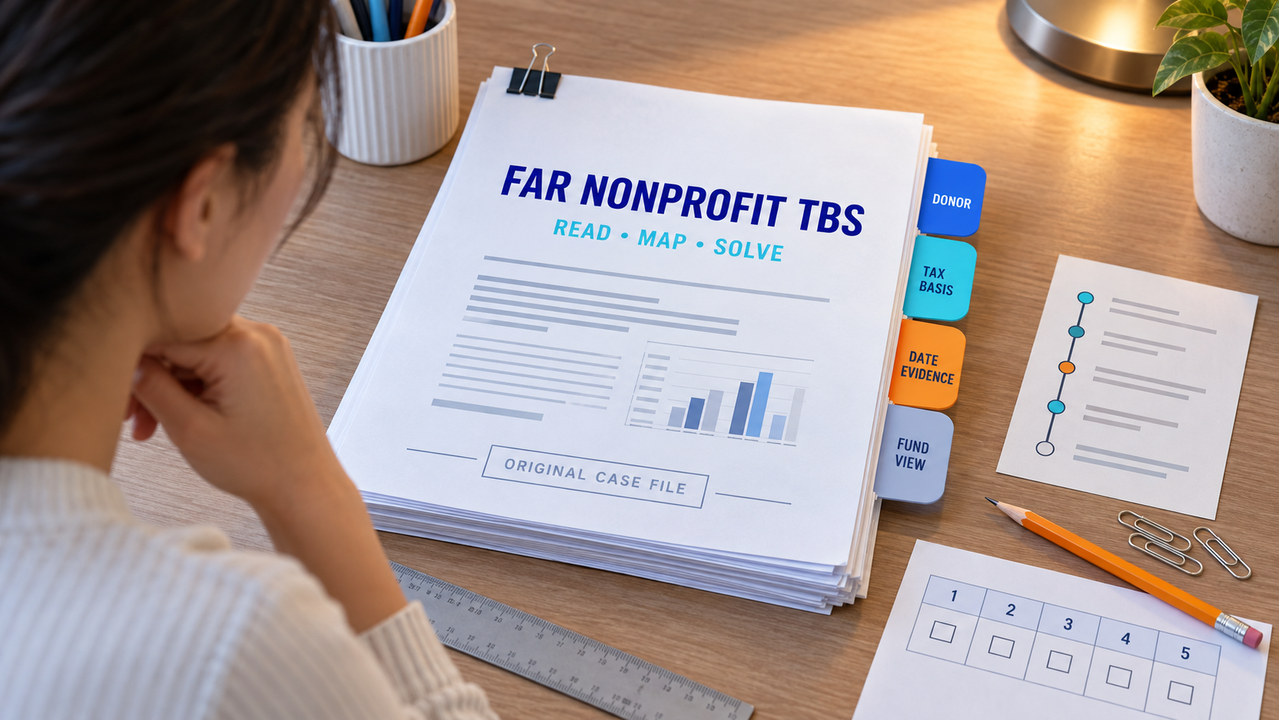

Direct answer: A useful far nonprofit accounting TBS starts with the response cell, maps each requested output to the right exhibit, extracts the controlling fact, shows only the needed work, and checks the format before moving on. The original Cedar Bridge case below uses five cells across donor purpose, tax basis, reporting-date evidence, and government reporting perspective.
Scope and originality note: This is original editorial practice for US CPA candidates. The exhibits, amounts, answer choices, rationales, and changed-fact retry are independently authored; they are not official, recalled, leaked, or provider-owned exam items. The editorial review role is CPA exam-prep scope mapping and source QA, not a personal licensure claim.
Use the AICPA CPA Exam Blueprint as the scope checkpoint. Use current FASB Topic 958, Topic 740, and Topic 855 for the accounting research routes, and current GASB material for the government-perspective item. The AICPA sample tests help with interface familiarity; the NASBA FAQ handles administration questions.
FAR nonprofit accounting TBS: income taxes, subsequent events, and government perspective
This far nonprofit accounting TBS practice set covers income taxes, subsequent events, and government perspective through a response-cell discipline. The topic mix is intentionally broad, but the solving method stays stable: identify what the cell asks, find the exhibit that controls it, name the trigger, complete the bounded calculation or conclusion, and check the requested format.
A TBS is not an invitation to summarize every document. It is a routing problem. A donor letter can control a restriction question, a tax worksheet can control a basis comparison, a date memo can control a reporting-date question, and a prompt that names a governmental fund can control the reporting perspective. Keep those routes separate before you connect them.
Read the response cell first
- Read: underline the task verb and the requested unit or conclusion.
- Map: point to the exhibit that can answer that exact request.
- Extract: copy the controlling fact, date, amount, or reporting level.
- Solve: show the shortest defensible calculation or rule path.
- Verify: check assumptions, sign, unit, rounding, and the cell format.
This route prevents two common errors. First, a learner can calculate a correct number for the wrong response cell. Second, a learner can apply a familiar rule before noticing that the prompt changed the reporting perspective. The cell sets the output; the exhibit supplies the evidence.
Use the five-cell TBS route
Before opening the original case, write five headings on scratch paper: cell, exhibit, trigger, work, check. The first four cells below use a different exhibit or perspective. The fifth cell is a transfer retry, so it tests whether you can update the route when one fact changes.

Do not reveal an answer while you are still locating evidence. A useful attempt contains a provisional answer, the exhibit you used, and one sentence explaining why the nearest distractor is not responsive. That record makes the later rationale diagnostic rather than merely confirmatory.
Open the Cedar Bridge case file
Cedar Bridge Community Services is a fictional nonprofit used only for this article. Its case packet contains four exhibits and five response cells. The amounts and names are invented to create practice constraints, not to imitate an official form.
- Exhibit A — donor letter: a $96,000 receipt includes a stated $30,000 youth-program purpose; no other donor-purpose direction is supplied.
- Exhibit B — tax worksheet: an asset has a $145,000 carrying amount, a $109,000 tax basis, and a stated 24% rate for this bounded calculation.
- Exhibit C — date memo: year-end is December 31; a customer enters bankruptcy on January 20, and the memo says financial difficulty existed before year-end.
- Exhibit D — reporting request: the prompt names a governmental fund and asks for the fund-level analysis, not an automatic government-wide substitution.
Original TBS cell 1 — Donor purpose
Skill: identify the classification trigger. Assumptions: Exhibit A is complete and no separate donor agreement exists. Difficulty: foundational. Which fact should control the first response?
- The total cash amount by itself.
- The donor’s stated youth-program purpose attached to $30,000.
- The 24% rate in Exhibit B.
- The fund perspective in Exhibit D.
Reveal the answer and rationale
Answer: B. Donor wording is the controlling trigger for this simplified cell. The cash total does not erase the stated purpose, and the other two facts belong to different exhibits. The nearest distractor looks attractive because it begins with a real amount, but it does not answer a classification question. Next action: rewrite the donor sentence without the youth-program phrase and state which portion of the analysis changes. Reopen Topic 958 before applying the shortcut to a complete fact pattern.
Original TBS cell 2 — Income-tax basis sequence
Skill: sequence a temporary-difference calculation. Assumptions: use the stated 24% rate only after finding the book-versus-tax difference. Difficulty: moderate. What is the first calculation?
- $145,000 × 24%.
- $109,000 × 24%.
- $145,000 − $109,000.
- $145,000 + $109,000.
Reveal the answer and rationale
Answer: C. First find the $36,000 difference. In this bounded example, applying 24% afterward gives $8,640. The rate is not the first operation because the question asks for the sequence and supplies both carrying amount and tax basis. Next action: change the tax basis to $117,000, recompute the difference, and only then apply the stated rate. Reopen Topic 740 for a complete recognition and measurement analysis.
Original TBS cell 3 — Subsequent-event evidence
Skill: separate the later discovery from the reporting-date condition. Assumptions: the January 20 bankruptcy is known after year-end and the memo’s pre-year-end difficulty statement is reliable for this exercise. Difficulty: moderate. What question comes first?
- Whether the later information provides evidence about the December 31 condition.
- Whether every event after year-end must be ignored.
- Whether the donor wording controls the customer balance.
- Whether Exhibit D’s fund perspective determines the date.
Reveal the answer and rationale
Answer: A. The first routing question is the condition at the reporting date. A later event may provide evidence about an earlier condition, but the final treatment needs current literature and the complete facts. Choice B treats all later events identically. Choices C and D borrow facts from the wrong exhibits. Next action: move the financial difficulty to January 10 and write the new research question before changing any conclusion. Reopen Topic 855 for the live analysis.
Original TBS cell 4 — Government reporting perspective
Skill: route the analysis to the perspective named in the prompt. Assumptions: Exhibit D expressly requests a governmental-fund analysis and does not ask for government-wide statements. Difficulty: foundational. What should happen before the transaction analysis?
- Use the named governmental-fund perspective.
- Switch automatically to government-wide statements.
- Apply the donor-purpose rule from Exhibit A.
- Apply the 24% calculation from Exhibit B.
Reveal the answer and rationale
Answer: A. The requested reporting level is the first routing fact. A government-wide analysis may be relevant in another prompt, but substituting it here changes the task. The other choices are true facts from the packet used in the wrong cell. Next action: rewrite the request so it asks for government-wide statements, then identify which analysis step changes. Reopen current GASB guidance before writing a complete conclusion.
Original TBS cell 5 — Changed-fact transfer
Skill: change the research route when the controlling fact moves. Assumptions: keep all amounts and the response format stable, but move the customer’s financial difficulty from before year-end to January 10. Difficulty: transfer. What should the learner do first?
- Repeat the original conclusion without changing the evidence record.
- Change the condition-date question, then rerun the subsequent-event analysis.
- Recalculate the $36,000 basis difference even though Exhibit B did not change.
- Convert the case result into a predicted exam score.
Reveal the answer and rationale
Answer: B. The changed fact is the date of the condition, so the date-evidence route must be rebuilt before any conclusion is repeated. Recalculating Exhibit B rehearses a stable step. A score prediction is outside the case purpose. Next action: keep the January 20 bankruptcy date, change only the condition date, and write one new research question for Topic 855.
Record evidence, not just answer letters
A TBS review record should let you reconstruct the path without reopening every exhibit. For each cell, note the requested output, controlling exhibit, trigger or formula, answer, and one distractor you rejected. If the answer is wrong, mark the first broken field rather than labeling the whole case a failure.
Change one fact before retry
Once the five cells are reviewed, change exactly one input. Good retries keep the response format stable while moving one fact: remove the donor purpose, change the tax basis, move the condition date, or request a different reporting perspective. Do not change all four exhibits at once; that makes the result impossible to diagnose.

Use a bounded retry record: first broken field → changed fact → new research question → one response cell. For a scope error, reopen the Blueprint or the named standard. For a calculation error, keep the facts visible and redo the sequence. With a perspective error, rewrite the requested reporting level before touching the numbers.
Keep the source boundary visible
Use the AICPA Blueprint as the tested-scope and task-statement checkpoint; it does not turn this fictional case into official exam content. FASB Topics 740, 855, and 958, plus current GASB material, are research routes for the bounded exhibits. The article’s amounts, labels, distractors, and explanations are original teaching devices.
Before reusing the case after a standards or blueprint update, reopen the official pages and replace any stale premise. Use the sample tests for interface familiarity, not for copied wording. Send administration and licensure questions to the relevant official channels and jurisdiction.
The best use of this far nonprofit accounting TBS is a repeatable evidence path: cell first, exhibit second, controlling fact third, bounded work fourth, format check fifth, then one changed-fact retry.
FAR nonprofit accounting TBS FAQ
Are these official CPA Exam questions?
No. The Cedar Bridge exhibits, amounts, answer choices, rationales, and retry are original editorial practice and are not recalled or official items.
Which exhibit should I read first?
Read the response cell first, then open the exhibit that can answer its exact requested output. Do not summarize every document before routing the task.
What should change on a retry?
Change one fact while holding the response format stable: donor wording, tax basis, condition date, or reporting perspective.
How do I review a wrong answer?
Name the first broken field, controlling exhibit, new research question, and one bounded response cell to retry.