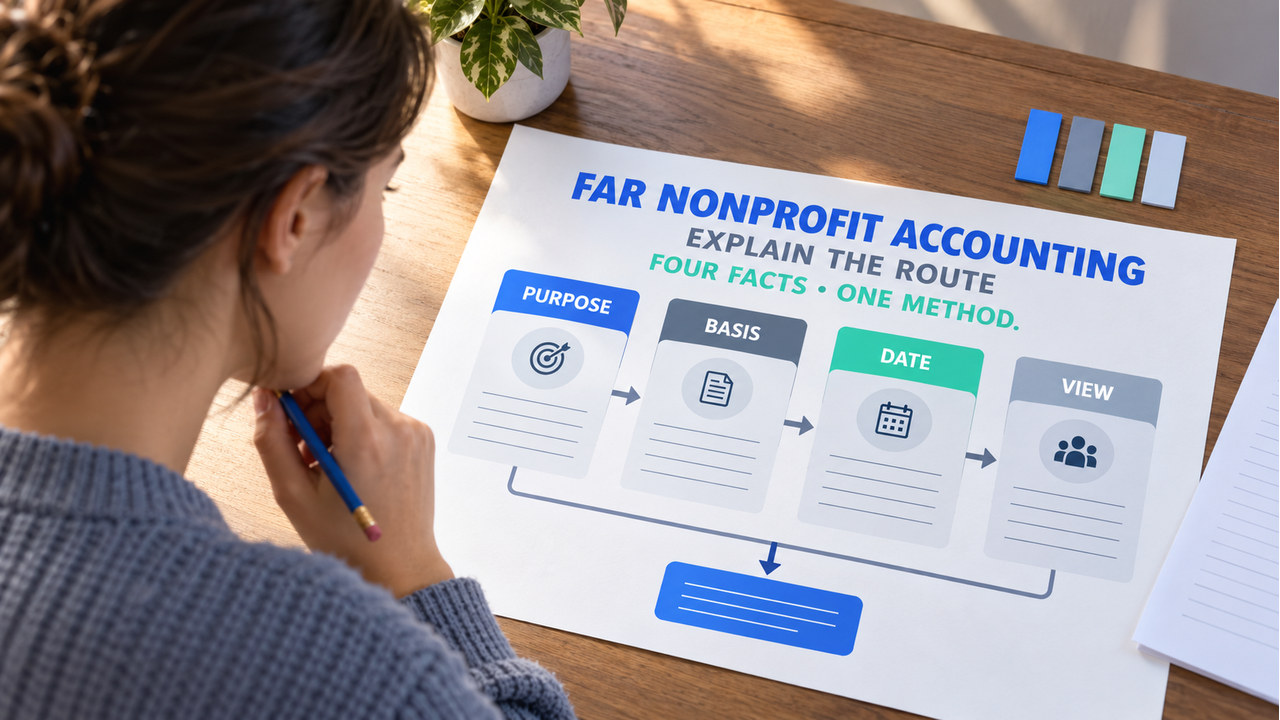

Direct answer: To understand far nonprofit accounting explained as one connected FAR lesson, anchor on four facts: donor wording, carrying amount versus tax basis, the condition at the reporting date, and the named reporting perspective. Then solve in order: name the route, state assumptions, follow the trigger or sequence, explain the tempting distractor, and change one fact to test transfer.
Scope and originality note: This is original editorial practice for US CPA candidates searching for far nonprofit accounting income taxes subsequent events government accounting explained. The examples, amounts, answer choices, rationales, and route map are independently authored. They are not official, recalled, leaked, or provider-owned exam items. The editorial review role is scope mapping and source QA, not a personal licensure claim.
Use the AICPA CPA Exam Blueprint as the scope checkpoint. Use current FASB Topic 958, Topic 740, and Topic 855 for the accounting research routes, and current GASB material for the government-accounting perspective. The AICPA sample tests help with interface familiarity; the NASBA FAQ handles administration questions.
FAR nonprofit accounting explained: start with the route
This far nonprofit accounting explained guide is a map, not a list of disconnected definitions. Nonprofit questions often turn on a purpose phrase. Income-tax questions turn on a book-versus-tax comparison. Subsequent-event questions turn on the condition date. Government-accounting questions turn on the reporting perspective named in the prompt.
Those triggers are different, but the study method is the same. Identify the fact that controls the route, separate it from the most tempting distractor, and write the next source or calculation step. A learner who starts with a familiar rule can still miss the task if the prompt asks for a different reporting level, date, or basis.
Map the four routes before calculating
Before doing arithmetic or choosing a conclusion, write the route in the margin. The route tells you what evidence deserves attention first and prevents a correct rule from being applied to the wrong question.

- Purpose: read the donor wording before treating the cash total as the classification trigger.
- Basis: compare carrying amount with tax basis before applying a stated tax rate.
- Date: ask whether later information gives evidence about the condition that existed at the reporting date.
- View: honor the named governmental fund or reporting level before importing a government-wide analysis.
Use a short explanation format for every route: trigger, evidence, distractor, next action. This makes the lesson usable after a wrong answer and keeps the review focused. The route is the noun, the evidence is the controlling fact, and the next action is the smallest check that could change your conclusion.
Practice 1 — purpose before cash
Skill: identify the nonprofit classification trigger. Assumptions: Northline Learning Foundation receives $84,000, and the donor letter says $20,000 is for a named youth-literacy program; no other agreement is supplied. Difficulty: foundational. Which fact should be read first?
- The entire $84,000 cash receipt.
- The donor’s stated purpose for $20,000.
- The tax rate from a separate worksheet.
- The government-wide reporting level.
Reveal the answer and explanation
Answer: B. The donor phrase is the trigger because the stated purpose can control the restriction analysis. The cash total is an input, but it does not replace the agreement’s wording. Distractor path: choosing A treats measurement as classification. Next action: underline the words that limit use of the funds, then restate the classification question before researching Topic 958.
Practice 2 — basis before rate
Skill: explain the sequence for a temporary-difference calculation. Assumptions: an asset has a $182,000 carrying amount, a $137,000 tax basis, and a stated 24% rate; use the rate only after the difference. Difficulty: moderate. What is the first step?
- $182,000 × 24%.
- $137,000 × 24%.
- $182,000 − $137,000.
- $182,000 + $137,000.
Reveal the answer and explanation
Answer: C. The bounded difference is $45,000, and applying 24% afterward gives $10,800. Distractor path: multiplying the carrying amount first skips the book-versus-tax comparison and can make a familiar rate look like the answer. Next action: change the tax basis to $149,000, recompute the difference, and reopen Topic 740 for the complete recognition and measurement analysis.
Practice 3 — condition before discovery
Skill: explain how a later event relates to the reporting date. Assumptions: year-end is December 31; a customer enters bankruptcy on March 9; a credit memo says the customer’s financial difficulty was already present at December 31. Difficulty: moderate. What should the learner test?
- Whether the later information gives evidence about the December 31 condition.
- Whether every event after year-end is automatically ignored.
- Whether the donor purpose controls the customer balance.
- Whether the governmental fund determines the date.
Reveal the answer and explanation
Answer: A. The discovery date and the condition date are separate facts. The credit memo may provide evidence about the year-end condition, but the complete facts must be evaluated under current Topic 855 guidance. Distractor path: treating March 9 as the only relevant date turns subsequent-event analysis into a calendar shortcut. Next action: move the financial difficulty to February 2 and write how the research question changes before repeating the conclusion.
Practice 4 — named view before substitution
Skill: keep the requested government-accounting perspective stable. Assumptions: the prompt requests a governmental-fund analysis and does not request government-wide statements. Difficulty: foundational. What is the first routing action?
- Use the named governmental-fund perspective.
- Switch automatically to government-wide statements.
- Apply the donor-purpose trigger.
- Apply the temporary-difference sequence.
Reveal the answer and explanation
Answer: A. The named perspective controls the first route. A government-wide analysis may be relevant to another question, but substituting it here changes the task. Distractor path: choosing B answers a different reporting-level question. Next action: rewrite the prompt to request government-wide statements and record which source and analysis step would change; reopen current GASB material.
Build a four-route recall card
After attempting the four items, compress each explanation into one line. Write the controlling trigger, the evidence you would reread, and the distractor that looked attractive. A compact card is more useful than a paragraph that repeats every definition.
Keep the labels stable across practice sets: purpose, basis, date, and view. If a wrong answer is caused by a missing qualifier, classify it as a reading or routing problem before adding more technical material. If the sequence is clear but the arithmetic is wrong, isolate the input and recompute it without changing the route.
Connect the four routes in one review pass
Use a five-line explanation whenever a mixed FAR prompt feels crowded. First name the route. Next freeze the supplied facts, including amounts, dates, wording, and reporting level. Then identify the trigger. Apply the route-specific sequence only after that trigger is visible. Finally, explain why the tempting alternative answers a different question.
- Name the route: purpose, basis, date, or view.
- Freeze the facts: copy the amount, date, phrase, or reporting level exactly.
- Identify the trigger: donor wording, basis comparison, condition evidence, or named perspective.
- Apply the sequence: classify, compare, evaluate the date, or stay in the requested view.
- Explain the distractor: state which fact it ignored or which different question it answered.
This structure also protects against topic blending. The presence of a tax rate does not turn a nonprofit restriction question into an income-tax question. A later bankruptcy does not erase the reporting-date analysis. A government-wide concept does not replace a named governmental-fund request.
Change one fact and re-explain
Transfer is visible when one fact changes and the response format stays fixed. Remove the donor purpose, change the tax basis, move the financial difficulty after year-end, or change the requested reporting level. Do not change all four at once; otherwise the review cannot show which explanation transferred.

Use this order: name the route, hold the other facts, change one input, check the named source route, and re-explain the conclusion in the same five-line format.
Keep the explanation source-aware
The AICPA Blueprint controls scope and task statements; it does not turn this page into official exam content. FASB Topics 740, 855, and 958, plus current GASB material, provide research routes for the simplified original examples. Reopen live sources after a blueprint or standards update.
Use sample tests for interface familiarity, not copied wording. Administration and licensure questions belong with the relevant official channels and jurisdiction. The local workbook has null Semrush US volume and KD fields; no search-volume claim is invented here.
The practical takeaway for far nonprofit accounting explained is simple: name the route before applying the rule. Freeze the controlling fact, explain the distractor, and change one fact to test whether the method transferred.
FAR nonprofit accounting explained FAQ
What four facts organize this lesson?
Use donor wording, carrying amount versus tax basis, the reporting-date condition, and the named reporting perspective.
Why should basis come before the tax rate?
The bounded calculation first compares carrying amount with tax basis; the stated rate is applied only after the difference is identified. Reopen Topic 740 for complete guidance.
Does a later bankruptcy decide the year-end answer?
No. Separate the later discovery from the condition at the reporting date and evaluate the complete facts under current Topic 855 guidance.
How can I test whether an explanation transferred?
Keep the response format stable, change one fact, check the named source route, and re-explain the same route without changing every variable.