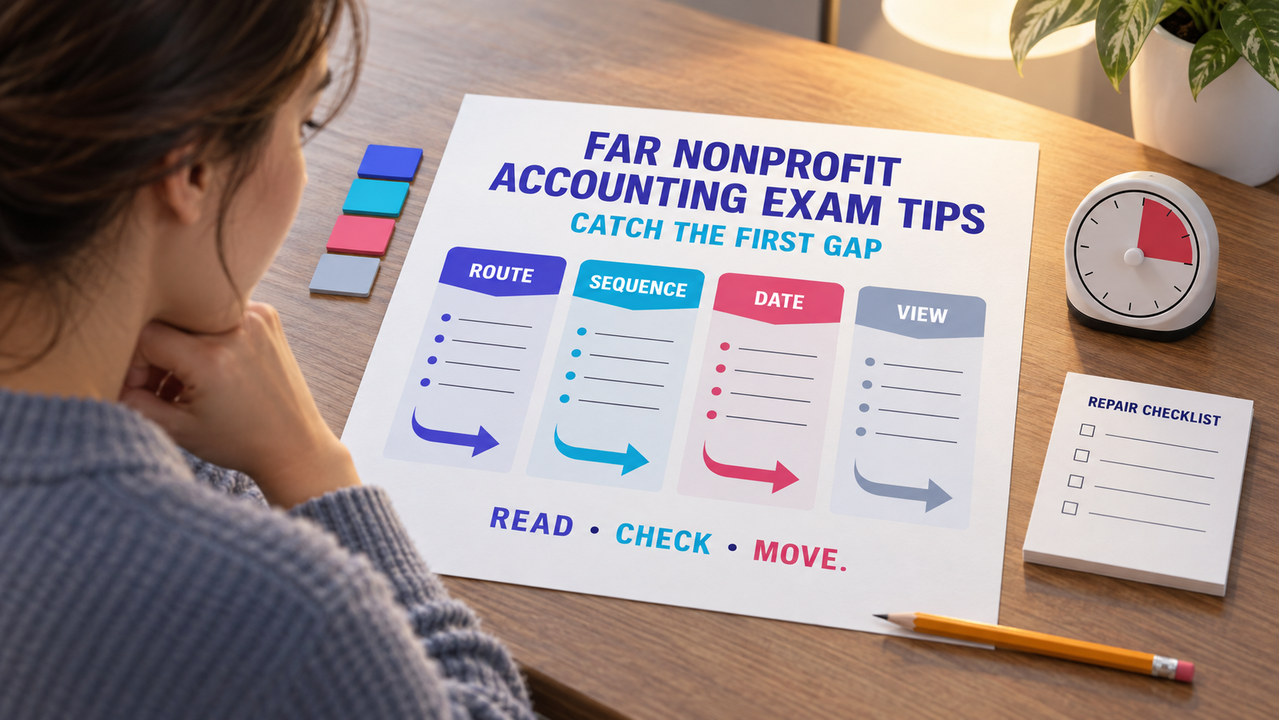

Direct answer: The most useful far nonprofit accounting exam tips protect four checkpoints: mark the route before solving, compare basis before applying a rate, separate the year-end condition from later discovery, and stay in the reporting view named by the prompt. Under time pressure, read the ask, mark the trigger, work the sequence, reject the distractor, and log one next repair.
Scope and originality note: This is original editorial practice for US CPA candidates searching for far nonprofit accounting income taxes subsequent events government accounting exam tips. The examples, amounts, answer choices, rationales, timing checklist, and repair loop are independently authored. They are not official, recalled, leaked, or provider-owned exam items. The editorial review role is scope mapping and source QA, not a personal licensure claim.
Use the AICPA CPA Exam Blueprint as the scope checkpoint. Use current FASB Topic 958, Topic 740, and Topic 855 for the accounting research routes, and current GASB material for the government-accounting perspective. The AICPA sample tests help with interface familiarity; the NASBA FAQ handles administration questions.
FAR nonprofit accounting exam tips: protect the first checkpoint
This far nonprofit accounting exam tips clinic is built for crowded FAR prompts. A familiar rule is not enough if the question changes the purpose wording, the basis, the relevant date, or the reporting level. Your first task is to identify the checkpoint that controls the route.
Use a two-pass rhythm. On the first pass, read only for the ask, the trigger, and the facts that could change the answer. On the second pass, complete the route-specific calculation or classification. This keeps a later number, date, or reporting concept from hijacking the original task.
Mark checkpoints before you calculate
Write four labels before you touch the answer choices: route, sequence, date, view. The labels are a quick defense against the most common exam-tip failure: solving a different question correctly.

- Route: mark whether donor wording, tax basis, a subsequent-event date, or a government perspective controls.
- Sequence: compare the correct inputs before multiplying, classifying, or adjusting.
- Date: separate the condition that existed at year-end from the date information was discovered.
- View: keep the named governmental fund or reporting level visible at the top of the work area.
If the answer choices all look plausible, ask which one follows the marked checkpoint and which one answers a neighboring question. That short comparison is more reliable than rereading every line at the same speed.
Tip 1 — read purpose before cash
Skill: find the nonprofit classification trigger. Assumptions: Harbor Youth Foundation receives $96,000, and the donor letter says $24,000 is limited to a scholarship program; no other agreement is supplied. Difficulty: foundational. What should be marked first?
- The full $96,000 receipt.
- The donor’s purpose wording for $24,000.
- The income-tax rate from another exhibit.
- The government-wide reporting view.
Reveal the answer and exam tip
Answer: B. The purpose phrase is the first checkpoint because it can control the restriction analysis. The cash total is a measurement fact, not a substitute for the donor’s wording. Distractor path: choosing A treats the largest number as the controlling fact. Next action: underline the limiting phrase, then write one sentence describing which amount or use is being evaluated under Topic 958.
Tip 2 — write basis before rate
Skill: keep a temporary-difference calculation in sequence. Assumptions: an asset has a $214,000 carrying amount, a $166,000 tax basis, and a stated 21% rate; apply the rate only after identifying the difference. Difficulty: moderate. Which move belongs first?
- $214,000 × 21%.
- $166,000 × 21%.
- $214,000 − $166,000.
- $214,000 + $166,000.
Reveal the answer and exam tip
Answer: C. The bounded difference is $48,000, and 21% applied afterward gives $10,080. Distractor path: multiplying the carrying amount first lets the visible rate replace the basis comparison. Next action: change the tax basis to $174,000, recompute the difference, and reopen Topic 740 for the complete recognition and measurement analysis.
Tip 3 — separate condition from discovery
Skill: connect later evidence to the correct reporting date. Assumptions: year-end is December 31; a customer loses a key contract on January 27; a later memo says the contract problem was already visible at December 31. Difficulty: moderate. What should the learner test?
- Whether the later information gives evidence about the December 31 condition.
- Whether every January event is ignored automatically.
- Whether donor wording controls the customer balance.
- Whether the fund perspective selects the date.
Reveal the answer and exam tip
Answer: A. The key question is whether the later information provides evidence about a condition that existed at year-end. The later discovery date alone does not settle the accounting; the complete facts must be evaluated under current Topic 855 guidance. Distractor path: treating January 27 as the only date turns the analysis into a calendar shortcut. Next action: move the contract problem to February 5 and write which evidence question changes.
Tip 4 — honor the named view
Skill: keep the requested government-accounting perspective stable. Assumptions: the prompt requests a special-revenue governmental-fund analysis and does not request government-wide statements. Difficulty: foundational. What is the first routing action?
- Stay in the named governmental-fund perspective.
- Switch automatically to government-wide statements.
- Apply the donor-purpose restriction trigger.
- Apply the temporary-difference rate sequence.
Reveal the answer and exam tip
Answer: A. The requested reporting view controls the first route. A government-wide treatment may answer another prompt, but it is not a harmless substitution here. Distractor path: choosing B changes the reporting level before the facts are analyzed. Next action: rewrite the prompt to request government-wide statements and record which analysis step would change; reopen current GASB material.
Log the first missed checkpoint
After each item, log only the first break: route, trigger, distractor, time spent, and next repair. A short record tells you whether to review wording, sequence, dates, perspective, or arithmetic. It also prevents a vague conclusion such as “I need more FAR questions.”
Keep the record separate from an official score. The point is to choose the next study action. If the route was correct but the difference was wrong, recompute one nearby amount. If the route was wrong, repeat the same item with one phrase highlighted before adding a new topic.
Use a two-pass timing rule
On pass one, mark the ask and trigger without trying to prove every detail. On pass two, execute the smallest route-specific sequence. For the four routes in this article, that means purpose before classification, basis before rate, condition before discovery, and named view before substitution.
- Read the ask: name the requested amount, date judgment, classification, or perspective.
- Mark the trigger: circle donor wording, basis labels, reporting-date facts, or fund language.
- Work the sequence: compare, classify, evaluate evidence, or stay in the requested view.
- Test the distractor: state which fact it ignored or which different question it answered.
- Log the next move: record one repair rather than reopening every FAR chapter.
This rhythm supports pacing without turning the page into a score promise. It is a study method for recognizing the first broken checkpoint under a time box.
Run a timed repair loop
A repair loop changes one fact while holding the response format stable. Remove the scholarship purpose, change the tax basis, move the contract problem after year-end, or change the requested reporting level. Use one short time box and write the reason in the same format as the original answer.

Use this order: read the ask, mark the trigger, work the sequence, test the distractor, and log the next move. If the explanation fails after one changed fact, return to the checkpoint rather than guessing faster.
Keep exam tips source-aware
The AICPA Blueprint controls scope and task statements; it does not turn this clinic into official exam content. FASB Topics 740, 855, and 958, plus current GASB material, provide research routes for the simplified original examples. Reopen live sources after a blueprint or standards update.
Use sample tests for interface familiarity, not copied wording. Administration and licensure questions belong with the relevant official channels and jurisdiction. The local workbook has null Semrush US volume and KD fields; no search-volume claim is invented here.
The practical takeaway for far nonprofit accounting exam tips is simple: mark the checkpoint before the rule. Read the ask, work the sequence, reject the distractor, and turn the first miss into one timed repair.
FAR nonprofit accounting exam tips FAQ
What should I mark before calculating?
Mark the route, sequence, date, and reporting view; then circle the fact that controls that checkpoint.
Why should basis come before the tax rate?
The bounded example compares carrying amount with tax basis first; the stated rate comes afterward. Reopen Topic 740 for complete guidance.
Does a later event automatically decide the year-end answer?
No. Separate the later discovery from the condition at the reporting date and evaluate the complete facts under current Topic 855 guidance.
How should I practice under time pressure?
Use two passes, log the first missed checkpoint, change one fact, and retry the same response format inside a short time box.