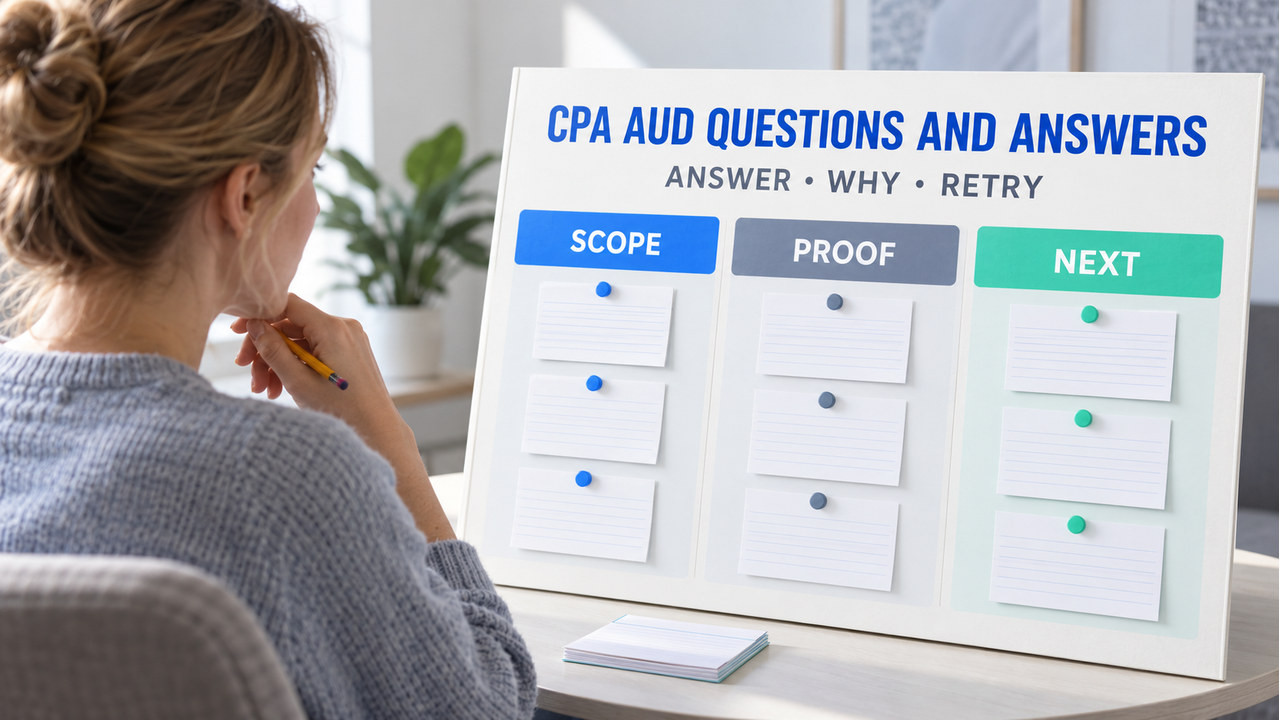

Direct answer: The best cpa aud questions and answers routine does not stop at the answer letter. State the answer, name the scope and rule, show the evidence that supports it, explain why the nearest option fails, and change one fact for the next retry.
Scope and originality note: This page contains original AUD-style questions and independently written answer explanations. It does not reproduce official, recalled, leaked, provider-owned, or score-predictive questions. Use the current AICPA CPA Exam Blueprint for scope, the current AICPA AUD resources for the subject boundary, and the NASBA FAQ for administration questions.
Start with the Blueprint-format explainer when you cannot name the tested task. For section orientation, open the AUD review overview; use the AUD review-course guide for resource fit, the topic MCQ page for volume, and the TBS practice guide when the task requires exhibits.
CPA AUD questions and answers: who this is for
This cpa aud questions and answers guide is for a learner who can see which option looks familiar but cannot yet explain why it is the best answer. It also helps when a learner reviews a question, reads the explanation, and still misses the same idea in a changed scenario.
The page is not a bare answer list and it is not a readiness score. Instead, it gives you a complete-rationale template, four original AUD items, a quality check for explanations, and a repair route for the first missing field. A small practice block produces local study evidence, not a prediction of exam performance.
Use the answer-why-why-not-next loop
Before you read an explanation, commit to an answer. Then write the explanation in four short moves plus one transfer move.
- Answer: state the option or conclusion that best fits the prompt.
- Why: name the rule, evidence, or boundary that makes the answer fit.
- Why not: explain why the closest distractor changes scope, misses the task, or overstates the evidence.
- Next: change one fact and predict what should change in the answer or reasoning.
First, keep the scope visible. Next, connect the key fact to the governing rule. Then, make the proof concrete. Finally, record the nearest wrong path. This order makes an explanation useful after the original question is gone.
Build one complete answer rationale
A strong explanation is short enough to review but complete enough to transfer. It answers the question, shows the match, and exposes the boundary that protects the answer from a plausible distractor.

Question: restate the requested output in your own words. Answer: name the best option without pretending that the item predicts a score. Why: connect the option to scope, rule, and evidence. Why not: identify the nearest wrong path and its boundary. Next retry: change one fact and state the new decision point. Use the same fields for every item so that explanations can be compared across topics.
Original AUD questions and answers
Try each item before reading the explanation. These are original study prompts, not official or recalled questions. The Blueprint connections describe the reasoning area; they do not claim that the exact prompt appears on an exam.
Question 1: independence and a financial interest
Scenario: A proposed audit engagement involves a team member who owns a direct financial interest in the audit client. Which response best frames the answer?
- A. Ignore the interest because the team member will not sign the report.
- B. Identify the independence threat and determine whether an appropriate response removes or reduces it before the engagement proceeds.
- C. Treat the interest as evidence that the client has a control deficiency.
- D. Issue an unmodified opinion before the interest is evaluated.
Answer: B is the best response. Why: the fact raises an independence question that must be evaluated before the engagement proceeds. Why not: A ignores the relevant relationship, while C and D jump to control or reporting conclusions that the scenario does not support.
Blueprint connection and next retry: This tests professional responsibilities and engagement acceptance. Change the fact so the interest belongs to an unrelated administrative employee, then explain why the evaluation may differ and what evidence still matters.
Question 2: a subsequent event
Scenario: A customer enters bankruptcy shortly after year-end but before the auditor signs the report. What should the learner examine first?
- A. Whether the bankruptcy provides evidence about a condition that existed at the reporting date.
- B. Whether every event after year-end requires a prior-year adjustment.
- C. Whether the event can be ignored because the financial statements are already drafted.
- D. Whether the event automatically creates an adverse opinion.
Answer: A is the best response. Why: the timing requires the team to evaluate what the later event says about the reporting-date condition and the appropriate financial statement treatment or disclosure. Why not: B uses an absolute rule, while C and D skip the required analysis.
Blueprint connection and next retry: This tests subsequent events and reporting consequences. Change the fact so the condition first arose after year-end, then identify which part of the explanation must change.
Question 3: using a SOC report
Scenario: An auditor plans to use a service organization controls report when evaluating controls relevant to a user entity. Which reasoning is strongest?
- A. Treat the report as automatic proof that every user-entity control operated effectively.
- B. Ignore the report because evidence from a service organization is never useful.
- C. Evaluate the report’s scope, period, control objectives, testing results, and complementary user-entity controls before deciding how it affects the work.
- D. Replace the audit opinion with the service organization’s conclusion.
Answer: C is the best response. Why: the report can inform the audit only after the auditor evaluates what it covers and what remains the user entity’s responsibility. Why not: A overstates the report, B rejects relevant evidence, and D confuses two different reporting relationships.
Blueprint connection and next retry: This tests evidence evaluation, internal control, and reliance on others. Change the report period so it does not cover the audit period, then name the missing evidence or additional procedure.
Question 4: management representation
Scenario: Management signs a representation about a material estimate, but the audit team has little corroborating evidence. Which answer best describes the next reasoning step?
- A. Treat the representation as sufficient on its own because management signed it.
- B. Obtain or evaluate other appropriate evidence and assess whether the representation resolves the remaining risk.
- C. Delete the estimate from the financial statements.
- D. Issue an adverse opinion without evaluating the estimate.
Answer: B is the best response. Why: the signed representation is part of the evidence record, but the team still needs to evaluate the estimate and the risk with appropriate support. Why not: A treats one source as an absolute substitute, while C and D skip the underlying measurement and conclusion work.
Blueprint connection and next retry: This tests evidence sufficiency, estimates, and conclusions. Change the fact so independent external evidence corroborates the estimate, then explain how the evidence assessment changes without promising a report result.
Check whether the explanation is complete
A useful answer explanation lets another learner reconstruct the decision without reopening the original stem. However, a bare letter cannot show whether the learner understood the scope, rule, evidence, or distractor boundary.

Complete explanation: it names the scope, states the governing rule, points to the evidence, explains the nearest distractor, and gives a next action. Bare letter: it records a result without a defensible match. Therefore, compare every explanation against the five fields before you count it as reviewed.
Run a four-pass answer review
First pass — commit: answer before opening the explanation and record your confidence as a study note, not a score.
Next — justify: write the rule, evidence, and boundary that make the answer fit.
Then — contrast: explain the nearest distractor in one sentence.
Finally — transfer: change one fact, retry, and log the first field that broke.
For example, “B is correct” is not enough. “B evaluates the independence threat before acceptance; A ignores the relationship” shows the match and the boundary. Likewise, a changed-fact retry reveals whether the explanation is a rule or merely a memorized phrase.
Choose the next AUD answer resource
Use the topic MCQ page when you need more original attempts. Use the Blueprint-format explainer when you cannot map the question to a task. Use the TBS practice guide when documents, evidence, or reporting transfer are the main challenge. Return to the AUD review hub for the section map. The AUD review overview and AUD course guide can connect a repeated rationale gap to a broader study choice.
These items are study aids. The current AICPA Blueprint and authoritative auditing guidance control scope and technical conclusions. NASBA controls jurisdiction, eligibility, scheduling, and administration details.
Common AUD answer-explanation mistakes
- Repeating the answer: add the rule or evidence that makes the option fit.
- Explaining only the winner: name the nearest distractor and its boundary.
- Using a broad slogan: tie the explanation to the stated scope, period, and audience.
- Skipping the changed fact: test whether the reason survives a small scenario change.
- Counting without reviewing: pause when a missing field repeats and repair that field first.
Choose the next explanation repair
After your next missed item, identify the missing explanation field. Then run one repair before doing a larger question block.
Choose the next explanation repair
After a missed item, identify the missing explanation field: answer, rule, evidence, distractor boundary, or next retry. Repair that field before doing a larger block.
- Identify the facts
- Choose the governing rule
- Check the result
Check your reasoning
Answer: Write the missing field in one sentence, then change one fact and check whether the explanation still holds.
Use the explanation in this article to verify each step.
An answer gap needs a one-sentence conclusion. A rule gap needs the governing principle. An evidence gap needs a support check. A distractor gap needs a boundary sentence. A transfer gap needs one changed fact. Repair the first missing field, not the most intimidating topic.
CPA AUD questions and answers checklist
- Commit to an answer before reading the explanation.
- State the scope, rule, and supporting evidence.
- Explain why the nearest distractor fails.
- Change one fact and predict the next decision.
- Log the first missing rationale field.
- Choose one resource that matches that field.
Finally, choose one original item, hide its explanation, write the five rationale fields, and run one changed-fact retry. That is how cpa aud questions and answers become evidence about what to study next.
CPA AUD questions and answers FAQ
Are these official CPA AUD questions?
No. They are original AUD-style study items with independently written explanations. Use the current AICPA Blueprint for official scope.
What should an AUD answer explanation include?
State the answer, show the scope and rule, point to supporting evidence, explain the nearest distractor, and run a changed-fact retry.
Why review the wrong answers?
A wrong option can reveal a scope, evidence, rule, boundary, or transfer gap. Naming that gap gives you a more useful next repair than simply adding volume.