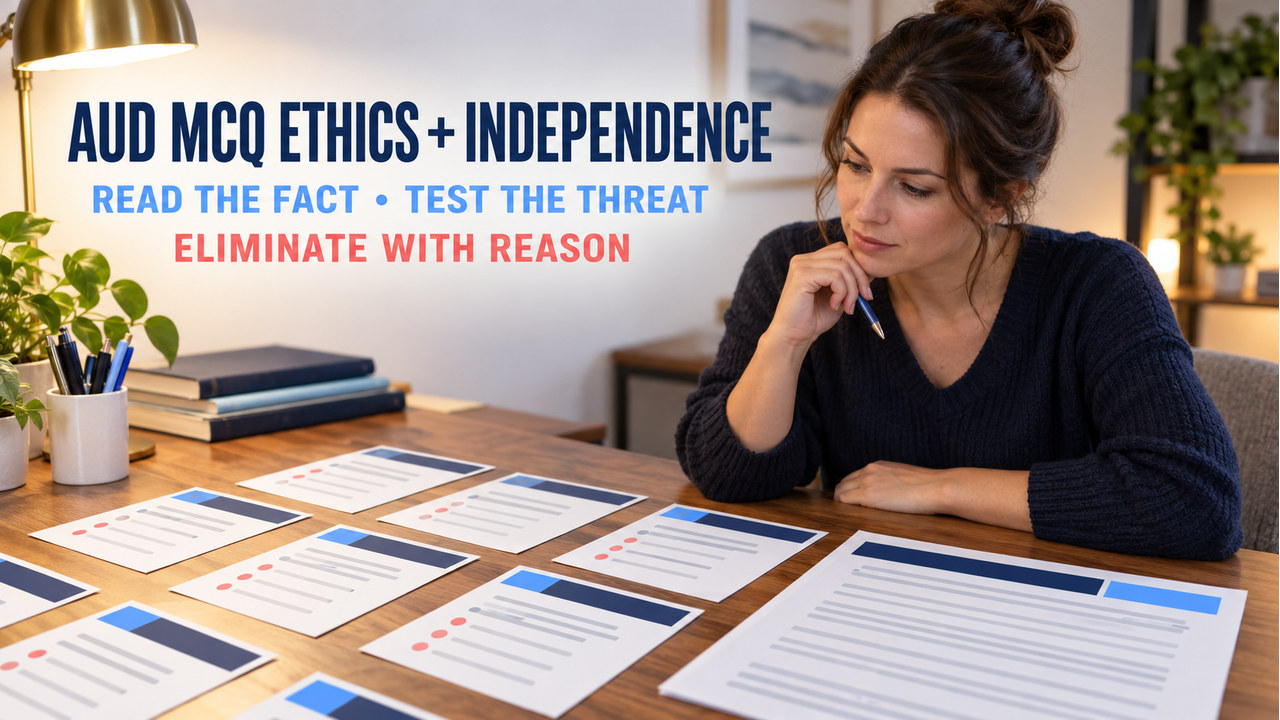

Direct answer: aud professional standards ethics and independence multiple choice questions are most useful when you test each option against the controlling fact instead of a memorized label. These aud ethics independence multiple choice questions use a repeatable routine: read the stem, name the decision verb, anchor the answer in one fact, check the applicable requirement, and eliminate the option that jumps too far. The items below are original study material, not official or recalled questions.
Scope and freshness note: We authored the scenarios on this page as new study material. They are not official, leaked, recalled, or remembered CPA items. Reopen the AICPA CPA Exam Blueprints for the testing window that applies to you. Use the AICPA AUD resources for current subject boundaries. For eligibility, scheduling, jurisdiction, or score questions, consult the NASBA FAQ. Our editorial review covers question design and source QA; we assert no personal licensure claim.
For orientation, start at the AUD review hub. The AUD review overview gives section context, the AUD review-course guide supports broader preparation, and the Blueprint format guide explains common planning fields. Use the topic MCQ page for focused retrieval and the TBS practice guide when the same judgment needs exhibit work.
AUD Ethics Independence Multiple Choice Questions: how to use this set
This set targets a narrow skill cluster: turning an ethics or independence stem into a defensible next analysis. The options are deliberately close. One may name a real concern but skip the fact check. Another may sound cautious but overstate the conclusion. Your task is to identify the decision verb, find the fact that controls it, and choose the option that preserves responsibility and documentation.
Difficulty is moderate. Each item requires application, not just recognition. Read the stem once for the actors and timing. Read it again for the service, relationship, offer, or responsibility point. Before looking at the rationale, write one sentence that begins with “The controlling fact is…” That sentence gives you a stable basis for comparing the choices.
Why the fact anchor matters
Multiple-choice questions become noisy when learners treat every option as a complete rule. Professional standards and independence analysis usually depends on who did what, for whom, at what point in the engagement, and who retained responsibility. A short fact anchor prevents the learner from choosing the most familiar phrase without checking whether the stem supports it.
Find the decision verb
Words such as identify, clarify, evaluate, document, decline, or continue tell you what the question is asking. If the prompt asks for the best first step, a final conclusion may be premature. If the prompt asks what to document, an option that merely names a threat may be incomplete.
Separate a concern from a conclusion
A relationship, service, gift, or role can create a fact worth testing without proving the final answer. Keep the fact, possible threat, current requirement, and response in separate notes. This separation makes it easier to reject an option that turns an incomplete stem into an automatic impairment or an automatic clearance.
Use elimination with a reason
Do not eliminate an option because it sounds too simple. Write the shortcut it takes. Common shortcuts include ignoring timing, confusing data preparation with management responsibility, treating a safeguard as a cure-all, or changing paperwork instead of changing the underlying fact. The best answer usually survives because it names the next verification or ownership step.
Build the MCQ decision ladder
Use the ladder below before you compare answer letters. The sequence is intentionally short enough for timed practice, but each rung has a distinct job: the stem supplies the facts, the decision verb sets the task, the fact anchor limits the claim, the rule gate identifies the source to reopen, and the best option states an appropriate next move.

Stem to decision verb
Underline the actors, service, relationship, offer, timing, and responsibility language. Then circle the verb in the question. A stem about what to do first should produce a process answer. A stem about which condition matters should produce a fact or requirement answer.
Fact anchor to rule gate
Write one controlling fact and one uncertainty. Next, identify whether the source you need is a current professional requirement, firm policy, engagement responsibility boundary, or Blueprint topic boundary. This prevents a broad study slogan from replacing the source check.
Rule gate to best option
Choose the option that responds to the task without claiming more than the stem supports. If two options remain, prefer the one that preserves management responsibility, identifies the applicable policy or requirement, and leaves an auditable next step. Then explain why the nearest distractor fails.
Original multiple-choice questions
We wrote every item below for this article. We designed the scenarios to practice reasoning, not to reproduce any official question. Assume that current professional standards and firm policy control the final decision, and reopen the applicable source before relying on a conclusion.
Question 1: a proposed client role
Fact pattern: Redwood Assurance is considering an audit engagement. Before acceptance, the client offers the spouse of a proposed controller a temporary role helping to prepare monthly close schedules. The stem does not state the role’s authority, duration, or whether the spouse would influence financial reporting.
Ask: What is the best first response?
- Ignore the offer because the engagement has not started.
- Assume an independence problem exists now.
- Clarify the spouse’s role, authority, timing, and the current independence requirement before deciding on acceptance or safeguards.
- Move the engagement to another partner and document nothing else.
Reveal the MCQ rationale
Before opening the rationale, choose the option that best matches the controlling fact, the threat check, and the current requirement.
Reveal the answer
Answer: Anchor the answer in the controlling fact, eliminate the option that jumps to a conclusion, and reopen the applicable requirement before accepting a broad rule.
Compare your process with the reasoning shown above.
Answer and rationale: Choice 3 is best. The stem gives a potentially relevant relationship and role but leaves controlling details open. The first distractor ignores timing and the relationship. Choice 2 turns an incomplete fact pattern into a final determination. The last option changes assignment without testing whether the underlying fact has changed.
Question 2: management responsibility in a memo
Fact pattern: Lakeview Foods asks its audit team to help draft a memo comparing two revenue-recognition policies. Management will select the policy, but management asks the team to recommend the preferred option and place the conclusion in the client file. The question asks what the team should clarify before doing the work.
Ask: Which response best fits a fact-first MCQ analysis?
- Choose the more conservative policy so the client can move faster.
- Clarify who owns the accounting decision, define the team’s permitted support, and check the current independence and responsibility requirements.
- Refuse all assistance because every memo creates an independence problem.
- Draft the recommendation under a neutral file name and let management sign it.
Answer and rationale: Choice 2 is best. Here, the controlling issue is decision ownership and the boundary of the requested service, not the apparent conservatism of one policy. The first option makes the professional team the decision-maker. A blanket rule replaces analysis in the third option. Finally, the last option changes the label while leaving responsibility unchanged.
Question 3: a restricted client discount
Fact pattern: During an audit, a team member learns that a client-owned supplier is offering employees of the audit firm a personal discount that is not available to the general public. The team member has not checked the firm’s policy or discussed the offer with the engagement leader.
Ask: What should the team member do first?
- Use the discount because it is not cash.
- Pause acceptance, disclose the offer, and check the applicable policy and professional requirement before deciding whether the offer creates a threat.
- Ask the supplier to issue the discount to the whole team and continue.
- Accept it after the engagement leader signs the audit report so timing resolves the concern.
Answer and rationale: Choice 2 is best. This offer is a fact that the team member should disclose and evaluate under the current policy and requirement. The first option changes the form of the benefit, not the need for analysis. A team-wide workaround does not answer whether policy permits the offer. Waiting until after the report treats timing as a cure.
Compare the distractor paths
Reviewing an answer letter is not enough. For each item, compare the stem, best option, tempting distractor, failure reason, and repair. The matrix makes the error pattern visible across different facts without turning the page into an answer-only bank.

- Stem: Which actors, service, timing, or responsibility fact controls the prompt?
- Best option: Which response answers the decision verb and preserves the next verification step?
- Distractor: Which choice sounds reasonable because it is fast, cautious, or familiar?
- Why it fails: Does it skip a fact, overstate a conclusion, or move responsibility to the wrong party?
- Repair: What one sentence or changed fact would make the missed distinction easier to see?
Map MCQ practice to the Blueprint
The current Blueprint provides the scope and skill signal for study planning. Use the task statement as the decision verb, then use the topic boundary to decide which facts belong in the stem. These original questions emphasize application: the learner must choose a next analysis from a short professional fact pattern rather than recall a phrase in isolation.
For these aud ethics independence multiple choice questions, hide the answer, write the fact anchor, and mark the distractor shortcut. For a TBS-style extension, use the TBS practice guide and add a short exhibit, policy excerpt, or responsibility note. The extension should deepen the same judgment instead of introducing an unrelated topic.
Common MCQ mistakes
- Answer-letter hunting: choose from the stem and decision verb before relying on pattern memory.
- Automatic impairment: separate a potentially relevant fact from the conclusion that still requires analysis.
- Conservative equals correct: check who owns the decision and what the current requirement permits.
- Paperwork substitution: renaming a file or moving an assignment does not change the underlying fact.
- Benefit-form shortcut: a discount or noncash offer still needs policy and threat analysis.
- No error sentence: record why the distractor fails so the next retry tests the same skill.
Repair the first miss
When an item goes wrong, do not add a large batch of unrelated questions. Identify the earliest break: did you miss the decision verb, overlook a controlling fact, use an overbroad rule, or accept an unsupported conclusion? Rewrite one fact-to-option sentence, then change one fact in the stem and retry. A useful repair changes the reasoning, not just the answer letter.
For example, change the spouse’s authority in Question 1, move management ownership in Question 2, or make the supplier discount publicly available in Question 3. If the best option changes, explain which fact caused the change. If it does not, reread the rule gate and the responsibility boundary.
AUD ethics independence multiple choice questions checklist
- Read the stem and name the actors, service, relationship, offer, timing, and responsibility point.
- Circle the decision verb: identify, clarify, evaluate, document, decline, or continue.
- Write one controlling fact and one uncertainty before comparing options.
- Reopen the current Blueprint, professional requirement, policy, or responsibility boundary that applies.
- Eliminate the option that skips a fact, overstates a conclusion, or moves ownership to the wrong party.
- Write one sentence explaining why the nearest distractor fails.
- Change one fact and retry before adding more question volume.
The practical use of aud ethics independence multiple choice questions is to rehearse a defensible choice process. Read the fact, test the threat, pass the rule gate, explain the distractor, and repair the first miss. That sequence builds more durable judgment than memorizing answer letters.
AUD MCQ ethics and independence FAQ
Are these supplied by an exam authority?
No. Redwood, Lakeview, and the supplier-discount items are original study scenarios, not official, recalled, leaked, or remembered questions.
What should I write before choosing an option?
Write the decision verb, one controlling fact, one uncertainty, and the current source or responsibility boundary you need to check.
How should I review a wrong MCQ?
Identify the first break, describe the distractor shortcut, rewrite one fact-to-option sentence, and retry after changing one fact.
Does the most cautious option always win?
No. The best option must fit the facts, preserve responsibility, and answer the question’s decision verb without claiming more than the stem supports.