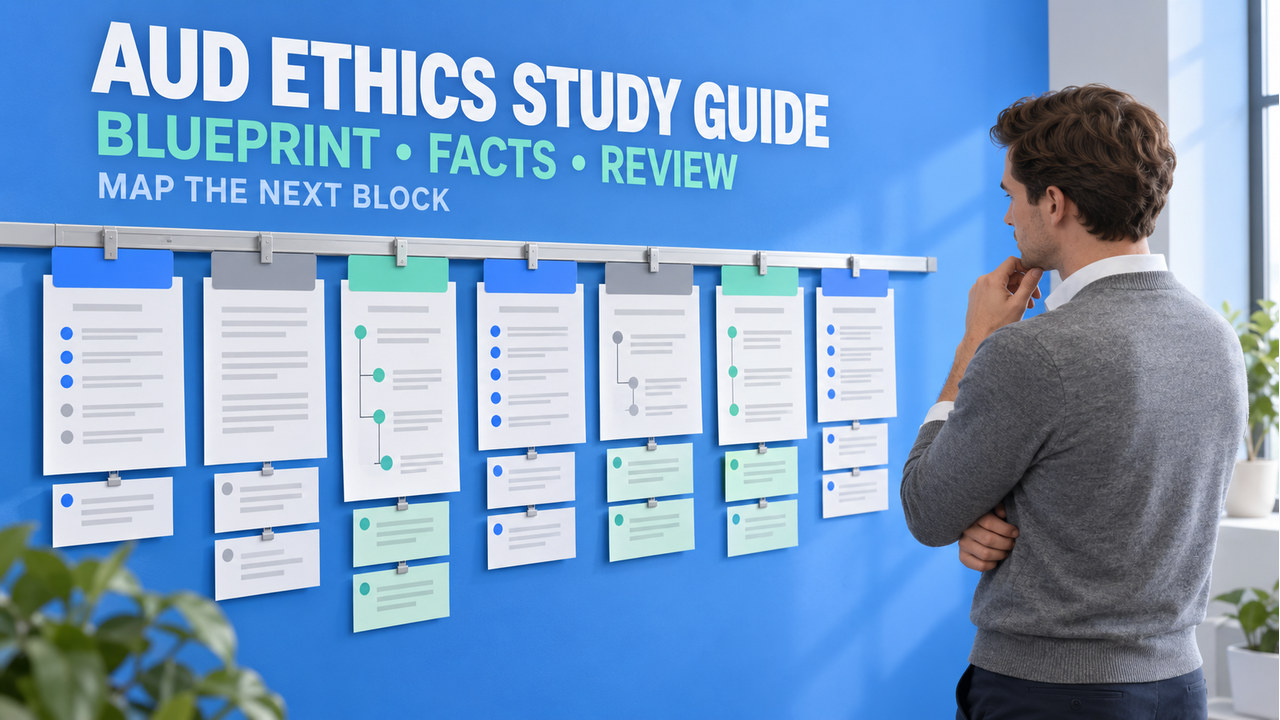

Direct answer: The most useful aud professional standards ethics and independence study guide starts with the current Blueprint, converts each topic into a fact-and-boundary question, and then uses original practice to test the reasoning. This aud ethics independence study guide gives you a study sequence, a review grid, three original scenarios, and a next-block method.
Scope and freshness note: This page is an editorial study aid, not an exam-authority publication. The scenarios, explanations, map, and checklist are original. Reopen the AICPA CPA Exam Blueprints for the testing window, the AICPA AUD resources for current subject boundaries, and the NASBA FAQ for eligibility, scheduling, jurisdiction, or score questions.
Start with the AUD review hub for section orientation. Use the AUD review overview for broader context, the AUD review-course guide for resource selection, the Blueprint format guide to define a task boundary, and the topic MCQ page or TBS practice guide when the same judgment needs more retrieval or exhibits.
AUD ethics independence study guide: target skill
First, this guide targets application. You are not only recalling a label such as independence or ethics. You are identifying the relationship, service, timing, role, or financial fact that controls the question, checking the current boundary, preserving management responsibility, and explaining the next defensible action.
Next, use moderate difficulty as the default. A good study session moves from a short scope note to a fact pattern, then from a chosen response to a rationale. If you cannot state the controlling fact in one sentence, do not add another page of notes. Mark the gap and make the next review smaller.
Four study lanes
Scope: What Blueprint topic, task statement, and skill signal are you studying? Fact: Which relationship or service changes the answer? Responsibility: Who owns the decision? Transfer: What happens when one fact changes? These lanes keep a broad topic from becoming a pile of disconnected definitions.
Read the Blueprint as a study map
First, start with the task statement and the topic boundary. Treat the task statement as the decision verb: identify, evaluate, determine, explain, or recommend each require a different answer shape. Then write the smallest fact pattern that would let you practice that verb. Finally, note the current source you must reopen before relying on a real engagement conclusion.
However, the Blueprint supplies scope and skill context; it does not turn a local practice item into an official result. Keep the date in your study notes, and reopen the current source when the testing window or professional requirement changes.
Build the study sequence
Next, use the map below from left to right. A study guide becomes actionable when every scope choice creates the next artifact: a task statement, a topic boundary, a controlling fact, a rule or source check, an original practice scenario, and a changed-fact retry.

- Task: circle the decision verb and write what the prompt asks first.
- Topic: state the ethics or independence boundary in plain language.
- Fact: underline the relationship, service, timing, or role that can change the answer.
- Rule: name the current source or policy to check; do not invent a universal shortcut.
- Practice: attempt an original scenario before reading its explanation.
- Retry: change one fact and state whether the response changes and why.
Use a four-block weekly study plan
First, Block 1 is scope and vocabulary. Read the current Blueprint row, define the decision verbs, and build a small list of relationships, services, roles, and timing words. Block 2 is fact discrimination. Take short scenarios and write the one fact that prevents a premature conclusion.
Next, Block 3 is boundary and responsibility. For each scenario, name the current source to reopen and keep management’s decision with management. Block 4 is transfer. Change one role, service, timing point, or financial detail and explain whether the best response changes.
Finally, keep the blocks short enough to review. The purpose is not to read every standard in one sitting. It is to create a chain of scope, fact, boundary, response, and retry that you can repeat under a later time box.
Try the original scenarios
Attempt the three original scenarios below before reading the explanations. They are written for this guide and are not exam-authority content. For each one, write the controlling fact, the boundary to check, and one action you would take first.
Reveal the study rationale
Before opening the explanation, write the controlling fact, the boundary to check, and the first action you would take.
Reveal the answer
Answer: Compare your note with the rationale, then underline the first missing fact or responsibility boundary instead of copying the answer letter.
Compare your process with the reasoning shown above.
Scenario 1: indirect financial interest
Fact pattern: Northline Assurance is considering an audit of a listed manufacturer. A staff member reports that a retirement account holds a broad fund with exposure to the client, but the file does not show account control, fund concentration, staff role, or the current requirement that applies.
Question: What should the team clarify first?
- Ignore the fund because it is not a direct purchase.
- Stop the engagement automatically.
- Clarify control, concentration, role, and the applicable current requirement before deciding on the response.
- Move the staff member without documenting the facts.
Answer and rationale: Choice 3 is strongest. The file lacks the facts that control the analysis. Choice 1 closes the inquiry too soon, Choice 2 reaches a conclusion without testing the facts, and Choice 4 changes assignment without documenting the relationship. Study note: write the missing fact before naming the conclusion.
Scenario 2: non-audit service and management responsibility
Fact pattern: Pine Harbor Services asks its audit team to help with a new reporting system. Management wants the team to choose the system owner, approve the control threshold, and sign the final implementation memo.
Question: Which response best protects the responsibility boundary?
- Choose the most conservative threshold for management.
- Clarify management’s ownership, define permitted support, and check the current independence boundary before drafting.
- Decline every discussion of controls without analyzing the service.
- Draft and let management approve the decision after implementation.
Answer and rationale: Choice 2 is strongest. The team may need to understand the service and its limits, but management must own the decision. Choice 1 transfers responsibility, Choice 3 uses an absolute rule, and Choice 4 postpones the boundary check. Study note: separate advice from a management decision.
Scenario 3: employment discussion during an audit
Fact pattern: During an audit, the client’s chief financial officer asks a senior associate whether the associate would consider joining the client after the reporting date. The associate has not told the engagement leader and continues work on sensitive estimates.
Question: What should happen first?
- Continue until a written offer exists.
- Disclose the conversation promptly, pause affected work as directed, and check the current policy and professional requirement.
- Wait until the report is issued and decide privately.
- Move the estimate to another file and keep the conversation confidential.
Answer and rationale: Choice 2 is strongest. The conversation is a relevant fact that needs prompt disclosure and a current-policy check. Choice 1 treats a written offer as the only trigger, Choice 3 uses timing as a cure, and Choice 4 changes the file location without addressing disclosure or work assignment. Study note: timing and disclosure can be the controlling facts.
Use the ethics review grid
After the scenarios, compare the same four actions across recurring situations. The grid keeps your study notes from becoming a list of labels. Ask what fact matters, check the current source, practice the answer shape, and retry with one changed fact.

- Financial interest: ask who controls the account and what concentration or coverage matters; check the current requirement; practice a fact-first answer; retry by changing control or concentration.
- Non-audit service: ask who owns the decision; check the responsibility boundary; practice separating permitted support from management; retry by changing the service or decision-maker.
- Employment: ask what was discussed, when, and who knows; check the current policy; practice prompt disclosure and work reassignment; retry by changing timing or role.
- Documentation: ask what fact is missing from the file; check the applicable source; practice writing a defensible next step; retry by changing the evidence available.
Turn weak lanes into a review plan
Instead, classify the first break rather than assigning yourself a vague “ethics weakness.” A scope break means the topic or task statement was not clear. The fact break means the relationship, service, timing, or role was missed. A responsibility break means management’s decision drifted to the professional team. The transfer break means one changed fact made the reasoning collapse.
Therefore, repair the earliest break. Reopen one current source, write one sentence that names the fact and boundary, and retry one scenario. If the retry works, schedule a different fact pattern next. If it fails, reduce the scope again rather than adding more pages.
Connect the guide to the Blueprint
Finally, use the current Blueprint as the scope anchor and the AUD resources as the subject-boundary check. The study guide’s original scenarios demonstrate how to reason; they do not replace current professional standards or a testing-window update. Keep the checkpoint date in your notes and revisit it during annual review.
For more retrieval, use the topic MCQ page. When the same judgment needs exhibits or a responsibility memo, use the TBS practice guide. Return to the AUD review overview when the gap is section-wide rather than topic-specific.
AUD ethics independence study guide checklist
- Save the current Blueprint row, task statement, skill signal, and checkpoint date.
- Write the decision verb and the smallest topic boundary you need to practice.
- Underline the controlling fact, relationship, service, role, or timing point.
- Name the current source or policy to reopen before relying on a conclusion.
- Attempt an original scenario before reading its answer explanation.
- Classify the first break as scope, fact, responsibility, or transfer.
- Change one fact and retry before adding more study volume.
Overall, the practical value of an aud ethics independence study guide is the chain it creates: Blueprint scope, controlling fact, current boundary, defensible response, and a changed-fact retry. Keep that chain visible in every review block.
AUD ethics independence study guide FAQ
Is this an official study guide?
No. It is original editorial study material. Use the current AICPA Blueprint and AUD resources for authoritative scope.
How should I start this topic?
Save one Blueprint row, define the decision verb, write the controlling fact, and attempt one original scenario before reading the rationale.
What if I know the labels but miss the questions?
Classify the first break as fact, boundary, responsibility, or transfer, then run one changed-fact retry on the same gap.
How often should I refresh the scope?
Reopen the current Blueprint during annual review and before relying on a time-sensitive study or engagement conclusion.