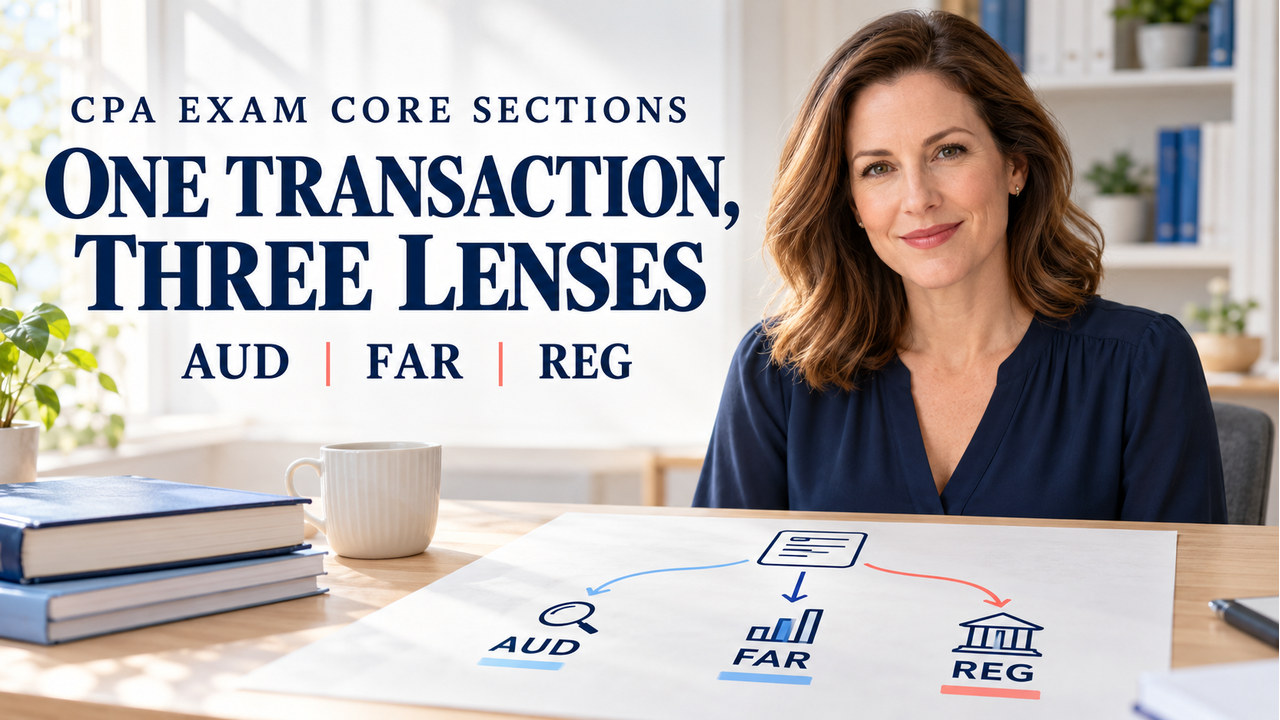

The CPA exam Core sections are Auditing and Attestation (AUD), Financial Accounting and Reporting (FAR), and Taxation and Regulation (REG). Every candidate must pass all three, plus one Discipline. The useful distinction is the work each section asks you to perform: FAR prepares and analyzes financial reporting, AUD evaluates engagement evidence and conclusions, and REG applies federal tax and business-law concepts. One sales folder can therefore lead to three different assignments.
This guide uses an original receivables example to make those differences concrete. You will calculate a balance, identify an audit question, and prepare a tax fact request. These exercises help you compare the CPA exam Core sections before choosing a starting point. They are teaching examples, rather than official questions or a complete treatment of the underlying accounting and tax rules.
Source check: October 25, 2026. The AICPA resource page lists a Blueprint effective January 1, 2026, and a separate edition effective January 1, 2027. Use the edition for your appointment date. This article uses the 2026 section structure and format; it does not analyze every upcoming change.
CPA Exam Core Sections: The Shared Requirement
The Core requirement is cumulative: AUD, FAR, and REG all count toward the examination requirement. Consequently, choosing a Discipline does not remove a Core section. Similarly, experience preparing tax returns does not create an exemption from REG. The AICPA exam toolkit describes three required four-hour Core sections and one four-hour Discipline.
In addition, all three Core sections contain multiple-choice questions and task-based simulations. However, a common format does not make the work interchangeable. A simulation may require you to reconcile information, select procedures, or complete a tax-related response. Accordingly, begin by identifying the requested assignment before choosing a formula or recalling a definition.
Specifically, the section descriptions cover more than one familiar classroom topic. AUD includes several engagement types and professional responsibilities. FAR extends beyond routine journal entries. REG includes business law and responsibilities alongside federal tax. Therefore, a strong introductory course in one topic is a starting resource, rather than a map of the entire section.
Compare the Three CPA Exam Core Sections
Imagine a small service business called Harbor Workshop. Its year-end folder contains a receivables ledger, customer invoices, service-completion records, and subsequent cash receipts. The same documents can support different questions. The comparison below describes the assignment you would prepare for; it does not imply that every examination question uses this exact folder.
| Section | Question to recognize | Work to practice | Common wrong turn |
|---|---|---|---|
| FAR | What balance or reporting treatment should the records show? | Prepare a calculation, reconciliation, entry, or reporting explanation | Assuming correct arithmetic proves all underlying entries are appropriate |
| AUD | What does the available evidence support for this engagement? | A procedure choice and a supported judgment | Using a relevant document to answer a different assertion |
| REG | Which taxpayer, tax rule, or legal responsibility controls the response? | Develop a fact-based tax calculation or legal classification | Copying a financial reporting result into a tax answer |
For example, a customer payment may appear in all three assignments. FAR may use it in a receivables rollforward. AUD may examine it as evidence about a recorded balance. REG may require additional facts about the taxpayer and applicable tax treatment. The document stays the same while the decision changes.

FAR: Build the Receivables Reconciliation
Start with a deliberately limited calculation. Harbor Workshop has opening gross receivables of $18,000. During the month, it records $42,000 of credit sales and $35,000 of collections against receivables. For this first exercise, assume there are no returns, discounts, write-offs, foreign-currency effects, or other movements. All amounts belong to the same reporting period.
The rollforward is $18,000 + $42,000 – $35,000 = $25,000. The $25,000 is closing gross receivables under those assumptions. It is not automatically revenue, cash, net receivables, taxable income, or an audited balance. Therefore, labeling the answer is part of solving the problem.
Next, connect each movement to a record. Opening receivables must agree with the opening ledger. Similarly, credit sales must agree with the relevant sales records. Collections must agree with the amounts applied to customer accounts. A cash-receipts total that includes an unrelated loan cannot be subtracted in full from receivables.
Now change the assignment: the question asks for the amount to present after an allowance adjustment. The original rollforward still helps, but it no longer completes the requested answer. You need the additional allowance facts and the applicable reporting treatment. This illustrates why FAR practice should include both calculations and the explanation of what a calculated amount represents.
Finally, check whether the case supplies enough information for recognition and cutoff. Our arithmetic exercise explicitly assumes appropriate entries. A broader reporting problem may require you to challenge that assumption. Do not silently carry a simplifying classroom assumption into a task that asks you to investigate the underlying records.

AUD: Decide What the Sales Evidence Supports
For the audit assignment, suppose Harbor Workshop records a $6,000 customer invoice dated December 29. A service-completion record is dated January 3, after the December 31 year-end. An auditor reviewing the folder notices the mismatch. The next task is to investigate the relevant facts, rather than immediately declare the invoice fraudulent or accept it because it has a number.
First identify the concern. The dates raise a possible cutoff question: does the transaction belong in the recorded period? Read the agreement and the records explaining performance and customer acceptance. Then relate those facts to the applicable reporting requirements. The invoice date alone does not settle that analysis.
Next, explain what a proposed procedure would establish. Inspecting a January receipt may help address collection of a recorded receivable. However, it does not by itself resolve every question about when the underlying service was performed. A useful answer links the procedure to the specific concern and identifies what evidence is still missing.
Be careful about direction as well. Starting with a recorded entry and looking for supporting documentation addresses a different risk from starting with activity records and checking whether the business recorded them. Practice explaining that distinction in your own words. Memorizing the names of procedures without their purpose leaves the important judgment unfinished.
AUD therefore needs practice with engagement context, evidence, and conclusions, as well as terminology. In a simulation, several exhibits may look relevant. Select the information that answers the actual question and explain any conflicting evidence. For more work with exhibits, use the simulation study guide.
REG: Identify the Taxpayer, Period, and Tax Question
Now give the same sales folder to the person preparing a federal tax response. The $25,000 gross receivables calculation is useful background, but it is not a tax return answer. Therefore, before applying a tax rule, identify the taxpayer or entity, the relevant tax year, the accounting method, and the transaction the question actually asks about.
In this example, the folder does not yet identify those facts. The correct learning task is to prepare a precise information request. Ask which taxpayer is reporting the transaction, which period is under review, what method applies, and whether the problem supplies adjustments or special conditions. Do not invent the missing information merely to produce a number.
Then distinguish a tax assignment from a business-law assignment. A question about a customer’s obligation under a contract may call for a legal classification. A question about an amount on a federal return may call for a tax calculation. Although both can appear in REG, they do not share one universal formula.
The current AICPA Blueprint resources provide the tested scope. Use your course and appropriate authority to learn the rule within that scope. Check the effective period when studying a tax provision. This guide deliberately gives no tax amount, rate, or filing conclusion for Harbor Workshop because the necessary facts and specific rule are absent.
That boundary makes the comparison useful. FAR’s rollforward answers a defined balance question. AUD’s investigation evaluates the supporting evidence. REG’s fact request prepares a different legal or tax analysis. Confusing those outputs can produce a confident answer to a question nobody asked.
Use One Sales Folder Across the CPA Exam Core Sections
Try a three-column exercise with a fresh practice folder. First, use the FAR column to name the balance or reporting treatment requested. Next, use the AUD column to identify the engagement concern and the evidence needed. Finally, use the REG column to identify the taxpayer, period, and tax or legal issue. Leave a field blank when the case does not supply it.
Compare the columns before checking any answer. For example, if all three contain only the same number, you have probably skipped the assignment distinction. By contrast, an AUD column containing a journal entry without an evidence discussion calls for a fresh reading of the question. Likewise, a REG column repeating financial reporting income needs the missing tax analysis.
This exercise is an original study method, rather than an official examination sequence. Its purpose is to make your work visible enough to diagnose. You do not need to study every topic in all three sections simultaneously. A short comparison can reveal a misunderstanding, after which you return to the section you are actively preparing.
Choose a Starting Order for Your CPA Exam Core Sections
The NASBA Candidate Guide permits candidates to take their sections in any order. Therefore, a preparation provider’s suggested order is a recommendation. Choose a starting section using your available study time, recent coursework, practical experience, and the gaps you can already identify.
For example, a candidate who struggles to read a receivables rollforward may benefit from refreshing that accounting foundation before tackling related audit judgments. Another candidate who recently completed a strong audit course may find AUD a practical starting point. Someone working regularly with federal tax returns may have a useful base for REG, while still needing business-law preparation.
These are conditional examples, rather than a ranking. Recent experience can make vocabulary familiar without covering the whole Blueprint. Likewise, choosing FAR first does not require finishing every financial reporting topic before you can understand a basic audit problem. Identify the specific missing prerequisite instead of postponing an entire section unnecessarily.
Write a provisional choice with one reason and one concern: “I will start with AUD because the engagement material is recent, but I need to refresh receivables and inventory accounting.” Then assign a concrete response to the concern. This produces a more realistic plan than selecting the section with the most reassuring reputation.
Keep Exam Format and Blueprint Dates Separate
For the 2026 format, AUD has 78 multiple-choice questions and seven simulations; FAR has 50 and seven; REG has 72 and eight. Each section allows four hours. These counts describe the examination design. They do not tell you how much practice an individual needs or which section will feel easiest.
Check the Blueprint edition independently of the section name. A course can correctly identify AUD, FAR, and REG while using an older scope outline. On the AICPA page checked for this article, the 2027 Blueprint is separately future-effective. If your appointment moves into 2027, compare that edition and its official change summary before extending your study plan.
Keep administrative decisions with the relevant authority. Your jurisdiction controls eligibility and licensing requirements; passing the three Core sections alone does not complete the examination or issue a license. Use the NASBA Candidate Guide for the general process and your board’s current instructions for personal requirements.
Build Your Three-Section Study Handoff
Before buying more material, check whether you can distinguish the three assignments in this article. The checklist below asks for specific work products. It does not calculate a readiness score or recommend a test date.
For a calculation gap, complete one receivables reconciliation with labeled inputs. Alternatively, an evidence gap calls for a note explaining what one audit procedure supports and what it leaves unresolved. For a tax gap, first identify the missing taxpayer, period, and method facts before applying a rule.
Finish by saving a one-sentence study instruction that names your chosen section and work product. For example: “My next FAR session will reconcile opening receivables, credit sales, and collections, then explain why the result is gross receivables.” You have compared the CPA exam Core sections successfully when that next assignment is clear.