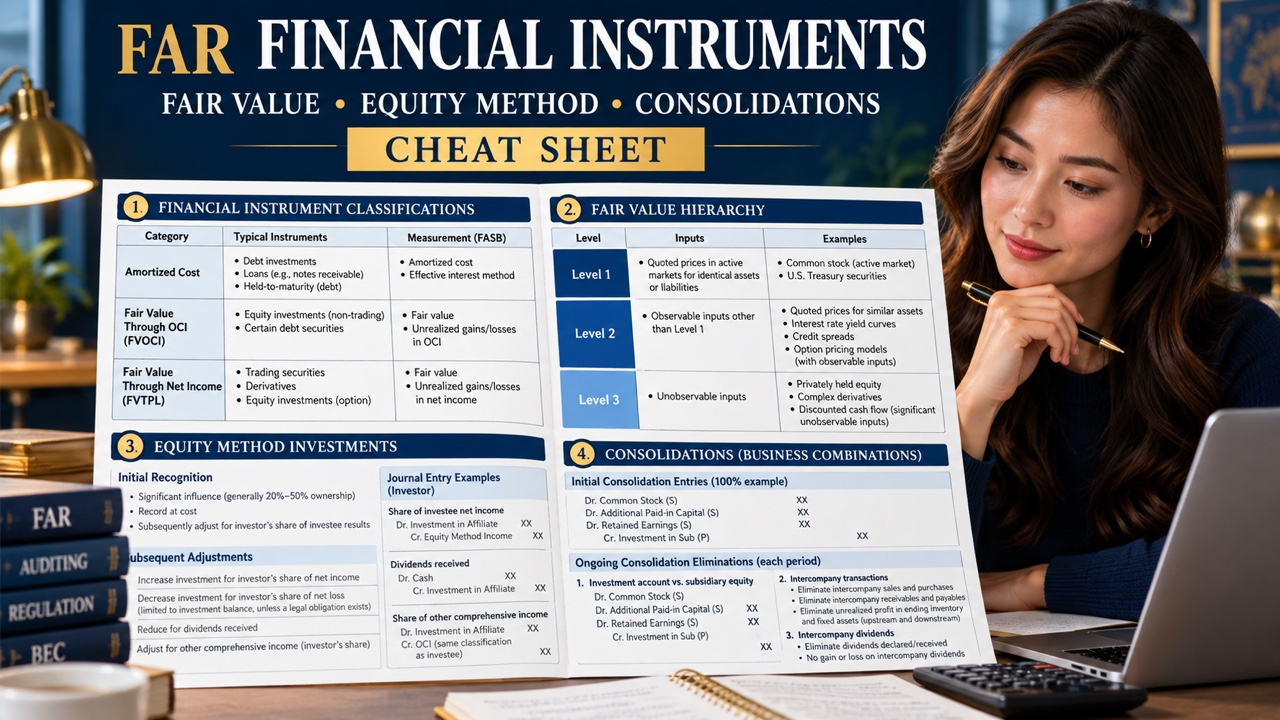

Direct answer: Treat far financial instruments fair drill as an evidence-routing exercise. Read the requested verb, choose the fact that can redirect the route, set a scope lock, and write the record that would let another reviewer retrace the choice. Only then perturb one input and see whether the route survives. The examples on this page are original study material.
Scope checkpoint: Check the current AICPA CPA Exam Blueprints before relying on task language. For administration questions, consult the NASBA CPA Exam FAQ. Names, amounts, and entities below are invented to isolate a study decision.
For orientation, visit the FAR review hub. Use the CPA study guide for sequencing, the Blueprint format guide for verbs, and the topic MCQ page or TBS practice guide when you need a different retrieval surface.
FAR financial instruments fair drill: make the decision visible
Read a prompt as a routing ticket. For a classification prompt, route toward contract terms and intent. For a measurement prompt, route toward a dated input. On an influence or control prompt, route toward current rights and governance. For consolidation prompts, route toward the reporting perimeter and reciprocal entries. Overall, write the requested output before considering an option.
Next, mark the single detail that could reroute the answer. A quoted price, a veto clause, a dispersed vote, or a reciprocal payable can matter differently depending on the verb. The guardrail says what that detail cannot establish by itself. The final line of the note names the supporting artifact, such as a term sheet, timestamped quote, charter, or worksheet.
FAR financial instruments fair drill evidence passport
Give every card an evidence passport with five stamps: task, trigger, guardrail, artifact, and perturbation. First, the task says what the examiner wants. Next, the trigger explains why the fact matters. Then, the guardrail blocks an overbroad shortcut. After that, the artifact points to a record. Finally, the perturbation changes one input for a second pass. As a result, this passport makes a two-minute review reproducible.
For instance, “evaluate the method” is incomplete until the card names the right that matters, the decision it can support, and the right that might defeat it. If a consent clause is removed, write the replacement route rather than merely changing an answer letter.
Set the study-guide review assumptions for far financial instruments fair drill
Begin with a dated checkpoint from the official Blueprint and copy the task verb into the margin. A classification verb calls for contractual features and management purpose. A measurement verb calls for an input, a date, and an observable-status note. An assessment verb calls for a rights map. An elimination verb calls for a group perimeter and a worksheet trail. This first routing step keeps the drill narrow.
Use four labels for this far financial instruments fair drill: instrument, market input, relationship, and group entry. Circle the label that dominates the prompt. Under it, write the unknown that would prevent a confident response. After that, name the exact exhibit or ledger that could resolve the unknown. The note should make the next search obvious to someone who did not see the original item.

FAR financial instruments fair drill case anatomy: route, guardrail, proof, result
Build a compact route card. First, the route card records the requested result. Next, the second line records the redirecting detail. Then, the third line records the scope lock and one contrary detail. Finally, the fourth line records the result and the proof artifact. For clarity, keep the wording concrete: “dated Level 1 quote supports the measurement date” is more useful than “use fair value.”
By contrast, background can be true and still be the wrong evidence. An old valuation memo may explain a trend but miss the reporting date. A market quote may anchor a date but say nothing about business purpose. An internal invoice may be genuine but still disappear in a group presentation. Ask what the document demonstrates, then list the gap it leaves.
FAR financial instruments fair drill four-minute evidence loop
Spend the first minute extracting the verb, the next two minutes routing the facts, and the last minute writing the passport. If a record is absent, write its filename or agreement section. Later, replay the card after changing one detail. The score of the drill is the quality of the route, not the speed of the first guess.
Run the far financial instruments fair drill study-guide review
Work each case cold. Write a route card before reading the explanation, and mark the one fact you would verify in a live file. Then compare your route with the rationale and state what would change under one deliberate perturbation. These are independently written practice cases; they are not official, recalled, or leaked questions.
Reveal the reasoning
Attempt the original item first. Write the controlling fact, the boundary or evidence check, and the reason you would save before opening the explanation.
Reveal the answer
Answer: Compare your note with the rationale, mark the first missing proof point, and change one fact before retrying. Do not use a raw answer letter as the study record.
Compare your process with the reasoning shown above.
Case 1: far financial instruments fair drill dated quote
Fact pattern: Redwood owns a quoted share. The close on the reporting date is $73.40, while a prior-quarter worksheet carries $68.10 and a lengthy commentary. The prompt asks which item should anchor a simplified measurement route.
Options: A. Keep $68.10 because the commentary is longer. B. Start with the $73.40 dated quote, save the source and timestamp, and label the worksheet as history. C. Use Redwood’s purchase price. D. Substitute the issuer’s book amount.
Answer and rationale: B fits the requested date and the observable input. The older worksheet can explain movement but cannot replace the current anchor. Likewise, the purchase price and book amount answer different questions. Record the quote first, then explain why the older file is context only.
Case 2: far financial instruments fair drill consent clause
Fact pattern: Meridian owns 18% of Solace, appoints one of nine directors, and receives monthly operating packs. A 54% holder controls ordinary votes. Meridian has consent over one financing covenant but cannot appoint the operating team. The prompt asks which relationship analysis should come first.
Options: A. Consolidate because the board seat proves control. B. Separate influence indicators from current decision power and document the covenant’s narrow reach. C. Treat every minority holding as a passive market input. D. Use 18% as the entire answer.
Answer and rationale: B keeps the relationship lanes distinct. The board seat and information access may support influence, while the narrow covenant does not automatically create current unilateral power. Save the ownership schedule, board minutes, and covenant before choosing a method.
Case 3: far financial instruments fair drill internal service
Fact pattern: Northstar controls Lumen. Lumen bills $12,700 of internal analytics, Northstar records the matching cost, and a $1,450 receivable remains on the close date. The prompt asks which worksheet trail belongs in the group result.
Options: A. Retain both entries because analysts performed work. B. Remove the reciprocal income and cost, then trace the receivable. C. Remeasure both lines as market transactions. D. Remove Lumen’s income only.
Answer and rationale: B follows the reporting perimeter. Work may have occurred, yet the reciprocal activity is internal when the entities are presented as one group. Also, trace the receivable so the elimination is complete. The other choices either change the issue or leave one side behind.
Separate influence, control, and measurement in far financial instruments fair drill
A percentage is a starting coordinate, not a destination. Ask which decisions are relevant, whether rights are presently exercisable, and whether another holder has a substantive removal or veto right. Influence indicators and control indicators belong on separate lines. Information access can support analysis without creating power.
FAR financial instruments fair drill relationship map
Put influence signals on the left: board participation, policy input, and material transactions. Put control tests on the right: current power, relevant activities, and the ability to use power. Under the map, answer the exact verb in one sentence. If the prompt asks for an equity method, do not let a control shortcut swallow the influence discussion.
Now perturb the map. Remove a veto, disperse the votes, or change who appoints the operating team. Record the new route and the agreement that supports it. That second pass reveals whether the learner understood the rights or merely remembered a percentage.
Build the far financial instruments fair drill consolidation bridge
Start at the perimeter. List the two ledgers, mark each reciprocal line, and tag any downstream amount. A genuine service can still be internal to the group; an outside sale can still be external even when its amount appears in two schedules. The bridge should show why a line stays or leaves.
FAR financial instruments fair drill elimination trail
Use four rows: source income, matching cost, related receivable or payable, and downstream effect. Keep the source ledgers beside the bridge. A matching total proves arithmetic agreement, not presentation status. If the balance settled before close, strike the old route and write the settlement date before recomputing.
Measurement cards use a different passport. Name the input, the observation date, the source, and the observable-status judgment. The word “value” appears in both measurement and elimination questions, but its evidence path is different.
Choose the next far financial instruments fair drill repair
After the cold attempt, label the first gap as scope, trigger, guardrail, artifact, or transfer. Pick one repair with a visible endpoint: reopen one agreement, annotate one quote, or rebuild one worksheet bridge. Then replay one case after changing one material detail. If the route still fails, narrow the question before adding more items.

FAR financial instruments fair drill perturbation ledger
Use three columns: altered input, held-steady facts, and artifact to inspect. Try a new measurement date while keeping contract terms fixed; remove a consent right while keeping ownership fixed; settle an internal receivable while keeping the source entries fixed. The ledger makes the reason for any route change visible.
Close the far financial instruments fair drill session
End with five entries: the dated Blueprint checkpoint, the task verb, the redirecting detail, the rejected shortcut, and the next artifact. Keep official scope statements separate from these original drills. Recheck AICPA material when task language changes and NASBA material when administration details change.
Far financial instruments fair drill: ten-minute close
Minute one extracts the verb. Next, minutes two and three build the route card. Then, minutes four through six test the guardrail and reject the nearest shortcut. After that, minutes seven and eight run the perturbation. Finally, minutes nine and ten schedule the exact document check. As a result, this cadence leaves a useful starting point for the next session.
When exhibits dominate, switch to the TBS practice guide. When narrow recall is the issue, switch to the topic MCQ page. Each route changes the next action while the passport preserves the evidence.
far financial instruments fair drill checklist
- Copy the official checkpoint date and task verb.
- Circle the lane: instrument, market input, relationship, or group entry.
- Mark the detail that could reroute the answer.
- Write the guardrail and one contrary detail.
- Name the quote, term sheet, charter, agreement, or worksheet to inspect.
- Explain why the closest shortcut fails.
- Change one material input and replay the route.
- Save the next artifact check.
Overall, a strong far financial instruments fair drill produces a replayable route. The learner can show what was asked, what redirected the analysis, which record supports it, and what would happen after one perturbation.
far financial instruments fair drill FAQ
Are these official exam questions?
No. The cases and explanations are original editorial practice. Use current AICPA material for authoritative scope and terminology.
Does an 18% holding establish control?
No. A holding and board participation may inform influence, while current rights and relevant activities require a separate control analysis.
Why remove the internal analytics lines?
The entities are presented as one group, so reciprocal internal income, cost, and related balances do not remain as outside activity.
What follows a failed drill?
Name the missing artifact, inspect one record, and replay one case after changing one material input.
Sources and scope
Reopen official sources before publication or reuse because testing boundaries and administration details can change. This page uses simplified amounts and original examples; it is not a live engagement conclusion or a score promise.