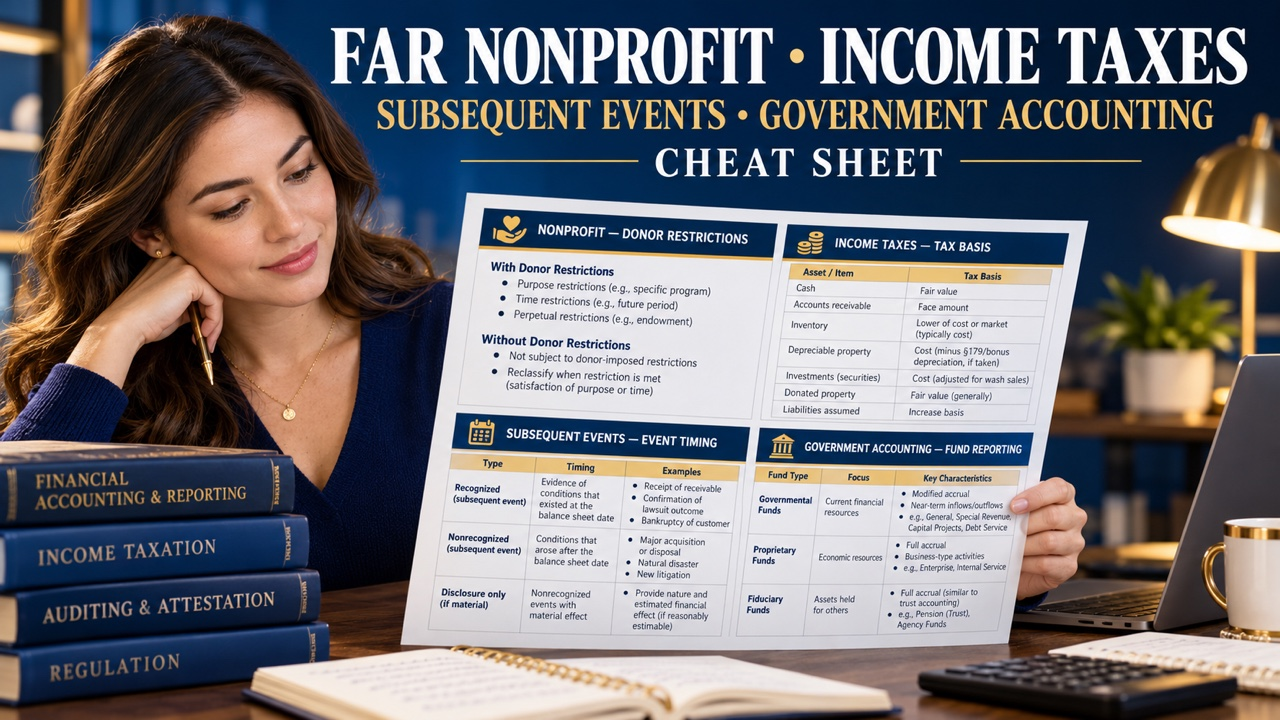

Direct answer: A useful far nonprofit taxes subsequent drill is a short decision ledger.
Name the task verb, place the fact in the right reporting lane, write the date or basis that controls it, and record the evidence you would inspect.
Then attempt an original case, explain the nearest distractor, and replay the case after changing one input. The aim is a defensible reasoning trail rather than a score promise.
Scope note: This is original study material. Reopen the AICPA CPA Exam Blueprints for current scope and the NASBA CPA Exam FAQ for administration questions.
Use the FAR review hub for section orientation. The CPA study guide supplies a broader plan, while the Blueprint format guide, topic MCQ page, and TBS practice guide support different retrieval modes.
FAR Nonprofit, Income Taxes, Subsequent Events, and Government Accounting: Decision Ledger
The four topics look crowded when they appear in one search phrase, but a question usually turns on one controlling lane. For example, a nonprofit restriction may control presentation and release.
A tax item may turn on basis and reversal timing.
By contrast, a later event may depend on whether the condition existed at period-end. Meanwhile, a government accounting prompt may first require the fund or reporting model.
As a result, the ledger keeps those triggers visible so a familiar word cannot substitute for analysis.
In addition, keep the cases below original and simplified. They are study prompts, not recalled, leaked, or official questions. Meanwhile, current Blueprint language and current professional guidance control a live conclusion.
When a fact is current-sensitive, write the source date in the ledger and reopen the source before reusing the note.
Build the ledger before the question
far nonprofit taxes subsequent drill: write the task verb
Start with the verb in the task statement: classify, measure, recognize, disclose, or recommend a review step. Circle that verb before you read the answer choices.
“Classify” asks for a lane and defining fact; “measure” asks for a basis, period, or amount; “disclose” asks what a reader needs to know and when; “recommend” asks for a bounded action.
If your note cannot repeat the verb, the prompt is not yet understood.
far nonprofit taxes subsequent drill: name the controlling lane
Then write one lane in the margin: nonprofit restriction, income-tax basis, subsequent-event timing, or government fund and model. Otherwise, add a second lane only if the prompt gives a direct bridge.
This prevents a tax difference from swallowing a later-event question or a fund label from replacing the reporting objective. The lane is a routing decision, not a conclusion.
For each item, use five short fields: task verb, controlling fact, date or basis, evidence to inspect, and next repair. In practice, a complete note can fit on one line per field.
Otherwise, if the evidence field is blank, mark the item for a source check instead of adding another mixed question.

Set a stopping rule for the study block
Use a small block: two minutes to read, three minutes to decide, and two minutes to explain. Stop the timer when you cannot name the lane or controlling fact.
That pause is useful data. It says whether the next session needs a terminology check, a timeline sketch, a basis calculation, or a fund-classification example. More volume cannot repair an unnamed gap.
Before opening a rationale, write the strongest distractor and why it is tempting. This makes the later explanation a comparison rather than a memory test.
A good explanation says which fact makes the selected route fit and which missing or changed fact would send the item to another route.
Attempt three original ledger cases
Attempt each case cold. Record the five fields before reading the answer. The amounts and dates are deliberately simple so the method stays visible; they are not authority examples.
Reveal the ledger reasoning
Attempt each original case, write the five-line ledger, then reveal the rationale and mark one missing field.
Reveal the answer
Answer: The strongest route names the verb, lane, controlling fact, evidence check, and repair.
Compare your process with the reasoning shown above.
Case 1: a restricted nonprofit gift
Fact pattern: A nonprofit receives a $90,000 donor commitment to renovate a community clinic.
The donor letter permits the money to be used only for the renovation, and the nonprofit has not yet completed the work.
A summary sheet calls the amount “support,” but it does not show the restriction language or the organization’s reporting framework.
Question: What should the learner resolve first?
- Record the amount as unrestricted because the word support appears in the summary.
- Ignore the donor letter and choose the answer with the shortest explanation.
- Read the restriction, confirm the entity and framework, and explain the presentation or release question that follows.
- Move directly to a tax-basis calculation.
Answer and rationale: Choice 3 is the disciplined route. The donor purpose and the reporting framework are the controlling evidence; the amount alone does not settle presentation or release.
However, Choice 1 treats a label as a rule. Choice 2 discards the strongest evidence. Instead, Choice 4 changes lanes before the nonprofit fact is resolved.
Therefore, the ledger repair is to save the restriction sentence and the source or exhibit that defines the release condition.
Case 2: a temporary tax difference
Fact pattern: A reporting book value is $48,000 higher than the tax basis for equipment.
The difference is expected to reverse over three years, but the prompt does not state whether the item is in a taxable or tax-exempt reporting context.
A tempting answer treats the $48,000 as a current tax expense without identifying the reversal pattern.
Question: Which next step protects the analysis?
- Multiply $48,000 by a remembered rate and stop.
- Identify the reporting context, confirm the basis difference and reversal timing, and then decide what measurement or disclosure task is being asked.
- Assume the difference is permanent because it is not cash today.
- Use the nonprofit restriction from Case 1 as the controlling rule.
Answer and rationale: Choice 2 is strongest. A temporary difference links book basis, tax basis, and future reversal. The reporting context determines the accounting question in scope.
However, Choice 1 skips the task verb. Choice 3 confuses timing with permanence. Instead, Choice 4 imports an unrelated lane.
Therefore, the ledger repair is to write the two bases, the expected reversal window, and the missing context that must be verified.
Case 3: a period-end event and a government fund
Fact pattern: A city’s year-end financial statements are nearly complete when a court ruling arrives on January 18.
The underlying claim was already pending at December 31, but the prompt also references a governmental fund and asks whether the report needs an adjustment or disclosure.
The ruling date is vivid, yet the condition at year-end is the quieter fact.
Question: What should the learner test before choosing a response?
- Use January 18 as the only date because it is the newest fact.
- Decide that every later event is disclosed and never adjusted.
- Confirm the fund and reporting model, then ask whether the condition existed at period-end and what the task verb requests.
- Return to the tax-basis calculation from Case 2.
Answer and rationale: Choice 3 keeps both boundaries visible. The event’s later date matters, but the pre-existing condition and the government reporting model determine the next analysis.
However, Choice 1 mistakes arrival of evidence for creation of the condition. Choice 2 applies a blanket rule. Choice 4 abandons the question’s lane.
Therefore, the ledger repair is to draw a two-point timeline and name the fund or model evidence you would inspect.
Read the rationale by proof category
After all three attempts, sort each miss into one category: scope, fact, rule, evidence, or transfer. First, a scope miss means the task verb or reporting lane was unclear.
A fact miss means the date, restriction, basis, fund, or condition was overlooked.
Next, a rule miss means the fact was seen but connected to the wrong treatment.
Finally, an evidence miss means you knew the rule but could not name the record that would support it.
A transfer miss means the original case worked but one changed input broke the explanation.
Accordingly, use the category to choose a small repair. Scope calls for one Blueprint row. Fact calls for a timeline, donor clause, basis bridge, or fund label.
Rule calls for one current source check. Evidence calls for a list of the exact record or exhibit. Transfer calls for a one-variable replay.
Therefore, this is more informative than simply counting correct answers.
Choose the far nonprofit taxes subsequent drill repair

Similarly, the second visual is a worked record, not a scorecard. Follow the question, evidence, step one, step two, and why fields in order.
When the input changes, update the conclusion and preserve the old note so you can see which fact carried the decision.
far nonprofit taxes subsequent drill: test the date
If the replay concerns a subsequent event, change only the condition date or the date evidence became available. Keep the reporting period and task verb fixed.
State whether the condition existed at period-end, what evidence supports that statement, and whether the requested treatment is adjustment, disclosure, or a source check.
far nonprofit taxes subsequent drill: replay one fact
If the replay concerns a restriction, tax basis, or government fund, change one fact that could move the item to another lane.
For example, remove the donor purpose, move the reversal into a different period, or change the fund named in the exhibit. Explain why the route changes or stays the same.
That sentence is the transfer proof.
Make the ledger repeatable
Additionally, keep one page for a week of review.
For that reason, each row should include the date, Blueprint checkpoint, task verb, lane, controlling fact, evidence checked, distractor rejected, repair category, and changed-input result.
Then use a new row for a new fact pattern; do not overwrite the first explanation.
As a result, the preserved comparison shows whether the repair improved reasoning or merely changed an answer.
Separate official scope from original practice. The AICPA links in this article point to current boundary material; the amounts, dates, prompts, rationales, and visuals are independently written.
For a different retrieval mode, move to the topic MCQ page for focused recall or the TBS practice guide for exhibit-heavy work.
far nonprofit taxes subsequent drill checklist
- Write the task verb before reading the answer choices.
- Route the item to nonprofit restriction, tax basis, subsequent-event timing, or government fund/model.
- Record the controlling fact, date, basis, or reporting context.
- Name the source, donor clause, calculation, timeline, or exhibit you would inspect.
- Reject the nearest distractor in one complete sentence.
- Classify the first gap as scope, fact, rule, evidence, or transfer.
- Change one input and replay the same case.
- Keep the original and replay notes together for the next session.
Overall, a strong far nonprofit taxes subsequent drill ends with a usable next action: one missing proof point, one record to inspect, and one changed fact to replay.
That ledger is the study asset you can carry into the next FAR block.
far nonprofit taxes subsequent drill FAQ
Are the cases official exam questions?
No. They are original editorial practice. Use current AICPA materials for tested scope and current professional guidance for live conclusions.
What should I do when the lane is unclear?
Stop the timer, write the task verb, list the four possible lanes, and identify the missing fact or source that would separate them. Then retry one bounded case.
Why change only one input?
One changed input shows which fact drives the route. Changing several facts at once hides the transfer signal and makes the repair difficult to audit.
Sources and scope
Reopen the AICPA CPA Exam Blueprints before using a task statement or content boundary again. Use the NASBA CPA Exam FAQ for administration questions.
This page supplies original study prompts and a decision-ledger method; it does not promise a score, replace a current source, or provide a live engagement conclusion.