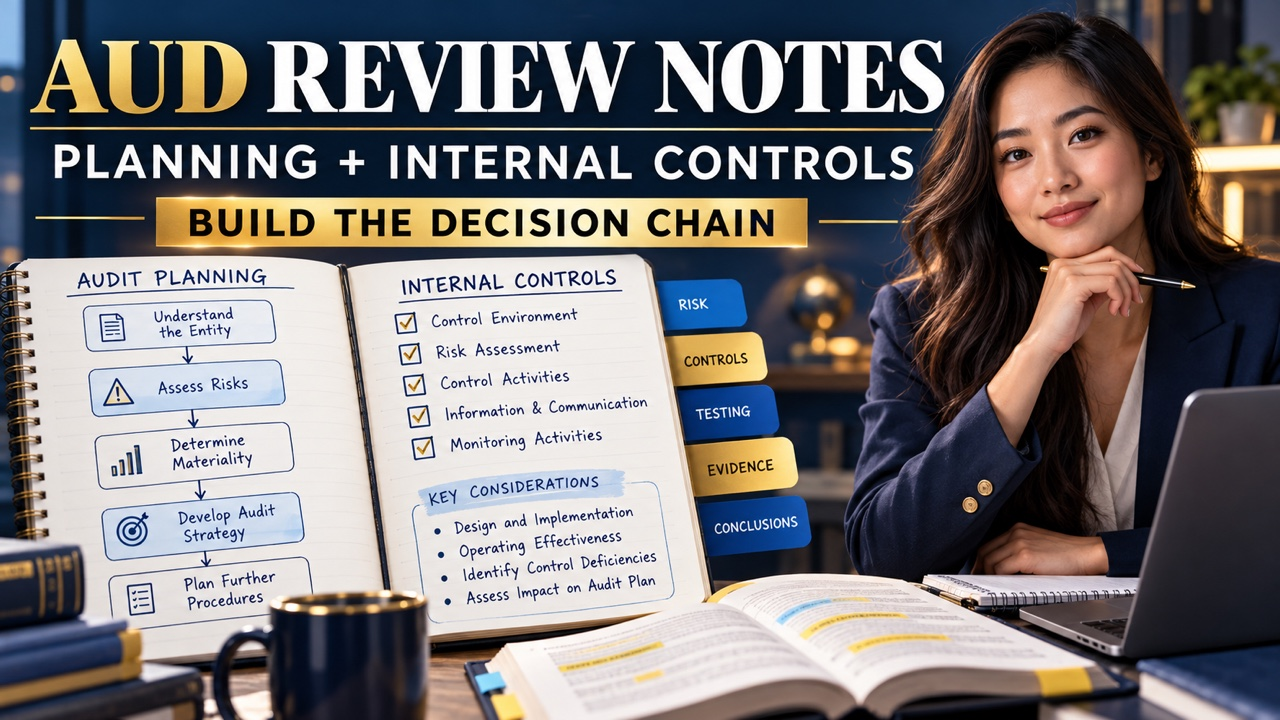

Direct answer: An aud planning internal controls drill works when you name the task verb, isolate the risk and control fact, identify the evidence that could prove the fact, and write one focused repair before you attempt another mixed set. The method below is original study material for planning, internal control, integrated audits, and IT controls. It helps you explain a response instead of memorizing an option letter.
Scope and freshness note: The scenarios and answer explanations are original editorial practice. Use the AICPA CPA Exam Blueprints for the current tested boundary, the AICPA AUD resources for subject orientation, and the NASBA FAQ for administration questions. Reopen those sources before relying on a current rule.
Start with the AUD review hub for section orientation. Use the CPA study guide for a wider review path, the Blueprint format guide for task boundaries, and the topic MCQ page or TBS practice guide when the next retrieval mode should change.
Build the aud planning internal controls drill map
Begin with a one-line map: risk → control → process step → evidence → audit response. This keeps the question anchored to a decision. A control description alone does not prove that the control was designed well, implemented, or operated for the period under review. The map makes the missing link visible.
For integrated audits, add the IT dependency that could change the conclusion. A system-generated approval, an access owner, a service-organization report, and a population extract each create a different evidence question. Name the dependency before you decide whether inquiry, inspection, reperformance, or another procedure would support the response.
Use the task verb as the first checkpoint
Write the verb in the prompt: identify, evaluate, determine, recommend, or explain. Then finish a sentence that begins with that verb. If the task asks you to evaluate a control, a definition or a risk label cannot replace evidence about the control. If it asks you to recommend a response, the answer must connect the fact pattern to a procedure and its purpose.
Separate the four evidence fields
Keep four short fields in the margin: controlling fact, boundary, proof, and response. The controlling fact is the detail that moves the analysis. The boundary is the current standard, blueprint row, responsibility line, or assertion that limits the conclusion. Proof is the record or observation that could support the fact. The response is the action that follows. This field order stops a familiar word from doing all the reasoning.

Set the aud planning internal controls drill assumptions
Before the clock starts, narrow the study block. Choose one planning or internal-control decision, one evidence type, and one changed fact that you will use for transfer. A bounded block is easier to audit than a broad list of topics because you can tell which link broke.
Write a usable evidence note
Record the source or exhibit, the date you checked it, the responsible owner, and the point that remains uncertain. When a service organization or an application controls the process, write what management still owns. A report or system label may inform the work, but it does not automatically move responsibility or establish operating effectiveness.
Time-box reading, decision, and review
Use three windows. Read for the task and the facts. Decide after you have named the controlling fact. Review only after you have committed to an answer. If the boundary remains unclear when the decision window ends, mark the uncertainty and continue; the review window should repair that uncertainty rather than reward a late guess.
Keep the scenario status explicit
Mark each case as design, implementation, operating effectiveness, or transfer. Those are different questions. A control can be described clearly but lack evidence that it operated. A change can be implemented but not tested across the relevant population. Keep the aud planning internal controls drill status beside the conclusion.
Run three original aud planning internal controls drill cases
Attempt each case before reading the explanation. Write the controlling fact, the boundary, and the evidence you would request. The options are original practice, not recalled or official exam questions.
Reveal the evidence reasoning
Attempt the three original cases first. Write the task verb, controlling fact, boundary, and evidence record before opening the rationale.
Reveal the answer
Answer: Compare your note with the rationale, name the closest distractor, and change one fact before retrying. Keep the evidence record in words instead of an answer letter.
Compare your process with the reasoning shown above.
Northstar: an automated revenue approval change
Facts: Northstar Retail moves a revenue approval step into an automated workflow three weeks before year-end. The workflow name matches the policy, but the file does not show the change owner, the population affected, or the system evidence that the approval operated after the change.
Question: What should you clarify before choosing an audit response?
- Use the shortest response because the workflow name matches the policy.
- Conclude that the control failed because the workflow changed near year-end.
- Identify the changed population, responsible owner, and evidence of operation, then tie the response to the period affected.
- Ignore the change and test only the old manual approval.
Answer and rationale: Choice 3 is strongest. The changed workflow is a cue, not a conclusion. First, the policy label does not show implementation or operation. Next, a near-year-end change does not by itself prove failure. Finally, testing only the old control can miss the period in which the new process operated. The evidence note should name the effective date, the population split, the owner, and the system record you would inspect.
Granite: a service organization and access owner
Facts: Granite Health uses a service organization for claims data and changes one access-control owner. The request says the service provider “handles the control,” yet the file does not separate the provider’s report, Granite management’s responsibility, or the evidence that the new owner reviewed access exceptions.
Question: Which response protects the reasoning boundary?
- Accept the requested conclusion because outsourcing saves time.
- Define the provider evidence, identify Granite’s owner, and test the changed access review before drafting a conclusion.
- Reject all provider evidence without analyzing its scope.
- Draft a conclusion first and document the responsibility split later.
Answer and rationale: Choice 2 is strongest. A service report can be relevant evidence, but it does not erase management’s responsibility or prove that the report covers the changed access owner. Choice 1 transfers judgment, choice 3 treats all provider evidence as unusable, and choice 4 delays the control point until after the conclusion. Save the report period, complementary user-entity control, owner, and exception follow-up as separate fields.
Lakeview: an exception with three effectiveness questions
Facts: Lakeview Foods reports a control exception but has not separated design, implementation, and operating effectiveness. The exception may involve a new system role, a changed population, or an incomplete review record.
Question: What is the best next study action?
- Repeat the same item until the answer letter feels familiar.
- Change one material fact, state whether the response changes, and explain which effectiveness question controls the result.
- Delete the item because the exception is too ambiguous.
- Add a larger mixed set without repairing the first missing proof.
Answer and rationale: Choice 2 is strongest because it tests transfer. If changing the population changes the response, the original answer depended on an unstated fact. Choice 1 rewards memory, choice 3 discards the learning signal, and choice 4 adds volume before the gap is fixed. Write whether the issue is design, implementation, operation, or evidence coverage, then choose one record to reopen.
Read the aud planning internal controls drill distractors through evidence
A distractor often contains a true sentence that answers the wrong task. “The policy says approval is required” may be true, but it does not show that the revised workflow was implemented or operated. “The provider issued a report” may be true, but it does not show whether the report covers the right period or whether Granite performed its complementary control.
Use the closest-wrong-answer test
After choosing, write why the strongest alternative fails. Name the missing fact rather than saying that the option is “less complete.” If the alternative skips population, period, assertion, owner, or evidence, put that noun in the note. This turns distractor review into an observable repair.
Check current boundaries before reusing a note
Blueprint language and professional guidance can change. Keep a checkpoint date beside any source-based statement, and reopen the AICPA or NASBA page before a later session. The original scenarios here are deliberately simplified, so they train the reasoning path without pretending to settle a live engagement.
Repair the first gap in the aud planning internal controls drill
The first missing proof point decides what to review next. Classify it as scope, fact, rule, evidence, responsibility, or transfer. Then choose one small repair: reopen one source, redraw one process step, inspect one report period, or change one fact and retry one item.

Use the second visual as a decision record. Start with the changed fact, point to the evidence that could test it, and finish with the response that remains supported. A focused repair is more useful than adding another broad set when the same field keeps breaking.
Run a changed-fact retry
Change one fact only. Move the effective date, change the access owner, or remove one operating record while keeping the other facts fixed. State whether the answer changes and why. If the method survives, log the evidence that made the transfer possible. If it fails, narrow the case again instead of changing several facts at once.
Make the aud planning internal controls drill repeatable
End each session with a compact evidence ledger: task verb, controlling fact, boundary, record checked, response, closest distractor, owner, and changed-fact result. The ledger makes the next session specific. It also shows whether the problem is recognition, application, evidence selection, or transfer.
Choose the next internal controls drill retrieval mode
Use the topic MCQ page when the missing skill is fast recognition. Use the TBS practice guide when the gap is an exhibit or evidence trail. Return to the AUD review hub when the boundary is unclear. Switching retrieval modes should follow the ledger, not a feeling that more volume must help.
Advance only when the explanation transfers
Move to a mixed set only after you can explain one original case and one changed-fact retry without relying on the answer letter. That checkpoint does not promise a score. It simply supplies better evidence that the next study block matches the gap you actually found.
aud planning internal controls drill checklist
- Write the task verb and one narrow planning or control decision.
- Map risk, control, process step, IT dependency, and evidence.
- Label the case as design, implementation, operating effectiveness, or transfer.
- Record the owner, period, population, and assertion that matter.
- Attempt an original scenario before opening the rationale.
- Explain why the closest distractor fails and name its missing fact.
- Reopen one current source when the boundary may have changed.
- Change one fact and record whether the response changes.
- Choose one focused repair before adding another mixed set.
Overall, the aud planning internal controls drill is a repeatable evidence habit: identify the task, isolate the fact, verify the boundary, explain the action, and test transfer.
aud planning internal controls drill FAQ
Are these official exam questions?
No. The scenarios, choices, and rationales are original editorial practice. Use current AICPA materials for authoritative scope.
What should I write when I miss a case?
Write the controlling fact, the boundary or record you should verify, the closest distractor, and one changed-fact retry.
How do integrated audits change the note?
Add the IT dependency, population, period, and owner. A system label or service report does not replace evidence about operation and responsibility.
Does this drill promise a passing result?
No. It creates a focused study record and next action; preparation and official performance determine the result.