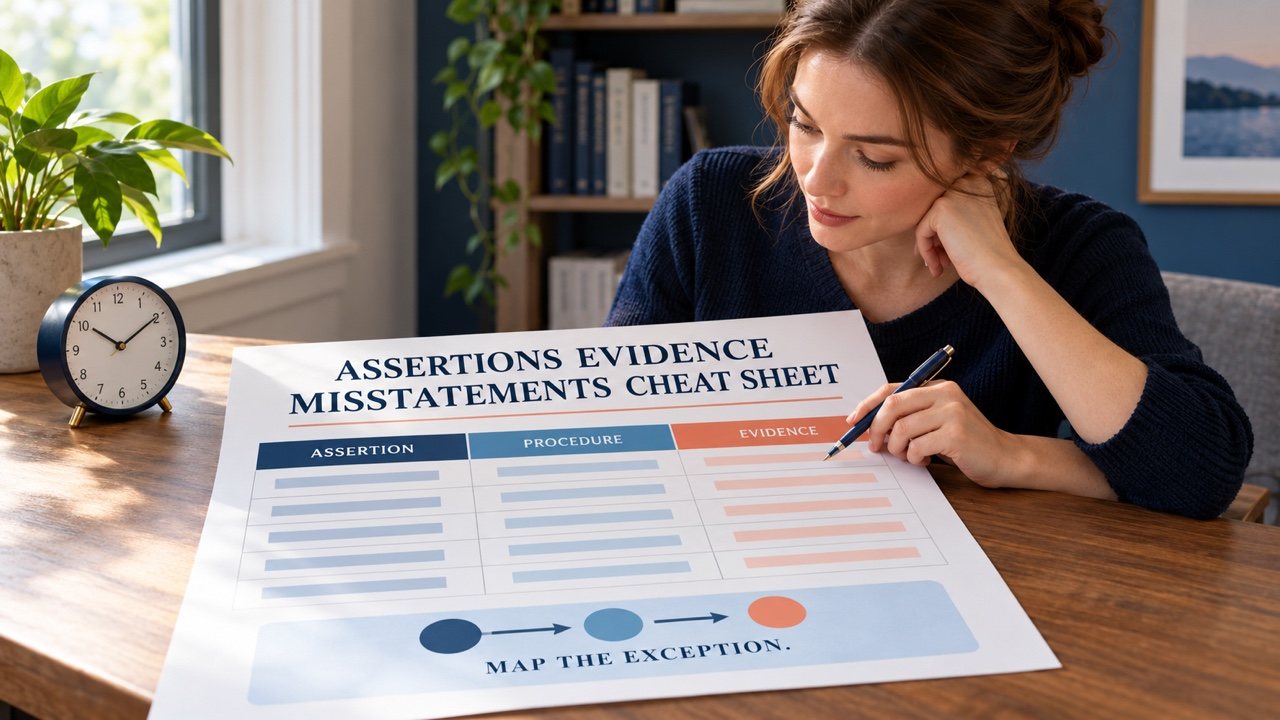

Direct answer: Use an evidence misstatements cheat sheet as a decision tool, not a list to memorize. Set one narrow audit fact pattern, name the assertion, select the procedure, evaluate the evidence, and explain whether the exception creates a misstatement. Then change one fact and record the next review action.
Scope and freshness note: This is original editorial study material, not an exam-authority publication. Reopen the AICPA CPA Exam Blueprints for the testing window, the AICPA AUD resources for current subject boundaries, and the NASBA FAQ for eligibility, scheduling, jurisdiction, or score questions.
Start with the AUD review hub for section orientation. Then use the CPA study guide for context, the Blueprint format guide for task boundaries, and the topic MCQ page or TBS practice guide when you need another retrieval mode.
Every card below is original practice. The scenarios are simplified study facts, not official, recalled, leaked, or exam-memory questions. Current authoritative sources control a live engagement conclusion.
For a broader preparation path, continue with our related CPA study resources.
evidence misstatements cheat sheet: map the decision
The tested skill is a chain. First, identify the assertion that the fact threatens. Next, choose a substantive procedure that can produce relevant evidence. Then judge the evidence quality and scope. Finally, state whether the exception is a misstatement, a control signal, or an unresolved limitation.
A familiar procedure is not enough. Confirmation, inspection, recalculation, observation, inquiry, and external evidence answer different questions. A good study note ties the procedure to the assertion and states what the evidence can and cannot prove.
Difficulty and timing assumptions
Start at moderate difficulty. Allow one minute to read the facts, one minute to choose the action, and one minute to explain the evidence boundary. If you can name a procedure but cannot name the assertion or the population, stop and label the missing proof point.
evidence misstatements cheat sheet: set the assumptions
Before the first card, save one current Blueprint row and write its decision verb. Identify whether the task asks you to identify, evaluate, calculate, or recommend. That verb changes the evidence you should record.
Next, use four lines for every card: assertion, procedure, evidence, and misstatement. Add the population or period when the fact pattern includes one. A changed shipping date, a revised estimate, or a new service period should change your conclusion only when it changes the controlling boundary.

What to write on the card
Write the task statement, controlling fact, assertion, selected procedure, expected evidence, exception, and next action. Also write the strongest distractor and why it fails. This makes the card useful after the timed attempt because it records reasoning rather than an answer letter.
Also, separate scope from responsibility. A learner can evaluate whether evidence supports an assertion, but the client or responsible preparer still owns the underlying representation and decision. Record that distinction when a prompt asks who should do what.
evidence misstatements cheat sheet: run original cards
Attempt each card before opening the rationale. First, underline the fact that changes the audit conclusion. Next, choose the evidence action. Therefore, a fast selection without a boundary sentence is incomplete.
Reveal the reasoning
Attempt the original card first. Write the controlling fact, assertion, procedure, and evidence check before opening the explanation.
Reveal the answer
Answer: Compare your note with the rationale, mark the first missing proof point, and change one fact before retrying. Do not use a raw answer letter as the study record.
Compare your process with the reasoning shown above.
Card 1: existence, occurrence, and cutoff
Fact pattern: Blue Mesa Retail lists 640 units in a December 31 finished-goods population. The receiving report shows 590 units received by year-end, while 50 arrived on January 3. The invoice date is December 30, so the familiar date could distract you from the population and cutoff evidence.
Question: What should the learner record before selecting a procedure?
- Use the invoice date as the conclusion because it is the earliest document.
- Ignore the receiving report because it changes the population.
- Name the population and cutoff assertion, reconcile the receiving evidence, and record whether the 50 units belong in the period.
- Choose a procedure at random and document the reason later.
Answer and rationale: Choice 3 is strongest. The receipt date changes the period boundary, so the learner must tie the population to cutoff evidence before concluding. The invoice-date shortcut confuses an invoice with transfer of control. That population shortcut removes the fact that controls the test. Finally, the undocumented approach hides the evidence gap.
Card 2: valuation and responsibility
Fact pattern: Harborview Clinics carries a $1.4 million allowance reserve. Management provides a probability schedule, and the audit team independently recalculates the math. The file does not identify the valuation assertion or who owns the estimate and conclusion.
Question: Which response protects the reasoning boundary?
- Accept the requested reserve because the recalculation agrees to the schedule.
- Clarify the valuation assertion, define the support and evidence limit, and keep estimate responsibility with management.
- Reject the estimate without considering the schedule or recalculation.
- Draft the conclusion first and add the assertion after review.
Answer and rationale: Choice 2 is strongest. Recalculation tests mathematical accuracy, but it does not by itself prove the assumptions or transfer responsibility. The recalculation shortcut overstates the procedure. An absolute rejection uses the wrong rule. Finally, the delayed assertion question misses the controlling boundary.
Card 3: completeness after a changed fact
Fact pattern: Redwood Components identifies an unrecorded $47,500 freight accrual. Change one fact: the carrier service relates to January rather than December. The original note says “completeness exception,” but it does not retest period or population.
Question: What is the best next study action?
- Repeat the same card until the answer feels familiar.
- Change the service period, state whether the conclusion changes, and explain the evidence that controls the revised result.
- Delete the card because the changed fact makes it harder.
- Add a longer mixed set before reviewing the first gap.
Answer and rationale: Choice 2 is strongest because transfer shows whether you understand the rule or only remember the label. The repetition shortcut rewards memorization. Deleting the card removes the learning signal. Finally, adding volume before repair preserves the first gap.
evidence misstatements cheat sheet: read the rationale
Read each explanation in the same order as the card. First, restate the controlling fact. Next, name the assertion and procedure. Then describe the evidence limitation or exception. Finally, state whether the changed fact alters the misstatement conclusion.
For assertions, procedures, evidence, substantive testing, and misstatements, the most common error is jumping from a familiar procedure to a conclusion. A confirmation may address existence or rights, but the population, timing, and response rate still matter. A recalculation may test arithmetic, but assumptions and source data may remain valuation issues.
When a distractor sounds familiar, write the missing sentence that would make it relevant. If no sentence can connect it to the task verb and evidence boundary, reject it. Save the exact source or exhibit you would reopen when the question depends on a current requirement.
evidence misstatements cheat sheet: choose one repair
Therefore, repair the earliest missing proof point. Reopen one source, write one sentence connecting the fact to the assertion, and retry one new card with a changed period, amount, population, or responsibility owner. If the retry works, test another assertion. If it fails, narrow the topic instead of adding more volume.

Use the second visual as a decision record: identify the changed fact, verify the evidence boundary, name the repair, and decide what to keep. The board is deliberately specific to misstatement review so you can return to the same error class without rebuilding the method.
evidence misstatements cheat sheet: repeat the method
Additionally, keep one evidence log for each session: Blueprint row, decision verb, controlling fact, assertion, procedure, evidence source, rejected distractor, changed-fact result, and next action. This turns a flashcard into a compact audit trail for your own reasoning.
Use different retrieval modes for different gaps. For assertion gaps, draw the fact-to-assertion link. When procedures are weak, compare evidence quality. Next, if changed facts cause errors, run a transfer card. For exhibit gaps, move to the TBS practice guide. For recall gaps, return to the topic MCQ page.
Finally, keep official scope separate from original practice. AICPA pages define the current testing boundary. The cards, rationales, visual boards, and repair actions here are independently written. Reopen current sources before reusing notes after a Blueprint or administration change.
evidence misstatements cheat sheet checklist
- Save one current Blueprint row and its checkpoint date.
- Write the task statement’s decision verb.
- State the population, period, and responsibility owner.
- Name the assertion before selecting a procedure.
- Write what the evidence would prove and what it would not prove.
- Record the exception or changed fact.
- Explain the strongest distractor in a complete sentence.
- Decide whether the fact creates a misstatement, limitation, or follow-up.
- Choose one bounded next review action.
Overall, a useful evidence misstatements cheat sheet creates observable reasoning. State the boundary, select the evidence, explain the exception, and show transfer before you add more cards.
evidence misstatements cheat sheet FAQ
Are these official exam flashcards?
No. The cards and rationales are original editorial practice. Use current AICPA sources for authoritative scope and terminology.
What should I record when I miss a card?
Record the controlling fact, assertion, evidence boundary, rejected distractor, and one changed-fact retry.
Should I add more cards immediately?
Only after the first missing proof point is repaired. Volume without a repair can preserve the same error.
Does this method promise a passing result?
No. It creates observable study evidence and a focused next action; actual results depend on current rules, preparation, and performance.
Sources
- AICPA CPA Exam Blueprints
- AICPA AUD resources
- NASBA CPA Exam FAQ
- AUD review hub