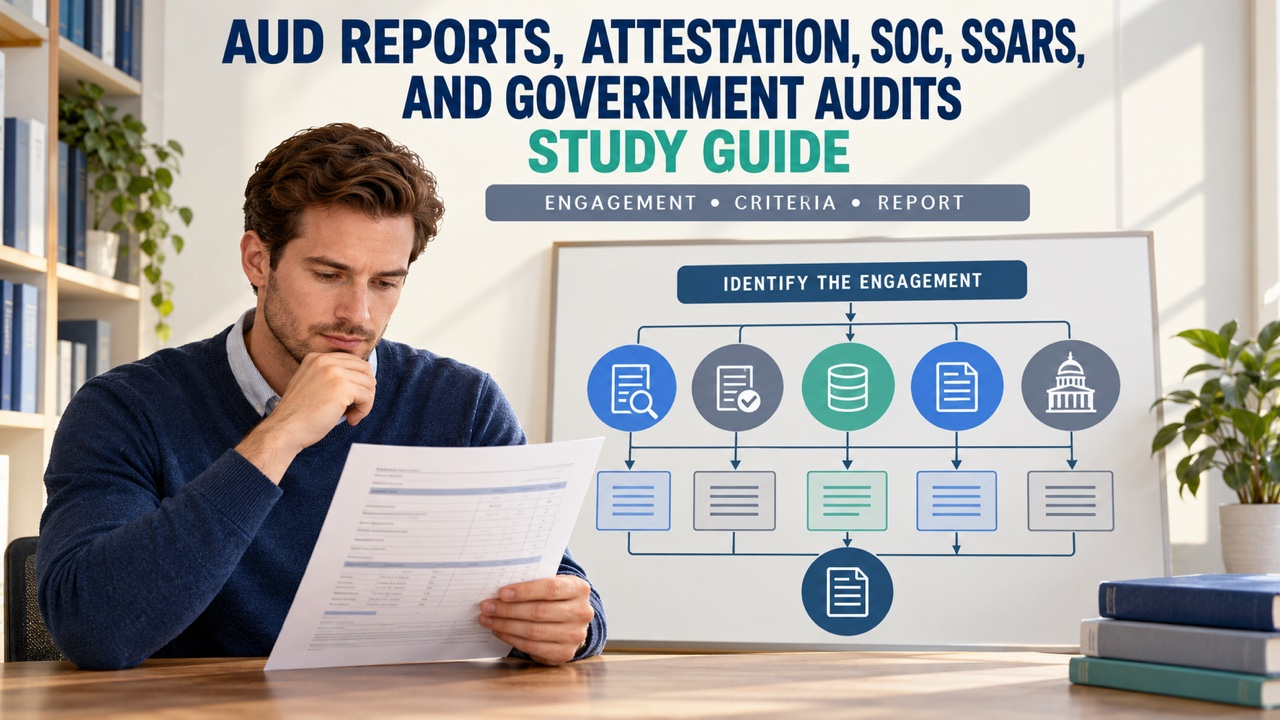

Direct answer: Use an aud audit reports attestation study guide as a decision route. Start with the task verb, identify the engagement and criteria, name the responsible party and intended users, mark the evidence or scope boundary, and then choose the report or communication that those facts support. After every original question, record the first missing proof point and retry after changing one fact. That sequence is more useful than memorizing a list of report names.
Scope and freshness note: This is independent study material for U.S. CPA candidates. The questions and explanations are original editorial practice, not official, recalled, leaked, or exam-memory questions. Reopen the AICPA CPA Exam Blueprints for the active testing window, the AICPA auditing and attestation resources for current subject boundaries, and the NASBA CPA Exam FAQ for administration questions.
For section orientation, use the AUD review hub. If your gap is broad, pair it with the CPA AUD review guide. Use the Blueprint format guide when a task statement is unclear, the topic MCQ guide when retrieval speed is the issue, and the TBS practice guide when exhibits or evidence mapping are the issue.
For a broader preparation path, continue with our related CPA study resources.
AUD audit reports attestation study guide: set the assumptions
In this cluster, the tested skill is classification under a changing fact pattern. A label such as SOC, review, preparation, or government audit points to a topic neighborhood; it does not by itself determine the service, criteria, responsibility, evidence, or report language. Before reading answer choices, copy the task verb and write the requested output. “Identify,” “evaluate,” “report,” and “recommend” require different reasoning routes.
To start, use moderate difficulty for the first round. Give yourself two minutes to sort the facts, four minutes to choose and explain an answer, three minutes to check the boundary, and three minutes to change one fact. The goal is a traceable explanation, not a score promise. If you cannot name the source checkpoint or the person responsible for the subject matter, mark the item open and route the next review to that missing line.

Five fields for audit reports attestation review
- Engagement: What work is being requested, and what work is actually described?
- Criteria: Which benchmark, assertion, description framework, or compliance requirement makes the subject matter testable?
- Responsible party: Who prepares, controls, or accepts responsibility for the underlying information?
- Proof and boundary: Which evidence supports the requested communication, and what limitation or restriction remains?
- Report voice: What conclusion or communication is consistent with the verified service and evidence?
For that reason, these fields are deliberately small. They make the study note reusable when a fact changes, and they stop a familiar acronym from doing the reasoning for you.
Map one case before choosing a report
Next, read a stem in three passes. On the first pass, circle the requested service and the intended users. On the second, underline the criterion, responsible party, and evidence boundary. Then ask what changed from the nearest familiar engagement. A strong answer connects a fact to a consequence; it does not merely repeat a definition.
For a SOC description, the key question may be which criteria support the description and who will rely on the communication. For SSARS work, separate preparation assistance from evaluation or review language. In a government audit, test whether a population, restriction, or compliance requirement is significant enough to change the conclusion or communication. The same five-field note can hold all three situations without pretending they are the same service.
Finally, save the nearest distractor in one sentence. That sentence belongs in the aud audit reports attestation study guide record because it preserves the reason an alternative failed. For example: “This option uses assurance wording, but the facts describe assistance without an evaluation.” That sentence records the broken link and gives you a better retry target than a red X.
Run the original study-guide review
All cases below are original editorial practice. Attempt each one before opening the rationale. Write the engagement, moving fact, evidence boundary, rejected distractor, and one changed-fact question. A choice letter alone is not a completed study record.
Reveal the reasoning
Attempt the original item first. Write the controlling fact, the boundary or evidence check, and the reason you would save before opening the explanation.
Reveal the answer
Answer: Compare your note with the rationale, mark the first missing proof point, and change one fact before retrying. Do not use a raw answer letter as the study record.
Compare your process with the reasoning shown above.
Case 1: Audit reports attestation scope at Riverbend Health
Situation: Riverbend Health asks for a communication about controls over a claims platform. The request says “SOC report,” but management has not identified the description criteria, the party responsible for the subject matter, or the intended users. The sales team wants a favorable report title immediately.
Question: What should the learner do first?
- Choose the most recognizable SOC label and fill in the criteria later.
- Assume that missing criteria automatically create a scope limitation.
- Define the requested service, criteria, responsible party, intended users, and evidence boundary before selecting report wording.
- Use the sales team’s preferred title because the customer used the word “SOC.”
Recommended route: Choice 3 is the defensible study answer. Without a criterion and responsibility frame, the learner cannot tell what is being evaluated or which communication the facts can support. The first distractor lets a label replace scope. Choice 2 jumps to a consequence before testing whether the missing facts can be obtained. The fourth distractor confuses a marketing request with an engagement definition.
Changed-fact retry: Suppose Riverbend supplies a recognized criterion and names intended users, but the description still omits a material control activity. Ask whether the omission changes the evaluation, the communication, or the need for additional evidence. The first broken line is now the completeness of the description, not the existence of a criterion.
Case 2: Audit reports attestation boundary at Oak Valley
Situation: Oak Valley asks for help assembling financial information. The owner supplies the records and makes the accounting decisions. After the file is assembled, the owner asks for a sentence saying that the statements are “reliable.” Nothing in the described work includes an evaluation against criteria.
Question: Which response protects the service boundary?
- Use the requested sentence because the owner supplied the underlying records.
- Refuse all assistance because any financial statement work is an assurance engagement.
- Separate preparation from evaluation, confirm the responsible party, and match the communication to the work actually performed.
- Deliver the file first and explain the boundary in a later email.
Recommended route: Choice 3 preserves the distinction the facts require. A requested adjective cannot create evaluation work that was never performed. The first distractor transfers a judgment to the preparer. Choice 2 overcorrects and ignores the described service. The fourth distractor delays the boundary until the reader may already infer assurance.
Changed-fact retry: If Oak Valley later asks for a review and provides a defined criterion, the engagement facts have changed. Reclassify the service, identify the new evidence expectations, and rewrite the report-voice note. Do not carry the preparation conclusion forward merely because the records are the same.
Case 3: Statewide Transit changes the population behind a compliance conclusion
Situation: Statewide Transit receives a grant and an audit team cannot obtain support for one compliance population. In version A, the population is peripheral to the conclusion. In version B, it drives the grant requirement and the report goes to both the grant agency and the transit board. The question asks what the changed fact does to the learner’s next step.
Question: What is the best study action?
- Repeat the version-A answer until the wording feels familiar.
- Record the changed population, test its significance and the intended users, and connect the limitation to the possible communication consequence.
- Discard version B because it is not the original fact pattern.
- Add ten more mixed items before examining the limitation.
Recommended route: Choice 2 tests transfer. A different population and different intended users can change significance and communication. The first distractor rewards memory without analysis. Choice 3 removes the exact fact that should drive learning. The fourth distractor adds volume while the first proof point remains unnamed.
Changed-fact retry: Make the population small again but keep the grant agency as an intended user. Write which facts still matter, which conclusion is unchanged, and which evidence would make the limitation material. The point is to show the boundary that controls the consequence, not to memorize a single modification phrase.
Read the rationale in a fixed order
Audit reports attestation checkpoint
Use the audit reports attestation route to connect the task verb, criteria, evidence boundary, and report consequence before you save the rationale.
After attempting a case, read the explanation from the top down. First ask whether the answer used the task verb. Next identify the fact that made the task answerable. Then connect that fact to criteria, responsibility, evidence, limitation, or intended users. Finish by stating the communication consequence. This four-step route keeps a long rationale tied to the question.
Meanwhile, common distractors in this topic cluster are predictable. A prestigious SOC label can hide an undefined criterion. Strong assurance wording can hide a preparation boundary. The word “compliance” can distract from the population or intended user that determines significance. When you reject an option, name the missing link rather than merely calling it wrong.
Therefore, keep a source line beside each rule-sensitive note. The aud audit reports attestation study guide should show the checkpoint date beside any rule-sensitive conclusion. Record the page title and the date you checked it, because the Blueprints and subject resources may change. The cases here teach a retrieval method; they do not freeze professional guidance for a live engagement or replace current authoritative material.
Choose the next study-guide review repair
Classify the first break as service, fact, rule, proof, or transfer. Service means the requested work was misread. Fact means a criterion, owner, intended user, or limitation was skipped. Rule means the boundary was known but applied incorrectly. Proof means the support did not reach the requested communication. Transfer means a changed version was never tested.
As a result, choose one bounded repair. Reopen one authoritative source, write two sentences in your own words without answer choices, and retry one new item with one changed detail. If the retry holds, keep the note and move to another signal. If it breaks, narrow the boundary before starting another mixed set.

The second visual models that repair: a changed fact enters, the affected boundary is named, the communication consequence is tested, and one next action is saved. Use it after a miss to decide which line of the study note needs another pass.
Make the review routine repeatable
For audit reports attestation review, keep the first broken line visible before you add another mixed set.
For the next session, keep one ledger row for every review round. Include the task statement, engagement, criteria, responsible party, intended users, evidence boundary, limitation, communication, rejected alternative, authority checked, and changed-fact result. Add the date of the source check and the sentence you rewrote. A dated ledger shows whether the gap is shrinking instead of merely producing a larger card count.
Then route the next session by signal. When service recognition caused the miss, revisit the AUD overview and restate the task verb. If evidence mapping caused it, switch to a TBS and trace the exhibit. If retrieval speed caused it, use a topic MCQ set. For a time-sensitive boundary, pause practice and reopen current authority. The next resource should answer the first broken line, not the loudest keyword.
Ten-minute audit reports attestation checklist
- Copy the active Blueprint task statement and checkpoint date.
- Name the requested engagement before reading answer choices.
- Write the criteria, responsible party, intended users, and evidence boundary.
- Mark any compliance requirement, access restriction, or reporting limitation.
- Attempt the original case and record the moving fact.
- Explain why the nearest alternative misses the task.
- Reopen current AICPA or NASBA material when the rule is time-sensitive.
- Change one fact and test the communication consequence.
- Classify the first broken line as service, fact, rule, proof, or transfer.
- Choose one next resource and one retry before adding volume.
Overall, a strong aud audit reports attestation study guide uses the audit reports attestation route therefore creates a traceable route: classify the service, frame the criteria, protect responsibility, test proof, and show what changes when a fact moves. That record is the study asset.
AUD reports, attestation, SOC, SSARS, and government audits study guide FAQ
Are these official exam questions?
No. The cases and explanations are original editorial practice. Use current AICPA material for authoritative scope and terminology.
What belongs in the study record when I miss an item?
Record the controlling fact, service boundary, responsible party, evidence or limitation, rejected distractor, source checked, and one changed-fact result.
When should I add more questions?
After the first broken line has a repair and a successful retry. More volume before that can repeat the same blind spot.
Does this routine promise a passing score?
No. It produces evidence about your reasoning and a next action. Current requirements, preparation, and performance determine the actual result.