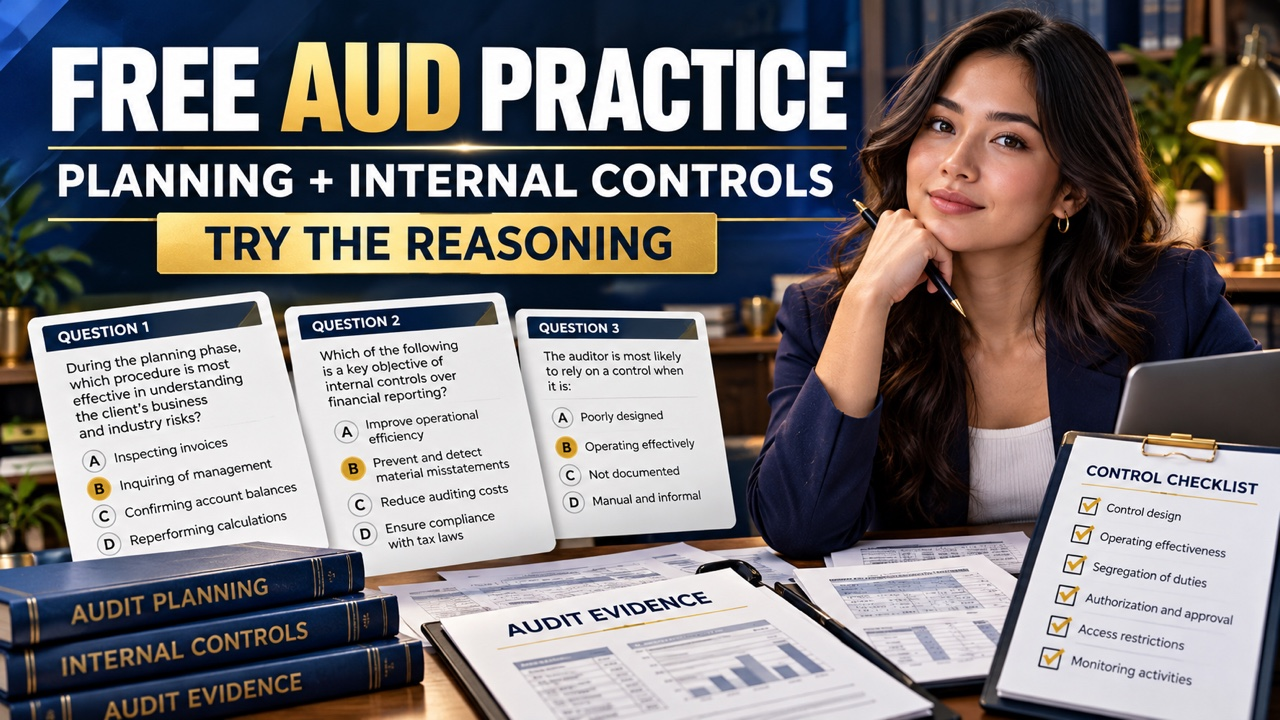

Direct answer: The most useful internal control practice questions make you name the decision, controlling fact, responsibility boundary, evidence record, and next action before you look at the rationale. Use the three original AUD cases below to separate design, implementation, operating effectiveness, integrated-audit responsibility, and IT dependency. Then change one fact and record what should change in your response.
Scope and freshness note: This is original editorial practice material, not an exam-authority publication. Reopen the AICPA CPA Exam Blueprints for the current tested window, the AICPA AUD resources for subject orientation, and the NASBA CPA Exam FAQ for eligibility, scheduling, jurisdiction, or score questions. Simplified facts below support study retrieval; they do not settle a live engagement conclusion.
For orientation, start with the AUD review hub. Use the CPA study guide for context, the Blueprint format guide for task boundaries, the topic MCQ page for recognition practice, and the TBS practice guide when the missing skill is an exhibit or evidence trail.
AUD internal control practice questions: build the evidence habit
The tested skill is not memorizing the word “control.” It is connecting a prompt’s decision verb to the fact that controls the answer and the record that would test that fact. An identify question may need a controlling fact. An evaluate question may need a design or operating boundary. A recommend question may need a procedure, owner, and purpose. A familiar policy label cannot answer a different verb.
These internal control practice questions use one consistent ledger: decision, fact, boundary, proof, owner, response. Write those six fields before reading a rationale. If one field is blank, the blank is the repair target. If the answer changes after one material fact changes, your original response depended on an unstated assumption.
Internal control practice questions: difficulty, timing, and what to record
Begin at moderate difficulty. Give yourself a reading window to mark the verb and controlling fact, a decision window to choose the response and evidence, and a review window to challenge the closest distractor. Record the period, population, owner, assertion, or change date whenever it controls the conclusion. Therefore, a raw answer letter is not a useful study record because it cannot tell you what to reopen.
Each item below is original practice written for this lesson. In particular, the facts are deliberately bounded so you can transfer the method to a new case. They are original study examples, not released or authority-issued questions.
Set the practice assumptions
Choose one narrow process, one risk, and one evidence boundary before starting. For an automated approval, the boundary may be the effective date and affected population. For a service organization, it may be the report period and the complementary user-entity control. With an IT access exception, it may be the role owner, review period, and follow-up record.
Then, decide what would change your answer. Meanwhile, a changed owner, date, population, exception route, or operating record should produce a visible response change. If no fact can change the response, the item is too broad for a useful repair. Keep one current Blueprint checkpoint beside the attempt and reopen it before reusing a time-sensitive note.

Internal control practice questions: choose the decision verb first
Circle identify, evaluate, determine, recommend, or explain. Then write the sentence the question is asking you to complete. This prevents a process description from replacing a conclusion or a control label from replacing evidence. When the prompt asks for an audit response, name whether the issue is design, implementation, operation, integrated responsibility, or IT dependency before selecting a procedure.
Internal control practice questions: separate design, implementation, and operation
Design asks whether the control could address the risk. Implementation asks whether the designed control was put into use. Operating effectiveness asks whether it worked during the relevant period. However, an unchanged policy can coexist with an automated rule change, an unassigned exception route, or a missing review record. Keep those layers in separate fields so one true statement does not overclaim.
Record the evidence owner
Write who performed, reviewed, approved, or maintained the evidence. A service report can describe a provider’s controls without transferring management’s responsibility for a complementary review. An access list can show a population without showing who approved the role. A change ticket can establish implementation without proving operation. In addition, the owner field keeps those boundaries visible.
Run three internal control practice questions
Use a two-pass method. On pass one, write the requested output and your selected record without checking the explanation. On pass two, mark the fact that made your choice possible and the detail that would reverse it. Instead, the point is a traceable decision, not a fast answer.
Reveal the evidence reasoning
Attempt the three original cases first. Write the decision, controlling fact, boundary, owner, and evidence record before opening the rationale.
Reveal the answer
Answer: Compare your note with the rationale, name the closest distractor, and change one fact before retrying. Keep the evidence record in words instead of an answer letter.
Compare your process with the reasoning shown above.
Question 1: Harborcrest changes a rebate approval rule
Facts: Harborcrest Retail changes a year-end rebate rule from a manager sign-off to an automated threshold on September 15. The policy manual still shows the old sign-off. For example, the change ticket names the developer but omits the release test, affected transactions, and the route for overrides.
Question: Which evidence set should anchor the next response?
- The policy page, because it is the only approved description.
- The last month of transactions, because it is nearest the reporting date.
- The developer’s statement that the threshold is reasonable.
- The release date, impacted population, test result, override owner, and transaction evidence spanning the change.
Correct path: Select choice 4. It connects implementation to operation and sets the period split. The policy page describes intended design, a late-month sample can miss pre-release items, and a developer statement does not demonstrate the control operated.
Question 2: BluePine relies on a payroll provider report
Facts: BluePine Logistics receives a payroll provider report covering access controls. During the same quarter, BluePine replaces the employee who reviews the provider’s exception file. The working papers do not identify the report coverage dates, the user-entity review step, or the new reviewer’s follow-up.
Question: What should the learner preserve before relying on the report?
- Map the report period and scope, name BluePine’s complementary control owner, and inspect the changed follow-up record.
- Reject the report because a provider cannot support a user-entity conclusion.
- Assume the old reviewer’s sign-off covers the replacement.
- Write the conclusion first and document the responsibility split later.
Correct path: Choice 1 keeps the provider evidence and BluePine’s responsibility in separate lanes. A report can inform the work without replacing the complementary control. The other answers either use an absolute rule, carry forward an unverified owner, or postpone the key boundary.
Question 3: Lakeview finds a privileged-access exception
Facts: Lakeview Arts finds a privileged role that remained active after a transfer. The note says only “access issue.” It does not tell you whether the role design was wrong, the transfer was not implemented, or the periodic review failed. As a result, the role owner and review population are also missing.
Question: Which follow-up produces the most useful study evidence?
- Repeat the item until the answer letter is familiar.
- Delete the case because the note is incomplete.
- Change one field, such as the transfer date or owner, predict the response, and name the record that would test it.
- Add ten more mixed questions before touching the note.
Correct path: Choice 3 tests whether the reasoning transfers. A single changed field exposes the missing boundary, while the other actions add recall or volume without identifying the proof.
Read the practice rationale through the proof gap
After each attempt, ask two questions: “What would I inspect?” and “What fact would change the conclusion?” A plausible distractor often supplies a true label while omitting a period, population, owner, or operating record. Write that omission in the margin before you review the explanation.
Design language versus operating evidence
For instance, a manual can describe a well-designed approval without showing that the September rule reached production. Separate the intended control, the release evidence, and the transaction sample. If the answer never names the population or effective date, it cannot support a period-specific response.
Provider evidence versus complementary responsibility
A service report may cover a provider’s controls, yet BluePine still owns its complementary review. Check the report’s coverage, the user-entity procedure, and the exception follow-up. This keeps “a report exists” from becoming “the client’s control operated.”
IT exception versus a vague label
“Access issue” is a starting signal, not a diagnosis. Ask who owned the role, which users were affected, when the transfer occurred, and where the review was recorded. Depending on the missing fact, the next drill may focus on design, implementation, or operation.
Choose the next practice repair
Label the first blank field before you choose more work. Use scope when the task or period is unclear, fact when the prompt hides the decision-changing detail, evidence when you cannot name a record, responsibility when the owner is blurred, and transfer when the method works only for one wording.

Internal control practice questions: repair scope with one sentence
Rewrite the prompt as “I must determine ___ for ___ population during ___ period.” Then return to the current Blueprint checkpoint and confirm that the task belongs in the selected AUD topic. Keep the next attempt inside that boundary.
Repair evidence with one record
Choose the record that could settle the question: a release test, approval log, access review, exception file, or provider report. Add its owner and coverage dates. “Test the control” is too broad to guide a useful retry.
Repair transfer with one changed field
Hold the case steady and move exactly one fact: the release date, role owner, population, or follow-up record. Predict the new response before checking the answer. If the response changes, keep the changed field in the error log; if it does not, explain why the evidence still controls.
Make the practice repeatable
End each session with a seven-line note: task verb, decision, controlling fact, boundary, record, owner, and changed-fact result. Add one sentence about the distractor you rejected. This note becomes a small evidence trail that shows whether the gap was recognition, application, evidence selection, responsibility, or transfer.
Use the topic MCQ page when the verb or concept is slow to recognize. Use the TBS practice guide when you need to select or interpret an exhibit. Revisit the AUD review hub when the topic boundary itself is uncertain. Therefore, the next mode should follow the missing field.
Internal control practice questions: write a testable response
Use this frame: “The decision turns on ___; I would inspect ___ for ___ period and ___ population, owned by ___.” The sentence forces a record, scope, and responsibility into the answer. If you cannot complete it, repair scope or evidence before adding speed.
internal control practice questions checklist
- Underline the decision verb and state the requested output.
- Limit the case to one process, risk, control, or IT dependency.
- Write the field that changes the answer: date, population, owner, assertion, or record.
- Name the evidence and its coverage before choosing a procedure.
- Attempt one original item without opening its rationale.
- Explain the nearest distractor by naming its missing field.
- Change exactly one fact and predict whether the response moves.
- Choose MCQ, TBS, or source review from the error category.
- Reopen current official material before reusing a time-sensitive boundary.
Finally, a complete attempt leaves a visible trail from question to evidence to next action. That trail is more useful than a total that cannot explain the miss.
internal control practice questions FAQ
Are these official exam questions?
No. The cases and explanations are original editorial practice. The AICPA resources define scope; they do not turn these examples into released or authority-issued questions.
What belongs in my error note?
Keep the decision verb, the fact you missed, the record that could verify it, the nearest distractor, and one changed-fact retry. Add the owner and period when they affect the response.
When should I switch to TBS practice?
Switch when you can name the decision but cannot select or interpret the supporting exhibit. Carry the same error note into the TBS attempt so the new format tests the repaired skill.
Should I add more timed questions?
Add volume after a bounded retry shows that the missing field is repaired. Otherwise, more items can rehearse the same shortcut.
Does this method promise a passing result?
No. It creates a concrete study record and a next action. Official rules, preparation, and performance determine the result.