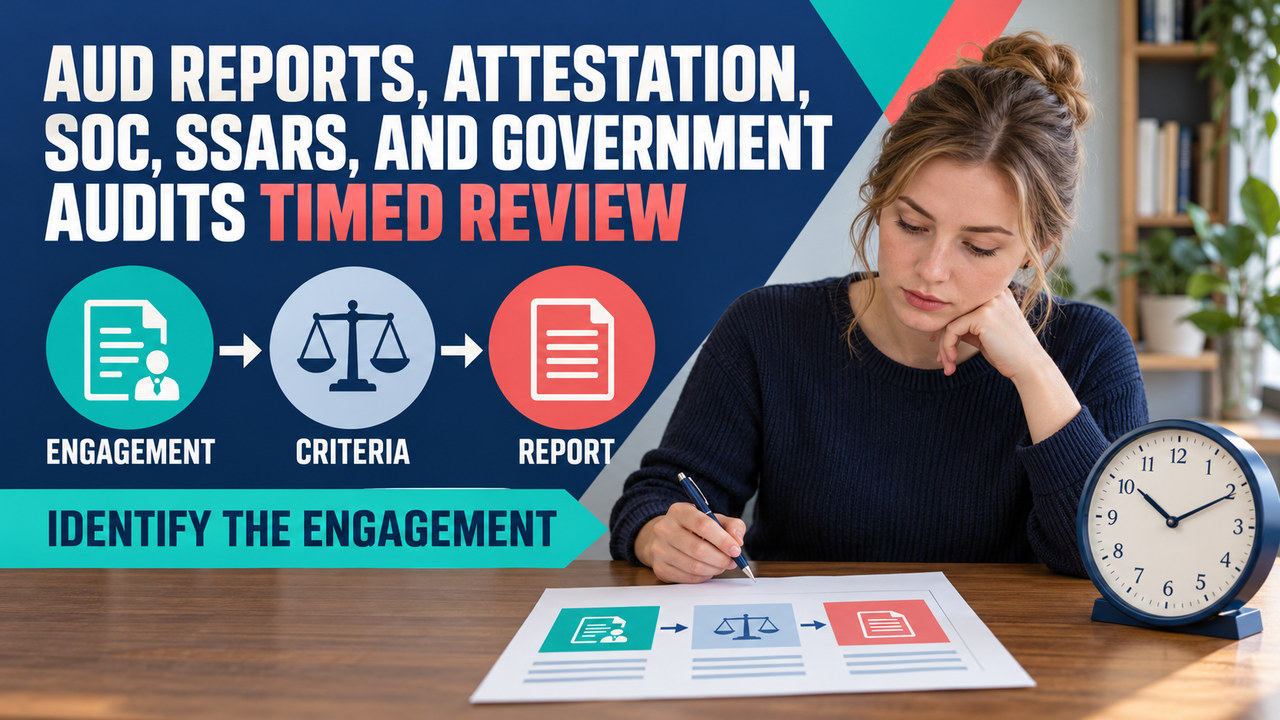

Direct answer: For an reports attestation soc practice mock exam, classify the engagement before you classify the report. Write down the responsible party, the criteria, the evidence or assurance level, the scope boundary, and the requested output. Then answer three original cases and log the first fact that made your reasoning stall. That fact chooses the next review block.
Scope and freshness note: This is independent study material for U.S. CPA candidates. It is not an AICPA, NASBA, or test-publisher question bank. Reopen the AICPA CPA Exam Blueprints for the current AUD task statements, the AICPA auditing and attestation resources for the subject boundary, and the NASBA CPA Exam FAQ for jurisdiction, scheduling, eligibility, or score administration.
Use the AUD review hub to orient the section. The AUD study guide supplies broader context, the Blueprint format guide explains task boundaries, and the topic MCQ page or TBS practice guide can change the retrieval mode after you repair the first gap.
For a broader preparation path, continue with our related CPA study resources.
AUD Report Classification Mock Exam: Separate the output from the engagement
First, a report label is the last step in the reasoning chain. Start with what the practitioner was engaged to do, who owns the underlying information, which criteria define success, and who will rely on the communication. A SOC description, a preparation engagement, an attestation examination, a review, and a government audit can share vocabulary while requiring different evidence and wording.
Meanwhile, the study facts in this mock exam are deliberately bounded. Do not treat a simplified case as live professional advice. The goal is to practice a repeatable decision: identify the task verb, mark the controlling fact, verify the boundary, select the response, and explain why the nearest distractor fails.
reports attestation soc practice: assumptions
Before the timer starts, open one page for an evidence note. Give it five headings: engagement, criteria, responsibility, evidence, and report. Add a sixth heading, limitation, when the case contains a scope restriction, intended-user issue, or government compliance requirement.
Then, use a 12-minute cycle for each case: three minutes to read, four to decide, and five to explain. The clock is a boundary, not a race. If you cannot name the fact that would change the answer, write “unknown” and continue. A clean unknown is more useful than a confident label borrowed from another engagement.
Keep the following distinctions visible:
- Engagement: What service or examination is actually being requested?
- Criteria: What benchmark, assertion, compliance rule, or description framework gives the work meaning?
- Responsibility: Which party prepares the subject matter, and which party evaluates it?
- Evidence: What procedures or support can justify the requested level of communication?
- Report: What conclusion, description, or restricted-use wording follows from those facts?

The first visual is a timed route for those five headings. It is a decision aid, not a scorecard. Keep the article’s topic labels beside the case sheet so you can see whether the problem is classification, evidence, or report wording.
Run the reports attestation soc practice test
Next, attempt each case without looking at the explanation. For every answer, save one sentence beginning “The controlling fact is…” and one sentence beginning “The tempting distractor fails because…”. Do not record only A, B, C, or D; an answer letter cannot tell you which boundary you misunderstood.
Reveal the reasoning
Attempt the original item first. Write the controlling fact, the boundary or evidence check, and the reason you would save before opening the explanation.
Reveal the answer
Answer: Compare your note with the rationale, mark the first missing proof point, and change one fact before retrying. Do not use a raw answer letter as the study record.
Compare your process with the reasoning shown above.
Case 1: Riverbend Health and an unnamed control criterion
Fact pattern: Riverbend Health asks for a communication about controls over patient-billing data. Management supplies a polished description of its process but cannot identify the criteria used to evaluate whether the controls are suitably designed. The request also does not specify intended users.
Question: What should the learner resolve first?
- Choose a familiar SOC label because the request mentions controls.
- Draft a favorable conclusion and ask for criteria after delivery.
- Clarify the criteria, responsible party, intended users, and engagement requested before selecting a report.
- Assume the absence of a criteria document automatically proves a scope limitation.
Answer and rationale: Choice 3 is the strongest response. Without criteria and responsibility facts, the learner cannot determine what service was requested or what conclusion could be supported. The shortcut in choice 1 lets a label substitute for scope. The option in choice 2 reverses the evidence sequence. By contrast, choice 4 jumps to a conclusion instead of clarifying the missing boundary. Evidence note: record the criteria source and the intended-user question you would verify.
Case 2: Oak Valley wants preparation work with assurance wording
Fact pattern: Oak Valley’s owner wants help assembling financial information and asks the practitioner to state that the statements are “reliable.” The owner remains responsible for the underlying records and decisions, but the draft request treats assistance as if it were an evaluation.
Question: Which response preserves the professional boundary?
- Use assurance language because the owner requested it.
- Refuse to discuss the engagement without checking what support is permitted.
- Separate preparation assistance from evaluation, confirm the responsible party, and use communication wording that matches the actual service.
- Complete the work first and document the distinction in a later memo.
Answer and rationale: Choice 3 protects the reasoning boundary. The practitioner can help with a permitted service, but the owner cannot outsource responsibility simply by requesting a stronger-sounding sentence. One shortcut transfers judgment. Another option uses an absolute refusal. By contrast, choice 4 delays the control point until after the wording has already shaped user expectations. Evidence note: write the exact fact that separates support from assurance.
Case 3: Statewide Transit changes one limitation
Fact pattern: Statewide Transit is subject to a grant requirement and a scope restriction prevents the team from obtaining evidence for one population. In the first version, the restriction is minor. In a changed-fact version, the missing population becomes central to the compliance conclusion and the intended users are the grant agency and the legislature.
Question: What is the best transfer action?
- Repeat the first answer until it feels automatic.
- Change one fact, state whether the conclusion or report wording changes, and cite the boundary that caused the change.
- Delete the second version because it is no longer comparable.
- Add a longer mixed set before reviewing the changed fact.
Answer and rationale: Choice 2 tests transfer. A changed population or intended-user fact can alter the significance of a limitation and the report consequence. The memory-first response rewards familiarity. Deleting the second version would remove the learning signal. Adding volume would leave the first gap untouched. Evidence note: name the changed fact and the report decision it controls.
Read the reports attestation soc practice rationale and reject the nearest distractor
After each attempt, compare your evidence note with the explanation in this order: first the task verb, then the controlling fact, then the boundary or criteria, and finally the requested report output. If your answer and the rationale differ, circle the first step where your chain diverged. That circled step is the repair target.
However, common distractors in this cluster sound professionally familiar. “SOC” can be attractive when the stem never establishes the description, criteria, or intended users. “Review” can sound plausible when the actual request is a preparation service. “Government audit” can feel decisive even when the question turns on a particular compliance requirement or a scope restriction. Familiar vocabulary is a cue to inspect the facts, not permission to skip them.
In addition, when a current source matters, record its title and checkpoint date. The Blueprints and AICPA subject resources can change; this editorial page cannot freeze a live standard. A source check belongs in the explanation, not hidden in a later study session.
Choose the next reports attestation soc practice repair
Sort the first miss into one of five labels: reading, fact, rule, calculation, or transfer. “Reading” means the task verb was missed. “Fact” means the engagement, criteria, responsibility, or limitation was overlooked. “Rule” means the boundary was known but applied incorrectly. “Calculation” means an amount or comparison drove the answer. “Transfer” means one changed fact was not tested.
Accordingly, the repair should be smaller than the original session. Reopen one authoritative source, write one sentence in your own words, and retry one new case with one changed detail. If the retry works, keep the note and move to a different signal. If it fails, narrow the engagement boundary before adding more questions.

The second visual makes this sequence visible: locate the first loss, attach one repair, and follow the resulting report path. Use it as a post-attempt record rather than as decoration.
Build a repeatable reports attestation soc practice log
Additionally, save one row for each case with these fields: Blueprint task statement, engagement, criteria, responsible party, evidence level, intended users, limitation, report output, rejected distractor, source checked, and changed-fact result. Add the date of the source check. This log lets you compare two different cases without confusing a familiar phrase with a transferable rule.
Use the site routes deliberately. Choose the TBS practice guide when exhibits or evidence mapping caused the miss. Choose the topic MCQ page when retrieval speed is the issue. Return to the AUD review hub only after the note identifies what needs rebuilding.
REPORTS ATTESTATION SOC practice checklist
- Save the current Blueprint row and the checkpoint date.
- Write the task verb before reading the answer options.
- Name the engagement, criteria, responsibility, and intended users.
- Mark any scope restriction or government compliance requirement.
- Attempt the original case and write the controlling fact.
- Reject the nearest distractor in a complete sentence.
- Check current AICPA or NASBA material when the boundary is time-sensitive.
- Change one fact and explain whether the report consequence changes.
- Use the first missing proof point to choose one next review action.
Overall, a useful reports attestation soc practice routine leaves an evidence trail. Classify the engagement, verify the criteria, protect responsibility, assess the limitation, select the report wording, and preserve the reason for the decision.
reports attestation soc practice FAQ
Are these official CPA exam questions?
No. The cases and explanations are original editorial practice. Use current AICPA materials for authoritative scope and terminology.
What should I save after a missed item?
Save the task verb, controlling fact, criteria or limitation, rejected distractor, source checked, and one changed-fact retry.
Should I add more timed cases immediately?
Repair the earliest missing proof point first. More volume can preserve the same misunderstanding when the boundary remains unnamed.
Does this mock exam promise a passing result?
No. It creates a visible reasoning record and a focused next action; actual performance depends on preparation and current exam requirements.