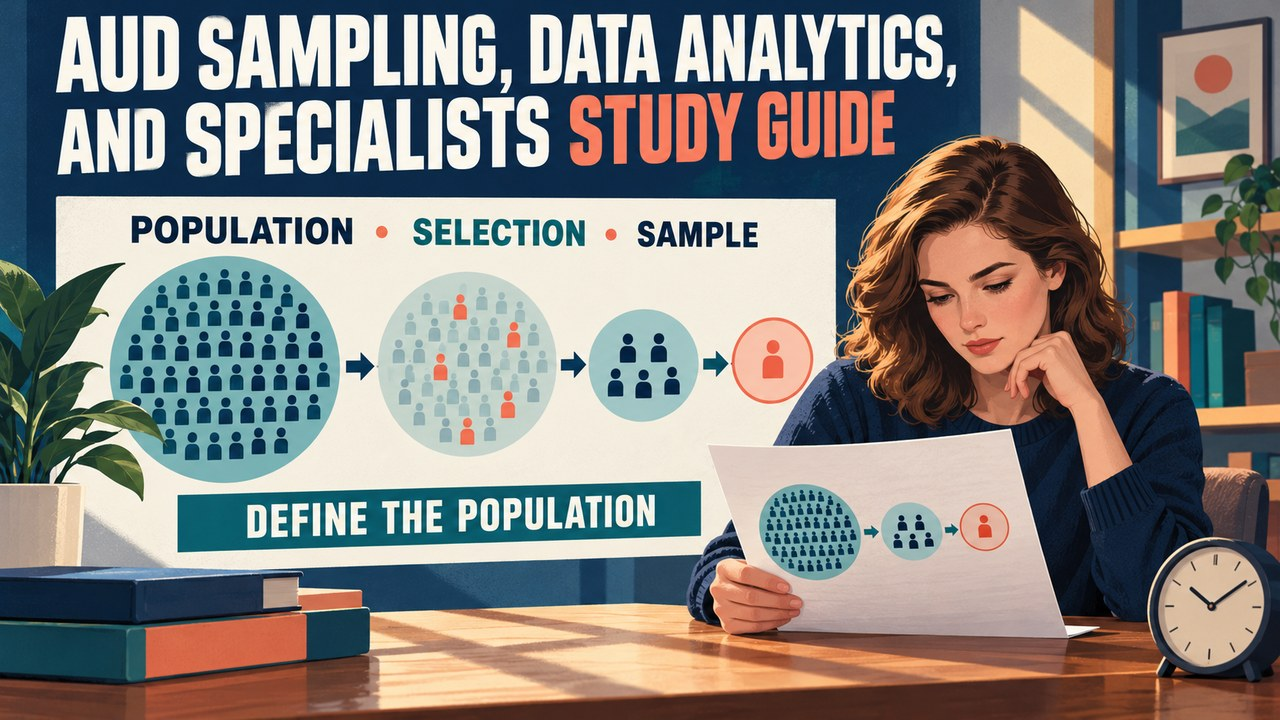

Start here: An AUD sampling data review becomes useful when you freeze the question before you chase the number. Mark the population, describe how a record reached your attention, test the limitation, and write the next document you would obtain. Then alter one fact and see if the decision survives. This page is original U.S. CPA practice material; it does not predict a score or stand in for professional guidance.
Authority check: Treat the AICPA CPA Exam Blueprints as the place to confirm the active testing window, task statements, and item boundaries. Reopen the AICPA AUD resources for subject context. Use the NASBA CPA Exam FAQ for jurisdiction, eligibility, scheduling, and score administration. The examples and study prompts below are independently written.
For section orientation, visit the AUD review hub. If you need a broader map, use the AUD review guide. The Blueprint format explainer, topic question library, and TBS practice guide each support a different next move.
For a broader preparation path, continue with our related CPA study resources.
AUD sampling data: the five-checkpoint map
When an AUD prompt mentions sampling, an analytic result, or a specialist, do not let the most technical-looking noun decide the response. Run five checkpoints in order: claim, frame, signal, limit, and owner. First, the claim says what conclusion is being considered. Next, the frame says which records and period could answer it. Meanwhile, the signal says why one row or pattern came to your attention. However, the limit says what the evidence still cannot establish. Finally, the owner says who must resolve the open question.
Together, this sequence is deliberately small. It works for an MCQ, a simulation exhibit, or a short review session because every checkpoint produces a sentence you can inspect. It also exposes a common error: treating an analytic signal as if it were a complete population test, or treating a specialist’s technical calculation as if it transferred the engagement team’s responsibility.
Use a 90-second trace card
Write the claim in five words, the frame in one line, and the signal in one phrase. Spend the remaining time naming the limit and the owner. If you cannot name the limit, write “open” rather than filling the space with a guess. The record you would save may be a timestamped export, a source ledger, an approval trail, or a specialist report with its scope page.
Set a checkpoint date beside the relevant Blueprint row. A live engagement may require additional procedures and documentation; the exercise here is to make your reasoning visible before you add speed.
AUD sampling data: lock the population and frame
First, a sample cannot answer a population question that was never defined. Ask which records belong, which period is under review, where the cutoff falls, and which later events could change the frame. A dashboard total can reconcile to an export while both views omit a late batch. The agreement is real, but its meaning is narrower than the distractor suggests.
Use the following trace fields:
- Claim: state the assertion or decision the evidence is meant to support.
- Frame: identify the source, period, cutoff, inclusions, and exclusions.
- Signal: describe the selection rule, analytic flag, or specialist output that drew attention.
- Limit: name the missing completeness, occurrence, scope, or corroboration fact.
- Owner: state who evaluates the remaining evidence and what will be retained.

Separate a selection from a signal
In practice, a designed sample and an exception screen serve different purposes. The first can support representation under its stated design. The second helps prioritize inspection. A repeated invoice number, unusual ratio, or outlier score is a lead. It becomes an exception only after a source record and the applicable assertion are examined. Your AUD sampling data note should preserve that distinction in plain language.
Similarly, specialist work has a similar boundary. Read the person’s competence, methods, assumptions, and scope. Then ask which population or assertion is outside that work. Technical support may strengthen an estimate while leaving completeness of the underlying register unresolved. As a result, keep the support and the unresolved question on the same trace card.
Try three original AUD data cases
Before you look at the options, cover the “Why” line. For each case, write claim, frame, signal, limit, and owner. These are original U.S. CPA study prompts, not official, recalled, leaked, or memory-based exam questions.
Reveal the reasoning
Attempt the original item first. Write the controlling fact, the boundary or evidence check, and the reason you would save before opening the explanation.
Reveal the answer
Answer: Compare your note with the rationale, mark the first missing proof point, and change one fact before retrying. Do not use a raw answer letter as the study record.
Compare your process with the reasoning shown above.
Case A: SummitCare and a moving claims frame
Facts: SummitCare freezes its outpatient-claims file at 8:00 a.m. on April 2. The dashboard agrees with the export. During the afternoon, a reversal batch for March services is posted. The proposed sample came from the morning file.
Prompt: What must the learner settle before treating the sample as evidence about March?
- Use the sample because two views agree.
- Ignore the reversal because selected claims appear ordinary.
- Reconstruct the period frame through the stated cutoff, include the late batch, and reassess whether the selection represents the claim.
- Stop all sampling whenever a system has a daily freeze.
Best response: Choice 3. The frame is the controlling fact. View agreement proves a shared morning total; it does not prove that later postings belong in the original population. The retained record should show the freeze time, reversal register, revised frame, and approving reviewer.
Case B: Luma Parts and a duplicate cue
Facts: Luma Parts runs a rule on vendor, invoice number, and amount. Fourteen pairs are flagged. The extract has no shipment identifier or approval reference, and two vendors reuse invoice numbers.
Prompt: What should the learner do with the analytic output?
- Label every pair a duplicate payment.
- Discard the procedure because software cannot create evidence.
- Trace each pair to shipment, approval, and payment records, then classify the match using the source facts.
- Increase the random sample before examining any flagged pair.
Best response: Choice 3. The rule is a prioritization device. A source document supplies the meaning that the extract lacks. Keep one resolved pair and write the fact that moved it from a lead to a valid repeat or an exception.
Case C: Great Basin Energy and a specialist estimate
Facts: Great Basin Energy receives a valuation specialist’s estimate for an asset-retirement obligation. The report describes the discount rate and sensitivity range. Its procedures do not test whether the asset register is complete, yet management asks the team to use the midpoint.
Prompt: Which action keeps the support inside its proper boundary?
- Use the midpoint because a specialist prepared the model.
- Reject the report before reading its methods.
- Assess competence, scope, methods, and assumptions, then obtain evidence for the population and relevant assertion.
- Ask the specialist to approve the engagement conclusion.
Best response: Choice 3. The report can inform the estimate while the engagement team retains responsibility for the population and conclusion. Save the scope page, assumptions, asset register, and completeness procedure.
Audit the trap option
The wrong choices are useful because each one hides a boundary error. Although “the totals agree” sounds reassuring, it leaps from reconciliation to completeness. Likewise, “the rule flagged it” leaps from prioritization to a duplicate-payment conclusion. In the same way, “the specialist modeled it” leaps from technical work to ownership of the assertion. Therefore, write the leap in your own words, then name the evidence that would be needed to make it defensible.
Change one fact on purpose
For transfer, do not repeat an item unchanged. Add the reversal to the frame, add a shipment ID to the extract, or expand the specialist’s scope to the asset register. Predict the new response first. As a result, a changed answer shows which fact was controlling. If it does not change, explain the boundary that still governs it.
Choose one AUD sampling data repair
Classify the first gap as a frame gap, a source-fact gap, a rule gap, a corroboration gap, or a transfer gap. Select one repair that can be finished before the next mixed set. For a frame gap, start with a cutoff check. When the source fact is missing, trace one row. If the rule is unclear, rewrite the task verb and assertion. When corroboration is missing, obtain the report, approval, or register. Finally, a transfer gap needs one changed-fact retry.

Then, read the worked example from left to right: question, evidence, exception, specialist boundary, and next action. The visual is a study aid for a U.S. candidate who wants to see what remains unproven, rather than a decorative scorecard.
Keep the AUD sampling data log
End each session with one line for the Blueprint row, one for the decision verb, one for the frame, one for the signal, one for the limitation, one for the owner, one for the trap you rejected, and one for the changed-fact result. Also, add the source or exhibit checked and the minutes used. The log tells you whether the problem is scope, evidence, or transfer; a raw percentage usually cannot.
After practice, verify any current subject boundary against the live AICPA resources. The NASBA pages cover administration. The scenarios, trace card, visual boards, and repair prompts here are original editorial work.
AUD sampling data and specialists cheat sheet
- Write the claim before the options.
- Freeze the population, period, cutoff, inclusions, and exclusions.
- Label the selection or analytic procedure as a signal, not a conclusion.
- State the limitation that could change the response.
- Read a specialist report for competence, methods, assumptions, and scope.
- Name the person who owns the remaining evaluation.
- Save one confirming record.
- Change one fact and predict the result.
- Classify the first gap and complete one bounded repair.
A practical AUD sampling data routine moves from claim to frame, from signal to limit, and from limit to a record. That chain is the cheat sheet.
AUD sampling data FAQ
Are these official exam questions?
No. The cases and explanations are original practice. Use current AICPA material for authoritative scope and terminology.
What belongs on the trace card?
Write the claim, frame, signal, limitation, owner, retained record, rejected leap, and changed-fact result.
Should I add volume when a case feels hard?
Repair the first missing proof point before adding another mixed set. More items can repeat the same boundary error.
Does this method predict a passing score?
No. It creates a visible study trail and a focused next action; performance depends on current rules, preparation, and execution.