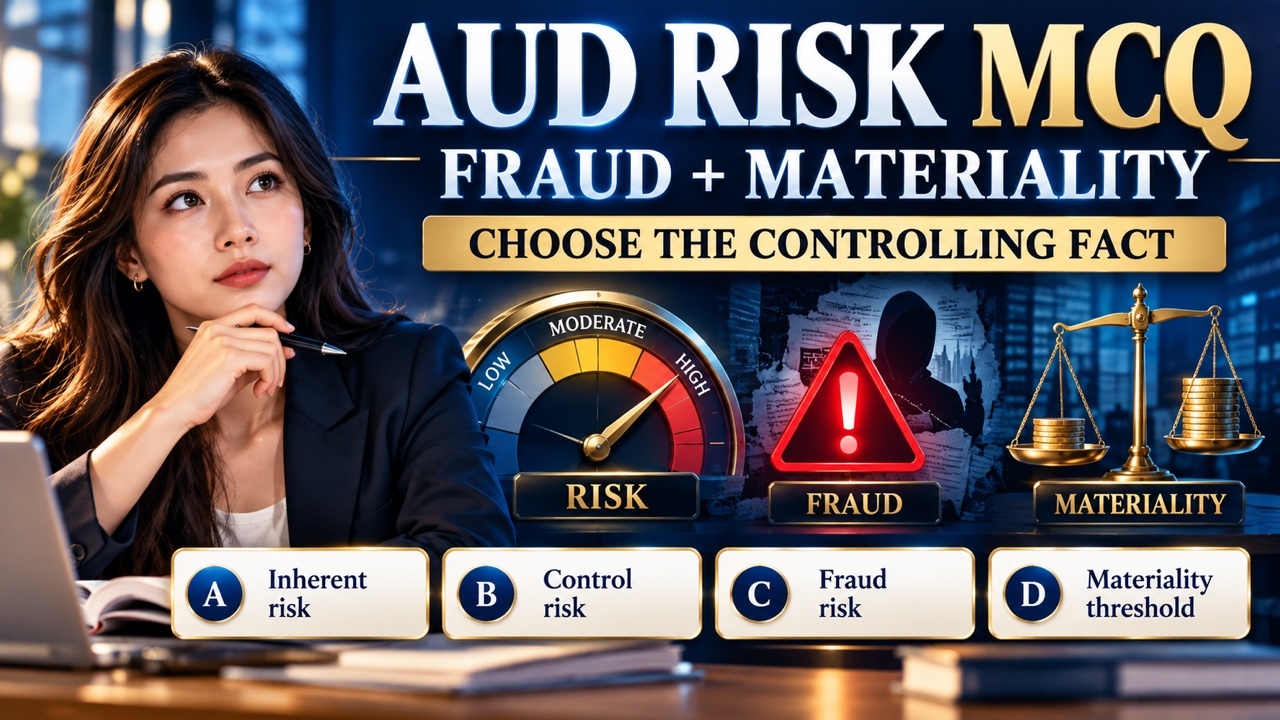

Direct answer: The best audit risk fraud mcq practice starts by naming the signal, assertion, materiality context, and evidence before choosing a response. Work each original case below in two passes: first commit to the answer, then explain why the strongest distractor fails. Finish by changing one fact and recording the next review action.
Scope and freshness note: This is original editorial practice material, not an exam-authority publication. Reopen the AICPA CPA Exam Blueprints for the current tested window, the AICPA AUD resources for subject orientation, and the NASBA CPA Exam FAQ for eligibility, scheduling, jurisdiction, or score questions. The simplified facts below teach retrieval; they do not settle a live engagement conclusion.
For section orientation, start with the AUD review hub. Use the CPA study guide for context, the Blueprint format guide for task boundaries, the topic MCQ page for recognition work, and the TBS practice guide when the missing skill is an exhibit or evidence trail.
Audit risk fraud materiality mcq: build the signal map
In practice, an audit question can mention revenue, a bonus, a control gap, or a disputed estimate without making that phrase the answer. The useful move is to translate the prompt into a signal-to-response chain: what changed, which assertion is exposed, why the fact could matter, what evidence would test it, and how materiality changes the work. A familiar fraud word is a starting signal, not a conclusion.
In addition, this audit risk fraud mcq method uses six fields: signal, assertion, incentive, materiality, evidence, response. Write the six fields before reading the rationale. If the response cannot be tied to a population, period, estimate, or transaction stream, the missing boundary is the repair target.
Audit risk fraud materiality mcq: timing, difficulty, and output
Begin at moderate difficulty. Give yourself a reading window to underline the decision verb, a decision window to select the response, and a review window to challenge the nearest distractor. Record whether the fact affects occurrence, completeness, cutoff, valuation, or presentation. Therefore, an answer letter without a reason is not a useful study record.
Audit risk fraud materiality mcq: separate signal from conclusion
Meanwhile, a sharp margin change may signal risk but does not identify the assertion by itself. An incentive may increase fraud risk but does not prove misstatement. A small amount can still be qualitatively material when it changes a covenant, hides a trend, or affects a key disclosure. Keep the signal, conclusion, and evidence in separate fields so one true observation does not overclaim.
For clarity, every item below is original practice for this lesson. The names, figures, and facts are teaching scenarios, not released, recalled, leaked, or exam-memory questions.
Set the practice assumptions
Meanwhile, choose one topic boundary before starting: revenue cutoff, fraud incentive, estimate bias, or qualitative materiality. Then write the output the question requests. “Identify the risk,” “select the procedure,” and “evaluate the misstatement” require different evidence. Keep the reporting period, population, assertion, and decision verb visible beside the question.
For example, predict one changed fact next. Then move the shipping date, the return window, the bonus threshold, the estimate range, the covenant, or the disclosure context. If your answer does not change when the controlling fact changes, you may be relying on a label rather than a reasoned boundary.

Audit risk fraud materiality mcq: choose the assertion before the procedure
First, for a year-end revenue signal, ask whether the evidence speaks to occurrence, cutoff, or completeness. Next, for an estimate, ask whether the issue is valuation or management bias. Finally, for an unrecorded obligation, ask whether completeness and presentation are affected. Naming the assertion first keeps the response from becoming a generic request for “more testing.”
Audit risk fraud materiality mcq: write the materiality context
Record the amount, the relevant benchmark, and the qualitative context. A difference below a numerical threshold can still matter when it changes a covenant, turns a loss into income, or masks a trend. Conversely, a large-looking figure may be less decisive when it belongs to a different population or period. The question is testing judgment within a boundary, not a percentage memorization shortcut.
Audit risk fraud materiality mcq: name the evidence owner
Write who created, approved, reviewed, or retained the record. A sales report may show a population without proving the shipment occurred. A forecast may show an estimate without showing the assumptions were challenged. An attorney letter may describe a matter without replacing the entity’s responsibility for completeness. The owner field exposes the evidence gap.
Run three audit risk fraud mcq cases
Use two passes. On pass one, select the best-supported option and write the assertion plus one record you would inspect. On pass two, identify the closest distractor and the fact that makes it weaker. Do not open the rationale until your note is complete; the goal is a transferable decision, not fast recognition.
Reveal the signal-to-response reasoning
Attempt the three original cases first. Write the risk signal, assertion, materiality context, and evidence record before opening the rationale.
Reveal the answer
Answer: Compare your note with the rationale, name the closest distractor, and change one fact before retrying. Keep the evidence record in words instead of an answer letter.
Compare your process with the reasoning shown above.
Question 1: Northgate’s year-end revenue signal
Facts: Northgate Outdoor records a 19% revenue increase in the final week of the year. Several large shipments left the warehouse on December 30, but customers received a 45-day return right that was not visible in the sales dashboard. The file shows invoices and a management explanation, but it does not connect the shipping population to post-date returns.
Question: Which next step best addresses the risk signal?
- Accept the invoices because an invoice proves that the sale occurred.
- Compare the December shipment population with delivery terms and subsequent returns, then test the cutoff and occurrence implications.
- Increase the sample of January cash receipts only, because cash is the strongest evidence for every revenue question.
- Conclude fraud because the revenue increase is unusually high.
Correct path: Choice 2 connects the signal to the relevant assertion and period. The return right can affect occurrence and cutoff, while the other options either treat one document as conclusive, use an unfocused procedure, or turn a risk signal into a conclusion.
Question 2: Cedarline’s bonus-linked estimate
Facts: Cedarline Health’s management bonus depends on meeting an operating-margin target. The allowance for disputed claims falls near the bottom of the supportable range even though appeal activity increased late in the year. The working paper lists the estimate and the bonus plan but does not show a sensitivity or retrospective comparison.
Question: What should the learner preserve before deciding whether the estimate creates a fraud-risk response?
- Only the signed representation that management used a reasonable method.
- The bonus plan, appeal population, assumptions, sensitivity range, and retrospective evidence, tied to valuation and management-bias considerations.
- Only the largest claims, because smaller claims cannot affect materiality.
- A conclusion that the estimate is fraudulent because an incentive exists.
Correct path: Choice 2 keeps incentive, valuation, and evidence in separate fields. An incentive increases risk assessment but does not prove a misstatement; the response must test assumptions and the affected population.
Question 3: Meridian’s covenant disclosure
Facts: Meridian Transit is slightly below a debt covenant before a proposed reclassification. The amount is below the team’s numerical posting threshold, but the reclassification would change the covenant presentation and management’s forecast narrative. The note contains no documented qualitative-materiality assessment.
Question: Which response best tests the materiality judgment?
- Ignore the amount because it is below the numerical threshold.
- Record the amount as automatically material without reviewing the covenant or disclosure context.
- Inspect the covenant terms, presentation effect, forecast users, and proposed disclosure, then document why the context does or does not change the conclusion.
- Replace the judgment with the prior year’s threshold.
Correct path: Choice 3 tests the qualitative context that can make a small amount important. The other options apply a fixed rule, skip the evidence, or carry forward a threshold without checking the current facts.
Read the rationale through risk, assertion, and materiality
In addition, after each attempt, ask: “What fact makes the risk plausible?” and “What record could change my response?” A distractor often contains a true statement but leaves out the period, population, assertion, incentive, or qualitative context that controls the conclusion.
Revenue signal versus revenue conclusion
For example, Northgate’s spike is a reason to connect shipping terms, delivery evidence, and returns. An invoice can be authentic while the cutoff or return treatment remains wrong. Keep the signal, the tested assertion, and the response procedure separate.
Incentive versus proven bias
As a result, Cedarline’s bonus plan increases the need to challenge the estimate; it does not establish fraud. Compare assumptions with the appeal population, sensitivity, and later outcomes. A representation can support the record without replacing independent evidence.
Numerical threshold versus qualitative materiality
By contrast, Meridian shows why context matters. A covenant, trend, or key disclosure can change how users interpret a smaller amount. The response should inspect the current terms and document the reasoning rather than importing a prior threshold.
Choose the next practice repair
Next, classify the first blank field before adding more questions. Use signal when you cannot state what changed, assertion when the response is not tied to a claim, incentive when motive and evidence are blended, materiality when the context is missing, evidence when no record is named, and transfer when the method fails after one fact changes.

Audit risk fraud materiality mcq: repair the assertion in one sentence
Rewrite the prompt as: “The risk signal affects ___ for ___ population during ___ period, so I would inspect ___.” Then name the record and the owner. This forces the procedure to answer a claim instead of a keyword.
Audit risk fraud materiality mcq: repair materiality with context
In practice, write the numerical amount, benchmark, qualitative trigger, and affected users. If the item touches a covenant, trend, loss-to-income change, or key disclosure, state that trigger before deciding how the evidence changes the response.
Audit risk fraud materiality mcq: repair transfer with one changed fact
Hold the reasoning steady and move one fact: the return period, bonus threshold, appeal rate, covenant term, or disclosure audience. Predict the response before checking the answer. If it moves, keep that fact in your error log.
Make the practice repeatable
End each session with a six-line note: signal, assertion, incentive, materiality context, evidence owner, and response. Add the strongest distractor you rejected and the one changed-fact retry. This record shows whether the gap was recognition, judgment, evidence selection, or transfer.
Use the topic MCQ page when the assertion or decision verb is slow to recognize. Use the TBS practice guide when you need an exhibit or workpaper. Revisit the AUD review hub when the topic boundary itself is uncertain. The next mode should follow the missing field.
Audit risk fraud materiality mcq: write a testable response
Use this frame: “The signal is ___; it affects ___ for ___ period and population; I would inspect ___, owned by ___, and evaluate ___ materiality context.” If the sentence is incomplete, repair the missing field before adding speed.
audit risk fraud mcq checklist
- Underline the decision verb and state the requested output.
- Name the risk signal without treating it as a conclusion.
- Choose the assertion and period before choosing a procedure.
- Record incentive, amount, benchmark, and qualitative context.
- Attempt one original item before opening its rationale.
- Explain why the strongest distractor leaves a boundary untested.
- Change one fact and predict whether the response moves.
- Choose MCQ, TBS, or source review from the error category.
- Reopen current official material before reusing a time-sensitive boundary.
Finally, a complete attempt leaves a visible trail from signal to assertion to evidence to next action. That trail is more useful than a total that cannot explain the miss.
audit risk fraud mcq FAQ
Are these official exam questions?
No. The cases and explanations are original editorial practice. The AICPA resources define scope; they do not turn these examples into released or authority-issued questions.
Does a fraud signal prove fraud?
No. A signal changes the risk assessment and the evidence plan. Document the assertion, population, period, and response before drawing a conclusion.
Can a small amount be material?
Yes, depending on context. A covenant, trend, loss-to-income change, or key disclosure can matter even when the amount is below a numerical threshold. Document the qualitative trigger and current users.
When should I switch to TBS practice?
Switch when you can identify the risk and assertion but cannot select or interpret the supporting exhibit. Carry the same error note into the TBS attempt so the new format tests the repaired skill.
Does this method promise a passing result?
No. It creates a concrete study record and a next action. Official rules, preparation, and performance determine the result.