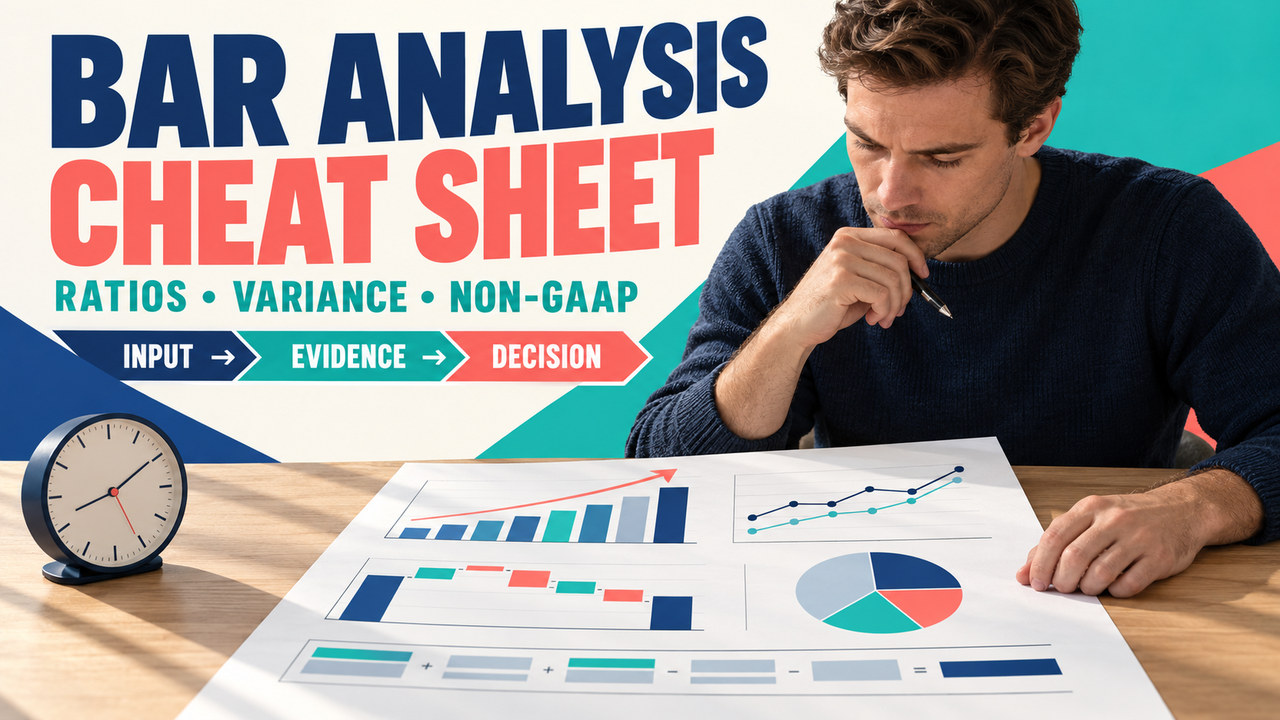

Direct answer: Use a bar analysis cheat sheet as a decision filter. Write the input, define the measure, isolate the driver, and name the evidence before you choose an action. This keeps ratios, variance, non-GAAP adjustments, and trend language from blending into one vague conclusion.
Scope and freshness note: This is original editorial study material, not an exam-authority publication. Reopen the AICPA CPA Exam Blueprints for current BAR task language and the NASBA CPA Exam FAQ for eligibility, scheduling, jurisdiction, and score questions. Every amount and scenario below is an original practice fact.
Start with the BAR review hub for section orientation. Use the CPA study guide for planning, the Blueprint format guide for task boundaries, and the topic MCQ page or TBS practice guide when you need another retrieval mode.
For a broader preparation path, continue with our related CPA study resources.
bar analysis cheat sheet: choose the decision lane
A compact review aid works when every line answers a different question. Start with Input: what period, population, contract term, balance, or assumption controls the item? Next write Measure: what will you calculate, compare, or interpret? Then name the Driver: which price, volume, mix, cost, adjustment, timing, or risk fact explains the movement? Finish with Evidence: which source line, reconciliation, exhibit, or schedule would let another reader check the conclusion?
Those four lines create a decision boundary. Mathematically, a ratio can be correct and still answer the wrong population. Meanwhile, a favorable variance can hide an unfavorable mix or temporary price effect. A non-GAAP label can change presentation without changing recurring economics. Likewise, a trend can be real for one period and still fail a persistence test. Therefore, the cheat sheet is a filter for scope before it is a list of formulas.
Set the difficulty and timing
Use moderate difficulty for the first pass. Give yourself two minutes to mark the controlling input, three minutes to make the measure or bridge, and two minutes to reject the strongest distractor. If the decision lane remains unclear, record the uncertainty and move to the next item. A later source check is more useful than a rushed answer that leaves no evidence.
bar analysis cheat sheet: map the evidence before the ratio
Before calculating, separate the story from the proof. Circle the date or period, underline the population, and mark the fact that could change the conclusion. Then ask four boundary questions: Is the numerator matched to the denominator? Next, check whether the variance bridge reconciles to the reported movement. Also test whether the non-GAAP adjustment has a recurrence test. Finally, ask whether the trend survives a changed baseline or one-time event?
Use a short margin note: “I am deciding whether this fact belongs in the measure, the driver, the evidence, or the action.” That sentence protects the analysis when a prompt combines ratios, variance, reporting, and forecasting language. It also gives you a clean place to attach the exhibit or calculation you would reopen.

What to save during the attempt
Save the task verb, controlling fact, measure definition, driver or adjustment, evidence source, chosen action, and rejected distractor. When the item depends on an average balance, save the averaging method. For a contract term, save the approval or reset clause. With a non-GAAP measure, save the reconciliation and a recurrence note. The record should let another reader reproduce the decision boundary.
bar analysis cheat sheet: attempt original cases
The three cases below are original practice. Attempt each one before opening the rationale. Write the four decision lines, then identify the evidence you would reopen. The numbers are intentionally self-contained and do not represent an official or recalled exam item.
Reveal the decision lanes
Attempt the original cases first. For each, name the input, measure, driver, and evidence before opening the answer reveal.
Reveal the answer
Answer: Compare your note with the rationale, mark the first missing lane, and retry one case after changing a single fact.
Compare your process with the reasoning shown above.
Case 1: ratio denominator and period
Original practice facts: A service division reports $4.8 million of operating income and an average operating asset balance of $32.0 million for the year. A draft note instead divides the income by the year-end asset balance of $40.0 million. The opening balance was $24.0 million, and a $16.0 million acquisition closed on the final day of the year. The prompt asks for the first review note.
Question: Which response protects the analysis?
- Use the $40.0 million year-end balance because it is the newest number.
- Use the $24.0 million opening balance because it avoids the acquisition.
- Confirm the ratio definition, match the income period to the average operating assets, and document how the final-day acquisition affects the average.
- Replace operating income with revenue because the asset balance is complicated.
Answer and rationale: Choice 3 is strongest. The measure must match its population and period. Choice 1 lets a closing balance distort a full-year comparison. Choice 2 ignores the assets used during the year. Meanwhile, choice 4 changes the requested measure. Save the ratio definition, opening and closing balances, acquisition date, and averaging method.
Changed-detail retry: Keep the income fixed but move the acquisition to the first day of the year. Rewrite the measure line and explain whether the average-assets evidence changes.
Case 2: variance driver and trend persistence
Original practice facts: A division planned a 24% contribution margin on $18.0 million of sales. Actual sales reached $19.2 million, but the margin was 21%. The bridge shows a $0.6 million favorable price effect, a $0.4 million favorable volume effect, a $0.5 million unfavorable mix effect, and a $1.0 million unfavorable input-cost effect. A supplier surcharge ends next quarter. The prompt asks for the next review move.
Question: Which response protects the decision?
- Call the plan wrong because actual margin is below 24%.
- Accept the result because sales exceeded plan.
- Reconcile the bridge, separate mix from input cost, and test the margin after the temporary surcharge ends.
- Replace contribution margin with revenue growth and stop the review.
Answer and rationale: Choice 3 is strongest. The bridge explains the movement, while the post-surcharge test addresses persistence. Choice 1 skips the drivers. Choice 2 treats volume as proof of profitability. Meanwhile, choice 4 changes the requested measure. Save the plan, actual, bridge, surcharge date, and the post-surcharge comparison.
Changed-detail retry: Keep the surcharge in place but restore the planned sales mix. Record whether the margin movement now points to mix or input cost before describing a trend.
Case 3: non-GAAP reconciliation and risk boundary
Original practice facts: A company forecasts $6.0 million of free cash flow. A $1.4 million working-capital release occurs once, debt refinancing is due in nine months, and management presents an adjusted operating metric that excludes $0.5 million of recurring implementation cost. The prompt asks for the first review note.
Question: What should the learner record?
- Use the full $6.0 million as recurring cash flow because it appears in the forecast.
- Use the adjusted metric because excluding implementation cost improves the valuation.
- Separate recurring and one-time cash effects, reconcile the adjusted metric to the base, and state how refinancing risk changes the decision boundary.
- Ignore debt maturity because valuation is independent of financing.
Answer and rationale: Choice 3 is strongest. Cash-flow quality, adjustment recurrence, and financing risk all affect the conclusion. Choice 1 treats a release as recurring. Choice 2 accepts a label without a reconciliation. Meanwhile, choice 4 removes a material risk fact. Save the cash-flow bridge, adjustment schedule, debt maturity, and the assumption that would change the decision.
Changed-detail retry: Keep the debt maturity fixed but remove the working-capital release from the forecast. Rewrite the evidence line and state whether the risk classification changes.
bar analysis cheat sheet: read the wrong answer by lane
After each attempt, compare your note with the rationale in the same order. First ask whether the input was defined before the measure. Next check whether the calculation or bridge reconciles. Then ask whether a one-time effect was separated from a recurring driver. Finally, ask whether the evidence could change the action.
Classify the first gap instead of marking every sentence as a problem. Scope means the population, period, or task verb was wrong. Input means a term, balance, date, or assumption was missed. Measure means the formula or denominator did not match the question. Driver means the bridge or adjustment was incomplete. Evidence means the source line or reconciliation was not reopened. Transfer means the answer was remembered but failed after one changed fact. This classification tells you what to review next.
bar analysis cheat sheet: make the next repair
Repair the earliest missing proof point before adding another mixed set. Write: “I will reopen ___, verify ___, and retry ___ after changing ___.” For example, if the denominator was unclear, reopen the ratio definition, verify the population and period, and move the acquisition date in a new case. If the non-GAAP adjustment was accepted too quickly, reopen the reconciliation, verify recurrence, and remove the one-time cost from the forecast.

Keep the repair attached to the evidence. A useful cheat sheet does not make the learner memorize more labels; it makes the missing decision lane visible. Stop when the next action is specific enough for another reader to check.
Make the cheat-sheet review repeatable
- Minutes 0–4: Choose one BAR topic, task verb, population, and period.
- Minutes 4–12: Attempt one original case and write input, measure, driver, and evidence.
- Minutes 12–18: Reconcile the ratio, variance bridge, non-GAAP adjustment, or trend baseline.
- Minutes 18–24: Reopen one source or exhibit tied to the first missing lane.
- Minutes 24–30: Change one fact and record whether the decision changes.
Use the TBS practice guide when the missing lane is exhibit evidence. Use the topic MCQ page when the missing lane is rapid recognition. Keep the current AICPA boundary open when the task language or terminology may have changed.
bar analysis cheat sheet checklist
- Write the decision verb before calculating.
- Define the population, period, numerator, and denominator.
- Separate price, volume, mix, timing, and input-cost drivers.
- Reconcile every non-GAAP adjustment to the base measure.
- Test whether a trend survives a one-time event or changed baseline.
- Save the source line, schedule, exhibit, or calculation you would reopen.
- Explain the strongest distractor in one sentence.
- Record one bounded retry before adding volume.
A good bar analysis cheat sheet leaves a visible proof trail: input, measure, driver, evidence, decision, and the fact that would change the conclusion.
bar analysis cheat sheet FAQ
Are these official exam questions?
No. The cases and rationales are original editorial practice. Use current AICPA sources for authoritative scope and terminology.
What belongs on a BAR analysis cheat sheet?
Keep the input, measure, driver or variance, evidence source, decision boundary, and one changed-fact retry.
Should I calculate every ratio before reading the prompt?
No. Define the population, period, denominator, and decision verb first; then calculate only the measure the facts support.
Does this method promise a passing result?
No. It creates observable reasoning evidence and a focused next action; current rules, preparation, and performance determine the actual result.
Sources
- AICPA CPA Exam Blueprints
- NASBA CPA Exam FAQ
- BAR review hub