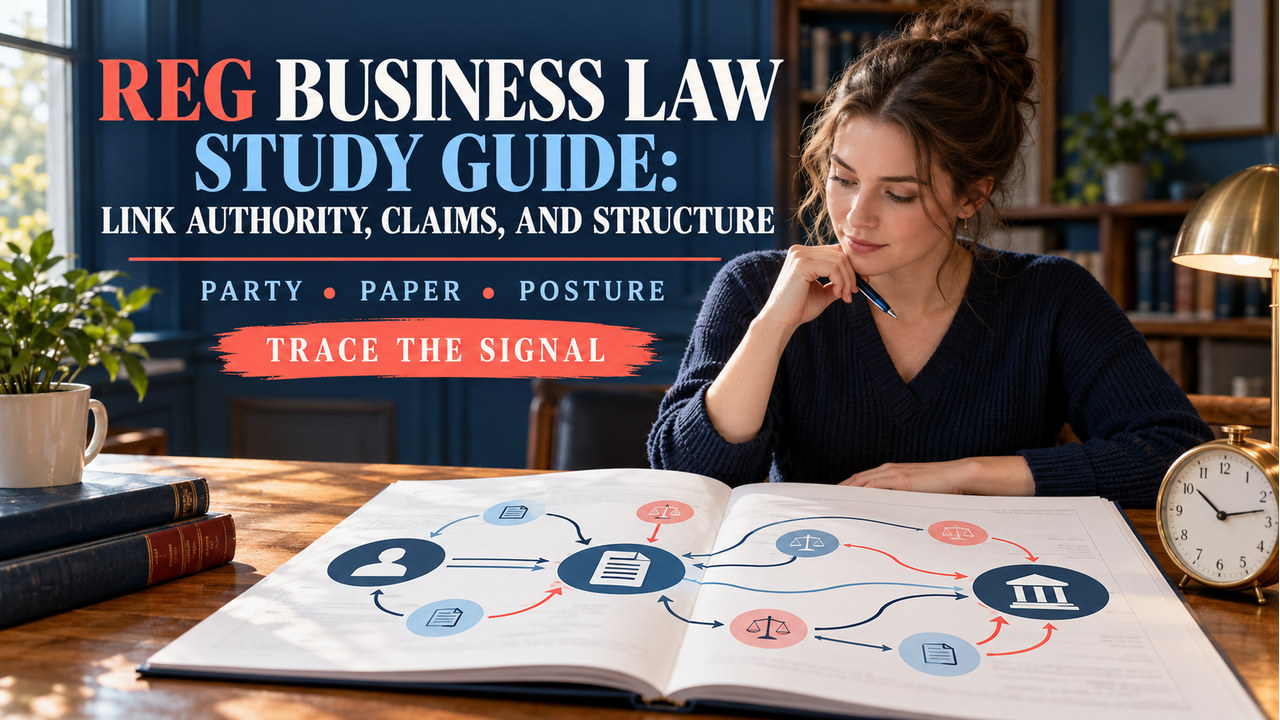

Direct answer: A useful business law study guide should make the legal relationship visible before it asks for a conclusion. Set one decision verb, sort the facts into agency, contract, creditor, bankruptcy, or entity structure, identify the document or event that controls the lane, and write the result the prompt requests. Afterward, change one material fact and see whether the reasoning moves with it. This review uses original practice situations and a short repair loop; it does not promise a score or replace current AICPA or NASBA information.
Scope and freshness note: The explanations and scenarios here are original editorial study material. Reopen the AICPA CPA Exam Blueprints for the current testing window and task statements. Use the NASBA CPA Exam FAQ for eligibility, scheduling, jurisdiction, or score questions.
Next, use the REG review hub to orient the section. The CPA study guide can frame a weekly block, while the Blueprint format guide clarifies task boundaries. When you need more retrieval volume, move to the topic MCQ resource or the TBS practice guide.
For a broader preparation path, continue with our related CPA study resources.
Business law study guide: name the legal signal
A long REG business-law stem often contains several true statements. In practice, only one of them answers the question being asked. Agency may supply the relationship, a contract may supply the operative term, a filing may supply the creditor’s position, a proceeding may supply the posture, and an entity record may supply the exposure question. Therefore, read the final sentence first, turn it into a decision verb, and then collect only the facts that can change that result.
Meanwhile, keep a five-word route in the margin: party, power, paper, posture, product. First, party identifies who is acting. Next, power identifies authority or capacity. Meanwhile, paper points to the agreement, filing, claim, formation record, or communication. Then, posture tells you what has happened procedurally. Finally, product names the requested result, such as binding effect, priority, discharge, or personal exposure.
The one-line boundary
Write one sentence before you calculate or choose an answer: “This item asks whether actor can produce result under document or event in posture.” For that reason, if a new fact does not fit that line, park it as background. This prevents a familiar keyword from pulling the analysis into a neighboring rule.
Set the business law study guide contract
Before the first question, make a small review contract with yourself. Choose one lane for the opening block, a stop time, and an evidence record. For example, a workable block might allow two minutes to read, three minutes to decide, and four minutes to explain. Meanwhile, the exact clock can change; the sequence should stay stable so that a rushed answer still leaves a trace.
First, write the decision verb: identify, evaluate, determine, calculate, or recommend. Next, list the controlling proof: an appointment or communication for agency; an offer term, acceptance method, warranty, or performance event for contracts; a filing, claim, lien, petition, or stay for creditor and bankruptcy items; or a formation record, signature, guaranty, or veil fact for structures.
However, do not use “I knew the rule” as the review record. Add the missing link: which fact activates the rule and which result follows. If the answer changed because the prompt changed “send” to “receive,” or “company” to “guarantor,” mark that transfer. Therefore, a rule without its trigger is hard to retrieve under time pressure.
What belongs in the margin
Use five short entries: actor, authority, event, posture, and ask. A blank entry is useful evidence. As a result, it tells you what to reopen instead of inviting a second blind attempt.

Map the business law study guide lanes
Keep five lane labels in your notebook: agency asks about authority and outside knowledge; contract asks about the operative term or performance event; creditor and bankruptcy questions ask about claims, filings, posture, and distribution; entity questions ask what record connects a person to an obligation.
For example, “the company owes money” does not answer lien priority or personal responsibility, and “the agent signed” does not settle actual or apparent authority. In practice, the lane tells you what to test first; it does not hand you the conclusion.
Separate relationship from remedy
After naming the lane, separate relationship from remedy. A valid claim can still lose a priority dispute; a contract can exist while damages depend on a limitation; an LLC can own an asset while a guaranty creates a separate exposure path. Write two lines: “What relationship exists?” and “What result is requested?”
Build the business law study guide ledger
Now make a ledger row that can survive a changed fact: party → power or term → event or document → posture → requested result. Therefore, the arrows force a causal explanation. A filing can change priority; a communication can change apparent authority; a received acceptance can change contract timing; a petition can change collection posture; a guaranty can change the path to personal exposure.
Then add one rejected distractor. Do not write only “B was wrong.” Write “B answers priority, while this item asks personal responsibility,” or “B uses the drafting date, while the term makes receipt the event.” This comparison trains discrimination, which is usually where close options separate.
In addition, record your confidence separately from your source check. “Certain” means the route is supported by the stated facts and current boundary. “Uncertain” means one document, term, or posture needs a quick reopen. As a result, the distinction keeps an appealing answer from becoming a false memory.
Run the business law study guide cases
Attempt the following original cases before revealing the explanations. Read the ask, draw the lane, and write your ledger row. Meanwhile, the scenarios are deliberately mixed so that the first move must come from the relationship rather than from a memorized phrase.
Case 1: a sales representative and a public limit
Facts: Northshore Tools appoints Dana as a sales representative. The internal appointment authorizes routine orders up to $9,000. Later, the company’s public directory lists Dana as “regional sales lead” without an amount. Dana signs a $14,500 supply order with a distributor that has never seen the internal instruction. Northshore refuses delivery after its finance manager notices the amount.
Question: Which first entry belongs in the ledger?
- Dana’s title proves that every order binds Northshore.
- The private amount automatically defeats any outside reliance.
- The appointment, the public communication, the distributor’s information, and the requested binding result.
- The signed page ends the analysis because authority cannot be separated from signature.
Rationale: Choice 3 preserves the two authority paths. The private instruction supplies evidence about actual authority, while the directory and the distributor’s knowledge bear on apparent authority. Therefore, the first repair is to identify which path the question asks you to test. A title is a clue, not a substitute for the communication and reliance facts.
Case 2: a changed acceptance instruction
Facts: A supplier emails an offer for custom packaging. Version A says the buyer must “send acceptance by Wednesday.” The buyer writes on Tuesday, sends on Wednesday night, and the supplier reads it Thursday. Version B says the buyer must “receive confirmation by Wednesday.” The buyer performs the same steps under both versions.
Question: What changed fact should control the comparison?
- The time the buyer drafted the response.
- The calendar day on which the supplier read the message, without the wording.
- The acceptance method and the event the two versions make operative.
- The rule remembered from a different offer.
Rationale: Choice 3 starts with the operative term. “Send” and “receive” point to different events, so the ledger must separate dispatch, receipt, and the requested contract result. In that case, if the dates are recorded without the instruction, the analysis has lost the transfer fact.
Case 3: lien, claim, and entity boundary
Facts: A small LLC buys a delivery van. One lender records a security interest before the van is delivered; another creditor later files a claim after the company misses a payment. The LLC files a bankruptcy petition. The owner personally signed a separate guaranty for one loan, while the other creditor points only to the LLC invoice.
Question: Which document set should be reviewed first?
- The LLC name and the unpaid invoice, because the company owns the van.
- The earliest dollar amount, because value decides every question.
- The formation and guaranty records, the two lien or filing records, the claim, and the bankruptcy posture.
- The owner’s job title, because it identifies the person who should pay.
Rationale: Choice 3 keeps priority, claim administration, and personal exposure in separate columns. The guaranty may create a path to the owner, while the filing and collateral records address a different question. Meanwhile, the petition changes the collection posture but does not erase the need to identify the controlling documents.
Reveal the reasoning
Attempt each original case first. Write the actor, document or term, event, posture, and requested result before opening the explanation.
Reveal the answer
Answer: Compare the ledger with the rationale, mark the first unsupported step, and change one fact before retrying.
Compare your process with the reasoning shown above.
Compare the business law study guide reasoning
After each case, compare your row with the rationale and underline the first unsupported step. Ask whether you named the right actor, connected the authority or term to an event, preserved the procedural posture, and answered the requested result. Then circle the strongest distractor and name the neighboring question it answers.
Next, classify the miss: a lane miss crosses into the wrong rule; a fact miss drops a date, term, or guaranty; a boundary miss uses an old scope; an evidence miss skips the controlling document; a posture miss ignores the proceeding stage; and a transfer miss keeps the old result after a changed fact. Therefore, use one label; it determines the repair.
Repair the business law study guide gap
Therefore, stop adding mixed questions after the first unsupported step. Reopen one authoritative source or course note, rewrite the missing boundary in plain language, and change one material detail in the case. Change the public communication for an authority miss, “send” to “receive” for an acceptance-timing miss, the filing sequence for a priority miss, or the guaranty for an entity-exposure miss. As a result, the focused retry should produce a new ledger row, not just another score.
Use a three-part repair: source, changed fact, and observable result. Name what you reopened, show the transfer with the new fact, and explain the new relationship or remedy in one sentence. Finally, save the row, then schedule a short follow-up.

Make the business law study guide loop repeatable
At the next session, begin with the earliest unsupported step from the prior ledger. Start in the same lane and keep the same evidence record for three items. Then introduce one neighboring lane only after the original repair holds. Thus, this sequence preserves the difference between knowing a rule and transferring it when the actor, document, event, or posture changes.
For the next loop, change one term for a contract repair, outside knowledge for an agency repair, filing sequence for a creditor repair, proceeding posture for a bankruptcy repair, or guaranty or formation fact for an entity repair. Name the action before the clock starts.
Business law study guide checklist
- Read the final ask and write the decision verb.
- Identify the lane: agency, contract, creditor, bankruptcy, or entity.
- Name the actor and the document, term, filing, or communication.
- Mark the event that makes the fact legally useful.
- State the procedural posture before choosing a remedy.
- Write the requested result in your own words.
- Reject the strongest distractor by naming its neighboring question.
- Record the first unsupported step and one repair.
- Change one material fact and retry one item.
- Save the new ledger row for the next study block.
A strong business law study guide leaves a visible trail from party to result. Therefore, that trail is more actionable than a list of answer letters because it tells you what to reopen and what to change.
Business law study guide FAQ
Are these official CPA exam questions?
No. The cases and explanations are original editorial practice. Use the current AICPA materials for authoritative scope and the NASBA FAQ for administration questions.
Should I memorize every business-law exception?
Build the relationship and trigger first. When a source reveals an exception, add it to the lane where it changes the result and test it with one changed fact.
What if I know the rule but cannot choose an answer?
Write the actor, document, event, posture, and ask. The missing entry usually shows whether the problem is a fact, boundary, evidence, or transfer miss.
Does this method predict a passing score?
No. It creates observable study evidence and a focused next action. A score or administration decision requires current official information.
Sources
- AICPA CPA Exam Blueprints and tested content resources
- NASBA CPA Exam FAQ
- REG review hub
- CPA exam study guide
- CPA Blueprint format guide
- CPA MCQ-by-topic resource
- CPA TBS practice guide