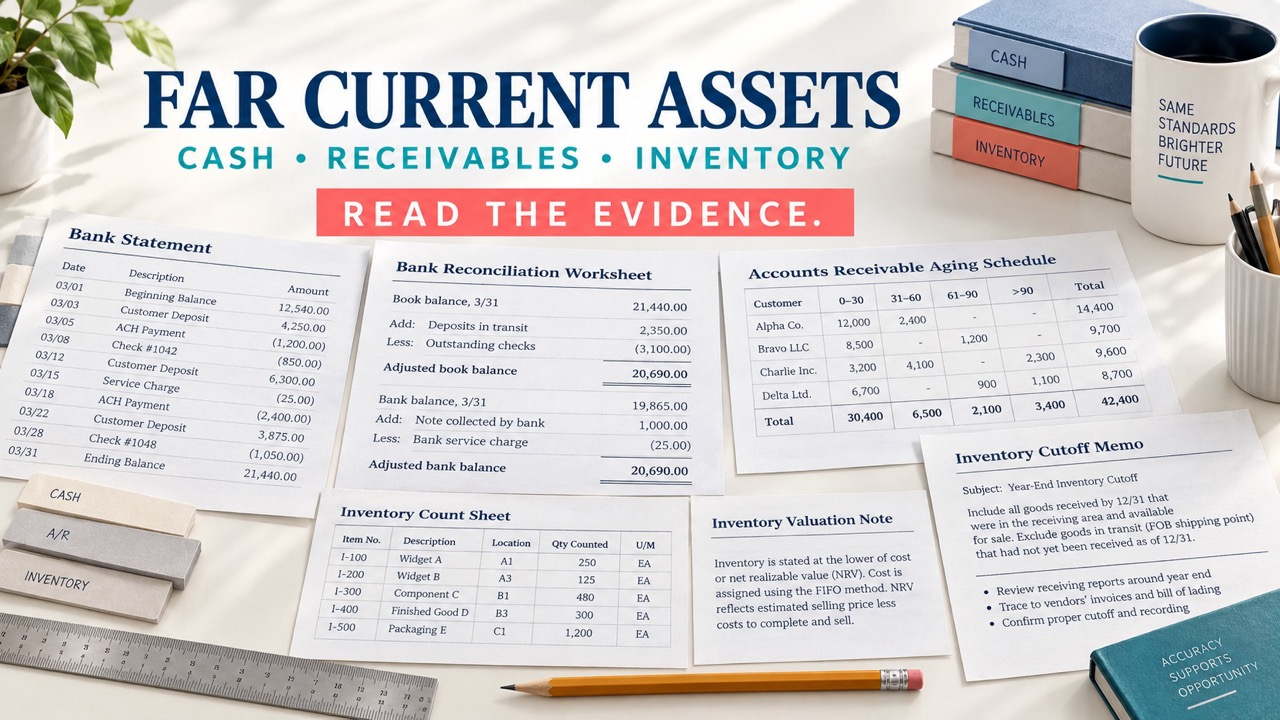

Direct answer: The safest way to use cash receivables inventory practice questions is to keep three lanes separate: reconcile cash to the bank statement, update receivables for collectibility, and test inventory for ownership, quantity, and valuation. Write the controlling fact before the calculation, then explain why the adjustment belongs in that lane.
Editorial review note: Written by the CPA Exam Prep study-content team and reviewed for terminology, arithmetic, internal consistency, and learner usefulness. The cases, amounts, prompts, answers, distractors, and retry are original editorial practice, not released exam content.
These FAR practice questions use simplified facts so the first decision stays visible. Current AICPA Blueprints and authoritative FASB guidance define the live boundary; this page supplies a compact study lab. If a prompt changes the inventory cost-flow assumption, ownership terms, allowance method, or reporting date, reopen current guidance before relying on a shortcut. For broader routing, visit the FAR review hub.
Cash receivables inventory practice questions: use a 90-second triage
Before touching a number, write the lane at the top of the scratch area. The goal is not to memorize three account names. The goal is to stop a bank-reconciliation item from becoming a receivables adjustment or an inventory cutoff error.
- Name the ledger: Is the fact about cash timing, customer collectibility, or goods owned and measured?
- Mark the cutoff: Circle the statement date, physical-count date, shipping term, receipt date, or later collection date.
- Separate recorded from required: Write the book amount, outside evidence, and amount that should remain after the adjustment.
- Choose the adjustment: Decide whether the fact changes cash, an allowance, accounts receivable, inventory, cost of sales, or disclosure.
- Answer with because: Finish with one sentence naming the evidence that controls the treatment.
A useful margin format is recorded, evidence, adjustment, and ending balance. It forces you to distinguish a book-side reconciling item from a bank-side timing item. It also prevents an inventory valuation question from being solved as though it were a physical-count question.

Cash receivables inventory practice: start with the reconciliation lane
Cash and receivables both look like current assets, but the controlling evidence is different. Cash reconciliation compares two records of the same cash position. Receivables analysis asks how much of the customer balance is expected to be collected. Start with the evidence source before choosing the arithmetic.
Bank-side items do not automatically change the books
A deposit in transit and an outstanding check explain why the bank statement and the ledger differ at the same date. They adjust the bank side of the reconciliation. A bank service charge, an NSF customer check, and interest credited by the bank usually require a book-side entry because the entity has not yet recorded those facts. Do not put every difference on the same side.
The clean sequence is: adjust the bank balance for timing differences, adjust the book balance for unrecorded bank activity, and confirm that both adjusted balances agree. If they do not agree, inspect the amount and sign before assuming a new accounting rule is needed.
Receivables questions need an allowance, not a guess about cash
When an aging schedule gives the required ending allowance, compare that target with the allowance already on the books. The difference is the current bad-debt expense under the simplified facts. The ending net realizable amount is gross receivables less the ending allowance. A write-off can reduce both a customer balance and the allowance without creating a second expense when the allowance method is already in use.
Write the target allowance first. Then write the existing allowance and the direction of the adjustment. This small step keeps an existing credit balance from being added when it should be increased only by the difference.
Inventory practice questions: separate ownership, quantity, and valuation
Inventory questions usually test one of three facts: who owns the goods at the reporting date, how many units belong in the count, or whether the recorded cost remains recoverable under the stated measurement rule. Read the shipping term and the cost-flow or valuation assumption before calculating.
Cutoff and consignment decide what belongs in the count
Goods shipped under a stated FOB term can belong to the buyer before physical receipt. Consigned goods held for another owner do not become the holder’s inventory merely because they are sitting in the warehouse. A cutoff question is therefore an ownership question first and a quantity question second. Put the item into or out of ending inventory only after deciding whose asset it is.
Lower cost and net realizable value is a comparison, not a forecast
Under the simplified non-LIFO, non-retail facts in this lesson, compare the recorded cost with net realizable value for the item or group specified by the prompt. If the recoverable amount is lower, record the stated write-down. Do not substitute a market ceiling, an expected profit, or a different cost-flow rule unless the question supplies it. If the prompt uses LIFO or the retail method, stop and apply the relevant current guidance instead of importing this simplified comparison.
Inventory practice questions: use the physical count to test quantity
A shortage between the perpetual record and the physical count changes the quantity on hand and may affect cost of sales or a loss under the assumptions. It does not by itself answer whether goods in transit are owned, whether consigned goods belong to the entity, or whether a recorded cost is recoverable. Keep quantity, ownership, and valuation as three separate checkboxes.
Original cash, receivables, and inventory practice questions practice set
Tested skill, assumptions, and difficulty: This original set tests bank reconciliation, allowance estimation, inventory cutoff, lower-of-cost-and-NRV reasoning, and physical-count variance. Assume a calendar-year entity and simplified facts. Difficulty is moderate: the arithmetic is short, but the answer depends on identifying the evidence source. Attempt each case before opening its reveal.
These are original editorial practice cases. They are not a live assessment or a score prediction. Use the explanation to identify the first broken decision, not to reward a guessed number.

Case 1 — Reconcile the two cash records
Original practice prompt: The December 31 bank statement shows $50,100. A deposit of $2,700 is in transit, and checks totaling $2,400 are outstanding. The entity’s book cash balance is $50,680 before recording a $40 bank service charge, a $260 NSF customer check, and $20 of bank interest. What adjusted cash balance should both sides show?
Reveal Case 1 answer and reasoning
Answer: The adjusted bank balance is $50,400 ($50,100 + $2,700 − $2,400). The adjusted book balance is also $50,400 ($50,680 − $40 − $260 + $20). The deposit and outstanding checks are bank-side timing items; the service charge, NSF check, and interest are book-side items. The nearest distractor adjusts both sides for every item. Repair verb: reconcile.
Case 2 — Update the receivables allowance to the target
Original practice prompt: Gross accounts receivable are $240,000. The allowance for doubtful accounts currently has a $7,000 credit balance. An aging analysis indicates that the required ending allowance is $12,500. Under the simplified allowance-method facts, what bad-debt expense and net receivables should the learner report?
Reveal Case 2 answer and reasoning
Answer: The allowance needs a $5,500 increase ($12,500 − $7,000), so bad-debt expense is $5,500. Net receivables are $227,500 ($240,000 − $12,500). The nearest distractor records $12,500 of expense without considering the existing credit balance. Repair verb: target.
Case 3 — Put goods in transit in the right owner’s count
Original practice prompt: On December 30, the entity buys goods costing $14,000 under FOB shipping point. The seller ships them on December 30, and the goods arrive on January 3. The entity’s physical count at December 31 excludes the shipment. What year-end inventory and payable adjustment belongs in the simplified buyer’s records?
Reveal Case 3 answer and reasoning
Answer: Include $14,000 in year-end inventory and record the related $14,000 payable, because the stated shipping term transfers the goods to the buyer when shipped. Physical nonreceipt does not override the ownership evidence. The nearest distractor excludes the goods solely because they were not in the warehouse. Repair verb: cut off.
Case 4 — Compare cost with NRV under the stated rule
Original practice prompt: A non-LIFO, non-retail inventory group has recorded cost of $84,000 and net realizable value of $81,500 at year-end. Ignore other complications. What write-down should the learner record, and what amount remains after the comparison?
Reveal Case 4 answer and reasoning
Answer: Record a $2,500 write-down ($84,000 − $81,500), leaving inventory at $81,500 under the simplified facts. The nearest distractor records no adjustment because the goods are still physically present, or applies a different market rule without being told to do so. Repair verb: compare.
Case 5 — Explain a physical-count shortage
Original practice prompt: The perpetual inventory record shows $46,800 at cost, but the verified physical count supports $45,900. No ownership or valuation issue is stated. What amount should the learner investigate as the quantity variance, and what does the small result support?
Reveal Case 5 answer and reasoning
Answer: The quantity variance is $900 ($46,800 − $45,900). Under the simplified facts, investigate and record the shortage through the applicable cost-of-sales or loss treatment. The result supports a targeted count-and-cutoff review; it does not prove a live exam score or a broad inventory-control conclusion. Repair verb: verify.
Review cash, receivables, and inventory practice questions by the first broken field
Do not turn five cases into one percentage and stop. Find the first broken field. A Case 1 miss means the learner mixed bank-side timing with book-side activity. A Case 2 miss means the learner ignored the existing allowance balance. A Case 3 miss means the shipping term was not read. A Case 4 miss means the measurement rule was replaced with a familiar rule. A Case 5 miss means the physical count was not compared to the perpetual record.
Record the case, confidence before the reveal, evidence source, first broken field, repair verb, and next ten-minute review block. If the first broken field is bank-side timing, redo one reconciliation. If it is allowance logic, write target minus existing before reading the answer. If it is ownership or valuation, label the rule in words before touching the amount.
Retry cash, receivables, and inventory practice questions after one fact changes
Change only the bank service charge in Case 1 from $40 to $90. Keep the bank statement, deposit in transit, outstanding checks, book balance, NSF check, and interest unchanged. Which amount changes, and which reconciliation relationship remains intact?
The adjusted book balance becomes $50,350 ($50,680 − $90 − $260 + $20). The adjusted bank balance remains $50,400, so the simplified records now differ by $50 until the book-side adjustment is recorded correctly or another fact is found. The retry changes one fact and exposes the next investigation; it does not justify changing the bank-side timing items.
Cash, receivables, and inventory practice questions: FAQ
Which bank-reconciliation items change the books?
Under the simplified facts, unrecorded bank service charges, NSF items, and bank interest change the books. Deposits in transit and outstanding checks usually explain timing on the bank side. Always follow the exact evidence supplied.
How do I calculate bad-debt expense when an allowance already exists?
Start with the required ending allowance, subtract the existing allowance balance in the correct direction, and record the difference as the current adjustment under the stated allowance-method assumptions. Then subtract the ending allowance from gross receivables.
Do goods in transit belong in ending inventory?
It depends on the ownership terms and reporting date. Read the shipping term first. Under the Case 3 facts, FOB shipping point transfers the goods to the buyer when shipped, even though physical receipt occurs later.
Can I use the same inventory valuation rule for every question?
No. Identify the cost-flow and measurement assumptions first. This lesson uses a simplified non-LIFO, non-retail cost-versus-NRV comparison; a prompt with LIFO, retail inventory, or a different rule requires current guidance.
Cash, receivables, and inventory practice questions: sources and refresh note
Current tested-content boundary: AICPA CPA Exam Blueprints. Format boundary: AICPA CPA Exam sample tests. Technical refresh: FASB Accounting Standards Codification. Candidate-process routing: NASBA CPA Exam FAQ. The team checked these pages September 23, 2026. Reopen current guidance when the reporting date, shipping term, cost-flow assumption, allowance model, or ownership fact changes. The cases, calculations, distractors, visuals, and retry are original editorial study content.