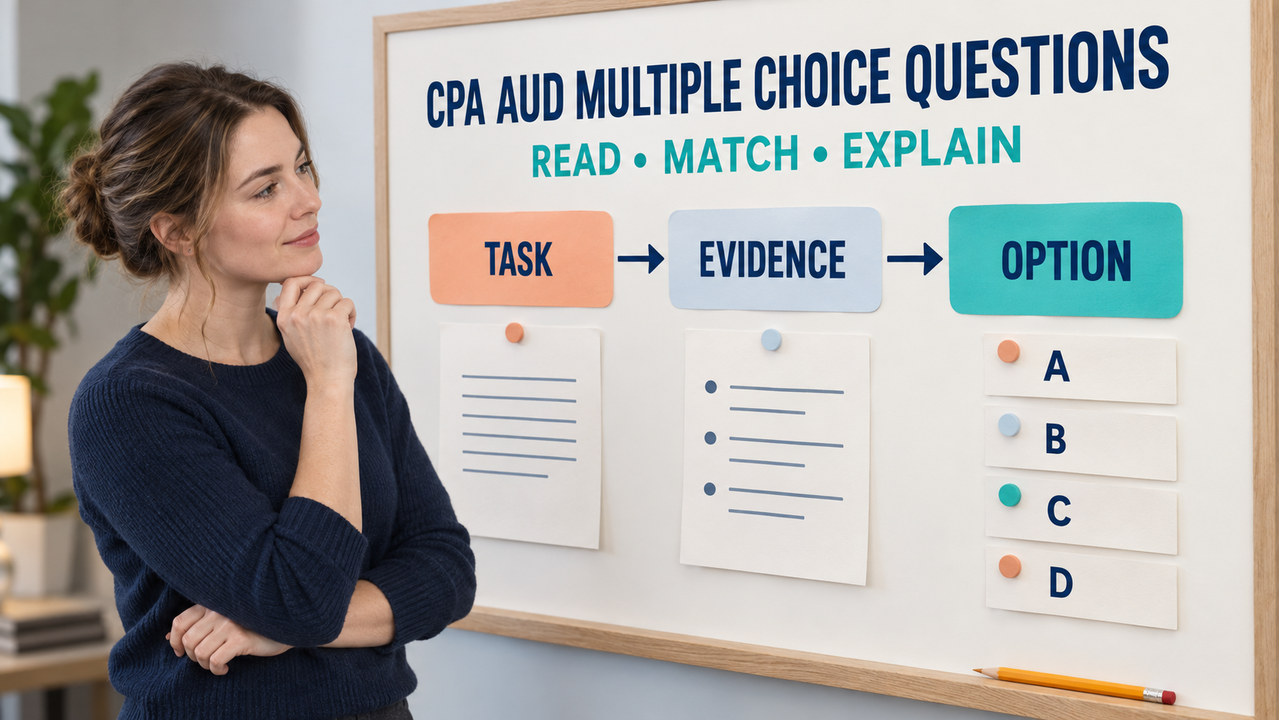

Direct answer: The best cpa aud multiple choice questions routine is a short reasoning loop: identify what the stem asks, match the answer to the evidence and rule, explain why the nearest distractor fails, and change one fact before moving on. A question count alone does not show whether the reasoning transferred.
Scope and originality note: This page contains original AUD-style multiple-choice items and independently written explanations. It does not reproduce official, recalled, leaked, provider-owned, or score-predictive questions. Use the current AICPA CPA Exam Blueprint for scope, the current AICPA AUD resources for the subject boundary, and the NASBA FAQ for administration questions.
Start with the Blueprint-format explainer when a question seems to test an unfamiliar task. For section orientation, open the AUD review overview; use the AUD review-course guide for resource fit, and the TBS practice guide when the task needs exhibits or documents.
CPA AUD multiple choice questions: who this is for
This cpa aud multiple choice questions guide is for a learner who can recognize familiar AUD terms but wants a more reliable way to choose between plausible options. It works before a mixed review block, after a lesson exposes a weak area, or when a learner keeps missing questions for different-looking reasons.
The page is not a directory of question links and it is not a readiness score. It gives you a repeatable solve-check-transfer route, four original examples, a distractor taxonomy, and a decision flow for choosing the next repair. The result from one small block is local evidence about a reasoning field, not a prediction of exam performance.
Build an AUD MCQ reasoning loop
Before you open the options, write one sentence that names the requested output. Then keep the solve loop compact enough to repeat.
- Read the ask: circle the task verb and identify whether the question wants a procedure, conclusion, communication, risk response, or definition.
- Match the proof: connect the key fact to the rule, evidence, assertion, or reporting boundary that can support the answer.
- Test the options: reject choices that change scope, use absolute language, answer a different task, or claim a result the facts do not prove.
- Explain and transfer: write the best reason, label the nearest distractor, change one fact, and predict what should change.
Use the same four labels across sessions. Consistent labels make it easier to see whether the problem is reading, rule selection, evidence fit, option logic, or transfer. They also keep review from turning into a race for a larger question count.
Map the stem before you judge the options
Many wrong answers look attractive because the learner starts with the options. Instead, reverse that order. Extract the engagement, material fact, task verb, and constraint first. Then ask what a defensible answer must prove.

Engagement: identify the audit, review, attestation, or other service context. Material fact: keep only the fact that changes the decision. Task verb: distinguish select, evaluate, determine, identify, communicate, or conclude. Constraint: record the timing, reliability, scope, independence, or reporting boundary. The best option should match the ask and stay inside those boundaries.
Original AUD multiple-choice questions with explanations
The following items are original study prompts. Try each one before opening the explanation. The explanation focuses on the reasoning field that separates the best option from the distractors.
Question 1: match the procedure to the assertion
Scenario: An auditor is testing the existence of a year-end receivable balance. Which next step most directly addresses the stated assertion while preserving room to evaluate reliability and nonresponse?
- A. Inspect an external confirmation response and investigate an exception or nonresponse.
- B. Recalculate the client’s aging report and treat the recalculation as proof of existence.
- C. Read the revenue policy and conclude that every recorded receivable exists.
- D. Compare the receivable balance with last year and issue the report.
Answer and explanation: A is the best starting point. It is directed at the existence assertion and leaves room to assess the response, exception, and any alternative evidence. B may test arithmetic or classification, but it does not by itself prove that a balance exists. C and D use relevant context as if it were direct support for the assertion.
Reasoning field: evidence fit. The transfer question is: if the assertion changes from existence to valuation, what new evidence would you need and why?
Question 2: evaluate a control exception
Scenario: A test of a review control finds one deviation in a sample. The team wants to decide whether the result affects its planned reliance. Which response is most defensible?
- A. Ignore the deviation because one exception cannot affect a control conclusion.
- B. Treat the deviation as an adverse opinion automatically.
- C. Investigate the nature and cause of the deviation, assess its effect, and determine whether additional work is needed.
- D. Replace all control testing with an unmodified opinion.
Answer and explanation: C is the best response. A deviation needs context: what failed, why it failed, how often the control operated, and what the result means for reliance or other procedures. A and B jump to opposite conclusions without analysis. D confuses a control test with the final report.
Reasoning field: conclusion boundary. The transfer question is: if the deviation is caused by a one-time event, what evidence would support that conclusion?
Question 3: recognize a service boundary
Scenario: A prompt describes a service in which the practitioner provides limited assurance through inquiry and analytical procedures. Which answer should the learner evaluate first?
- A. A conclusion that uses the level of assurance and procedures described in the prompt.
- B. An audit opinion that assumes the practitioner performed extensive examination procedures.
- C. A tax conclusion because every financial statement service is a tax engagement.
- D. A conclusion that guarantees the financial statements are free from misstatement.
Answer and explanation: A is the best fit. The service boundary in the prompt controls the type of conclusion the practitioner can express. B expands the work beyond the facts. C changes the service. D promises a level of assurance that the described procedures do not support.
Reasoning field: scope reading. The transfer question is: if the prompt changes the procedures and assurance level, which conclusion language must change with it?
Question 4: communicate a significant control matter
Scenario: The engagement team identifies a control matter that deserves attention from those charged with governance. What should the learner do before selecting a communication label?
- A. Describe the condition, its significance, and the appropriate communication path.
- B. Choose the strongest report modification because every control issue changes the opinion.
- C. Omit the matter when management disagrees with the team.
- D. Use the same communication for every control matter regardless of severity.
Answer and explanation: A is the best response. A useful communication starts with the condition and why it matters, then follows the relevant path. B, C, and D replace evaluation with an absolute shortcut. The question asks for the reasoning before the label.
Reasoning field: communication fit. The transfer question is: if the matter is less significant or affects a different audience, what fact changes the communication choice?
Diagnose the distractor before you review more questions
A missed option is more useful when you can name its failure pattern. A distractor may contain a true fact but answer the wrong task. It may use a word such as always or never. It may shift the scope, or it may claim a conclusion that the evidence does not support.

Scope shift: compare the service, assertion, period, or audience in the option with the stem. Absolute claim: replace the slogan with a condition and ask whether exceptions matter. Right fact, wrong task: rewrite the prompt as a sentence and check whether the option answers that verb. Unsupported result: name the missing evidence before accepting the conclusion.
This taxonomy helps you repair the earliest break. In particular, if a scope error appears before technical recall is relevant, more memorization is not the first fix. If the evidence matched but the conclusion overreached, practice boundary language. Likewise, if the option answered a different verb, rewrite the task in your own words.
Use a four-pass MCQ review
First pass — frame: write the engagement, key fact, task verb, and constraint.
Next — solve: state what the best answer must prove before reading the option wording as a slogan.
Then — explain: write one sentence for the winning option and one sentence for the nearest distractor.
Finally — transfer: change one fact, predict the new answer path, and record the first field that broke.
Also, keep the written explanation short but specific. “A is correct” is not a rationale. “A fits the existence assertion and leaves nonresponse open for follow-up” shows the match. “B recalculates an internal report but does not prove the balance exists” shows the distractor boundary.
Choose the next AUD MCQ resource
Next, use the topic-based MCQ page when you need a larger recognition block. Use the Blueprint-format explainer when you cannot name the tested task. Use the TBS practice guide when documents, exhibits, evidence, or reporting transfer are the main challenge. Return to the AUD review hub for the section map. The AUD review overview and AUD course guide can help connect a pattern to a broader study choice.
These items are study aids. The current AICPA Blueprint and authoritative auditing guidance control scope and technical conclusions. NASBA controls jurisdiction, eligibility, scheduling, and administration details.
Common AUD MCQ mistakes
- Starting with the answer choices: write the requested output first.
- Using a true statement as proof: ask whether it supports the exact assertion or conclusion.
- Accepting absolute language: test the option against timing, reliability, scope, and exceptions.
- Changing the service: keep the assurance level and procedures inside the prompt.
- Stopping at the answer letter: explain the winner, label the distractor, and run one changed-fact retry.
Choose the next MCQ repair
After your next missed question, identify the earliest broken field. Then run one repair before adding a larger question block.
Choose the next MCQ repair
After your next missed item, name the first break: task reading, evidence fit, distractor logic, or transfer. Run one matching repair before adding another block.
- Identify the facts
- Choose the governing rule
- Check the result
Check your reasoning
Answer: Repair the earliest broken field with a rewritten task sentence, an evidence comparison, a distractor label, or a changed-fact retry.
Use the explanation in this article to verify each step.
A task-reading gap needs a one-sentence rewrite. An evidence-fit gap needs a procedure comparison. A distractor-logic gap needs a label and wrong-reason sentence. A transfer gap needs one changed fact. Repair the first break, not the most intimidating topic.
CPA AUD multiple choice questions checklist
- Name the engagement or service boundary.
- Keep the material fact and task verb visible.
- State what the answer must prove.
- Reject scope shifts, absolute claims, wrong tasks, and unsupported results.
- Write the winning reason and nearest distractor trap.
- Change one fact and log the first broken field.
Finally, your next action is simple: choose one original item, hide the explanation, write the answer rule in one sentence, and complete one changed-fact retry. That is how cpa aud multiple choice questions become evidence about what to study next.
CPA AUD multiple choice questions FAQ
Are these official CPA AUD questions?
No. They are original AUD-style study items with independently written explanations. Use the current AICPA Blueprint for official scope.
How many AUD multiple-choice questions should I do?
Use a block large enough to reveal a pattern, then pause to explain misses and run a changed-fact retry. More volume is not the first fix for a reasoning gap.
What should I do when two options seem plausible?
Write the requested task, name the proof, and reject the option that shifts scope, uses an absolute shortcut, answers a different task, or overstates the evidence.