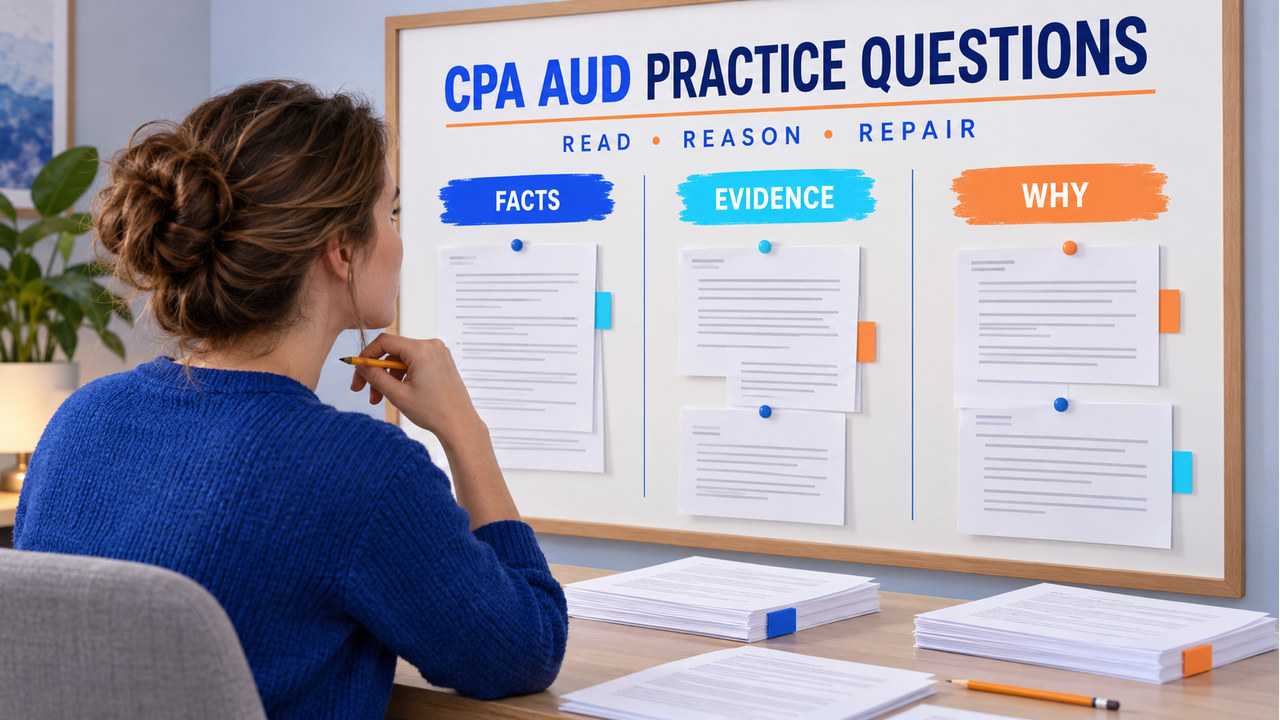

Direct answer: The best cpa aud practice questions are original diagnostic items. Read the stem, name the Blueprint task, choose the evidence or conclusion, explain why the best option works, identify the distractor trap, and retry after one fact changes.
Scope and originality note: This page contains original exam-style practice items and independently written rationales. It does not reproduce official, recalled, leaked, provider-owned, or score-predictive questions. Use the current AICPA CPA Exam Blueprint for scope and the current AICPA AUD resources for the subject boundary. Administration questions belong with the NASBA FAQ.
Use the Blueprint-format explainer to read Area, Group, Topic, task, skill, and item-type fields. Then choose the AUD review overview for section orientation, the AUD review-course guide for resource fit, or TBS practice when a task requires documents and exhibits.
CPA AUD practice questions: who this page is for
This cpa aud practice questions page is for a learner who wants to practice AUD reasoning rather than collect answer letters. It works as a first diagnostic block, a repair block after a course lesson, or a transfer block before a mixed review session.
Each item below has one clear task. The explanations focus on the first decision that separates the best answer from a distractor. The items are not a prediction of a score. They are a way to collect evidence about scope, reading, risk, evidence choice, and reporting transfer.
Set up a practice-question block
Open the current Blueprint before you begin. Select one Area, Group, Topic, task statement, and skill level. Write the task verb beside your scratch work. Then commit to an answer before reading any explanation.
- Frame the item: identify the engagement, client fact, requested output, and time or scope condition.
- Mark the task verb: distinguish assess, determine, evaluate, communicate, document, or select.
- Choose the proof: state what evidence, calculation, document, or report element would support the conclusion.
- Explain the option: write one sentence for the best answer and one sentence for the nearest distractor.
- Change one fact: predict what should change before you open a new item.
Read the question anatomy before you answer
Many AUD mistakes begin before the learner reaches the answer options. However, a familiar term can attract attention while the task verb or constraint points to a different procedure or conclusion.

Facts: write only the facts that affect the engagement, risk, evidence, or report. Task verb: circle the requested action. Evidence cue: name the proof that would support the action. Constraint: record the scope, timing, reliability, independence, or reporting condition that limits the answer.
Original AUD practice questions with rationales
Question 1: engagement acceptance
Scenario: An audit client asks the engagement team to accept a new service even though management has not agreed to provide access to key records. Which response best frames the next step?
- A. Begin substantive testing and resolve the access issue later.
- B. Evaluate whether the preconditions and agreed responsibilities support acceptance or continuance.
- C. Treat the access problem as an immaterial control deficiency.
- D. Select an unmodified opinion because the engagement has not started.
Answer and rationale: B is the best response. The first task is to assess the engagement boundary and management responsibilities before the team plans work. A jumps to procedures. C labels the matter without evaluating acceptance. D skips the evidence and reporting path entirely.
Blueprint connection: This item tests an engagement and professional-responsibility task. The repair question is: “What fact would make acceptance possible, and who must agree to it?”
Question 2: control evidence
Scenario: A walkthrough shows that an employee described a review control accurately. The question asks whether the control operated throughout the period. Which evidence gap matters most?
- A. The team has evidence about design or implementation, but not enough evidence about operating effectiveness.
- B. The team must issue a qualified opinion immediately.
- C. The walkthrough proves that substantive procedures are unnecessary.
- D. The control automatically becomes a key audit matter.
Answer and rationale: A is the best response. A walkthrough can help the team understand design and implementation, but the task asks about operation over time. B, C, and D jump to consequences that the stated evidence does not support.
Blueprint connection: This item tests risk, controls, and evidence. The changed-fact retry should replace the walkthrough with a set of operating-effectiveness evidence and ask what conclusion that evidence supports.
Question 3: evidence choice
Scenario: The auditor needs evidence about the existence of a receivable balance and can send an external confirmation or inspect an internally prepared aging report. Which reasoning is strongest?
- A. Choose the aging report because internal documents are always more relevant.
- B. Choose the confirmation automatically because external evidence always resolves every assertion.
- C. Match the procedure to the assertion, consider reliability and response risk, and evaluate what limitation remains.
- D. Avoid both procedures because analytical procedures are always sufficient.
Answer and rationale: C is the best response. The procedure must fit the assertion and the risk. The team should consider the reliability of each source, the response or nonresponse, and any remaining limitation. A, B, and D turn a useful evidence principle into an absolute slogan.
Blueprint connection: This item tests evidence evaluation and procedure choice. The retry can change the assertion from existence to valuation and ask what additional evidence becomes relevant.
Question 4: reporting transfer
Scenario: A matter affects the auditor’s work, but the team has not yet described the condition, the evidence effect, or the required communication. What should the learner do first?
- A. Select a report label from memory.
- B. Identify the condition, assess its effect on the work or conclusion, and determine the communication path.
- C. Ignore the matter if the client disagrees with it.
- D. Treat every unresolved matter as a reason for an adverse opinion.
Answer and rationale: B is the best response. Reporting follows the condition and its effect on the engagement. A and D choose conclusions before analysis. C confuses disagreement with a reason to omit required evaluation or communication.
Blueprint connection: This item tests reporting, conclusions, and communication. The retry can change the effect from a scope limitation to a misstatement and require a different explanation.
Use the rationale X-ray after each answer
After you check an answer, do not stop at “correct” or “incorrect.” Rebuild the reasoning. Name the conclusion, key fact, governing rule, evidence, distractor trap, and next retry.

A correct answer with a weak rationale is still a repair signal. For example, write the fact that made the answer fit. Then state why the nearest distractor failed. Finally, change one fact and predict the new answer path. Therefore, keep the changed-fact retry short and specific. This routine separates recognition from judgment.
Run a four-pass AUD question routine
First pass — scope: map the item to one current Blueprint row and record the task verb.
Next — solve: frame the facts, constraint, evidence cue, and requested output before you choose.
Then — explain: write the right reason and the distractor trap in your own words.
Finally — transfer: change one fact, retry, and log the first broken field. Use the same labels across sessions so that practice volume does not hide a recurring gap.
Choose the next AUD practice resource
Use the Blueprint-format explainer when the item scope is unclear. Use the topic-based MCQ page when you need more recognition practice. Use the TBS practice page when the task requires exhibits, documents, evidence, or reporting. Return to the AUD review hub for the broader map. The AUD review overview and AUD course guide can help you connect a question result to the next study choice.
These original items are study aids. The current AICPA Blueprint and authoritative auditing guidance control scope and technical conclusions. NASBA controls jurisdiction and administration details.
Common AUD practice-question traps
- Reading the topic instead of the task verb: circle what the prompt actually asks you to determine or communicate.
- Choosing an evidence slogan: explain what the procedure supports and what limitation remains.
- Confusing design with operation: identify the period and evidence needed for the conclusion.
- Jumping to a report label: describe the condition and effect before naming the communication or opinion.
- Adding volume after a miss: change one fact and repair the first broken field instead.
Choose the next question repair
Choose the first field that broke in your last item, then run one matching repair before you add more questions.
Choose the next question repair
Name the first break in your last item: scope, task verb, evidence choice, distractor reading, or reporting transfer. Run the matching repair before adding more questions.
- Identify the facts
- Choose the governing rule
- Check the result
Check your reasoning
Answer: Repair the earliest broken field with one changed fact and one written rationale sentence.
Use the explanation in this article to verify each step.
A scope gap needs a Blueprint-row check. A task-verb gap needs a stem rewrite. An evidence gap needs a procedure comparison. A distractor gap needs a wrong-reason sentence. A reporting-transfer gap needs one changed condition. Repair the earliest break, not the most intimidating chapter.
CPA AUD practice questions checklist
- Save the current Blueprint row and task verb.
- Frame the engagement, fact, requested output, and constraint.
- Commit to an answer before reading the rationale.
- Write the right reason and the nearest distractor trap.
- Change one fact and retry the item.
- Log the first broken field and next resource.
The next action is to choose one original item, write the rationale in your own words, and run one changed-fact retry. That is how cpa aud practice questions become evidence about what to study next.
CPA AUD practice questions FAQ
Are these official CPA AUD questions?
No. They are original exam-style study items with independently written rationales. Use the current AICPA Blueprint for official scope.
How should I review a wrong AUD answer?
Name the first broken field, explain the distractor trap, and retry after changing one fact.
Should I use MCQs or TBSs for AUD?
Use MCQs for recognition and focused TBS work when the task requires exhibits, documents, evidence, or reporting decisions.