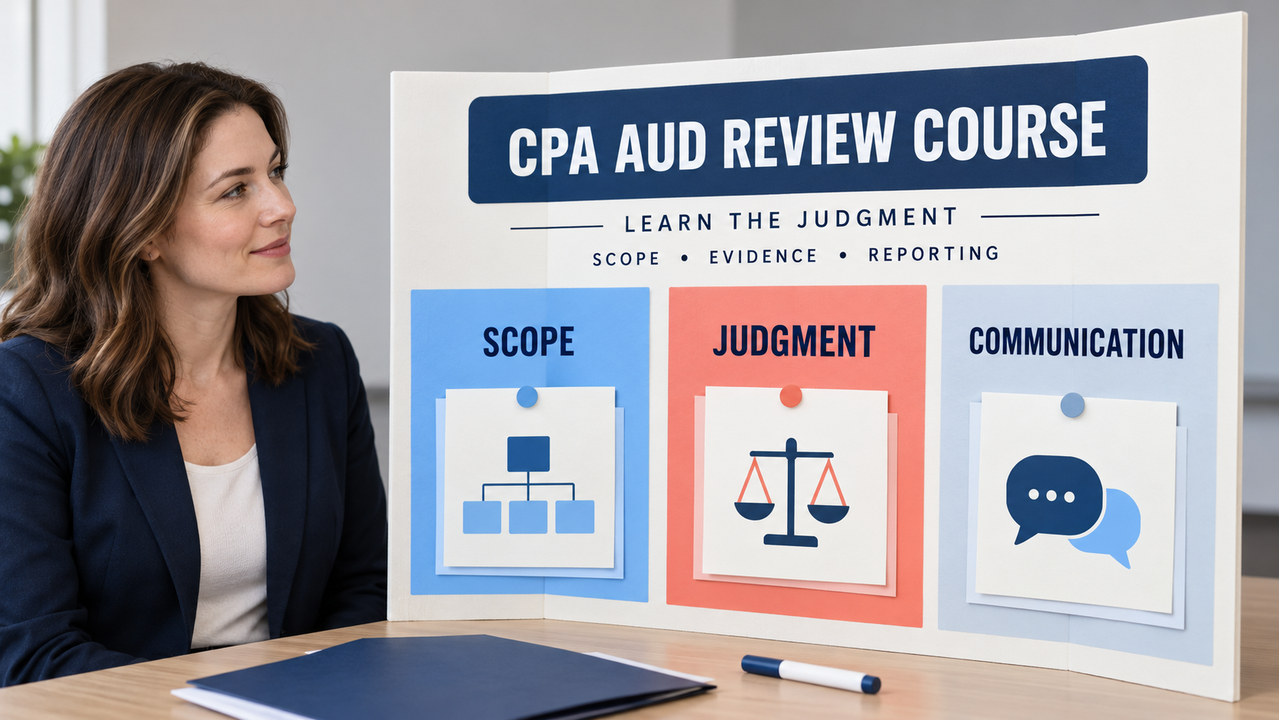

Direct answer: A useful cpa aud review course should map the current Blueprint, teach audit judgment with concrete examples, let you practice both recognition and application, and show how to repair the first gap. Instead, choose a course by the evidence it produces, not by the size of its topic list or a promise about results.
Scope and originality note: This is an original editorial guide for US CPA candidates comparing course functions, not a provider ranking. The curriculum architecture, course-fit scorecard, examples, and study route are written for this page. This guide is not an official, recalled, leaked, provider-owned, or score-predictive exam resource. The editorial role covers scope mapping and source QA. It does not assert a personal licensure claim.
Use the AICPA CPA Exam Blueprint as the scope checkpoint and the current AICPA AUD resources for the subject boundary. Read the Blueprint-format explainer before judging a course outline. Next, use the AUD review overview, topic-based MCQ practice, or TBS practice for the next observable test. Administration questions belong with the NASBA FAQ.
CPA AUD review course: who this page is for
This cpa aud review course guide is for a candidate who wants a complete first stop but does not want a directory of provider claims. It helps a new learner understand the AUD map, helps a returning learner diagnose a weak lane, and helps a course shopper test whether a resource can move from explanation to application.
A review course has several jobs. It should set scope, explain the reason behind a rule, provide a realistic practice task, give feedback that names the broken decision, and support transfer when one fact changes. However, a course can look comprehensive and still leave one of those jobs untested. The checks below make the missing job visible.
See the AUD course architecture in three layers
Use three layers to read a course outline. The layers organize the learner’s work; they do not replace the current Blueprint or claim an official weighting.

Scope: what belongs in the course?
Start with the Blueprint, Area, Group, Topic, task statement, skill level, references, and item type. A course should explain how its lessons map to those fields. Before the lesson expands into ethics, acceptance, independence, or reporting, identify the engagement or service. A clean scope map prevents a long vocabulary list from becoming the learner’s only navigation system.
Judgment: how does the learner decide?
Judgment connects client facts to risk, controls, evidence, and the limits of a conclusion. Look for examples that separate control design from operating effectiveness and tests of controls from substantive procedures. In addition, look for evidence choices that explain relevance, reliability, sufficiency, and appropriateness. When SOC or other attestation material appears, the course should show what a report can establish and what it cannot establish for the engagement.
Communication: how does the work become a conclusion?
Reporting lessons should connect the work performed, unresolved matters, opinion or conclusion, and required communication. A useful example states the condition, the effect on the report, and the information that belongs in the communication. Therefore, the learner should explain why a report changes, not merely memorize a label.
Inspect an AUD review course before you commit
Use a small course-fit inspection instead of relying on a broad feature list. Ask what the course shows, what evidence you can collect, and what test you can run before you make the resource central to your study calendar.

Scope check
Open the current Blueprint and select one AUD row. Can the course locate the row or explain its boundary? If the outline only names chapters, ask how the task statement and skill level appear in the lesson.
Explanation check
Choose one unfamiliar rule and write a plain-language “why.” For example, a useful lesson should connect the rule to an engagement fact, risk, evidence choice, or reporting consequence. It should also identify a limitation or exception when one matters.
Practice check
Match the task to the response format. Use MCQs for recognition and focused TBS work for documents, evidence, calculations, or reporting decisions. Count the explanation after the attempt, not only the number of questions completed.
Feedback check
A good explanation tells you which decision broke first. The label might be scope, reading, risk, control, evidence, calculation, or reporting transfer. If feedback only repeats the answer, add your own error label before the next block.
Transfer check
Change one fact and retry. Change the evidence reliability, control operation, engagement type, reporting condition, or risk level. The course earns a stronger place in your plan when it helps you explain what changed and why.
Run a four-part AUD course study route
Part 1 — map: save the current Blueprint row, the course lesson, and the task verb. Keep the source date beside the note.
Part 2 — explain: write the purpose, risk, evidence, and reporting consequence in plain language. Mark the point where your explanation becomes uncertain.
Part 3 — apply: complete one original MCQ or focused TBS that matches the task. Use the course explanation only after you commit to a response.
Part 4 — transfer: change one fact, explain the new result, and log the next action. Repeat the same loop across older rows so that the course calendar follows evidence rather than novelty.
Keep one row in view until the loop closes. One row defines scope. A task verb names the work. Its proof field names the evidence. Practice reveals the first break. Your error log records the repair. If the same gap returns, change the fact pattern or response format before adding more volume. If the gap disappears, move to the next row with the same evidence standard.
Use original examples to learn AUD judgment
Examples should make the decision visible. Consider four original practice situations:
- Engagement boundary: a service request mixes review language with audit expectations. Name the requested service, responsibility, and conclusion before choosing a procedure.
- Control response: a walkthrough shows a control design, but the prompt asks whether the control operated. Separate design evidence from operating evidence and choose the response that fits the risk.
- SOC boundary: a service-organization report describes a control environment, but the engagement still needs a conclusion about the client’s risk. State what the report supports and what additional work remains.
- Reporting consequence: an unresolved matter affects the work or communication. Identify the condition and evidence effect before naming the opinion, conclusion, or communication.
These examples do not reproduce official exam questions. They show the kind of reasoning a course should make observable: fact, risk, evidence, limitation, and conclusion.
Choose the next AUD course resource
Use the Blueprint-format explainer when the scope fields are unclear. Use the topic-based MCQ page when you need recognition practice. Use the TBS practice page when the task requires exhibits, evidence, documents, or reporting. Return to the AUD review hub after the block. The AUD review overview can help you reconnect a course lesson to the broader section map.
Keep official boundaries separate from resource fit. The Blueprint defines scope. A lesson explains a task. A practice attempt produces evidence. Your error log identifies the repair. None of those alone is a jurisdiction-specific licensure ruling or a pass prediction.
Common AUD review-course traps
- Choosing volume over fit: ask what one lesson, explanation, and retry can prove.
- Confusing a chapter list with a scope map: connect lessons to current Blueprint fields.
- Using recognition as application: add a document or changed-fact task when the objective requires judgment.
- Accepting answer-only feedback: record the first broken decision and request a concrete repair.
- Mixing provider claims with official boundaries: reopen AICPA and NASBA sources for current scope and administration details.
Choose your AUD review course path
Choose the first course function you cannot verify, then run only that test before you add another resource.
Choose your AUD review course path
Name the first thing you cannot verify: scope, explanation, practice, feedback, or transfer. Use the matching course check before buying or switching resources.
- Identify the facts
- Choose the governing rule
- Check the result
Check your reasoning
Answer: Test the first unsupported course function with one Blueprint row, one original practice task, and one written next action.
Use the explanation in this article to verify each step.
Unsupported scope calls for a Blueprint-row check. An explanation gap calls for a plain-language why. Practice gaps call for one matching MCQ or TBS. Feedback gaps call for an error label. When transfer fails, test one changed fact. Repair the earliest missing function, not the most impressive feature list.
CPA AUD review course checklist
- Open the current Blueprint and save the effective date.
- Choose one AUD row and locate it in the course outline.
- Write the engagement purpose, risk, evidence, and reporting consequence.
- Complete one matching MCQ or focused TBS.
- Label the first broken decision and write one repair.
- Change one fact and explain what should change.
The next action is simple: select one Blueprint row, test one course function, and keep the resulting evidence. That is the fastest way to turn a broad cpa aud review course search into a study decision you can defend.
CPA AUD review course FAQ
What should an AUD review course teach first?
It should anchor the current Blueprint, then connect engagement purpose, risk, evidence, and reporting before it expands into practice.
How can I test a course before I commit?
Choose one Blueprint row, write a plain-language why, complete a matching practice task, and record the first error label and changed-fact retry.
Should I use MCQs or TBSs with a review course?
Use MCQs for recognition and focused TBS work when the task requires documents, evidence, calculations, or reporting decisions.