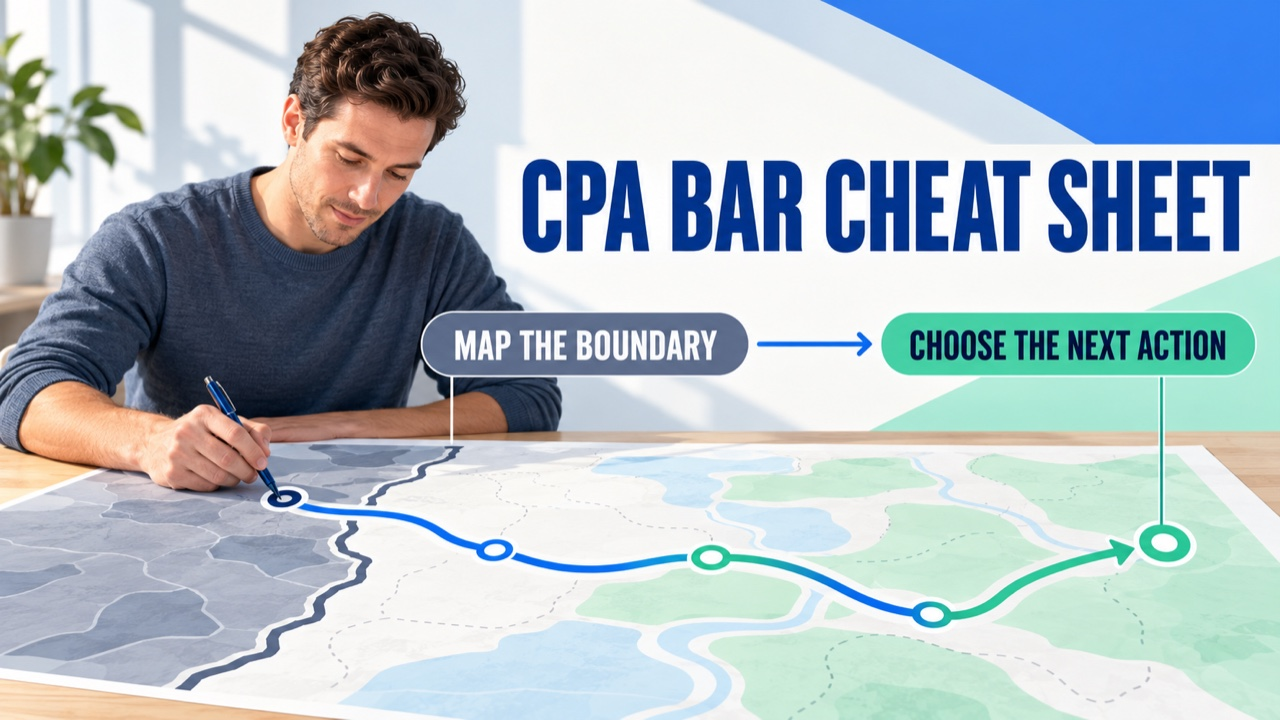

Direct answer: a cpa bar cheat sheet works best as a one-page boundary map. Start with the current Blueprint row, name the task verb, isolate the controlling fact, identify the proof format, and write one next action. The page should help you decide what to study next, not become a crowded list of every BAR rule.
Scope and freshness note: This is original editorial study guidance for the US CPA audience. It is not an exam-authority publication, tax conclusion, legal conclusion, licensing decision, or personal readiness score. Reopen the AICPA CPA Exam Blueprints and the NASBA CPA Exam FAQ before relying on a current boundary, task statement, or administration detail.
Use the BAR review hub when you need the section overview. Open the Blueprint format guide when a row or task verb is unclear. Move to MCQ practice by topic for rule recognition and discrimination, or use the TBS practice guide when the output depends on exhibits, calculations, or several evidence fields. The CPA exam study guide can hold the wider weekly plan after this page selects the immediate handoff.
For a broader preparation path, continue with our related CPA study resources.
cpa bar cheat sheet: start with the boundary
This page is for a candidate who knows BAR is broad but keeps losing time between an outline, a practice set, and a review note. A useful cpa bar cheat sheet gives that candidate a repeatable handoff. Write the section, topic, task verb, input, proof, and next action in that order. If one field is missing, the sheet should expose the gap instead of disguising it with more highlights.
The first line should answer a simple question: “What am I trying to produce?” The verb may ask you to calculate, analyze, interpret, compare, evaluate, or explain. That verb changes what counts as a useful practice attempt. A calculation needs an input and a checkable result. An analysis needs a reasoned connection. An interpretation needs a defined meaning. Do not choose a practice format until the requested output is visible.
Keep the boundary narrow enough to use in one sitting. A page that promises to summarize every BAR topic becomes a second textbook and still leaves the learner unsure what to do. A focused map can point to a deeper article later. It can also show when the current source is too old, too broad, or aimed at a different item type.
Use the cpa bar cheat sheet to set the Blueprint boundary
Begin each session with the current AICPA Blueprint. Treat it as a scope reference for tested content, task statements, skill levels, references, and item types. It is a boundary for planning, not a promise about an individual exam form. Copy the row title in your own words, then keep the official source open so your paraphrase can be checked.
Give the row four short fields:
- Scope: the topic area and the row you are working from.
- Task: the action the learner must perform, such as analyze or calculate.
- Trigger: the fact, input, assumption, or change that controls the result.
- Proof: the source, exhibit, computation, or explanation that would let another person check the response.
These fields prevent a common error: studying a familiar label while missing the task beneath it. “Valuation” can mean different work from “reporting,” and a familiar rule can still be the wrong answer when the fact pattern changes. If the row is not specific enough to choose a proof format, use the Blueprint format guide before opening a large practice bank.
Write a boundary sentence beneath the four fields: “For this block, I will explain one BAR topic, test one controlling input, and save one proof.” That sentence makes the sheet useful as a navigation page. It also gives the next session a clean starting point.
Map four lanes on the cpa bar cheat sheet
A strong cpa bar cheat sheet does not flatten BAR into a pile of terms. Use four lanes to keep major areas visible without duplicating every supporting article:
- Financial statement analysis: follow how a reported amount, trend, or relationship is interpreted. Mark the input that makes the interpretation change.
- Reporting and measurement: identify the measurement basis, presentation choice, or reporting consequence that the task asks you to evaluate.
- Forecasting and valuation: separate the assumption from the resulting estimate. Record which assumption would move the conclusion and why.
- Strategy and government or nonprofit context: name the purpose, constraint, or accountability setting before choosing evidence. The same word can require a different explanation when the reporting context changes.
These lanes are orientation labels, not a substitute for the current Blueprint. The value is the handoff: each lane tells you what kind of trigger to look for. In financial analysis, begin with a trend or ratio. A measurement note can start with a basis or classification. For valuation, write the assumption first. In a government or nonprofit context, name the reporting purpose. The sheet stays short because it records the trigger and proof, not every definition.
When two lanes overlap, keep both names and state the difference in one sentence. For example, “The measurement lane determines the basis; the analysis lane explains what the resulting amount means.” That distinction is more useful than a long list of linked headings.
Build the cpa bar cheat sheet route from fact to proof
Now turn the map into a route. The route should be visible on the page and in your notes: topic leads to controlling fact, the fact leads to a source, the source leads to a practice mode, and the practice result leads to a next action. If the route stops at “review,” it is not finished. Name what will be reviewed and how you will know the review worked.

For a short example, imagine a BAR prompt that asks you to evaluate a forecast after an assumption changes. For this example, the topic is forecasting and the trigger is the changed assumption. Use the calculation plus a sentence explaining the direction of change as proof. A calculation-heavy response may fit a TBS-style attempt, while a quick rule distinction may fit an MCQ. The next action could be “change the assumption once more and explain why the conclusion moves.”
Use a red-pen test before you leave this section. Circle every sentence in your note that cannot be checked. For each circled sentence, add one of four things: the exact input, the source location, the calculation step, or the reason the practice mode fits. This test keeps the sheet from becoming motivational language that cannot guide a new item.
The route also protects against over-collecting resources. If the current proof is a source paragraph and one changed-fact explanation, opening six more articles is not progress. Save the missing proof point, complete the smallest retry that can test it, and then decide whether the gap remains.
Choose practice with the cpa bar cheat sheet gap rule
Use the gap, rather than habit, to choose MCQ or TBS practice. A cpa bar cheat sheet should make that decision visible in one line: “I need to recognize the rule,” or “I need to build and defend an output.” That distinction is more reliable than choosing the item type you find most comfortable.
Use MCQ when the gap is recognition
Choose an MCQ block when you need to discriminate between close rules, identify the controlling fact, or explain why a distractor fails. Before you answer, write the trigger in a few words. After you answer, record the strongest distractor and the fact that defeats it. If you cannot explain the distractor, the result is a signal to reopen the source, even when the percentage looks good.
Use TBS when the gap is transfer
Choose a TBS-style attempt when the task requires exhibits, calculations, several evidence fields, or a constructed explanation. Start by naming the requested output. Then label the input, the step where the input changes, and the check that would catch an arithmetic or interpretation error. A partial response can still be useful when it tells you exactly which proof field is missing.
Switch formats when the evidence says to switch. A string of correct MCQs with weak explanations points toward a transfer attempt. A TBS miss caused by one misunderstood term points back to a narrow recognition block. The sheet should record this decision so the next session does not repeat the same comfortable pattern.
Run the cpa bar cheat sheet review checklist
Use the checklist below after one source review and one practice attempt. Mark a line only when you can show the evidence. The first unchecked line is the next action; it is not an official readiness score.
When the checklist is complete, write one sentence that joins the fields: “When this trigger changes, this output changes because this source-backed reason; I will test it with this practice mode.” The sentence is deliberately small. It gives you a clear restart point without pretending that one session measures the whole exam.
Repair one gap with the cpa bar cheat sheet
Repair begins with the first missing proof point, not the most interesting topic. When the scope is unclear, reopen the Blueprint. For a missing trigger, rewrite the fact pattern and underline the input that moves the result. A source gap calls for the relevant reference and a plain-language note. When the proof format is unclear, compare one MCQ explanation with one TBS output and state which better matches the task verb.
Finish the repair with a changed-fact retry. Change one material fact, keep the rest of the prompt stable, and explain whether the answer should change. If it should change, name the step where it changes. If it should not, say why the boundary holds. This retry distinguishes memorized wording from a usable rule and gives the next review block a concrete target.
Save the retry with a date, the Blueprint row, the changed fact, and the proof you checked. Do not label the note “mastered” because one attempt went well. Label it with the next evidence you still need. A precise unfinished note is more useful than a vague confidence statement.
Route the cpa bar cheat sheet to the next resource
Use the page that matches the missing field. Start with the BAR review hub when you need section orientation. The Blueprint format guide fits a scope, task-verb, or item-type question. A rule-recognition gap belongs on the MCQ-by-topic page. An exhibit, calculation, or constructed-output gap belongs in the TBS practice guide. Place the result into a weekly plan with the wider CPA exam study guide after the immediate gap is named.
Keep one clear handoff at the bottom of the sheet: “Open this resource, complete this bounded attempt, and save this proof.” That is enough navigation for a section landing page. It prevents the page from becoming a directory and keeps the next action connected to the reader’s actual evidence.
cpa bar cheat sheet FAQ
Should I study every BAR topic in the same order?
No. Start with the current Blueprint and the first evidence gap. Keep the four lanes visible, but let the task verb and requested output choose the next block.
Is a high practice percentage proof that I am ready?
No. A local percentage is not an official CPA score or readiness determination. Record the trigger, the reason the answer works, and whether one changed fact changes the response.
When should I use MCQ versus TBS practice?
Use MCQ for rule recognition and discrimination. Use TBS-style practice for exhibits, calculations, multiple evidence fields, or a constructed explanation. Let the task verb decide.
What should I do after a miss?
Save the first missing proof point, reopen one relevant source, rewrite the boundary in your own words, and retry one new item after changing one material fact.
Sources
- AICPA CPA Exam Blueprints
- NASBA CPA Exam FAQ
- BAR review hub