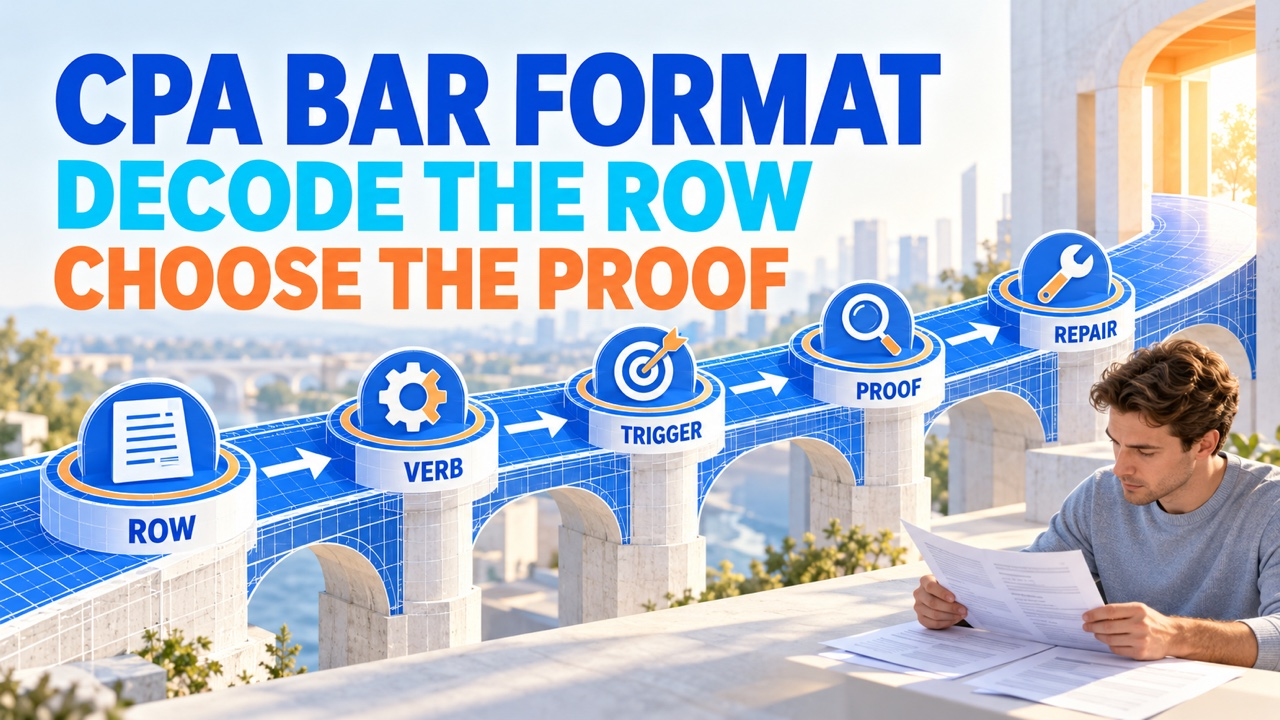

Direct answer: cpa bar exam format becomes useful when you decode one current Blueprint row into five things: the topic, the task verb, the fact that can move the result, the proof you will produce, and the next handoff. That sequence gives a candidate a bounded study block. It also keeps a local practice note from being mistaken for an official score, prediction, or licensing conclusion.
Scope and freshness note: This is original study guidance for the US CPA audience. It is not an exam-authority publication, tax conclusion, legal conclusion, licensing decision, or professional conclusion. Reopen the AICPA CPA Exam Blueprints for current tested-scope and task boundaries and the NASBA CPA Exam FAQ for administration details before relying on a moving boundary.
Start broad with the BAR review hub. Then use the Blueprint format guide to read a row, the CPA MCQ by topic page for recognition gaps, or the CPA TBS practice guide when the response requires exhibits or a workpaper.
For a broader preparation path, continue with our related CPA study resources.
cpa bar exam format: decode five layers before you practice
The word “format” is overloaded. A candidate may be asking what BAR covers, what a task statement asks for, which skill level is in play, what item type will show the skill, or how a study block should be recorded. Put those layers in order instead of searching each one as a separate fact.
- Row: identify the current Area, Group, Topic, task statement, skill level, reference, and item type.
- Verb: translate the task into an action such as calculate, evaluate, classify, identify, or recommend.
- Trigger: name the fact, input, role, date, assumption, or criterion that can change the response.
- Proof: choose the source, exhibit, calculation, explanation, or reconciliation that would make the response inspectable.
- Handoff: decide which one resource, question type, or retry belongs in the next block.
This decoder prevents a familiar label from doing all the work. “Forecasting” does not tell you whether the task is to calculate a sensitivity, evaluate an assumption, or explain a decision. The verb and trigger do. “Reporting” does not tell you whether a short explanation or an exhibit trail will prove the answer. The requested output does.
cpa bar exam format: make the Blueprint row the format anchor
Use the current Blueprint as a boundary marker, not as a promise about a particular exam form. Copy one row into a study note and leave neighboring rows collapsed until the first response is complete. Record the task language exactly enough to preserve the requested action, then rewrite it in plain English. That second sentence is where you decide what a successful response must contain.
A useful note might read: “Evaluate a reporting choice; trigger is the stated objective and measurement basis; proof is a short comparison with one source reference; next handoff is a five-question discrimination set.” Another row might read: “Calculate a forecast sensitivity; trigger is the changed volume assumption; proof is an input-to-output workpaper; next handoff is a TBS-style exhibit task.” Both are BAR work, but their proof footprints are different.
Do not turn this note into a personal readiness claim. A correct practice answer shows that one task was handled under one set of facts. It does not establish an official score, a passing probability, or a licensing result. Those boundaries belong in the note beside the format fields.
Use four BAR lanes, each with its own proof footprint
A section overview is helpful when it distinguishes the work rather than collecting every possible topic. Use four lanes as a navigation map:
- Analysis: connect the measure to its definition, input, variance, and decision use. The proof footprint is a labeled input and a reasoned interpretation.
- Reporting and measurement: keep the reporting objective, data source, assumption, and presentation effect together. The proof footprint is a boundary explanation tied to the objective.
- Forecasting and valuation: separate volume, price, timing, risk, capital structure, and sensitivity drivers. The proof footprint is an input trail with an output check.
- Strategy and public-interest context: match the decision to the entity, constraint, purpose, and decision-maker. The proof footprint is a recommendation with its governing evidence.
These lanes are orientation tools, not substitutes for the current source. They help you choose the first question or exhibit. If the row and the lane disagree, reopen the Blueprint and preserve the row boundary.
Write a five-field format note before opening a set
Before practice, write five short lines: row, verb, trigger, proof, and handoff. Add a sixth line only when timing itself is the observed problem. This format is compact enough to keep beside an item and specific enough for another learner to audit.
Use the verb to keep the block honest. If the verb is “evaluate,” an answer that only defines a term is incomplete. When the verb is “calculate,” an answer without inputs and an output check is incomplete. For a recommendation verb, the response needs a decision criterion and a stated reason. That trigger tells you which sentence, number, or relationship deserves a second look.
The proof line should name an artifact, not a feeling. “I understand” is not proof. “I can point to the assumption, show the calculation, and explain why the nearest alternative fails” is proof. The handoff line then chooses one bounded next step, such as a short MCQ set, one exhibit task, or a changed-fact retry.
Use the format route from row to proof
The route is a continuous handoff: Blueprint row → task verb → controlling trigger → source or exhibit → practice mode → repair action. Each arrow represents a decision that can be checked. If you cannot name the trigger, return to the row. When the proof is available but the distractor or wrong turn is still unclear, keep the item in review. Afterward, read the visual once, close it, and reconstruct the sequence from memory.

The goal is not to memorize a poster. The goal is to notice which handoff is missing. A blank trigger needs row work; a blank proof needs source or exhibit work; a blank next action needs a smaller practice block.
cpa bar exam format: pick MCQ or TBS by the output
Choose the item type after you name the requested output. This prevents a habit such as doing only multiple-choice work because it feels faster.
Use MCQ for recognition and boundaries
Use an original MCQ block when you can read the row but confuse definitions, rules, measures, or distractors. Keep the set short enough to write a complete explanation. Before selecting an answer, underline the verb and circle the trigger. Afterward, write why the nearest wrong option fails. A letter without a reason cannot show whether the boundary was understood.
Use TBS-style work for evidence assembly
Choose TBS-style work when the gap is assembling exhibits, reconciling fields, performing a calculation, or writing a multi-step recommendation. Start with one requested output and one evidence field. Name the exhibit or source that supplies the field, then show the work in the order another learner would inspect it. Shrink the next attempt if the response is too large to audit.
Both modes can belong to one study week. The format note tells you which one comes first. A recognition gap usually needs an MCQ explanation before a long workpaper. An evidence-assembly gap usually needs a small TBS task before more definitions.
Run the BAR format-to-repair checklist
Use this checklist at the end of a focused block. Mark only decisions you can explain from one current row. The first unchecked line becomes the next action; it is not an official readiness score.
cpa bar exam format: repair the first miss with one controlled change
After a miss, record what the stem asked, what controlled the response, what proof was missing, and why the strongest distractor failed. If the answer was correct but the explanation was vague, keep it in review. When the answer was wrong but the missing field is precise, the repair note already has value.
Then change one material fact while keeping the verb fixed. Change the objective while holding the data constant, change volume while holding price constant, or change the role while holding the transaction constant. State whether the response changes and identify the evidence that moved with it. One controlled change tests transfer more honestly than a larger mixed set.
If the row is current-sensitive, write the source checkpoint beside the retry. Reopen the live authority before reusing a note about scope, administration, tax, reporting, legal rules, or technology. The study method can stay stable while the boundary is refreshed.
cpa bar exam format: choose one next resource, then stop browsing
Visit the BAR review hub when you need orientation across the section. Open the Blueprint format guide when the row or skill language is unclear. Use CPA MCQ by topic for recognition and distractor work. For exhibits, calculations, reconciliations, and constructed outputs, open CPA TBS practice.
Before opening another tab, attach one destination to the first unchecked line. Write the next block as row, item type, trigger to change, proof to save, and time box. Then close the extra tabs. A clean handoff is part of the cpa bar exam format because it leaves a decision that can be repeated.
cpa bar exam format FAQ
Does format mean the same thing as the exam blueprint?
No. The Blueprint defines tested scope and task language. Your format note adds the trigger, proof artifact, and next handoff for study. Reopen the current Blueprint when the row or item type is unclear.
Should I begin with MCQ or TBS work?
Begin with the output you cannot yet prove. Use MCQ for recognition and rule boundaries. Use TBS-style work for exhibits, calculations, reconciliations, or multi-step outputs.
Can a practice percentage show that I am ready?
No. A local percentage is practice evidence, not an official score or readiness determination. Keep the trigger, proof, distractor, and changed-fact result with the item.
What should I save after a miss?
Save the task verb, controlling trigger, missing proof point, strongest wrong turn, and one changed-fact retry. That record selects the next resource better than a percentage alone.
Sources
- AICPA CPA Exam Blueprints
- NASBA CPA Exam FAQ
- BAR review hub