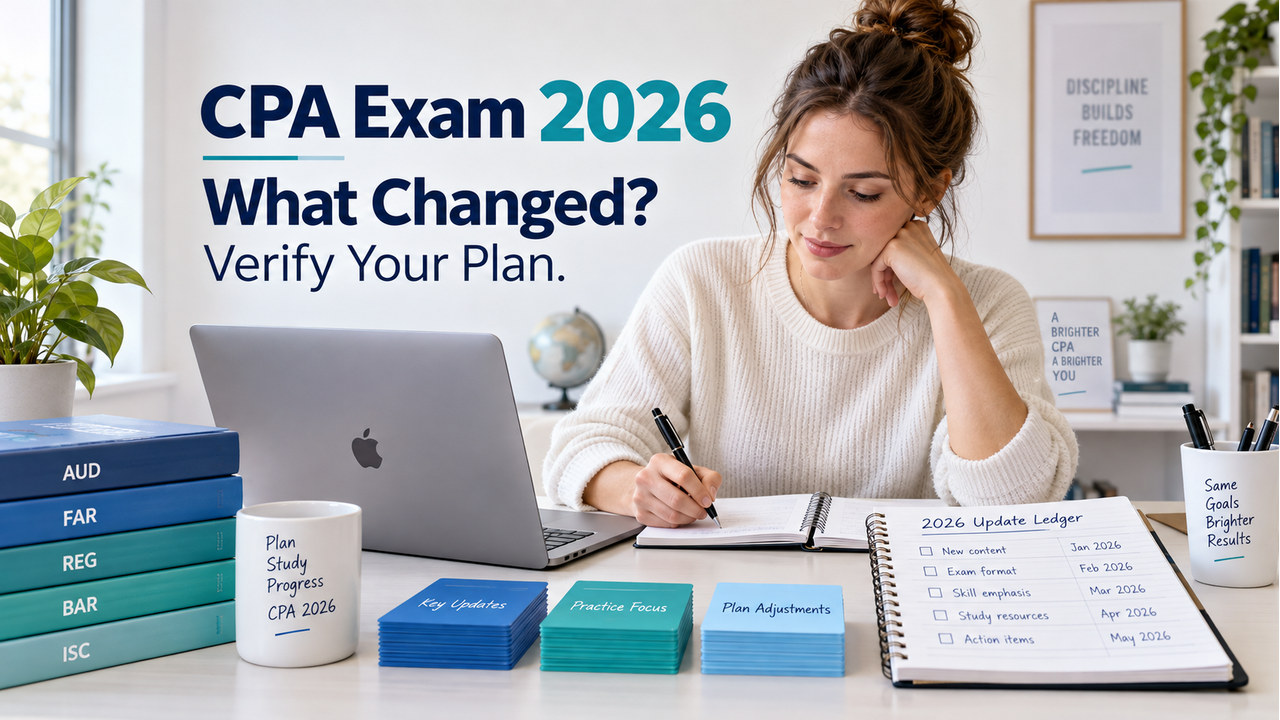

Quick answer: This cpa exam 2026 update is checked as of September 11, 2026: the exam uses three Core sections—AUD, FAR, and REG—plus one Discipline choice: BAR, ISC, or TCP. The 2026 Blueprints are effective January 1, 2026. The practical question is not whether every page with “2026” in its headline is current; it is which fact changed, which official source controls it, and what you need to verify in your own study materials.
Checked for this edition: September 11, 2026
Update owner: CPA Exam Prep editorial team. Recheck this page when AICPA releases a new Blueprint, NASBA changes candidate guidance or score information, a tax-law eligibility date moves, or an announced future platform change becomes current.
For a broader preparation path, continue with our CPA Exam Study Guide.
CPA Exam 2026: The Short Answer
What Is Current for the CPA Exam 2026?
The current exam path is a four-section structure: three Core sections and one selected Discipline. The Core sections are Auditing and Attestation (AUD), Financial Accounting and Reporting (FAR), and Regulation (REG). The Discipline branch contains Business Analysis and Reporting (BAR), Information Systems and Controls (ISC), and Tax Compliance and Planning (TCP). A candidate takes the three Core sections and chooses one Discipline; the six labels are not six required exams.
For tested-content questions, the current AICPA Blueprint is the controlling reference. It organizes what can be tested through Areas, Groups, Topics, task statements, skill levels, references, and item types. For administration questions such as scores, notices, or candidate procedures, use current NASBA information. For eligibility and licensure, use the board or jurisdiction where you are applying.
Why a date and owner matter
“Updated for 2026” is not enough evidence by itself. A page can have a new title while retaining an old schedule, a historical section label, or a state-specific example presented as if it were universal. This guide therefore uses a small Update Ledger. Each entry records the effective date, the source owner, the decision it affects, the candidate action, and the next time to check it.
What Is Current in the CPA Exam 2026?
The CPA Exam 2026 Structure Still Needs Version Checks
The Core-plus-Discipline structure is the starting map for 2026 planning. It answers the first orientation question, but it does not replace the section-specific Blueprint. A section name tells you the domain. The Blueprint tells you the tested hierarchy and the kind of performance a task statement expects.
One useful format reminder is that each section is delivered through two multiple-choice question (MCQ) testlets followed by three task-based simulation (TBS) testlets. Use that information to vary practice: recognition and calculation work should eventually connect to document interpretation, procedures, analysis, or a multi-step conclusion. Do not treat a format description as a prediction of a particular item.

What the 2026 Blueprints control
The AICPA Blueprint page is the right place to check whether a topic, task, reference, skill level, or item type belongs in your current study plan. Start at the section, move to the relevant Area and Group, and read the task statement rather than relying on a review-provider summary. Keep the effective date beside your notes so that a later edition can be compared rather than silently mixed with the current one.
This also creates a boundary for this article. It gives a current map and a verification method; it is not a substitute for reading the full Blueprint, a jurisdiction application, or a candidate’s complete preparation course.
The CPA Exam 2026 Update Ledger
Here is the short change log for this edition. It is intentionally bounded: a useful ledger should help you decide what to check next, not become an archive of every announcement.

| Date or status | What the source says | What a candidate should do |
|---|---|---|
| January 1, 2026 Current |
The 2026 Uniform CPA Examination Blueprints became effective. They are the version to compare with a study resource that claims current coverage. | Write the Blueprint version in your notes and compare only the section or chapter you are about to study. |
| July 1, 2026 Content timing |
AICPA update material identifies provisions of H.R. 1, also referred to as the One Big Beautiful Bill Act (OBBBA), with 2024 or 2025 effective dates as eligible for testing in REG and TCP beginning July 1, 2026. | Check the current AICPA update and the affected REG or TCP material. Mark this as content timing, not as a claim that the whole exam was redesigned. |
| Future: July 2027 Not a 2026 content change |
AICPA has discussed a future delivery-platform and user-interface transition. Its future status matters for planning, but it is not evidence of a 2026 tested-content change. | Keep the note separate from your 2026 Blueprint comparison and recheck the official announcement before the transition window. |
How to Read a CPA Exam 2026 Update Without Overreacting
Each row answers a different question. The January row tells you which Blueprint edition to use. The July row tells a REG or TCP learner to inspect a particular tax-law update and its testing timing. The future row tells you not to move a 2026 study plan solely because an interface transition has been announced. The ledger is useful precisely because it narrows the affected decision.
If a source does not identify an effective date or affected section, treat the claim as a lead for verification, not as a completed change. Save the URL, capture date, and your unresolved question in the same record.
Which Official Source Controls Which CPA Exam 2026 Question?
Current-year research becomes easier when ownership is explicit. The most common mistake is to use a correct source for the wrong type of question—for example, using a review-provider schedule to answer a state-board eligibility question or using a Blueprint page to answer a score-release question.
| Your question | Controlling source | What to verify |
|---|---|---|
| Is this topic or task in the exam? | AICPA CPA Exam Blueprints | Section, Blueprint effective date, Area, Group, Topic, task statement, skill level, and item type. |
| When should I expect a score or what candidate process applies? | NASBA score information, FAQ, and Candidate Guide | The live notice, target-date caveat, NTS or candidate procedure, and any current status note. |
| Am I eligible in my jurisdiction? | The relevant state board or licensing jurisdiction | Education, experience, credit, fees, application steps, and deadlines that apply to you. |
| Does a tax-law update affect my study material? | AICPA update notice plus the current REG or TCP Blueprint | Effective date, affected section, testing-eligibility date, and your provider’s matching revision. |
Commercial study pages can still be useful for explanations and navigation. Use them as secondary teaching aids, not as the final owner of a moving rule. If their visible update date, terminology, or claim conflicts with an official source, pause and resolve the conflict before changing your plan.
How to Check Whether Your CPA Study Materials Are Current

A freshness check should be narrow enough to finish. You do not need to audit every page of every book before studying. Check the next section you plan to open, record the evidence, and expand the comparison only if the official source shows a material change.
Step 1: identify the type of claim
Label the claim as content, administration, or licensure. “Is this task tested?” is content. “When might my score appear?” is administration. “Do my education hours qualify in my state?” is licensure. The label tells you which source owner to open first.
Step 2: record the version and date
Write the resource edition, the official page title, the date you checked it, and the effective date shown by the source. If a page has no clear date, do not invent one. Write “date not stated” and flag the claim for an editor or authority to confirm.
Step 3: Compare the CPA Exam 2026 Chapter Only
Match the official section, Area, Group, Topic, or task statement to the chapter or video in your study resource. Look for three kinds of mismatch: a topic that is missing, a rule that is described for the wrong effective period, or a former label presented as current. Do not rewrite unrelated chapters because one row in the ledger changed.
What Should You Verify First?
Use the source owner and the affected decision to choose one next check; do not rebuild your entire plan from a headline.
- Identify whether the claim is content, administration, or licensure
- Open the official source owner for that claim
- Record the version or effective date
- Compare only the affected chapter and set a recheck
Check your reasoning
Answer: Use all four in order. The next action depends on the claim owner: AICPA for tested content, NASBA for exam administration, and the relevant state board for licensure.
A dated, narrow check is more reliable than replacing every study resource whenever a commercial page uses a new headline. If the official page is unclear, pause the claim and ask the relevant authority or editor before treating it as current.
Step 4: run a bounded practice check
After marking a possible gap, complete a small set that matches the topic and item type. Record whether the problem was a missing rule, a wrong setup, a calculation error, a reading error, or an inability to explain the conclusion. The practice check is not an official question bank and should not be presented as one; it is evidence about your own study need.
Step 5: set the next recheck
Choose a date or trigger for the next review. A fixed date works for a stable Blueprint comparison. An event trigger works for a live issue: a new AICPA release, a NASBA status change, a state-board notice, or a provider revision. If the official source remains unchanged, keep the record and move on.
Worked example: a REG chapter after the July timing note
Imagine that your resource has a REG chapter covering a tax area affected by the July 1, 2026 testing-eligibility note. Your ledger row should say: Source checked—AICPA update and current REG/TCP Blueprint; date checked—September 11, 2026; affected decision—whether this chapter is ready for current REG or TCP study; action—compare the chapter’s effective-period language, complete a targeted practice set, and mark any mismatch; next recheck—when AICPA publishes another relevant update or the provider posts a revision.
Notice what this record does not say. It does not claim that every tax answer changed, that every candidate must rebuild a course, or that a commercial page is wrong merely because it uses different wording. It isolates the part that needs evidence.
Turn a 2026 Update Into a 30-Day Study Reset
When the freshness check finds a real gap, use a reversible reset rather than abandoning the entire calendar. The following 30-day sequence is a planning example. Adjust it to your workload, application status, and the section you are preparing.
Days 1–3: define the gap
Open the official source, write the effective date, and identify the affected Blueprint section and task statement. Highlight the exact paragraph or chapter in your resource that needs comparison. If the source does not clearly establish the claim, keep it in a “verify” list instead of turning uncertainty into a study instruction.
Days 4–10: repair the explanation
Read the authoritative explanation and rewrite your own study note in plain language. Put the rule, the trigger facts, the expected task, and one boundary case on the page. If the issue is a tax-law timing item, write the effective period beside the note. If it is a format or administration issue, do not blend it into the content note.
Days 11–21: test the affected skill
Use a bounded practice set that matches the task. For a calculation, show the setup before the arithmetic. For a TBS-style reasoning task, list the documents, the decision rule, and the conclusion. For AUD or ISC work, explain why the evidence or control response fits the stated risk. For a content-heavy reading gap, close the book and summarize the rule before checking your wording.
Days 22–30: decide and schedule
Review your error categories. Keep the original plan if the gap is repaired; insert a short reinforcement block if one category remains; or move the checkpoint if the official material is still in transition. Record what changed and the next source-check trigger. A study plan that can absorb verified changes is more useful than one that looks precise but cannot be updated.
This approach also protects your time. The purpose of a current-year update is to improve the next decision, not to make you restart every topic whenever a headline changes.
What an Older CPA Exam Guide May Get Wrong
A former section label used as a current requirement
The former BEC label is historical transition context, not a current instruction to take an additional section. If an older page presents it as a present-day requirement, compare the page with the current Core-and-Discipline structure and date the older explanation before using it.
A frozen score or schedule table
NASBA publishes current score information and target dates, but target dates can change. A screenshot or table copied from an earlier edition may be useful for history and still be unsafe as your current appointment or score plan. Open the live NASBA page when the date matters.
A state rule presented as universal
Education, experience, fees, credit windows, and application details can depend on the jurisdiction. A general guide can tell you where to look; it cannot turn one state’s rule into a nationwide answer. Write the jurisdiction beside the claim and verify it with the responsible board.
A difficulty ranking treated as a decision
“Hardest section” lists compress different backgrounds, study resources, and task types into one opinion. Use a ranking only to generate questions. Replace the conclusion with your Blueprint check, targeted practice, error category, and calendar evidence.
CPA Exam 2026 FAQ
Is the CPA Exam 2026 Being Redesigned Again?
The 2026 planning answer depends on what you mean by “redesigned.” The current section structure and the 2026 Blueprints are the content baseline. The July 1 REG and TCP note concerns testing eligibility for specified tax-law provisions. A future July 2027 delivery-platform or interface transition is a separate, future item—not evidence that the 2026 Blueprint has been replaced.
Do I take all three Discipline sections?
No. The current map has three Core sections and one Discipline choice. Use the current AICPA material for section and task details, then use your own evidence to decide what to study. Do not let an old six-label list turn one choice into three required exams.
Where should I check a score-release date?
Use the current NASBA Score Information page. Treat listed dates as live targets rather than permanent promises, and read the page’s current status notes. This article does not freeze a calendar because the authoritative page can change.
Does this guide determine whether I am eligible to sit or become licensed?
No. Exam structure and licensure are different decisions. Check the current state-board or jurisdiction guidance for education, experience, application, credit, and fee requirements. If a NASBA procedure is involved, use NASBA’s current candidate information as well.
How Often Should I Check CPA Exam 2026 Study Materials?
Check before starting a section, when a source publishes a relevant update, and when your provider labels a revision. A short dated ledger entry is enough for a stable topic. For a live tax, administration, or jurisdiction issue, use an event trigger and recheck the official owner.
Your Next Verification Step
Create your first ledger row today
Open the current AICPA Blueprint for the next section you plan to study. Write five items: the page URL, the date checked, the effective date, the affected task or chapter, and your next practice action. If your question is about a score, notice, or candidate process, switch to NASBA. If it is about eligibility or licensure, add your jurisdiction and open the relevant state-board page.
That five-line record is the most useful first move after reading a current-year article. It gives you a source, a boundary, an action, and a reason to revisit the decision—without turning a changing exam environment into a pile of undated summaries.