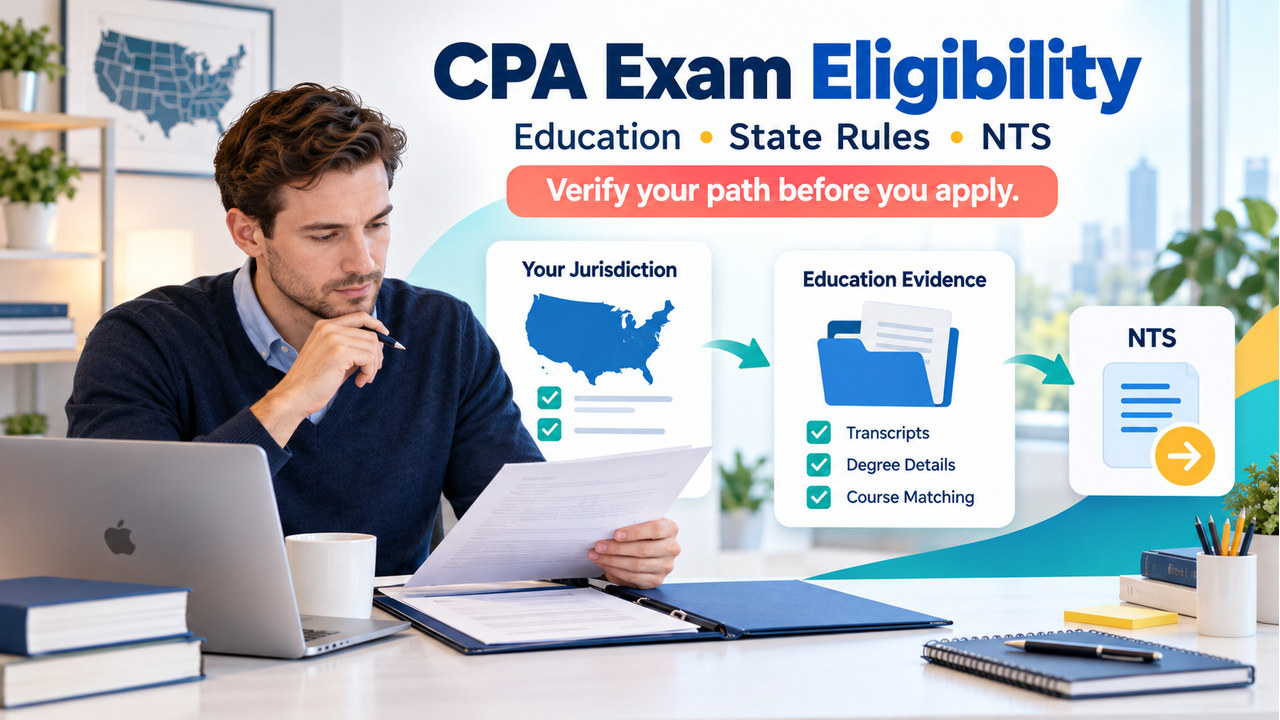

Quick answer: the state or territory that handles your exam file decides cpa exam eligibility, not one national credit number. The national exam has a shared structure, but education, subject-credit, document, identity, residency, application, and later license rules can differ by jurisdiction. Therefore, your first job is to identify the right authority and prove which current rule applies to your records.
This guide is a planning map checked against official AICPA and NASBA guidance on September 13, 2026. It helps you organize questions and evidence; it is not an eligibility decision, legal advice, an NTS, or a license. Reopen the current board or candidate-service instructions before sending records or paying a fee.
What Does CPA Exam Eligibility Mean in 2026?
In practical terms, eligibility answers a narrow question: does the responsible jurisdiction allow this candidate to apply for and sit for an exam section under its current rules? It differs from choosing a study product, finding a convenient test center, or completing every requirement for a CPA license. Keeping those questions separate prevents a general article from turning a useful explanation into a false personal conclusion.
Meanwhile, the current exam model is common across the U.S.: three Core sections—AUD, FAR, and REG—plus one Discipline choice from BAR, ISC, or TCP. AICPA describes the exam scope through its current Blueprint, including areas, groups, topics, task statements, skill levels, item types, and weights. That Blueprint tells you what may be tested; it does not decide whether your school record satisfies a particular board.
Think of the route as three linked but separately owned layers:
What CPA Exam Eligibility Has to Answer
- Exam scope: AICPA materials describe the assessment and the Blueprint version that applies to your testing window.
- Exam eligibility: the state or territory and its candidate-service path decide whether your file qualifies for a section application.
- Licensure: after the exam, the licensing jurisdiction may require experience, ethics, education, identity, residency, or other evidence before issuing a license.
Therefore, the safest answer is not “you need exactly X credits.” It is “find the jurisdiction owner, read the exam-stage rule, match your evidence to that rule, and stop when an official decision is still missing.”
Choose the Jurisdiction Before You Count Credits
First, start with the jurisdiction that makes sense for your intended license and future work path. Do not choose a state only because a search result shows an easy-looking number, a short processing time, or a nearby appointment. The jurisdiction that handles your file may have rules that matter later, and those rules may not match a neighboring state.
There are three locations to keep distinct:
The Decision Owner Behind CPA Exam Eligibility
- License jurisdiction: the state or territory whose board may ultimately evaluate the license path.
- Exam-file jurisdiction: the board or candidate service that receives, evaluates, or routes the records needed to apply for a section.
- Testing location: the Prometric site where you actually sit after the required approval. A convenient location does not replace the first two decisions.
After that, some routes point these labels to the same place; in others, the candidate-service handoff makes ownership less obvious. Write down the exact jurisdiction name, the official board or service page, and the question that page answers. If you cannot name the owner, you are still researching—not ready to rely on the conclusion.
Match Each Eligibility Question to Its Owner
| Question you have | Evidence you should name | Likely decision owner |
|---|---|---|
| May I sit for a section? | Current exam-stage rule, education record, subject credits, and identity/file items. | The selected state or territory and its named candidate-service route. |
| Will this course count? | Official transcript, course title or description, credits, and the rule category. | The board or review service specified by that jurisdiction. |
| Can I test somewhere else? | A valid authorization and current scheduling instructions. | The official exam path plus the testing provider. Location does not change eligibility. |
| Will I receive a CPA license? | Post-exam experience, ethics, education, identity, and application evidence. | The licensing board; a passed exam alone is not the license. |
Use this as an ownership map, not as a substitute for a board’s current instructions. The valuable detail is the separation: when a page gives a broad answer, you can immediately ask which owner and which evidence make that answer applicable to you.
Build an Education Evidence File
Once the jurisdiction is chosen, collect evidence in the same categories that its rule uses. A degree name by itself is rarely a reliable substitute for the official record. The board may care about total education, named accounting or business subjects, the way credits are counted, the timing of completion, and how the record is delivered.
Organize Evidence for CPA Exam Eligibility
Next, make two columns in your notes. In the first, record what you can prove: school, degree, completion date, course title, credit value, transcript wording, and document status. In the second, write the conclusion you hope the board will reach. Do not merge the columns. “The transcript lists Intermediate Accounting” is evidence; “the board will count it for the required category” is a decision that may still need confirmation.
That small separation is especially useful when a course title is translated, abbreviated, unusually broad, or similar to a category but not clearly inside it. Instead, mark it for review rather than quietly counting it twice.
Use an Evidence Ladder for CPA Exam Eligibility
Move upward only when the lower layer is clear. The ladder below is an original organizing method, not an official board classification.
Move Through the Five Evidence Layers
| Layer | What to capture | Move forward when | Stop signal |
|---|---|---|---|
| 1. Identity | School, degree or route, dates, and where the official record is held. | The record is complete and belongs to the person applying. | Name mismatch, missing page, or unfinished route. |
| 2. Quantity | The jurisdiction’s stated total and your calculation dated the day you made it. | You calculated the total using the jurisdiction’s method. | A national number was copied without the board’s rule. |
| 3. Subjects | Course, credits, transcript wording, and the named accounting or business category. | Each required category has evidence or a clear review question. | Course content or category fit is unclear. |
| 4. Delivery | How the record must be sent, translated, evaluated, sealed, or matched to the file. | You saved the official route and receipt. | You cannot show who received it or whether the route is accepted. |
| 5. Decision | The board or candidate service’s current response, case note, or status. | The board tied the decision to the same jurisdiction and application path. | The conclusion comes only from a directory, forum, or old guide. |
Notice what the ladder prevents: it does not allow a completed transcript to masquerade as a board decision, or a rough credit count to masquerade as eligibility. If your evidence reaches layer four but not layer five, the next action is an official check—not a section purchase.

Check Foreign Education Without Assuming Approval
CPA Exam Eligibility for International Records
For international candidates, education adds a routing question before the course-counting question. NASBA’s FAQ explains that an international education evaluation is connected to a specific jurisdiction and does not, by itself, determine whether a candidate is eligible. The report can help describe or compare the education; the responsible board still decides whether the current rule is met.
Before ordering a review, write four facts into your record:
- Destination: which state or territory will receive or rely on the evaluation.
- Accepted route: which evaluation service or submission method the current instructions name.
- Document path: which official transcripts, translations, seals, delivery methods, and identity matches are required.
- Remaining question: what the board still needs to decide after the report arrives.
As a result, a report prepared for one route may not answer another route’s question. Even a favorable equivalency statement can leave an accounting-subject, business-subject, identity, residency, or timing issue open. Keep the report, receipt, official instructions, and board response together, but label each as evidence or decision.
Also, do not let the testing location blur this boundary. NASBA notes that a candidate may be able to sit outside the jurisdiction handling the application, but testing in another place does not bypass the education or licensing rules of the application jurisdiction. The board still controls the file; location is only a scheduling choice after the board authorizes the file.

Follow the Eligibility-to-NTS Sequence
From CPA Exam Eligibility to Your NTS
After your record appears to fit the current exam-stage rule, use the official sequence for that jurisdiction. NASBA states that a candidate must be declared eligible before applying for an exam section in its exam pathway. Because the precise forms, fees, services, and handoffs vary, the sequence below is a control map rather than a universal promise.
- Lock the owner: save the current board or candidate-service page, jurisdiction name, and date checked.
- Prepare the file: gather official education records, identity details, degree evidence, and any jurisdiction-specific evaluation or translation.
- Submit the required review or application: use the route named by the owner and retain the receipt, case number, or delivery proof.
- Wait for the eligibility decision: sending records is not the same as being cleared to sit.
- Apply for an exam section: select a Core or Discipline section according to the current path after eligibility is confirmed.
- Read the NTS: capture the sections, issue date, expiration or end-date rule, and any restrictions that appear on the notice.
- Schedule: use the current official scheduling directions and save the appointment confirmation.
Audit Each Handoff Before You Advance
| Handoff | Your saved proof | Do not advance when |
|---|---|---|
| Rule → file | Current owner, page, date, required records, and identity match. | The rule is from a different jurisdiction or the record route is unclear. |
| File → eligibility | Decision, status, case note, or official response tied to the application. | You only have a submission receipt or a personal credit calculation. |
| Eligibility → section | Confirmed section application instructions and selected section. | The authorization or timing requirement is still unresolved. |
| Section → NTS | NTS showing the relevant section and current end-date rule. | The notice conflicts with an old guide or has an unclear window. |
| NTS → appointment | Current scheduling instruction and appointment confirmation. | A booking page is being used to infer eligibility or license rules. |
Therefore, the control is simple: one unresolved handoff means the file is not ready for the next irreversible step. If an old PDF conflicts with a current page, save both but follow the current owner while you request clarification. If the NTS has an end date, record it in your calendar and recheck the official notice rather than relying on memory.

Separate Exam Eligibility from CPA Licensure
Keep CPA Exam Eligibility Separate from Licensure
However, passing the exam is important, but it is not identical to receiving a CPA license. NASBA’s licensing guidance describes jurisdiction differences in education and post-exam requirements. Depending on the route, the later file may include experience, ethics, identity, residency, application, or other conditions. This article intentionally does not turn those changing rules into a single checklist.
Next, use two separate trackers. Label the first sit for the exam and stop it at the current NTS and scheduling record. Label the second apply for the license and start it after the exam with the board’s current licensing instructions. A completed first tracker is not proof that the second one is complete.
This boundary also protects your study decisions. AICPA’s Blueprint can tell you what to learn for the selected section, while the board tells you whether you may enter the testing path. Neither source, by itself, answers every post-exam licensing question. A good plan links the sources without making one authority speak outside its role.
Keep Your Eligibility Research Fresh
How CPA Exam Eligibility Changes With the Source Date
Eligibility pages are live information. Therefore, add an “as of” date whenever you save an education rule, foreign-evaluation route, application instruction, fee, NTS window, or license condition. The AICPA Blueprint currently referenced here is effective January 1, 2026, but Blueprints and policy information can be updated. Board pages, candidate guides, processing instructions, and score-credit rules can change separately.
Use a four-field source ledger for every important answer:
- Owner: AICPA, NASBA, a state or territory board, a candidate service, or the named scheduling provider.
- Rule: the exact question answered, such as subject credits, delivery, NTS validity, or license experience.
- As-of: the date checked plus the document or page version when one is shown.
- Next action: save, ask for a written answer, submit, schedule, or recheck before a date.
Mark a record READY only when the current source and your evidence answer the same question. Choose VERIFY when the source is current but your record or interpretation needs confirmation. Reserve REBUILD for a wrong jurisdiction, a stale document route, or a missing handoff. These labels are practical safeguards, not official board statuses.
Use the Eligibility Decision Card
Record CPA Exam Eligibility Evidence Before You Apply
Before paying for an application, evaluation, or section, reduce the broad search to one question at a time. A card makes it harder to hide an unresolved assumption inside a confident-looking checklist. First, fill in the owner and date before you write the answer.
Example: instead of writing “I have enough credits,” write “Does the board handling my application count Course X in the named accounting category for the exam-stage rule? Owner: current board page or contact. Evidence: official transcript and course description. As of: date checked. Next action: request written confirmation.”
Common CPA Exam Eligibility Mistakes
Copying a universal hour number
Education requirements are jurisdiction-owned. A number from another state, an old article, or a preparation provider may be a useful lead but not your decision. Always pair a number with its owner, stage, and date.
Counting a course from its title alone
Titles can be abbreviated, translated, or broader than the rule category. Preserve the transcript wording and ask how the board treats the course if the category fit is not explicit.
Treating a foreign evaluation as approval
An evaluation is evidence in a route. It is not automatically a board declaration that you may sit. Keep the evaluation’s destination and the board’s decision separate.
Using a test center to choose a license path
A convenient appointment answers a location problem, not an education or license problem. Solve the owner and eligibility questions first.
Applying before the eligibility handoff is clear
NASBA’s exam path requires eligibility before a section application. A receipt showing that you sent records is not the same as the official clearance needed for the next step.
Saving instructions without a date
A screenshot loses context when a page changes. Save the page, owner, date, version, and next action so you know what must be refreshed before scheduling.
CPA Exam Eligibility FAQ
Is there one national education requirement for sitting?
No single number answers every jurisdiction’s exam-stage rule. Check the state or territory that owns your application and match its current education and subject-credit categories to your official records.
Can I sit in another state after applying through one jurisdiction?
Possibly, if the official path allows it and you have the required authorization. The different testing location does not remove the application jurisdiction’s education or licensing rules.
Does finishing an education evaluation make me eligible?
Not automatically. The evaluation is tied to a jurisdiction and supports its file. The responsible board or service still determines whether the current requirements are met.
Do I apply for a section before receiving an NTS?
Follow the current jurisdiction sequence. In the NASBA exam pathway, the candidate must be declared eligible before applying for a section, and the NTS comes after the relevant application steps.
Does exam eligibility mean I am already a CPA?
No. Eligibility lets you enter the exam path. A CPA license is a later decision with its own jurisdiction-specific requirements, even after the exam is passed.
Key Takeaway
The reliable way to handle cpa exam eligibility is to verify the owner before counting the credits. Choose the jurisdiction that fits your intended path, separate exam scope from exam eligibility and licensure, organize education evidence in layers, route international records to the specific jurisdiction, and advance from file to eligibility to section to NTS only when each handoff is supported. Record an as-of date and next action for anything that can change.
Official sources: AICPA CPA Exam toolkit, AICPA CPA Exam Blueprints, NASBA CPA Exam, NASBA CPA Exam FAQ, NASBA Candidate Guide, and NASBA licensing guidance.
For the next narrower step, review our CPA Exam format guide when eligibility is confirmed, or use the CPA Exam study guide to turn the selected section into a study plan.
CPA exam questions
Is there one national education requirement for sitting?
No single number answers every jurisdiction’s exam-stage rule. Check the state or territory that owns your application and match its current categories to your official records.
Can I sit in another state after applying through one jurisdiction?
Possibly, if the official path allows it and you have the required authorization. The testing location does not remove the application jurisdiction’s education or licensing rules.
Does finishing an education evaluation make me eligible?
Not automatically. The evaluation is tied to a jurisdiction and supports its file; the responsible board or service still determines whether the current requirements are met.