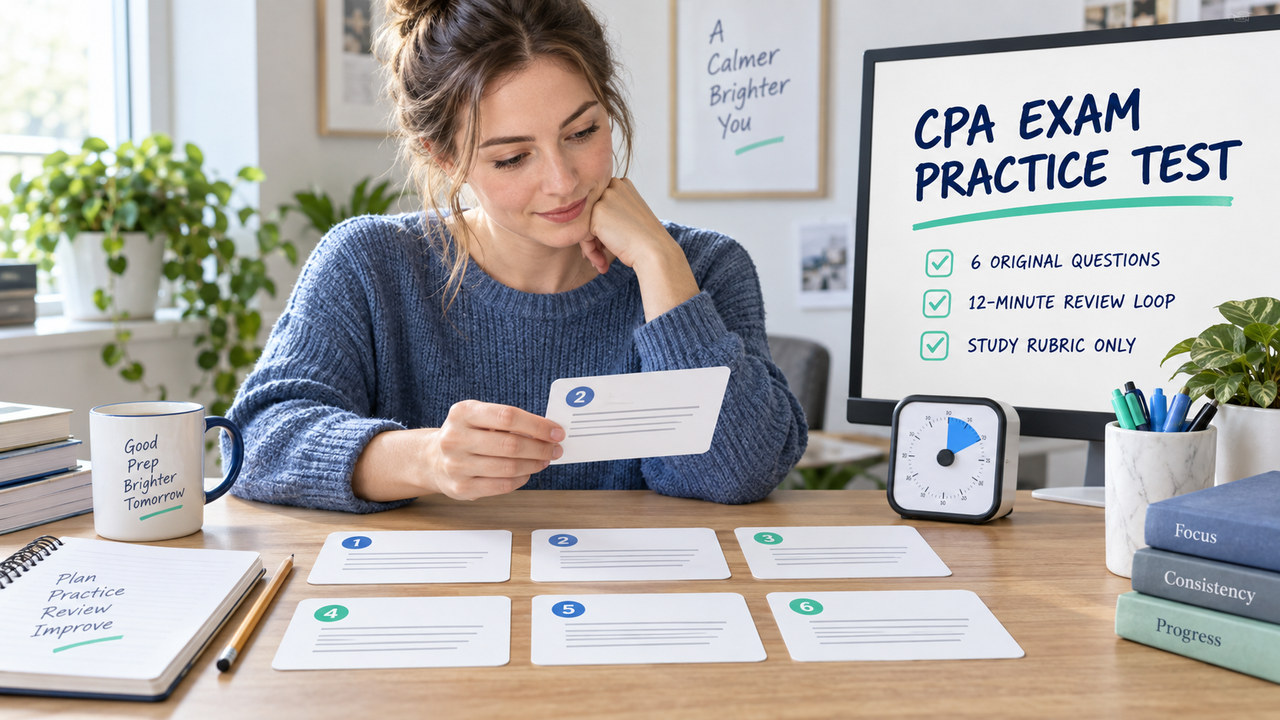

Quick answer: this cpa exam practice test is a six-question, 12-minute original assessment for checking timing, reasoning, and review habits. It can show what to study next, but it is not official AICPA content, an official score, or a pass-readiness prediction.
First, keep the boundary clear. The AICPA sample test is a shorter software-familiarization version of the Exam that lets candidates practice the interface before test day. In addition, it is not scored and does not determine readiness. Instead, this page serves a different purpose: it gives you original questions and a repeatable review loop.
Meanwhile, the current AICPA Blueprints describe the scope, skills, task statements, item types, and weighting for the six section labels. For scope, use that official resource for what is tested; use this page for a short study check. Checked September 15, 2026.
For a broader preparation path, continue with our CPA Exam Study Guide.
CPA Exam Practice Test: What This Mini Assessment Measures
In short, the set tests whether you can read a fact pattern, select a defensible first move, complete a small calculation, or recognize a control and planning boundary. It samples AUD, FAR, REG, BAR, ISC, and TCP once each. Therefore, six correct answers do not represent a section score or a complete content review.
Likewise, every item below is original practice content. First read the skill, assumptions, and difficulty. Next choose an answer without opening the reveal. Then compare the reasoning, name the distractor that pulled you away, and write one next action. As a result, that sequence makes a raw result useful.
How to Run This CPA Exam Practice Test in 12 Minutes
To begin, set a 12-minute timer and give yourself about two minutes per item. Also, use blank paper or a note file for the question number, answer, confidence level, and error label. During the attempt, do not search for an answer while the timer is running; the point is to observe your own decision process.
- Prepare: open the page, start the timer, and write H, M, or L confidence beside each answer.
- Attempt: read the facts once, identify the tested skill, and commit before opening any explanation.
- Reveal: after the six attempts or after each timed item, read the answer and the reason, not just the letter.
- Label: mark each miss as concept, process, reading, or time control.
- Review: choose one repair and schedule a short retry instead of taking another random quiz.
For context, the AICPA sample test itself allows up to two hours and is designed to familiarize you with exam software. This 12-minute block is an editorial study method, so it intentionally measures a small decision loop rather than recreating the official experience.

CPA Exam Practice Test: Six Original Questions
For clarity, these questions use current section labels as a scope cue, not as a claim that this page reproduces the Blueprint or any official item. First, keep your answers hidden until you finish the attempt. Then use the explanation to decide what kind of review will help.
1. AUD: Tie Evidence to the Assertion
First, tested skill: connect evidence to an assertion. Assumptions: an inventory memo changed after a software transition. Difficulty: foundational application.
First, original practice question: What is the best first move before judging whether the memo supports the audit conclusion?
- Call the control ineffective immediately.
- Identify the assertion, evidence source, and period covered.
- Copy the prior-year memo into the file.
- Convert the memo into a readiness score.
Reveal answer and reasoning
Answer: 2. First, define the assertion, source, and period; only then can you evaluate whether the evidence supports the conclusion. The key distractor is 1, because a software change is a reason to investigate, not an automatic control conclusion. Next action: write the assertion beside one practice fact pattern and name the evidence that would address it.
2. FAR: Calculate Operating Cash Flow
Next, tested skill: classify and total simple operating cash flows. Assumptions: ignore taxes, interest, financing, and investing; all listed flows are operating. Difficulty: foundational calculation.
Next, original practice question: A company collects $84,000 from customers, pays $50,000 to suppliers, and pays $20,000 in wages. What is net cash from operating activities for this set?
- $14,000
- $34,000
- $54,000
- $154,000
Reveal answer and reasoning
Answer: 1. Compute $84,000 − $50,000 − $20,000 = $14,000. The key distractor is 2, which subtracts suppliers but forgets wages. Next action: write the sign for every cash flow before adding the next three-item operating set.
3. REG: Calculate Adjusted Basis
Similarly, tested skill: track basis after a stated recovery amount. Assumptions: equipment starts with a $12,000 basis and the only adjustment is $2,000 of depreciation; ignore other tax facts. Difficulty: foundational calculation.
Similarly, original practice question: Under these assumptions, what adjusted basis remains immediately after the depreciation adjustment?
- $2,000
- $10,000
- $12,000
- $14,000
Reveal answer and reasoning
Answer: 2. The adjusted basis is $12,000 − $2,000 = $10,000. The key distractor is 1, which reports the adjustment rather than the remaining basis. Next action: label each number as original basis, adjustment, or adjusted basis before solving another basis question.
4. BAR: Interpret a Debt-to-Equity Ratio
Meanwhile, tested skill: calculate and interpret a ratio. Assumptions: debt is $120,000 and equity is $300,000; use debt divided by equity. Difficulty: foundational calculation.
Meanwhile, original practice question: What debt-to-equity ratio follows from these amounts?
- 0.25
- 0.40
- 2.50
- 40.00
Reveal answer and reasoning
Answer: 2. Divide $120,000 by $300,000 to get 0.40, or 40%. The key distractor is 3, which reverses the numerator and denominator. Next action: write the ratio formula in words before inserting numbers.
5. ISC: Apply Least Privilege
In addition, tested skill: choose a controlled access response. Assumptions: an analyst needs one report for two days and does not need administration rights. Difficulty: foundational application.
In addition, original practice question: Which response best fits least privilege?
- Give permanent administrator access.
- Share a coworker’s password.
- Grant a time-limited report role, approve it, and log the access.
- Disable access logging to reduce friction.
Reveal answer and reasoning
Answer: 3. The role is limited to the need, expires after the stated window, and leaves an approval trail. The key distractor is 1, which solves convenience by expanding privileges. Next action: state the user, resource, duration, approval, and log for one access scenario.
6. TCP: Gather Facts Before Planning
Finally, tested skill: separate fact gathering from a tax recommendation. Assumptions: a client asks which of two strategies will produce the lowest tax, but filing status, timing, basis, and governing authority are not yet confirmed. Difficulty: foundational application.
Finally, original practice question: What is the strongest first response?
- Promise the lowest tax result.
- Gather the missing facts, state the assumptions, and verify the current authority.
- Choose the strategy with the shorter name.
- Use a prior-year answer without checking the year.
Reveal answer and reasoning
Answer: 2. First, collect the facts and confirm the governing authority; only then can a recommendation be evaluated. The key distractor is 1, because a tax outcome cannot be guaranteed from an incomplete prompt. Next action: write three missing facts and one source you would verify.
Score This CPA Exam Practice Test Without a Fake Pass Line
After the attempt, give yourself one point per correct answer, then review confidence. However, a high-confidence miss deserves a different repair from a low-confidence guess. Importantly, the bands below are original study rules for this page; they are not an AICPA score, a scaled score, a passing standard, or a readiness determination.
| Correct out of 6 | Study reading | Next action |
|---|---|---|
| 0–2 | Rebuild the tested rules and process. | Review the two lowest-confidence misses, then retry a smaller set untimed. |
| 3–4 | The method is partly working; find the error pattern. | Repair one category and repeat two related items with a short timer. |
| 5–6 | Keep the reasoning fresh and test transfer. | Review the one miss or fastest guess, then move to a different fact pattern. |
CPA Exam Practice Test Review Queue: Turn Misses into Next Actions
Next, classify the first miss before opening another mixed set. Similarly, a concept miss means the rule or definition was missing. A process miss means you knew the idea but used the wrong formula, order, or control step. A reading miss means you overlooked a qualifier. A time-control miss means the clock changed your decision.

For example, a FAR calculation with the right concept but the wrong sign belongs in process review. In contrast, a TCP response chosen before the facts were gathered belongs in reading or planning review. As a result, do not repeat the same six questions immediately; repair the category, then change the fact pattern.
AICPA Sample Test vs. an Original CPA Exam Practice Test
In practice, the two tools can sit in the same preparation plan, but they answer different questions. In particular, the AICPA sample test is for becoming familiar with the software and test-center-style functionality. Specifically, AICPA says it is shorter, shows correct answers, allows up to two hours, and is not scored or a readiness determination.
By comparison, this original CPA exam practice test is a small content-and-process check. Instead, its 12-minute timer, six questions, confidence notes, and study rubric are editorial choices. As a result, they help you decide what to review next; they do not imitate official scoring, replace the current Blueprint, or guarantee performance.
Meanwhile, commercial question banks may offer larger inventories, analytics, or product-specific mock modes. Therefore, compare those features on the provider’s current page. Keep this article’s original explanations separate from any vendor claim, and keep official eligibility or score questions with NASBA, the applicable Board, or the official AICPA resource.
How to Choose Your Next Session
After the review, schedule one next block rather than reacting to the percentage alone. First, if most misses are concept errors, read the relevant Blueprint topic and complete two untimed items. Next, if the errors are process-based, write the formula or control sequence and repeat it with new numbers. Finally, if you were accurate but slow, repeat three different items with a modest time limit and keep the explanation closed until the attempt is finished.
- Low score: shrink the set and rebuild the rule before adding time pressure.
- Middle score: repair one error category, then test a new fact pattern.
- High score: test transfer, confidence, and pacing; do not label the result as official readiness.
In other words, a useful practice test ends with a better next question. Finally, record the date, timer result, confidence, error category, source reviewed, and retry date so the next session has a purpose.
FAQ: CPA Exam Practice Test
Is this an official AICPA practice test?
No. Instead, this is an original six-question study set. The AICPA sample test is the official software-familiarization resource; this page does not reproduce its questions or convert its answer visibility into a score.
How long should I spend on this practice test?
For this page, use 12 minutes for the six original items, or about two minutes per item. Afterward, adjust the timer only after you record what changed. The 12-minute choice is a study method, not an official section time limit.
Does a 5 out of 6 mean I am ready?
No. In fact, the rubric only selects the next review action. The AICPA sample test itself is not scored and does not determine readiness, and a six-item set cannot represent a complete section or official result.
Where should I verify current CPA Exam scope?
To verify current scope, use the current AICPA CPA Exam Blueprints for tested areas, task statements, skills, item types, and weighting. Use NASBA and the applicable jurisdiction for eligibility, application, and score-reporting questions.
Sources and Originality Note
Checked September 15, 2026. Meanwhile, AICPA and NASBA sources establish the official boundaries described above. By contrast, the six questions, choices, explanations, distractor notes, study bands, error taxonomy, timer, and review loop are original to CPA Exam Prep. For transparency, Semrush US Volume, KD, and Intent were not fabricated; refresh the workbook row before a human publish decision.
- AICPA sample tests — purpose, section labels, two-hour boundary, answer visibility, and non-score note.
- AICPA CPA Exam FAQ — software and test-center context.
- AICPA CPA Exam Blueprints — current scope, skills, task statements, item types, weighting, and testlet structure.
- NASBA CPA Exam — process, eligibility, and score-reporting boundary.
Update owner: CPA Exam Prep content team. Recheck the live official pages after any Blueprint, sample-test interface, or jurisdiction-process change.