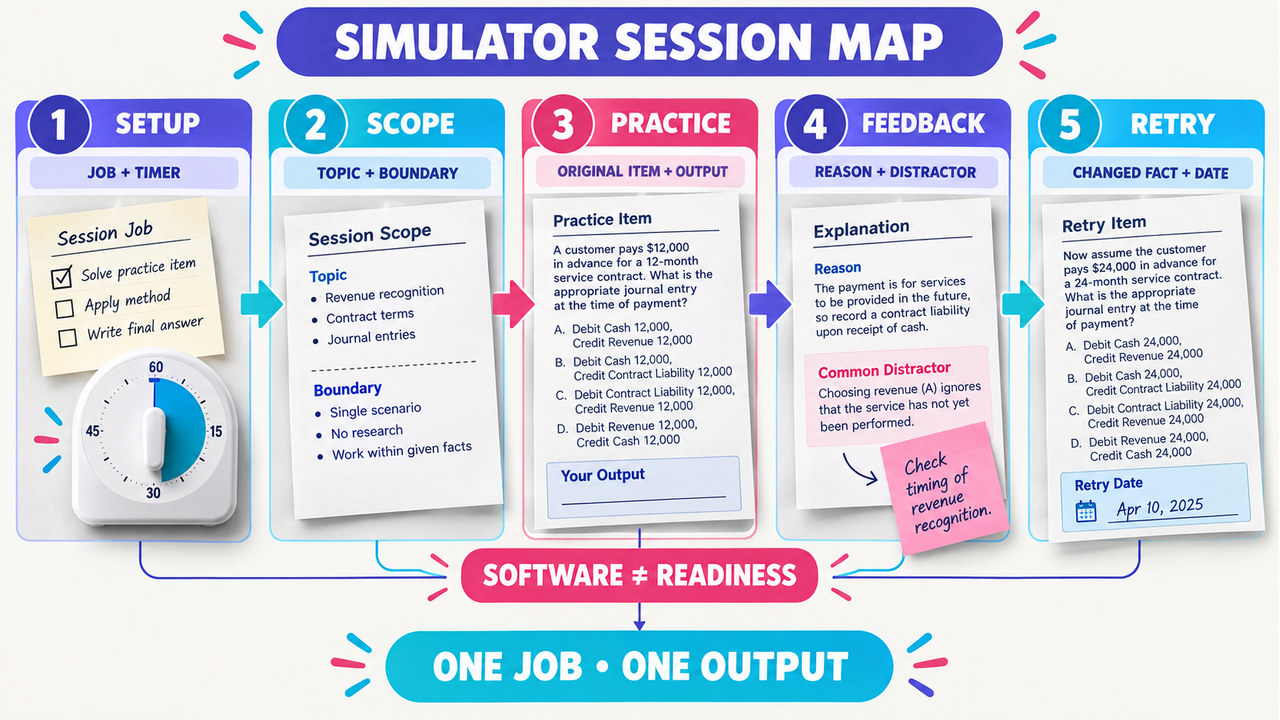

Quick answer: a cpa exam simulator free search can lead to several different tools. In practice, an official sample test can help you learn format and software functionality. A current scope source tells you what to study. Original questions test content. A timed block tests pacing. However, none of those alone is an official score or readiness determination.
Therefore, use a free simulator as a bounded study session, not as a mysterious number. Define the job, attempt the task, save one output, name the first gap, and book a changed-fact retry.
For a broader preparation path, continue with our CPA Exam Study Guide.
CPA Exam Simulator Free: What It Means
First, define simulator. Search results may mean an official software-familiarity sample, a commercial trial, a timed set, a dashboard, or a printed-card dry run. These are not interchangeable. A tool can imitate a session while measuring one narrow job.
Next, use six job labels before you compare features:
- Software: Can you navigate the kind of screens, controls, and task sequence you expect to use?
- Scope: Can you confirm the current topic, terminology, or task boundary?
- Practice: Can you apply one defined skill without copying an answer?
- Timing: Can you finish a bounded block while recording where time disappeared?
- Feedback: Can you explain why the answer works and why the tempting alternative fails?
- Retry: Can you change one fact and test whether the reasoning transfers?
As a result, a free simulator is valuable when it produces a useful output for one of these jobs. In contrast, a countdown or colorful score screen does not make it useful.
CPA Exam Simulator Free: Separate Software from Readiness
The AICPA sample-test resource is the right kind of official reference for software and format familiarity. Specifically, it is a shorter practice experience for learning the software and seeing correct answers. The page also says it is not scored and is not a readiness determination. Record that boundary exactly: “I practiced the interface and format,” not “I am ready to pass.”
Meanwhile, use the AICPA Blueprints page for a different question: what content, task statements, skill levels, references, item types, and weighting belong in your current scope check. The page currently presents a 2026 Blueprint context effective January 1, 2026. Because labels and dates can change, reopen the live page before treating a topic as current.
Also note the visible refresh boundary on the AICPA sample-test page. It currently says the sample-test content is current as of July 1, 2023. Use it for software practice, not as proof of the latest scope. Pair software familiarity with a current scope check and independent content practice.
Finally, for eligibility, application, or jurisdiction questions, move to NASBA and the applicable board. A simulator cannot answer who owns a process question. Keeping these source jobs separate is the first quality check.
Build a CPA Exam Simulator Free Session
Before you begin, write a one-line session contract: “I am using this simulator to produce one output about one job in one time box.” For example, “I will use the official sample test for software navigation and save three controls I need to remember.” Alternatively, “I will do five original questions on one skill in 25 minutes and save one explanation sentence for each miss.”
- Set up: First, choose the source, time box, paper, timer, and interruption rule. Do not add extra tabs halfway through.
- Set the scope: Next, name the skill or format task. If the topic is uncertain, verify it against the current official scope source first.
- Practice: Then, attempt the task before opening the answer or explanation. Save the output, not just the result.
- Review: Afterward, write the reason, the important distractor, and the first gap. A wrong answer without a reason is incomplete evidence.
- Retry: Finally, change one fact, source, timing condition, or error category and schedule the next block.
For this reason, keep the session small enough to diagnose. A giant mixed set can hide whether the problem was content, pacing, software friction, or weak feedback.

Five Original Simulator-Choice Drills
First, these are original editorial scenarios, not official questions. Before each item, read the tested skill, assumptions, and difficulty. Write your choice and confidence first. Then open the reveal and record the distractor and next action.
1. What Does the Official Sample Test Prove?
Tested skill: separate software familiarity from content readiness. Assumptions: you navigate an official sample test smoothly and see the correct answers, but you have not completed a content explanation set. Difficulty: foundational classification. So, this drill tests evidence boundaries.
Original practice item: what is the strongest conclusion you may record?
Reveal the answer and reasoning
Answer: record that you practiced format and software functionality. Do not record an official score, passing probability, or readiness conclusion. Reasoning: the tool’s stated job controls the evidence it can produce. Distractor: “I navigated easily, so I know the content” changes interface evidence into a content claim. Next action: therefore, pair the session with one original content drill and one written reason.
2. Which Setup Matches a Software-Familiarity Goal?
Tested skill: match the environment to the simulator job. Assumptions: your goal is to learn controls and navigation, not to measure content accuracy. You have an official sample-test page, paper notes, and a timer. Difficulty: foundational application. Therefore, document controls.
Original practice item: what should you save at the end of the block?
Reveal the answer and reasoning
Answer: save a short control-and-navigation checklist, such as where you moved between task views, submitted an answer, or opened feedback. Reasoning: the output must match the software job. Distractor: saving only a percentage or counting questions completed gives no evidence about the controls you meant to learn. Next action: afterward, repeat the checklist once without notes, then move to content practice if the software gap is closed.
3. How Should You Read a Timed Weak Result?
Tested skill: interpret timing evidence without overclaiming. Assumptions: you finish four of five original items in a 25-minute block, and the fourth item consumed most of the time because you reread the prompt. The items were not official. Difficulty: foundational judgment. As a result, keep the conclusion narrow.
Original practice item: what is the most useful first conclusion?
Reveal the answer and reasoning
Answer: record a possible timing or prompt-parsing gap, not a readiness score. Reasoning: the visible evidence is where time went in this bounded set. It does not prove how you would perform on an official exam. Distractor: treating four completed items as a pass forecast ignores the tiny, original sample. Next action: in the next block, run a changed-fact set with a two-minute prompt-parsing rule and record whether the time loss moves.
4. What Comes After a Wrong Answer with No Explanation?
Tested skill: classify a feedback gap after a simulator miss. Assumptions: you chose an answer, saw it marked wrong, and cannot explain why the tempting option fails. You have a scope source and another explanation source available. Difficulty: foundational diagnosis. Thus, the missing reason is key.
Original practice item: what should you do before starting a larger set?
Reveal the answer and reasoning
Answer: write the exact skill and unanswered “why,” check the scope boundary, and choose one explanation source that can supply a reason before retrying. Reasoning: the first gap is feedback, not question volume. Distractor: immediately increasing the set preserves the same unknown and may create more unreviewed misses. Next action: instead, retry one changed-fact item and write the reason in your own words.
5. What Makes a Retry Diagnostic?
Tested skill: schedule a changed-fact retry. Assumptions: your first session tested one defined skill and produced a written reason, but you are unsure whether the reasoning transfers. You can change one fact while keeping the skill constant. Difficulty: foundational planning. For that reason, change one material fact.
Original practice item: which retry design gives the clearest evidence?
Reveal the answer and reasoning
Answer: keep the skill and output requirement constant, change one material fact, and set a new date or time box. Reasoning: one changed variable makes the next result easier to interpret. Distractor: changing the skill, source, timing, and question format at once creates a new experiment rather than a useful retry. Next action: for that reason, book the retry within two study blocks and compare the written reason, not just the percentage.
Record a CPA Exam Simulator Session
Use a study-only record with seven fields: job, environment, source, task, output, first gap, and next action. In addition, add confidence from 1 to 5 only if it changes your next block. Confidence is a planning signal, not a score prediction.
For example: “Software; official sample test; output: three-control checklist; gap: one navigation step still slow; next action: repeat once without notes.” A content entry can record the same fields with a written reason and a changed-fact retry.
As a result, count a session as complete only when it produces an output and a next action. Do not count clicks, opened tabs, or a colorful dashboard as study evidence. This protects a free workflow from becoming a collection habit.
Compare Free Simulator Options by Job
Compare tools by the job they can perform, not by the loudest feature list.
- Need software familiarity? First, start with the AICPA sample-test resource and save a control checklist. Respect its visible content-date boundary.
- Need current scope? Next, start with the live AICPA Blueprints page. Save the checked date and the topic or task statement you used.
- Need original practice? Then, use a bounded question set where you can attempt first, explain the choice, and review the distractor.
- Need timing evidence? Also, use a small, repeatable time box and record where time went. Do not mix timing diagnosis with a readiness claim.
- Need process information? Finally, use NASBA and the applicable jurisdiction. A simulator is not an eligibility or application authority.
A free trial can be useful when it lets you test one missing job. Record its access end date, topic coverage, explanation quality, and the output you can save. However, if it only increases the number of links, it has not earned a place in the stack.
Finally, paid review may add broader coverage, deeper feedback, tracking, or scheduling. The honest comparison remains: which gap is open, and what is the lowest-friction way to close it?
Repair a Weak CPA Exam Simulator Result
When a session feels weak, first label the first observable gap before changing tools. A format gap means controls or navigation slowed you. A content gap means you could not apply the defined skill. A timing gap means a repeatable part of the block consumed too much time. An evidence gap means you cannot explain why the answer works. A follow-through gap means you know the repair but did not book it.
- First, write the job you intended the simulator to perform.
- Next, point to the first concrete evidence of a gap.
- Then, choose one source or action that can close that gap.
- Afterward, write one repair sentence, such as “I need a reason for the distractor before I do more questions.”
- Finally, book a changed-fact retry and compare the same output field.
For example, a slow interface is repaired with a short navigation repeat, not a larger question bank. A missing explanation is repaired with one worked reason, not another score screen. A scope uncertainty is repaired with a current official check, not a random forum summary.

FAQ: CPA Exam Simulator Free
Is a free CPA exam simulator enough to pass?
No. A free simulator can support software familiarity, a defined practice block, timing diagnosis, feedback review, or a retry routine. However, none of those alone establishes full coverage or personal readiness. Use the output to choose the next study action.
Does the AICPA sample test give a score?
Use it for the purpose the AICPA describes: format and software familiarity. The visible resource says it is not scored and is not a readiness determination. Instead, it may show correct answers, but that is different from an official result.
Should I use a countdown timer?
Use one when timing is the skill you are testing. Then keep the block small, record where time went, and avoid using the result as a prediction. Otherwise, if the job is software familiarity, the timer should not distract from the navigation checklist.
What should I do after a low simulator result?
Do not immediately buy another tool or start a larger set. Instead, label the first gap as format, content, timing, evidence, or follow-through. Choose one repair and schedule a changed-fact retry.
Can I use a Mac for simulator practice?
The method itself does not require a particular device. Follow the live official instructions for supported browsers, display, and controls. If you use Apple hardware in a visual, show the accurate Apple logo; in the article’s visuals, paper materials are used instead.
Sources and Refresh Note
Current scope: AICPA CPA Exam Blueprints. Software and format familiarity: AICPA sample tests. Practical FAQ: AICPA CPA Exam FAQ. Candidate process: NASBA CPA Exam. Checked September 16, 2026. The five drills, job map, session record, first-gap taxonomy, and retry method are original editorial study content, not official questions. Recheck live pages, provider access, and Semrush row data before publication.