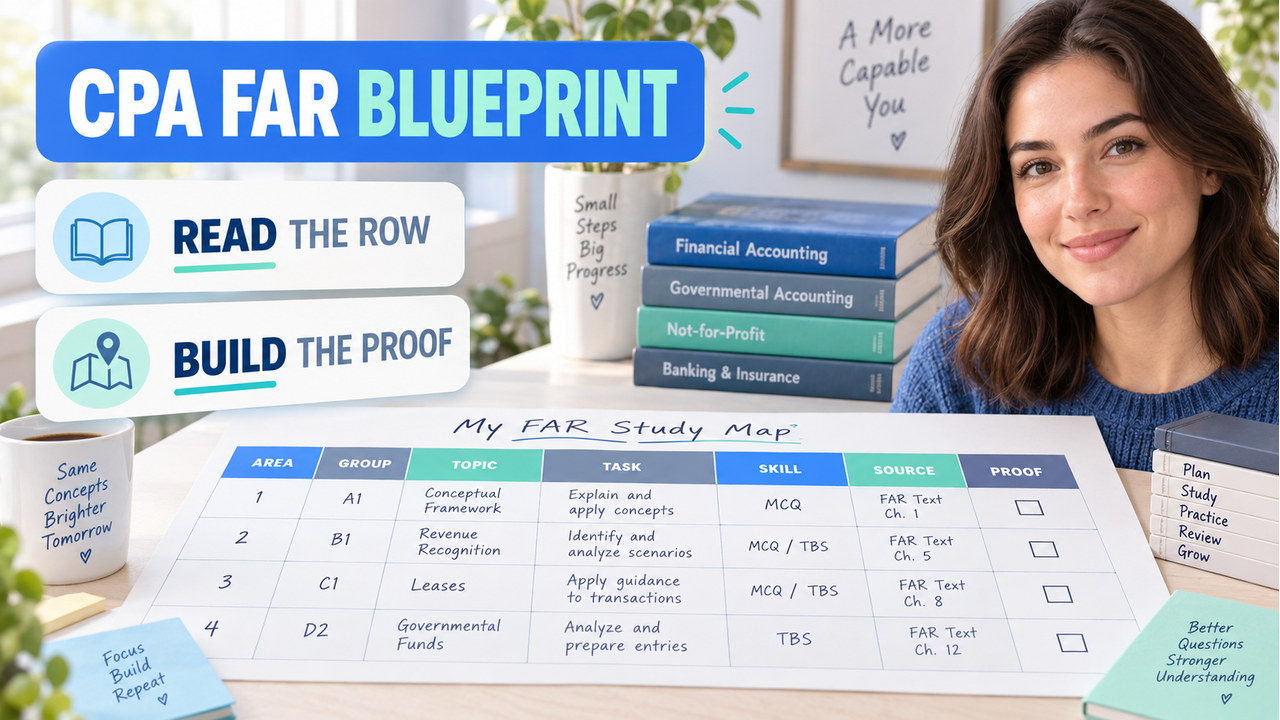

Quick answer: The cpa far blueprint is the official scope map for what FAR can test and how the work is organized. However, it is not a chapter checklist or a promise that every bullet will appear on your form. Instead, read one row in five passes: locate the Area, Group, and Topic; rewrite the task as a verb plus an output; identify the skill level; open the supporting reference; then choose MCQ or TBS evidence that proves the skill transferred.
This guide is for a candidate who has opened the FAR Blueprint and wants to turn a dense row into a useful study decision. It does not reproduce released questions, calculate a personal score, or replace current accounting literature. For the wider section route, start with the FAR review hub; use the FAR study guide when you need broader orientation.
What is the CPA FAR Blueprint?
The Blueprint is the official description of content eligible for testing and the minimum knowledge and skills expected for initial licensure. In particular, AICPA’s current resource says that each section is organized by Area, Group, and Topic, with score weighting, sample task statements, skill levels, reference materials, item types, and item-type weighting. Therefore, this field list is more useful than a topic-only outline because it tells you what action the candidate may need to perform.
For FAR, the current AICPA page lists two 25-question MCQ testlets followed by TBS testlets containing 2, 3, and 2 tasks. Use that layout as a format boundary for practice design, not as a prediction of your exact exam form. However, the Blueprint tells you what to prepare; it does not tell you how many hours you personally need or predict a particular question mix.
cpa far blueprint: What it is not
It is not your review provider’s table of contents, a pass-rate calculator, or a list of released questions. Meanwhile, a provider may group content differently for teaching. Therefore, reconcile that teaching sequence with the current official row, especially when a technical change, effective date, or new Blueprint release may have moved the boundary.
Read the CPA FAR Blueprint fields
First, start with the row rather than a random chapter. Then, use each field to answer a different study question.
Area, Group, and Topic: Where does the task live?
Area is the broad container, Group narrows the family of work, and Topic gives the most useful study label. Next, copy all three into your notes. If you record only “FAR,” you cannot tell whether a later miss came from the same family or from a different one. As a result, the three-level label helps you link a practice result back to the exact source row.
Sample task statement: What must you do?
First, read the task statement for its verb and output. For example, “identify,” “calculate,” “explain,” and “evaluate” imply different proof. Then rewrite the sentence as: I can [verb] [object] and produce [output] under [boundary]. As a result, a familiar topic label is less likely to hide the actual response demand.
Skill level: How much reasoning is required?
The skill level is a practice-design signal. For a recognition-heavy task, use a clean concept check. For an application or analysis task, add a changed fact, a multi-step setup, or a TBS-style evidence trail. Therefore, do not use the label to predict difficulty; use it to decide what a convincing proof should look like.
Reference materials: Which source controls the boundary?
Use the listed references to verify definitions, exceptions, and effective dates. When an answer depends on a technical accounting conclusion, open the FASB Accounting Standards Codification or the current authoritative source named by the row. In addition, remember that a summary note can help you learn, but it should not silently override the source boundary.
Item type and weighting: What form should your proof take?
Weighting helps you allocate attention across the section; however, it is not a percentage-correct promise for one sitting. For a row tested through MCQs, add fast recognition plus a clean calculation. Similarly, a row that needs transfer into TBS work should add exhibits, response cells, or a changed fact. Finally, keep the official scaled-score language separate: AICPA says a reported score is on a 0–99 scale and is not a percentage-correct conversion.
Use the CPA FAR Blueprint Row Translator
Use this five-stage translator whenever a row feels too broad. The goal is not to copy every sentence into a notebook. The goal is to create one bounded study artifact and one proof that the skill transfers.
- Locate: write the Area, Group, and Topic exactly as the current Blueprint presents them.
- Rewrite: turn the task statement into a verb, object, requested output, and boundary.
- Level: choose the smallest practice that matches the skill level, then add one change that tests transfer.
- Anchor: record the reference, effective-date question, and the point at which you must reopen the source.
- Prove: choose MCQ or TBS evidence, record the first unsupported step, and route the next repair.
The translator keeps the Blueprint from becoming a passive reading exercise. When you cannot write the requested output, the problem is still scope. Once you can write it but cannot explain the boundary, open the source. However, if the clean version works but the changed-fact version fails, add transfer evidence rather than rereading the entire chapter.

Run the CPA FAR Blueprint row check
First, choose one current row and mark only what you can support. Then, let the first unchecked line become the next study action; do not mark a line merely because the topic looks familiar.
After the check, save a compact record: row → verb/output → skill proof → source → transfer result. As a result, the record is more reusable than a page of copied notes because it preserves the decision that produced the next task.
Work a CPA FAR Blueprint example
Suppose your current row covers a FAR task that asks you to evaluate a transaction and produce a reported amount. Instead of opening every lesson in the topic, first write: “I must evaluate the stated facts and produce the requested amount or classification.” Next, label the skill level and decide what evidence would show it: a clean calculation for the first pass, then one changed fact or exhibit for transfer.
Now create two versions of the practice record. In version A, list the relevant fact, the rule or source boundary, the setup, and the output. In version B, change only one fact and explain why the output changes. If both versions work, add a short timed item or a TBS-style response cell. When version B fails, keep the row fixed and repair the missing boundary; do not conclude that all of FAR is weak.
This example deliberately avoids pretending to reproduce a live or retired question. Meanwhile, the official Blueprint defines the task family and skill expectation; your review material and current authoritative literature supply the technical facts. Finally, your original record supplies the evidence that the skill moved from recognition to application.
Avoid common CPA FAR Blueprint mistakes
Reading the Topic and skipping the task verb
A topic label can make a session feel complete while leaving the requested action undefined. Instead, put the verb and output at the top of the practice page before reading the explanation.
Using weighting as a personal score forecast
Weighting helps you plan attention across the section. It does not convert your question percentage into an official score. Therefore, remember that AICPA’s score is scaled and reported from 0 to 99, with 75 required to pass.
Using an old Blueprint after a change
AICPA publishes Blueprints periodically and describes when new pronouncements become eligible for testing. If your notes, course, or saved PDF is dated, compare it with the current official page before locking a plan. Therefore, verify the current authoritative literature before relying on a technical detail.
Practicing only the easiest item type
MCQs and TBSs can expose different parts of the same skill. Meanwhile, the current FAR layout includes both. After a clean recognition pass, add one response that requires evidence selection, a multi-step setup, or a changed fact.
Choose the next resource from the Blueprint
Use the job of the next page to decide where to go. The FAR review page is the broad section orientation. Next, the FAR study plan helps allocate weekly capacity after you know the rows. Meanwhile, the FAR practice questions page is for original item-level reasoning. For exhibit and response-format transfer, use the task-based simulation guide. Finally, if you need the route across all CPA sections, use the CPA Exam Study Guide.
Make the link choice explicit in your notes: “I am opening this page because my first unchecked Blueprint field is ___.” This sentence prevents a useful resource from becoming another open tab with no defined job.
CPA FAR Blueprint refresh and FAQ
How often should I check the CPA FAR Blueprint?
Check the current AICPA release when you begin a section, when your plan spans a new testing period, and whenever a source or course announces a technical change. In particular, the official resource says Blueprints are typically published one to two times per year; dated claims still need a live-page check.
Does the Blueprint tell me exactly what will be on my exam?
No. It defines eligible content, task examples, skills, references, item types, and weighting. Instead, treat it as a scope and preparation boundary, not a form prediction or a list of released questions.
Should I study every FAR row in the same way?
No. Match the proof to the task verb, skill level, reference, and item type. For example, a recognition task may need a concise concept check, whereas an analysis task may need a changed fact, evidence trail, or TBS-style response.
What should I do first?
First, open the current Blueprint, choose one FAR row, write the verb plus output, and run the five-line row check. Then use the first unchecked field to choose one bounded study action.
Next action: open the FAR review hub, choose one current Blueprint row, save your Row Translator record, and complete one proof that matches the row’s skill and item type.
Sources and refresh note
Current scope and testlet layout: AICPA CPA Exam Blueprints. Score-language boundary: AICPA scoring and pass rates. Software rehearsal boundary: AICPA sample tests. Administration context: NASBA CPA Exam FAQ. Technical research: FASB Accounting Standards Codification. Checked September 18, 2026. Finally, reopen the live official pages before using a dated plan or technical conclusion. The Blueprint Row Translator, worked mapping method, checklist, and resource-routing rules are original study guidance, not official scoring advice.