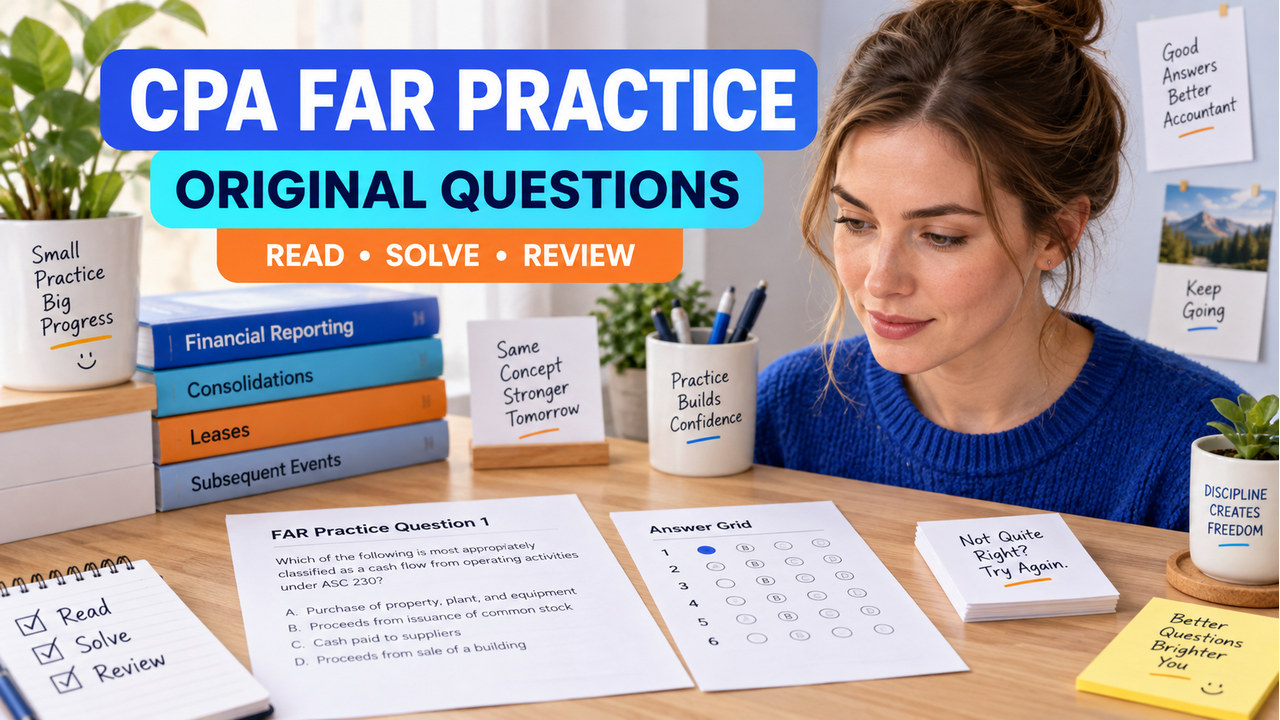

Quick answer: These cpa far practice questions are an original six-item FAR drill with answer rationales, distractor analysis, Blueprint-oriented topic labels, and one mini TBS-style cash reconciliation. Solve before reading the explanations, then use the first broken step to choose what to study next. The items are editorial practice, not live or provider-supplied exam content, and they do not predict results.
Use this page for a short block before a larger question bank. For the full route, continue to the site’s FAR review page.
How to use these cpa far practice questions
First, save a short uninterrupted block. Select one current FAR Blueprint topic, answer the six MCQs before looking at the keys, then write the rule trigger or calculation. Next, review the distractors, change one fact, and complete the mini TBS-style worksheet.

The FAR practice boundary and Blueprint check
The AICPA Blueprint organizes the exam by Area, Group, Topic, task statements, skill levels, references, item types, and weighting. Its current FAR table lists 25 MCQs, 25 MCQs, 2 TBSs, 3 TBSs, and 2 TBSs. Therefore, reopen the Blueprint before a dated plan because eligible content can change.
AICPA’s public sample test is for format and software familiarity; it is not scored or a readiness determination. Instead, these original questions make the reasoning path visible. Also, use the current FASB Accounting Standards Codification or another applicable authoritative source when a technical conclusion matters.
NASBA states that a section requires a score of 75 or higher, but a reported score is not a percentage correct. Consequently, treat the practice result as a descriptive study signal: topic, skill, earliest gap, and next action.
Original cpa far practice questions with answers
Every item below was authored for this page. These numbers are clean illustrations, not official exam data. For efficient review, explanations stay short; use the linked authoritative source for changed or material technical issues.
Q1 — Revenue received before service
Topic: Revenue and contract liabilities · Skill: Application
On December 15, Year 1, a company receives $12,000 for a 12-month service contract beginning January 1, Year 2. No service is provided by December 31. Which entry describes the receipt?
- A. Debit revenue $12,000 and credit cash $12,000.
- B. Debit cash $12,000 and credit a contract liability $12,000.
- C. Debit a contract liability $12,000 and credit revenue $12,000.
- D. Make no entry until the first monthly invoice is issued.
Answer: B — Therefore, cash arrived, but no service was transferred. Meanwhile, the contract liability records the remaining obligation; revenue follows service delivery under applicable guidance.
Why the other choices fail: However, A and C reverse the entry or timing. D ignores both the cash and the obligation.
Changed-fact retry: Next, change one fact: one month is delivered in December. Write the delivered service and remaining liability first.
Q2 — Lessee recognition at commencement
Topic: Leases and right-of-use accounting · Skill: Application
A lessee signs a five-year office lease. It is not short-term and no scope exception applies. What is the general commencement-date result?
- A. Recognize neither an asset nor a liability until the first payment.
- B. Recognize a right-of-use asset and a lease liability, subject to the applicable measurement guidance.
- C. Recognize only a lease expense and never a lease liability.
- D. Record the sum of all future payments as the right-of-use asset without considering present value.
Answer: B — In this case, the lessee records the right to use the asset and the payment obligation at commencement. However, classification affects later presentation, not whether measurement is ignored.
Why the other choices fail: However, A and C omit balance-sheet recognition. D skips measurement and uses an unadjusted future-payment total.
Changed-fact retry: Next, change the facts to a qualifying short-term lease. State why the general model may no longer apply.
Q3 — Equipment acquired with a note
Topic: Statement of cash flows and noncash transactions · Skill: Application
A company acquires equipment by signing a five-year note payable; no cash changes hands. How is it handled in the cash-flow statement?
- A. Report the note proceeds as an operating cash inflow.
- B. Exclude the transaction from the cash-flow totals and disclose the noncash investing and financing activity separately as required.
- C. Report the equipment cost as a cash outflow because the asset was acquired.
- D. Report both a cash inflow for the note and a cash outflow for the equipment.
Answer: B — Because no cash changes hands, assets and liabilities change without a cash-flow total. Therefore, the exchange belongs in the required noncash activity disclosure, not cash totals.
Why the other choices fail: However, A, C, and D invent an inflow or outflow. Labels do not create cash.
Changed-fact retry: Next, replace the note with cash. Identify the cash-flow section, then separate cash from noncash effects.
Q4 — Evidence about a year-end condition
Topic: Subsequent events · Skill: Analysis
A customer files a claim in January before issuance. It relates to a December 31 condition, and a February settlement confirms the obligation. What treatment fits the year-end statements?
- A. Adjust the year-end statements for the confirmed obligation, subject to the applicable recognition threshold.
- B. Ignore the settlement because it occurred after the reporting date.
- C. Record the entire settlement only in the next year’s statements in every case.
- D. Treat the event as a new condition that could never affect the prior year.
Answer: A — Thus, later evidence confirms a condition already present at year-end. In contrast, that distinguishes this case from a new January condition; current guidance controls the exact entry or disclosure.
Why the other choices fail: However, B, C, and D focus only on the later date and miss the reporting-date condition.
Changed-fact retry: Next, move the underlying loss to January. Explain why the analysis shifts toward later-period treatment.
Q5 — Inventory sold inside a group
Topic: Consolidation and intercompany inventory · Skill: Analysis
A parent sells inventory to its subsidiary for $18,000; cost was $12,000. The subsidiary still holds it at consolidated year-end. What is the effect before an external sale?
- A. Keep the $6,000 profit because the subsidiary paid the parent.
- B. Eliminate the intercompany sale and cost and defer the $6,000 unrealized profit until the inventory is sold outside the group.
- C. Recognize an additional $6,000 group profit because two entities recorded the sale.
- D. Write the inventory down to zero because all intercompany sales are losses.
Answer: B — Accordingly, the group is one economic entity. Then, eliminate the internal sale and defer profit on inventory still inside the group.
Why the other choices fail: However, A and C recognize internal profit early. D confuses elimination with writing off the inventory.
Changed-fact retry: Next, have the subsidiary sell outside before year-end. State when the deferred profit becomes group profit.
Q6 — New information about useful life
Topic: Accounting changes, estimates, and errors · Skill: Application
New operating data leads management to revise a machine’s useful life. The original estimate was reasonable; no mistake is being corrected. How is the change handled?
- A. As a prior-period error that requires rewriting every earlier statement.
- B. Prospectively in the current and future periods affected by the revised estimate.
- C. By eliminating all accumulated depreciation immediately.
- D. By ignoring the new information until the asset is disposed of.
Answer: B — Therefore, new information creates an estimate change, not an error in the original reasonable judgment. Finally, apply revised depreciation prospectively under applicable guidance.
Why the other choices fail: However, A calls new information an error. C and D fail to apply the revised estimate to affected periods.
Changed-fact retry: Next, change the fact to a transposed digit in the original calculation. Classify it before choosing correction.
Blueprint-oriented map for the practice set
These study labels help place a miss; however, they are not official AICPA task codes. Confirm the live Area → Group → Topic wording and references in the current Blueprint before your exam window.
| Item | Study topic label | Skill focus | What to record |
|---|---|---|---|
| Q1 | Revenue and contract liabilities | Application | Keyed answer, distractor reason, and changed-fact retry |
| Q2 | Leases and right-of-use accounting | Application | Keyed answer, distractor reason, and changed-fact retry |
| Q3 | Statement of cash flows and noncash transactions | Application | Keyed answer, distractor reason, and changed-fact retry |
| Q4 | Subsequent events | Analysis | Keyed answer, distractor reason, and changed-fact retry |
| Q5 | Consolidation and intercompany inventory | Analysis | Keyed answer, distractor reason, and changed-fact retry |
| Q6 | Accounting changes, estimates, and errors | Application | Keyed answer, distractor reason, and changed-fact retry |
| Mini TBS | Cash reconciliation and evidence-to-output transfer | Analysis | Book adjustment, bank timing difference, final tie-out, and retry |
Mini TBS-style cash reconciliation
This original worksheet is not copied from the exam. Instead, treat the facts as an evidence packet and complete the outputs before reading the key.
Evidence: Unadjusted book cash is $48,200; the bank statement is $47,415. A $3,400 deposit is in transit, outstanding checks total $2,100, the bank collected a $600 electronic receipt, and an $85 service fee has not reached the books.
Requested output: Calculate the adjusted bank balance and adjusted book balance, then state why the two timing items do not enter the book adjustment.
Key: Adjusted bank = $47,415 + $3,400 − $2,100 = $48,715. Meanwhile, adjusted books = $48,200 + $600 − $85 = $48,715. The deposit and checks are bank-side timing items; therefore, the EFT and fee need book entries. Label each fact before tying out.
How to review a cpa far practice questions miss
Do not start with the correct count. Name the first failed layer: scope (wrong row), reading (missed output or condition), rule (missing trigger), calculation (input, sign, unit, or operation), distractor (close choice ignored a fact), or completion (a field or tie-out was left unfinished).
Then, change one fact—date, amount, relationship, delivery status, or measurement assumption—and predict the direction before recalculating. If the same layer fails twice, use a focused explanation or topic page.
Choose the next FAR study action
If the row is unclear, use the Blueprint format guide. When rule recognition is weak, use MCQ by topic. If evidence transfer breaks, use TBS practice. Finally, for a broader schedule, use the CPA Exam Study Guide.
In addition, keep the row, result, and next action together.
FAQ for cpa far practice questions
Are these official CPA Exam questions?
No. They are original editorial practice items written for this page, not live exam content or a prediction of results. Instead, use the AICPA Blueprint for eligible content and the official sample test for software familiarity.
How many FAR practice questions should I do?
No universal number proves readiness. A smaller set reviewed at the distractor and changed-fact level can expose more than a right-or-wrong tally. Then, let the earliest gap determine the next block.
Should I practice MCQs and TBSs together?
Use both when the topic supports recognition and application. For example, MCQs isolate close-rule choices; TBS-style work adds evidence selection, calculation, and response completion. Let the current Blueprint and candidate window set the emphasis.
Can my raw practice percentage predict my CPA score?
No. NASBA explains that the official score is not a percentage correct. Therefore, record the next topic or skill instead of assigning an official readiness label.
What should I do if I miss most of the set?
First, separate scope, reading, rule, calculation, distractor, and completion errors. Review one layer, retry one changed fact, and choose a focused resource on the site’s FAR review page.
Sources and refresh note for cpa far practice questions
Blueprint and FAR testlets: AICPA Blueprints. Next, review the format boundary: AICPA sample tests. Candidate process and scores: NASBA FAQ and Score Information. Technical boundary: FASB Codification. Checked September 18, 2026. Reopen the official pages and refresh Semrush US fields before publication. The questions, rationales, worksheet, map, and review log are original and do not replace authoritative guidance.