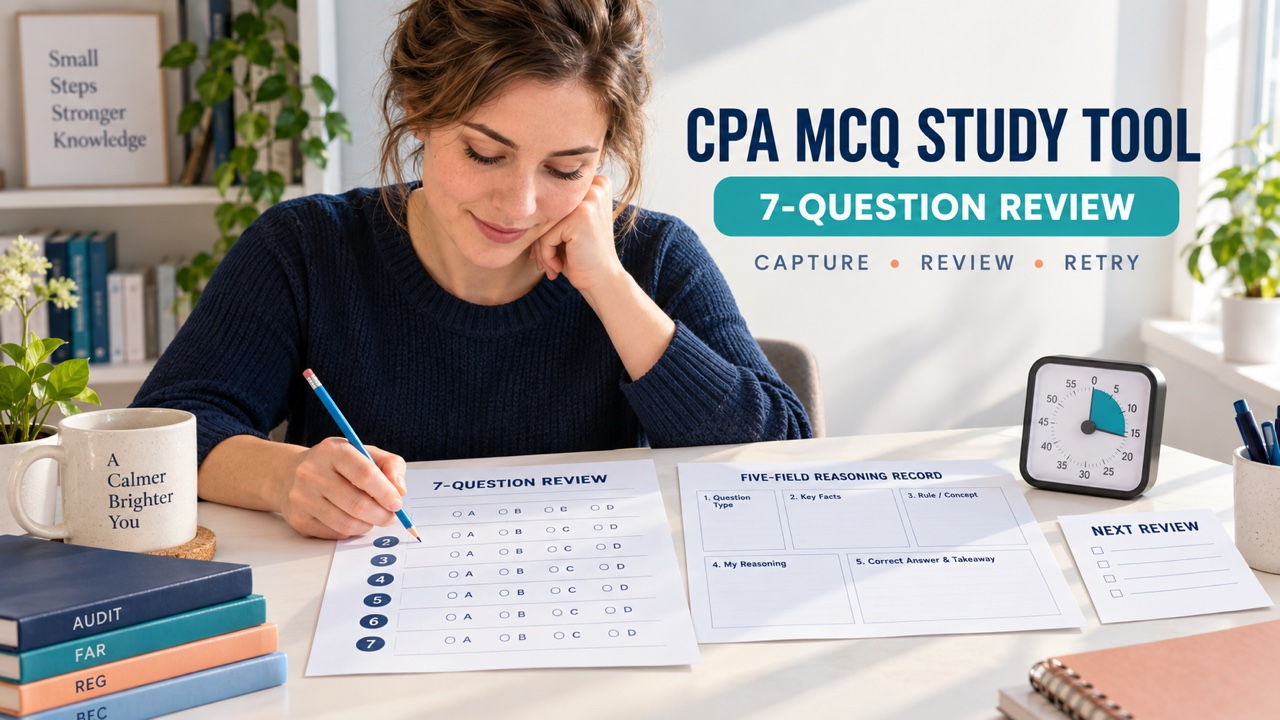

Quick answer: A useful cpa mcq study tool is a reasoning record, not a counter of questions opened. Capture the section or topic, tested skill, controlling fact, first answer and reason, confidence, strongest distractor, first gap, and next repair. Attempt first, reveal second, and retry the same skill with one changed fact. The seven questions are original editorial practice, not distributed exam content, an official score, or a readiness test.
For a broader preparation path, continue with our CPA Exam Study Guide.
cpa mcq study tool: What Should It Capture?
First, start with the smallest record that can change your next study block. The current AICPA CPA Exam Blueprints organize tested material by Area, Group, and Topic and provide task statements, skill levels, references, item types, and weighting. Therefore, the tool should connect a question to a current section or topic before it tells you to do more of the same.
- Scope: write the section, topic, or task family. “FAR” is a starting point; “revenue timing” is a more useful practice label.
- Skill and fact: state the verb you must perform and the amount, date, assertion, period, entity, or qualifier that controls the answer.
- First reason: save the answer you chose and one sentence explaining it before opening the reveal.
- Feedback: note the correct path and why the strongest distractor was tempting.
- Repair: choose one rule check, formula drill, stem annotation, or changed-fact retry.
In addition, a lucky answer, a slow answer, and a confident answer with a missing qualifier call for different next steps. A question count cannot show which reasoning changed.
Build a cpa mcq study tool in Five Blocks
Next, use the same five blocks for each item: capture the section and skill, frame assumptions and the controlling fact, commit with a reason, reveal the rationale and distractor, then write one next action and retry with one changed fact.
- Capture: name the section or topic and the tested skill.
- Frame: mark facts, assumptions, dates, amounts, assertions, or entities that can change the result.
- Attempt: choose once and preserve the first reason before checking the explanation.
- Reveal: compare the correct rule or calculation with the distractor that felt plausible.
- Retry: choose a repair and change one fact while keeping the tested skill and task form stable.

Also, the visual loop is paper-based to keep the evidence chain visible. Additionally, if you use a spreadsheet or notes app, keep the same fields and preserve the original reason after reviewing the answer.
7 Original Questions for the cpa mcq study tool
Then, run the set as a practice session. Next, read the tested skill, assumptions, and difficulty first. For example, choose an option and write one reason. Only then expand the answer. Each reveal names the controlling fact, the strongest distractor, and one next action. These are original editorial examples, not exam content.
1. AUD: Which Direction Matches the Assertion?
Tested skill: match evidence direction to an assertion. Assumptions: recorded year-end receivables are being tested for existence, customer addresses are available, and positive confirmations can be sent. Difficulty: foundational application.
Original practice item: Which procedure most directly addresses the stated assertion?
- Trace shipping documents forward into the sales journal
- Send positive confirmations to selected customers
- Recalculate the allowance percentage
- Compare gross margin with the prior year
Reveal the answer and explanation
Answer: B, send positive confirmations. Explanation: the customer is an external source that can support whether a recorded receivable exists. The controlling fact is the assertion, not the general topic of receivables. Distractor: A may feel concrete, but tracing from shipping documents into the records more naturally tests completeness because it asks whether activity was recorded. Next action: write the assertion and evidence direction beside the next three AUD stems.
2. FAR: What Amount Belongs to the Service Month?
Tested skill: connect service delivery to revenue timing. Assumptions: a company receives $15,000 on October 1 for three equal months of service beginning immediately; ignore taxes, refunds, and other adjustments. Difficulty: foundational calculation.
Original practice item: How much revenue belongs in October?
- $0
- $5,000
- $10,000
- $15,000
Reveal the answer and explanation
Answer: B, $5,000. Explanation: one of three equal service months has been delivered, so divide $15,000 by three. The payment date establishes cash movement, while the service period controls the amount earned for October. Distractor: D treats the entire receipt as October revenue without considering the remaining obligation. Next action: write cash date, service period, and recognized month on three separate lines in your FAR record.
3. REG: Which Facts Belong Before the Rule?
Tested skill: identify facts that control a current tax conclusion. Assumptions: a federal treatment is requested, the payment belongs to a named year, and the taxpayer’s entity classification is not yet confirmed. Difficulty: foundational judgment.
Original practice item: What should the study tool require before the learner applies a tax rule?
- The most repeated answer in a discussion thread
- The tax year, effective date, and taxpayer classification from a current source
- The number of questions in the provider’s tax category
- Whether another learner chose the same answer
Reveal the answer and explanation
Answer: B, verify the tax year, effective date, and taxpayer classification. Explanation: a date-sensitive rule can change when it applies, and entity facts can change the treatment. A dependable study tool therefore records the missing inputs before recording a conclusion. Distractor: A can sound reassuring, but repetition does not establish current authority or the correct fact pattern. Next action: add a “facts checked” line to the next REG or TCP note.
4. BAR: Which Ratio Uses the Matching Balances?
Tested skill: calculate a current ratio from matching balances. Assumptions: current assets are $84,000 and current liabilities are $42,000; no other measure is requested. Difficulty: foundational calculation.
Original practice item: What is the current ratio?
- 0.5 to 1
- 1 to 1
- 2 to 1
- 42,000 to 1
Reveal the answer and explanation
Answer: C, 2 to 1. Explanation: divide current assets by current liabilities: $84,000 ÷ $42,000 = 2. The tool should preserve both the formula and the units so a correct result is reproducible. Distractor: D carries a raw denominator into the answer instead of creating a ratio. Next action: write numerator, denominator, and decision use before solving the next BAR metric.
5. ISC: What Should Change After a Role Change?
Tested skill: apply least privilege to an access change. Assumptions: an employee moves from invoice entry to a review role, the new role does not require vendor-master edits, and access can be adjusted before the next shift. Difficulty: foundational application.
Original practice item: Which action best reflects least privilege?
- Keep every old permission in case it becomes useful
- Grant administrator access so the change is easier to manage
- Remove unneeded invoice-entry and vendor-edit permissions, then test the new role
- Delete all access without recording the reason
Reveal the answer and explanation
Answer: C, remove unneeded permissions and test the new role. Explanation: least privilege keeps only the access needed for the assigned work, and a test confirms that the new role still functions. Distractor: A preserves excess access, while D removes evidence about what changed. Next action: record old role, new role, removed permission, retained permission, and test evidence in the ISC field set.
6. TCP: What Missing Fact Blocks the Comparison?
Tested skill: gather facts before comparing tax-planning alternatives. Assumptions: a prompt compares two choices for a taxpayer, but the taxpayer type and tax year are not stated; no numerical conclusion is requested yet. Difficulty: foundational planning.
Original practice item: What should the learner do first?
- Choose the option with the higher advertised savings
- Confirm taxpayer type, tax year, and governing rule
- Reuse a prior-year example without checking assumptions
- Choose the alternative that appears in more practice questions
Reveal the answer and explanation
Answer: B, confirm taxpayer type, tax year, and governing rule. Explanation: planning comparisons are fact dependent. The same alternative can change when the taxpayer, year, or effective rule changes, so the missing inputs belong in the study record before a conclusion. Distractor: A treats an unverified savings statement as if it were a conclusion. Next action: list the missing facts and the current source you will check before retrying.
7. Study Method: Which Record Changes the Next Action?
Tested skill: choose evidence that makes a practice result actionable. Assumptions: the learner wants to decide whether to review a rule, annotate a stem, drill a formula, or retry a changed fact. Difficulty: foundational planning.
Original practice item: Which record is most useful after an uncertain answer?
- A percentage with no first reason
- A count of every question opened
- The skill, controlling fact, first reason, confidence, distractor, first gap, and repair
- A comparison with another learner’s pace
Reveal the answer and explanation
Answer: C, the evidence-rich record. Explanation: it preserves the path behind the answer and links the observed gap to one defined repair. That makes a later retry interpretable. Distractor: A and B measure quantity without explaining whether the difficulty came from scope, knowledge, reading, calculation, or transfer. Next action: use the record fields below on the next item even if you answered correctly.
Review the cpa mcq study tool Record
Afterward, record more than correct or incorrect. Then, keep the section or topic, tested skill, controlling fact, first choice, reason, confidence, strongest distractor, first gap, and next review block. The record should answer: what changes on the next item?
However, you may count correct answers as a study signal, but do not convert seven editorial questions into an official scaled score or readiness judgment. Likewise, the AICPA sample test has its own official purpose and is not a scored readiness tool. This record preserves reasoning and changes the next action.
- High confidence and wrong: inspect the controlling fact or the shortcut that bypassed it.
- Low confidence and right: retrieve the rule or formula without notes before adding volume.
- Changed answer during review: compare the first reason with the later reason; second-guessing may be the signal.
- Slow but accurate: keep the accuracy-protecting step and shorten one unnecessary step.
As a result, once the record is complete, choose one review block: a FAR service-period miss calls for a changed-period calculation, while an AUD evidence-direction miss calls for a changed assertion. Test the repair instead of repeating old volume.
Repair the First Gap in Your cpa mcq study tool
For this reason, start with the earliest gap that the record can support. Next, select one repair and hold the tested skill stable. The five labels below are study diagnoses, not official exam ratings:
- Scope: you could not place the item in the current section, topic, task, or source boundary. Check the current Blueprint.
- Knowledge: you recognized the topic but could not state the rule or control. Restate one trusted explanation and retrieve it without notes.
- Reading: you missed an amount, date, assertion, qualifier, or entity. Mark the controlling words before solving again.
- Calculation: you knew the rule but skipped a variable, unit, period, denominator, or sequence. Write the formula before computing.
- Transfer: the original pattern made sense, but one material fact changed the decision. Keep the skill and change exactly one fact in the retry.
For instance, if you selected $15,000 because the cash arrived, your repair is not “do more FAR.” Then, write “identify the service period,” review one explanation, and retry with a two-month contract. Similarly, if you selected a recorded-receivable procedure for a completeness question, preserve the evidence-direction rule and change only the assertion. Consequently, the next attempt has a clear job and the study tool can show whether the reason improved.

FAQ: cpa mcq study tool
Is a cpa mcq study tool the same as a question bank?
Not exactly. Instead, a question bank supplies items; a study tool preserves the skill, controlling fact, first reason, distractor, and next repair. You can use a bank as the source of questions while keeping this evidence record separately.
Are these exam questions?
No. They are original editorial practice questions. Therefore, use the current AICPA Blueprints for scope and the official AICPA sample test for its own format-familiarity purpose.
Does the record create an official score?
No. Correct count, confidence, and error labels are study signals. They do not produce a scaled score or predict readiness.
How many questions should I put in one tool session?
Finally, use the smallest set that lets you preserve a reason and review each distractor. Seven can fit a focused block when every item produces evidence; add volume only after the record is useful.
Where should I check current CPA rules?
Also, for scope and current terminology, use AICPA Blueprint resources. Moreover, for eligibility, fees, accommodations, jurisdictions, applications, and licensing, use NASBA or the applicable Board. Reopen official pages whenever a date, rule, or exam format changes.
Sources and Refresh Note for cpa mcq study tool
Current scope and item types: AICPA CPA Exam Blueprints. Format and software familiarity: AICPA sample tests. General administration: AICPA CPA Exam FAQ. Candidate process: NASBA CPA Exam. Checked September 16, 2026. The five-field tool, seven questions, choices, rationales, distractor notes, error labels, and retry method are original editorial study content. Reopen live official pages and refresh the workbook’s Semrush US fields before publication.