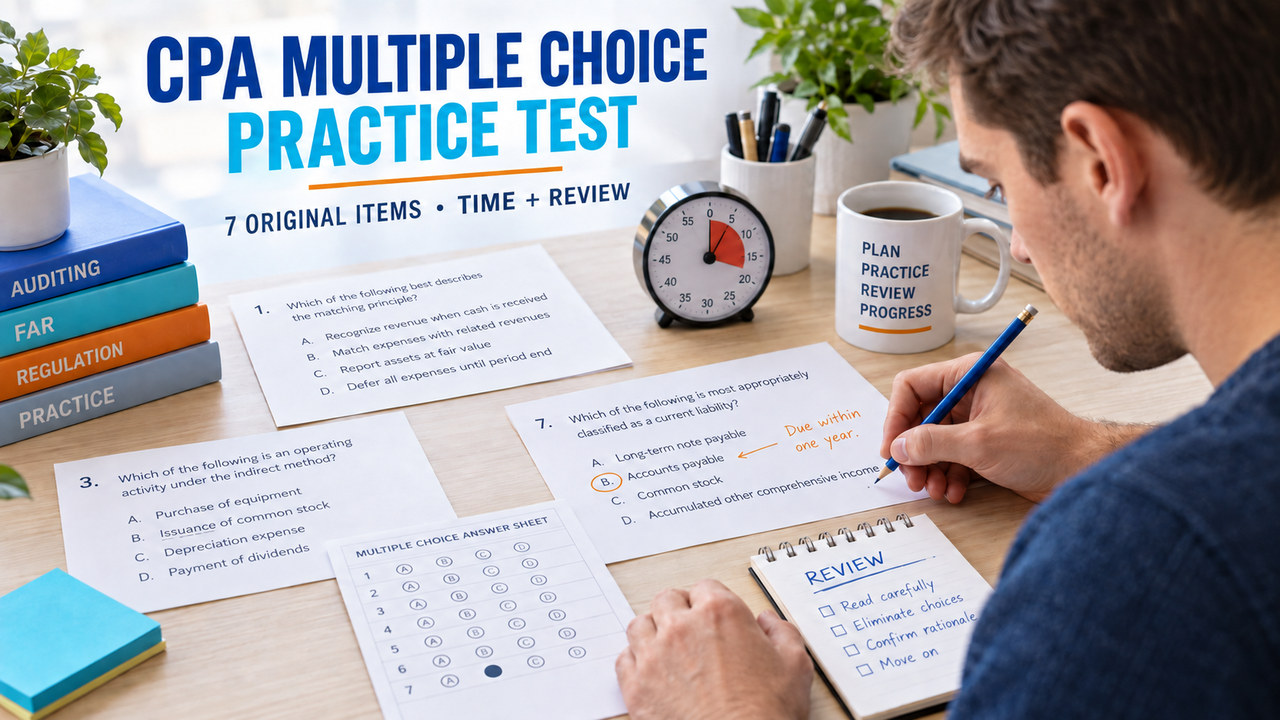

Quick answer: a cpa multiple choice practice test is most useful when it is small enough to finish and structured enough to explain. Set a bounded block, read the skill and assumptions, choose an answer with one reason, and reveal only after the attempt. Then record time, confidence, and the first error tag. The record is a study aid; it is not a released question set, an official score, or a readiness determination.
Large question banks can create motion without diagnosis. The seven original items below combine judgment, application, and calculation so you can observe the method, not just chase volume.
cpa multiple choice practice test
A good practice test measures more than whether a letter matches an answer key. It reveals whether you can identify the skill, isolate controlling facts, apply the rule, and explain why another option loses. A slow correct answer may need a method check; a fast wrong answer may need a reading or knowledge repair.
For scope, start with the current AICPA Blueprints to understand official tested-content boundaries and item types. Meanwhile, the AICPA sample test serves a different purpose: it helps you rehearse format and software, shows correct answers, and is not scored or a readiness determination. This page is an original editorial practice block. It does not reproduce or imply released examination content.
Before you begin, write three lines: skill, assumptions, and block length. In addition, treat a 20-minute block as a diagnostic instrument rather than a ranking. If a question needs a calculation, show the formula. When a rule may vary by year or jurisdiction, flag the missing fact instead of guessing.
How to Run a CPA Multiple Choice Practice Test
Treat the first pass as a sealed attempt before any answer reveal. Begin by reading the tested skill and assumptions. Next, underline the amount, date, qualifier, authority, or performance condition that controls the item. Then select one option and write a one-sentence reason. Afterward, open the reveal, compare the reasoning, and write the strongest distractor. Finally, tag the first observable problem and book one repair.
- Set: choose a short block and remove answer notes from view.
- Frame: name the skill and write the facts that must remain true.
- Commit: choose one option and preserve your reason before checking.
- Review: compare answer, rule, distractor, time, confidence, and next action.
Instead of pausing the clock to search every unfamiliar term, mark the uncertainty and finish the attempt. Afterward, return during review. That separation keeps the time signal interpretable. As a result, the practice session remains an assessment rather than a research session with an impressive question count but no evidence about decision-making.

7 Original Questions for a CPA Multiple Choice Practice Test
All seven items below are original practice. First, read each item’s skill, assumptions, and difficulty before looking at the choices. Then commit to an option and reason before opening the delayed reveal. Each explanation identifies the strongest distractor and a next action. Therefore, none of the items should be treated as released examination content.
1. CPA Multiple Choice Practice Test: Which Source Defines the Study Boundary?
Tested skill: distinguish a scope source from a provider topic list. Assumptions: you are deciding whether a topic belongs in a current section study plan. Difficulty: foundational judgment.
Original practice item: Which source should you check first to define the current tested-content boundary?
- A provider’s largest question inventory
- The current AICPA Blueprint for the relevant section
- A social-media study schedule
- A prior candidate’s memory of a test day
Reveal the answer and reasoning
Answer: B, the current AICPA Blueprint. Reasoning: the Blueprint organizes tested content and describes task statements, skill levels, references, item types, and weighting. Distractor: a large provider inventory can help you practice, but its coverage does not define the governing scope. Next action: write the exact Blueprint Area, Group, or Topic beside your next block.
2. What Is Recorded When Cash Arrives Before Service?
Tested skill: apply performance timing to a revenue fact pattern. Assumptions: a company receives $6,000 before it provides the promised service, and no service has been delivered at receipt. Difficulty: foundational application.
Original practice item: Which initial entry best reflects the facts?
- Debit cash and credit revenue
- Debit revenue and credit cash
- Debit cash and credit a contract liability
- Debit a contract liability and credit cash
Reveal the answer and reasoning
Answer: C, debit cash $6,000 and credit a contract liability $6,000. Reasoning: consideration has arrived, but the stated service has not been performed, so the amount is not earned revenue on these assumptions. Distractor: A treats collection as performance and ignores the timing condition. Next action: change the fact so half the service is complete and explain which balance remains deferred.
3. Which Procedure Directly Addresses Receivable Existence?
Tested skill: match an audit procedure to the evidence question. Assumptions: the auditor wants evidence about a customer’s stated accounts-receivable balance and can request a response. Difficulty: foundational application.
Original practice item: Which procedure generally provides the most direct external evidence about that balance?
- Inspect an internal sales invoice
- Send a confirmation request to the customer
- Recalculate the allowance estimate
- Read the entity’s credit policy
Reveal the answer and reasoning
Answer: B, send a confirmation request to the customer. Reasoning: the external response addresses the balance stated by the client, subject to the auditor’s evaluation and alternative procedures when needed. Distractor: an internal invoice can support a recorded transaction, but it is not the same direct response from the customer. Next action: retry with a nonresponse and name an alternative procedure for the remaining risk.
4. What Is the Present Value of One Future Cash Flow?
Tested skill: discount one stated cash flow with the correct period count. Assumptions: an asset pays $10,000 at the end of year 2, the annual discount rate is 10%, and there is no interim cash flow. Difficulty: foundational calculation.
Original practice item: What is the approximate present value?
- $7,513.15
- $8,264.46
- $9,090.91
- $10,000.00
Reveal the answer and reasoning
Answer: B, $8,264.46. Reasoning: use $10,000 ÷ (1.10)2 = $10,000 ÷ 1.21. Distractor: C discounts for only one period, while D ignores the time value of money. Next action: write the period count before the formula and retry with a year-3 cash flow.
5. Which Access Design Uses Least Privilege?
Tested skill: match a job need to a minimum-permission design. Assumptions: a billing clerk needs to enter and view invoices but does not need user administration, database export, or system configuration rights. Difficulty: foundational application.
Original practice item: Which control design best matches the stated need?
- Give the clerk an administrator account
- Share a supervisor’s account during busy periods
- Assign a role with only the required invoice permissions
- Grant every permission and review it at year-end
Reveal the answer and reasoning
Answer: C, assign a role with only the invoice permissions required. Reasoning: least privilege limits access to the minimum functions and data necessary for the task while preserving individual accountability. Distractor: an administrator account may be convenient, but it grants unrelated power and weakens the evidence trail. Next action: change the job function and name one permission that should be removed.
6. What Comes Before a Date-Sensitive Tax Rule?
Tested skill: frame missing facts before selecting a tax rule. Assumptions: the result may depend on tax year, taxpayer type, jurisdiction, or a recent change, and the question does not supply those fields. Difficulty: foundational judgment.
Original practice item: What should you clarify first?
- Memorize the most familiar rate
- Choose the answer with the longest explanation
- Identify the tax year, taxpayer, jurisdiction, and governing source
- Use the rule from the last practice question
Reveal the answer and reasoning
Answer: C, identify the tax year, taxpayer, jurisdiction, and governing source. Reasoning: a correct rule for the wrong year or taxpayer can still produce a wrong result. Distractor: recalling a familiar rate first creates confidence before the controlling assumptions are known. Next action: write those four fields before solving another date-sensitive item.
7. CPA Multiple Choice Practice Test: Which Practice Record Best Guides the Next Block?
Tested skill: interpret time, accuracy, confidence, and error tags together. Assumptions: you missed an original item and want to determine whether the next block should teach, reread, calculate, or transfer. Difficulty: foundational planning.
Original practice item: Which record is most useful?
- A percentage with no explanation
- A list of every question you opened
- The first choice, reason, time, confidence, distractor, error tag, and repair
- A comparison with another learner’s pace
Reveal the answer and reasoning
Answer: C, the evidence-rich record. Reasoning: it shows the path behind the answer and ties the observed problem to a defined next action. Distractor: a percentage or question count cannot tell you whether the first problem was reading, knowledge, calculation, timing, or transfer. Next action: change one material fact in a same-skill retry and compare the written reasons.
How to Review a CPA Multiple Choice Practice Test
After the final reveal, do not average every signal into one verdict. Begin with the first observable error. For example, a missed qualifier suggests reading; a known rule with poor pacing suggests timing; a correct letter without an explanation suggests knowledge or transfer.
Start with accuracy as a prompt to inspect reasoning, not as a readiness claim. Next, use time to ask whether the method was efficient or whether the item deserved a deliberate calculation. Then use confidence to find calibration problems: high confidence plus a weak reason needs a careful reread, while low confidence plus a sound reason may call for retrieval practice. As a result, uncertainty becomes a reason to choose the next experiment rather than a verdict.
Preserve the strongest distractor. In practice, it is often more useful than the correct letter because it records the path that felt plausible. For example, a distractor based on a missing assumption calls for framing. Likewise, a distractor based on a one-period shortcut calls for a formula and a changed period count, while a broad permission role calls for a minimum-necessary access check.
Choose the Next Review Block
Choose one repair, not a new library of resources. Next, use the following tags to make the decision explicit:
- Timing: you knew the method but spent the block inefficiently. Rework one item with a written time budget.
- Scope: you could not identify the current topic boundary. Check the relevant Blueprint Area, Group, or Topic.
- Knowledge: you recognized the topic but could not state the rule. Restate one authoritative explanation and retrieve it without notes.
- Reading: you missed a date, amount, qualifier, or authority. Mark the controlling words before solving again.
- Calculation: you knew the rule but skipped or reversed a step. Write the formula and period count on paper.
- Transfer: the original item made sense, but one changed fact broke the method. Retry with exactly one material fact changed.
Write the repair as a sentence: “I need to name the period count before discounting the cash flow.” Then schedule a same-skill retry within the next two study blocks. Next, compare the new reason with the old one. If the reason changes in the intended direction, you have better evidence than a larger unexplained question count.

FAQ: CPA Multiple Choice Practice Test
Are these released examination questions?
No. They are original editorial practice items. Instead, use the current AICPA Blueprints for scope and do not treat any answer on this page as a released or endorsed item.
How long should a practice test be?
Use the smallest block that lets you explain the result. For this page, the seven-item set is designed for a short timed session. Add length only when the time, confidence, and error evidence from the current block is useful.
Should I use a percentage as my practice result?
You may record accuracy as one study signal; however, do not convert seven original items into a passing prediction. Preserve the reason, distractor, time observation, confidence, and next action so the number has context.
What if I run out of time?
If time runs out, finish the smallest defensible attempt and mark where time changed your method. Then tag timing only if the method—not the content—caused the miss. Finally, retry one same-skill item with a written time budget.
Where should I check current exam scope and software?
For current scope and software familiarity, use the AICPA Blueprints and AICPA sample test. Also use NASBA or the applicable board for eligibility, applications, fees, jurisdictions, and licensing. Those sources can change independently of this practice set.
Sources and Refresh Note
Current scope and item types: AICPA CPA Exam Blueprints. Format and software familiarity: AICPA sample tests. General administration: AICPA CPA Exam FAQ and NASBA CPA Exam. Checked September 16, 2026. The seven questions, rationales, time-and-confidence record, error tags, and retry method are original editorial study content. Reopen the live official pages and refresh the workbook’s Semrush US fields before publication. For a broader preparation route, continue with our CPA Exam Study Guide.