
Direct answer: To use the cpa reg exam format well, read it as a chain of requested outputs rather than a list of labels. Start with one current Blueprint row, name the task verb, isolate the fact that controls the response, choose MCQ or TBS-style work for the proof you lack, and save one changed-fact retry. The format becomes useful when it tells you what evidence to produce next.
Scope and freshness note: This is original U.S. CPA exam-prep guidance. It is not an exam-authority publication, tax conclusion, legal conclusion, licensing decision, or professional conclusion. Reopen the AICPA CPA Exam Blueprints for the active testing window, use IRS tax resources for current technical refreshes, and use the NASBA CPA Exam FAQ for administration questions.
Use the REG review hub for section breadth. Open the CPA Exam Blueprint format guide when a row or task statement is unclear. Use CPA MCQ by topic to test recognition and boundaries, then use CPA TBS practice when the requested proof requires exhibits, calculations, or several response fields.
For a broader preparation path, continue with our related CPA study resources.
cpa reg exam format: read the requested output
A candidate can know that REG includes taxation, business law, ethics, and procedure and still study inefficiently. The missing step is translating the format into an output. Before a practice item, write one line that says what you must return: a classification, calculation, conclusion, explanation, authority-and-remedy analysis, or assembled workpaper.
That line changes how you read the stem. A number may be a distractor if the task is classification. However, a familiar rule may be incomplete if the question asks for a procedural response. Likewise, a correct choice may still be a weak study result if you cannot name the fact that made it correct. Treat each item as a small handoff from scope to proof.
Next, keep the boundary visible. The current Blueprint describes the tested scope and task language; it does not forecast a personal score or guarantee an exam form. A local practice percentage is evidence about the selected work. It is not an official CPA result, readiness determination, tax conclusion, or legal conclusion.
Map a Blueprint row before practice
Start with one current row instead of an entire chapter. Copy the section, Area or group, topic, task statement, skill level, reference, and item type. Then add three study fields: the output you must produce, the controlling fact or input, and the source checkpoint you will reopen before reusing the note.
- Scope: write the narrow topic in the row’s own language and leave neighboring rows out of the first block.
- Verb: preserve the requested action, such as identify, calculate, evaluate, determine, or explain.
- Trigger: circle the role, date, ownership, amount, notice, condition, or classification that can move the response.
- Proof: decide whether a reasoned choice, calculation, exhibit trail, or multi-field response will demonstrate the skill.
- Retry: choose one material fact to change after the first attempt and write what should stay constant.
For example, a basis question may turn on the acquisition event and holding detail, while a business-law prompt may turn on authority and remedy. A procedure prompt may require a notice and its activating date together. These examples show a reading method; they do not settle a live matter.
Separate the cpa reg exam format lanes
Use the broad lanes to orient the search, then let the requested output decide the work. Each lane can use MCQ or TBS-style practice, but the evidence you save should match the question’s shape.
- Federal taxation: identify the taxpayer and transaction, then isolate timing, basis, income, deduction, credit, or limitation facts before calculating or classifying.
- Business law: identify parties, authority, agreement or default, filing or priority fact, and requested remedy. A familiar term can point to the wrong consequence when one role changes.
- Ethics and professional responsibility: separate duty, reliance boundary, disclosure or record obligation, and procedural deadline. A memorized phrase is weaker than a duty-to-fact explanation.
- Tax procedure and application: read notice, authority, trigger date, and response as one chain. A date without its trigger is an incomplete procedure record.
After naming the lane, write a five-part handoff: requested output, activating fact, source checkpoint, evidence format, and retry variable. This gives a mixed REG block a common shape without pretending that every rule operates the same way.
Use the cpa reg exam format worksheet
The worksheet below keeps a format question from becoming a passive reading exercise. It should fit beside one Blueprint row and make the next resource obvious.
- Locate: copy the row and mark the smallest topic boundary that still answers the task.
- Translate: turn the task statement into a verb plus an output. For instance, “evaluate” should become a conclusion with a reason, not a copied definition.
- Anchor: reopen the official or technical source and write the boundary in your own words. Record what would force a fresh source check.
- Select: choose MCQ for recognition or rule discrimination, or TBS-style work for exhibits, calculations, reconciliation, or several response fields.
- Transfer: change one fact and state whether the answer, calculation, or next action changes. Explain the trigger either way.
Each handoff should leave an artifact: a marked row, a one-sentence task, a source checkpoint, a chosen practice mode, and a retry note. If a step has no artifact, the block probably measured exposure rather than transfer.
Match MCQ to the cpa reg exam format proof gap
Use an original MCQ set when the gap is recognition, boundary discrimination, or distractor control. Keep the set narrow enough to explain every miss. After choosing an answer, write why the strongest wrong option fails and name the fact that would make that option plausible in a neighboring question.
For a useful MCQ debrief, record four lines: the task verb, the controlling fact, the rule boundary, and the wrong turn. A correct guess without those lines stays in review. Likewise, an incorrect answer with a clear boundary may be a productive repair rather than evidence that the entire lane is weak.
When an item looks familiar, ask whether the familiar word is the requested output or only context. That question prevents keyword matching from replacing analysis. The format is doing its job when the answer choice is the last step, not the first.
Match TBS-style work to the REG proof gap
Choose TBS-style work when the requested proof requires exhibits, calculations, reconciliations, role-and-authority chains, or multiple response fields. Keep inputs, source, transformation, and conclusion together. A workpaper can be short; it simply needs to show how the evidence became the requested output.
Do not choose TBS merely because it sounds harder. Choose it when assembly is the missing proof. If you can state the rule but cannot place the right facts into the right fields, a constructed workpaper exposes that gap more clearly than another recognition set.
Before you begin, write the response fields you expect to complete. During the attempt, mark the exhibit or calculation that supports each field. Afterward, change one input and state which fields should change. This keeps a long task bounded and makes the retry auditable.
Turn the cpa reg exam format into a timed REG block
A practical block can be thirty minutes. Spend five minutes mapping the row and output, twelve minutes on a focused practice set or workpaper, eight minutes on a changed-fact retry, and five minutes filing the repair note. Adjust the minutes when the task requires more assembly, but keep the handoff sequence.

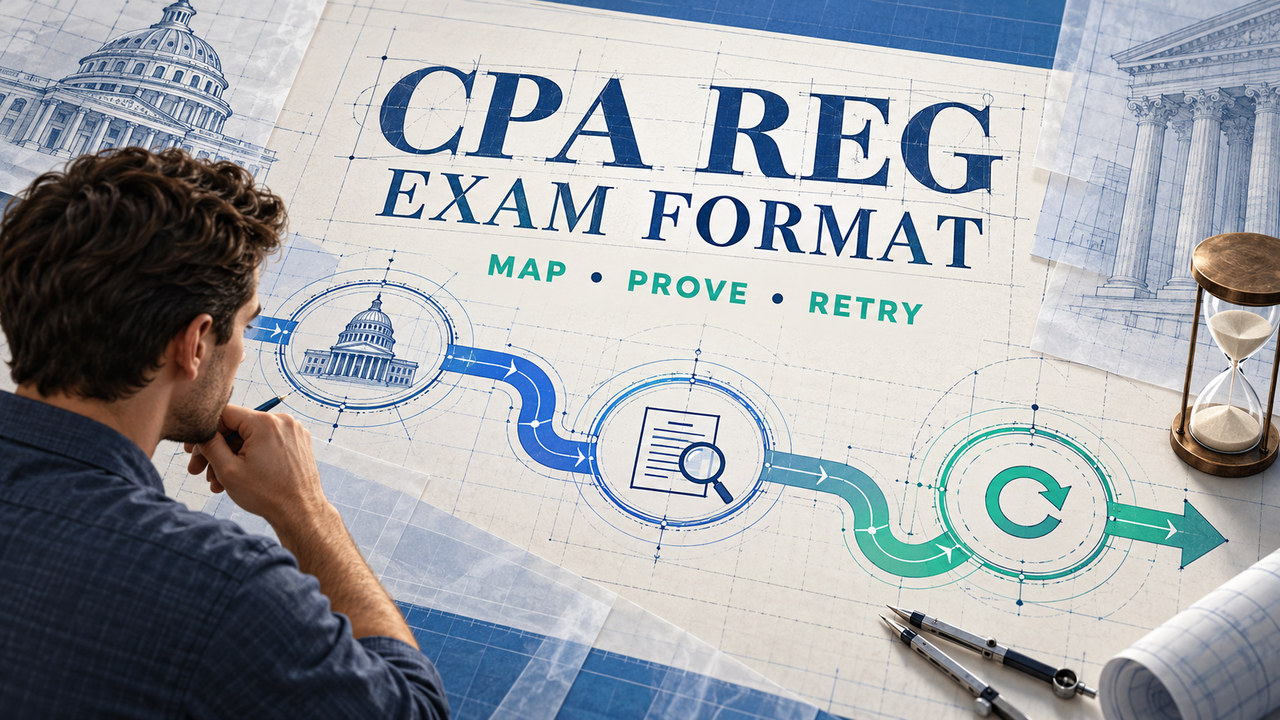
The route is intentionally compact. The visual is a working map: topic leads to the controlling fact, the source gives that fact meaning, the practice mode produces proof, and the next action follows from the first missing field. Do not add another resource until the current handoff is recorded.
Run the REG format checklist
Use this checklist at the end of one focused block. Mark a line only when you can explain it from the current row and source. The first unchecked line chooses the next repair; it is not an official score or readiness test.
If the first blank is scope, narrow the row. If it is the task verb, rewrite the requested output. When the trigger is missing, isolate the fact that moves the response. If the source is unclear, reopen the authority. Next, choose MCQ or TBS-style work by the missing proof. Finally, run the changed-fact retry.
Record format errors without blaming the whole section
After each attempt, save one line for the earliest broken handoff. Use labels such as scope, verb, trigger, source, assembly, or transfer. Then add the row, the fact, the evidence you checked, the strongest wrong turn, and the next action.
When several misses share a trigger, keep the topic narrow and vary only the fact. When misses come from different lanes, separate them instead of creating one broad “REG weakness” label. A repair ledger should make tomorrow’s first decision easier, not merely preserve an explanation you will not reopen.
For current-sensitive rules, record when you checked the source and what remains uncertain. Editorial examples help you practice the reading move, while live authority controls the boundary. The study format can remain stable even when a technical detail must be refreshed.
Route the next REG resource
Use one resource for the first observed gap. The REG review hub provides breadth. The Blueprint format guide clarifies row language. CPA MCQ by topic supports recognition and boundary control. CPA TBS practice supports exhibits, calculations, and constructed outputs. Opening every page at once can hide the handoff you are trying to repair.
- REG review hub — orient the section and its major lanes.
- CPA Exam Blueprint format guide — translate a row into task and item-type evidence.
- CPA MCQ by topic — test recognition, boundaries, and distractor reasoning.
- CPA TBS practice — assemble exhibits, calculations, reconciliations, and multi-step outputs.
End with one scheduled action: name the row, practice mode, fact to change, evidence to save, and time for the retry. That is the practical value of the cpa reg exam format: the format selects the next proof instead of encouraging another unfocused review session.
cpa reg exam format FAQ
Should I memorize every REG label before practicing?
No. Start with one current Blueprint row, preserve its task verb, and let the requested output determine the practice format. Expand only after the first handoff remains stable.
Does a high practice percentage prove readiness?
No. A local percentage is one observation, not an official CPA score or readiness determination. Keep the reason, wrong-turn analysis, and changed-fact retry with the result.
When should I use MCQ instead of TBS-style work?
Use MCQ for recognition and rule-boundary control. Use TBS-style work when the proof requires exhibits, calculations, reconciliations, or several response fields. Reopen the current Blueprint when the item type or skill level is unclear.
What should I do after a first format miss?
Save the earliest missing handoff, reopen one relevant source, rewrite the trigger in your own words, and retry one new item after changing one material fact.
Sources
- AICPA CPA Exam Blueprints
- IRS tax resources
- NASBA CPA Exam FAQ
- REG review hub