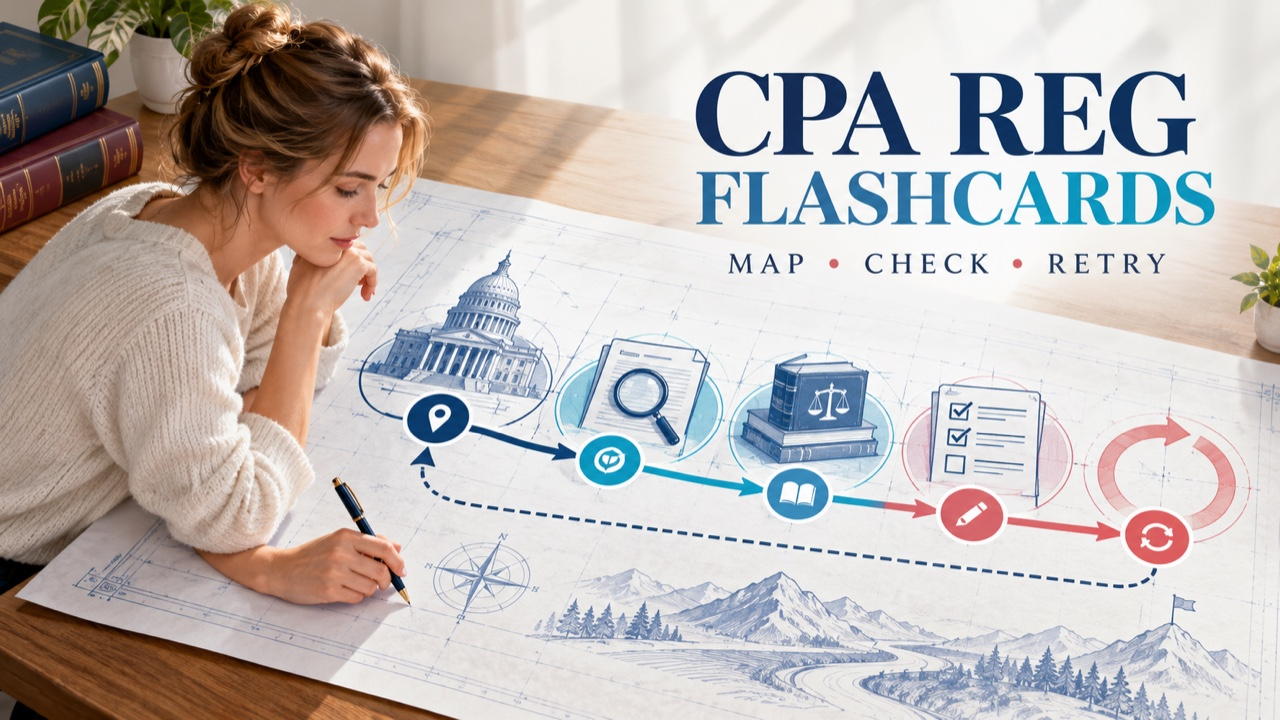

Direct answer: Use cpa reg flashcards as a control panel for the next REG study block. Each prompt should identify a topic, the fact that moves the response, the source that anchors the boundary, and the practice output that proves transfer. End by changing one fact and scheduling one repair.
Scope and freshness note: This is original U.S. CPA study-planning guidance for a Regulation audience. It does not reproduce official items, set a tax position, answer a legal matter, make a licensing decision, or predict a score. Recheck the AICPA CPA Exam Blueprints for the active testing window, consult IRS tax resources for technical updates, and use the NASBA CPA Exam FAQ for administration information.
Navigate by the job of the next resource: the REG review hub supplies a section map; the Blueprint format guide decodes task language; CPA MCQ by topic tests recognition; and CPA TBS practice rehearses evidence assembly.
For a broader preparation path, continue with our related CPA study resources.
cpa reg flashcards: choose the proof, not the card
A prompt is valuable only when it directs a decision. However, a candidate may remember that REG covers tax, law, ethics, and procedure and still choose the wrong next exercise. As a result, the missing move is to connect recall with proof: identify the requested response, name the input that controls it, and decide what an observer should be able to see after the attempt.
Next, build each prompt around four fields: topic, trigger, anchor, and evidence. The topic keeps scope narrow. In practice, the trigger says what could change the result. Next, name the page or exhibit worth reopening. Then choose a recognition set, calculation, workpaper, or multi-field response as evidence. If one field is blank, that blank is the next study task.
Map the cpa reg flashcards route to one Blueprint row
First, take a single row from the current Blueprint and turn it into a study ticket. Capture its Area or group, topic, task statement, skill level, reference, and item type. Next, rewrite the requested output in plain language. A task to evaluate needs a conclusion and reason; a task to calculate needs inputs and a transformation; a task to identify needs a classification plus the fact that supports it.
- Bound the ticket: name the smallest topic that can answer the row and postpone neighboring rows.
- Translate the verb: keep the row’s action visible instead of turning it into a vague “know this” note.
- Circle the switch: mark the role, date, ownership, amount, notice, condition, or classification that can move the response.
- Set the anchor: save the official or technical page you will revisit before carrying the boundary into another session.
- Specify the proof: decide whether the result should be a reasoned choice, number, exhibit trail, or set of fields.
- Plan the mutation: choose one material fact to alter and state what should stay unchanged.
This ticket turns a memory prompt into a handoff. A partner can inspect the row, the switch, the anchor, and the chosen exercise without guessing what you intended to study.
Separate the cpa reg flashcards lanes before memorizing
Meanwhile, use four lanes to sort REG prompts before you start a mixed session. The lanes orient the search; they do not replace the task statement or determine an answer by themselves.
- Federal tax: first identify the taxpayer and transaction. Then sort the facts into timing, basis, income, deduction, credit, or limitation before doing arithmetic.
- Business law: trace party, authority, agreement or default, filing or priority, and requested remedy. A change in one role can change the consequence.
- Ethics and professional responsibility: distinguish the duty, reliance boundary, disclosure or record obligation, and procedural deadline. Explain the duty alongside its activating fact.
- Tax procedure and application: keep notice, authority, trigger date, and response together. A deadline without its trigger is not a usable procedure note.
In addition, for any lane, preserve five handoff fields: requested output, activating fact, source checkpoint, evidence format, and retry variable. As a result, the fields give a mixed REG plan a common frame while the lane-specific facts keep the reasoning accurate.
Turn cpa reg flashcards into a study artifact
Instead, do not leave the result as a front-and-back memory pair. In practice, leave an artifact that records why the prompt belongs in this block and what would count as transfer.
- Prompt: write the row’s topic and action in original language. Never copy recalled, leaked, or official item text.
- Switch: identify the role, input, date, amount, or condition that activates the rule. If two facts compete, explain which one separates them.
- Anchor: paraphrase the rule boundary and save the source checkpoint that should be reopened when the detail changes.
- Output: choose a recognition explanation, calculation, exhibit trail, reconciliation, or multi-field response that matches the task.
- Mutation: change one fact and write whether the answer, number, or next action should move.
For instance, a tax ticket can require classification before computation. A law ticket can connect authority to remedy. A procedure ticket can bind the notice to the date that activates the response. These are editorial methods for study design, not official question wording.
Choose cpa reg flashcards practice by the gap
Therefore, pick the exercise that exposes the missing proof. A compact MCQ set is appropriate when you confuse recognition, boundaries, or distractors. After selecting an answer, explain the best wrong option and name the changed fact that would make it plausible. A lucky choice without that explanation stays unresolved.
Similarly, a TBS-style workpaper fits when the task is assembly: exhibits, calculations, reconciliations, authority chains, or several response fields. At the same time, keep the inputs, source, transformation, and conclusion in the same record. Difficulty is not the decision rule; missing assembly evidence is.
Match practice mode to the requested output
For example, classification calls for a narrow recognition explanation. Calculation calls for inputs and visible steps. Procedure calls for notice, trigger, authority, and remedy in one chain. A constructed response calls for an exhibit or calculation tied to each field. Let the row’s requested output choose the format.
Time the cpa reg flashcards block and save the retry
Try a thirty-minute block: five minutes to issue the study ticket, twelve minutes for the selected exercise, eight minutes for a one-fact mutation, and five minutes to file the repair. Add time when the task requires more assembly, but keep the sequence. Therefore, a bounded record is more useful than a long stack of unchecked prompts.

The route graphic shows the intended handoff. A topic narrows the trigger, the source gives the trigger meaning, the exercise produces evidence, and the first missing field chooses the next action. Keep the route visible while you work.
Run the cpa reg flashcards review checklist
Afterward, use this checklist after one ticket, not after an entire chapter. Mark a line only when you can explain it from the current row and source. The first blank is a routing signal; it is not an official score or readiness test.
Then use the first blank to decide what happens next: tighten scope, restate the action, isolate the switch, reopen the anchor, change the exercise, explain the wrong turn, or run the mutation.
Repair the first cpa reg flashcards miss
After the attempt, label the earliest broken handoff: scope, verb, switch, anchor, assembly, or transfer. Add the row, the activating fact, the source or exhibit, the strongest wrong turn, and the next action. This keeps a miss small enough to repair.
Keep speed separate from confidence. If the clock ends while the boundary is uncertain, mark the ticket and return with a narrower row. A larger mixed set will not explain the missing fact.
When several misses share one switch, vary only that switch. When misses come from different lanes, keep separate labels rather than inventing one broad REG weakness. The ledger should tell tomorrow’s first decision.
For a current-sensitive boundary, record when you checked the source and what still needs verification. Editorial examples teach a reading move; live authority controls the technical boundary. The route can remain stable while the note is refreshed.
Finish with one mutation. Keep the task action fixed, change one material fact, and decide whether the answer, calculation, or resource changes. Explain the trigger either way. That explanation is the payoff of the prompt.
Route the next cpa reg flashcards resource
Finally, let the first missing field select one destination. Use the REG hub when you need orientation. For row language, open the Blueprint format guide. For recognition or distractor reasoning, open the MCQ page. When exhibits, calculations, reconciliations, or constructed fields are missing, choose the TBS guide.
- REG review hub — set the section boundary and identify a lane.
- CPA Exam Blueprint format guide — translate row language into a study ticket.
- CPA MCQ by topic — test recognition, limits, and distractor logic.
- CPA TBS practice — assemble evidence across exhibits and response fields.
Finally, close the block by scheduling one action with a row, format, fact to change, evidence to keep, and retry time. That is how cpa reg flashcards become a navigation system rather than another tab to collect.
cpa reg flashcards FAQ
Should I study every REG topic in the same order?
No. Let the current Blueprint row and the first evidence gap choose the next ticket. Keep nearby topics in view, but do not mix them into the first repair.
Is a high practice percentage proof that I am ready?
No. A local percentage is one observation, not an official CPA score or readiness finding. Keep the reason, the failed distractor, and the one-fact mutation beside it.
When should I use MCQ versus TBS practice?
Use MCQ for recognition and boundary decisions. Use TBS-style work for exhibits, calculations, reconciliations, or several fields. Check the current Blueprint if the item type or skill level is unclear.
What should I do after a miss?
Record the earliest missing handoff, reopen one source, restate the switch in your own words, and retry one new item after changing a material fact.
Sources
- AICPA CPA Exam Blueprints
- IRS tax resources
- NASBA CPA Exam FAQ
- REG review hub