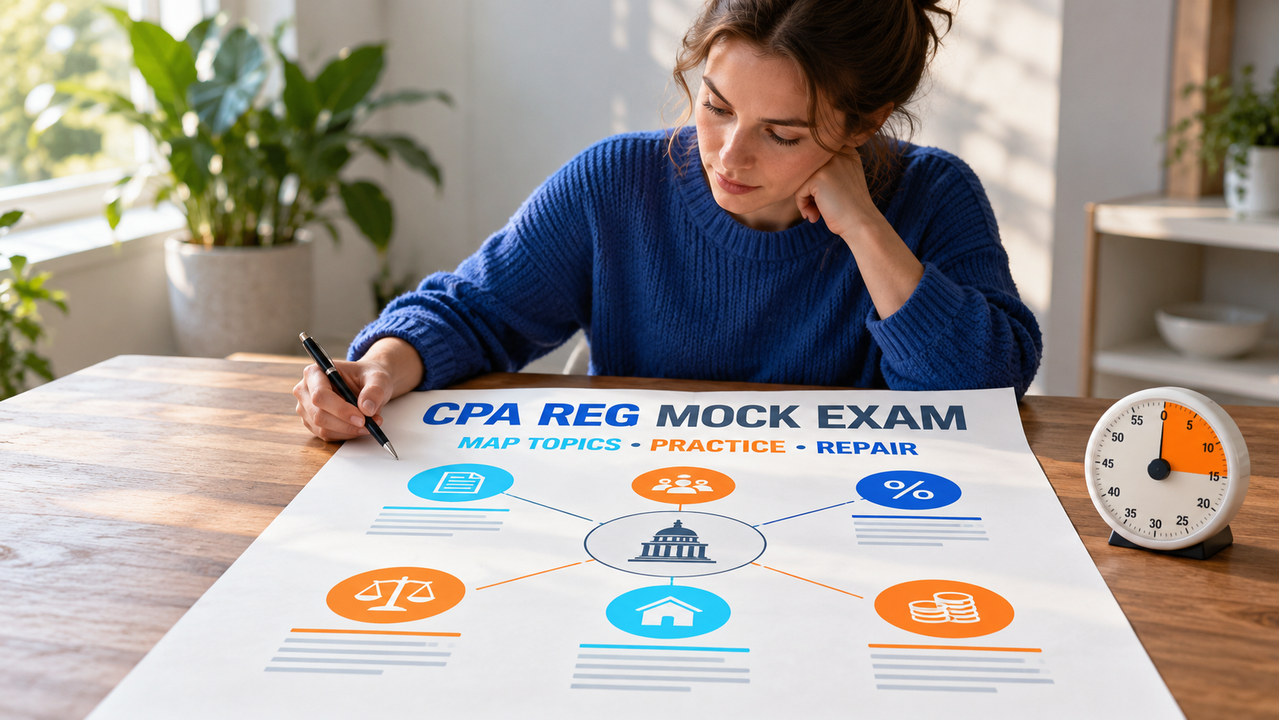

Direct answer: A cpa reg mock exam is most useful when it produces a review map, not just a percentage. Start with one current Blueprint row, name the REG topic and task verb, isolate the fact that can change the response, and decide what evidence the next practice block must produce. Then debrief the first weak proof point and schedule one changed-fact retry.
Scope and freshness note: This is original study guidance for the U.S. CPA audience. It is not an exam-authority publication, a tax conclusion, legal conclusion, licensing decision, or personal readiness score. Reopen the AICPA CPA Exam Blueprints for the active testing window, use IRS tax resources for current technical refreshes, and use the NASBA CPA Exam FAQ for administration questions.
Use the REG review hub for section orientation. Open the Blueprint format guide when a row or task statement is unclear, the CPA MCQ by topic page when the gap is rule recognition, and the CPA TBS practice guide when you need exhibits, calculations, or several response fields.
For a broader preparation path, continue with our related CPA study resources.
cpa reg mock exam: turn a broad section into a review route
A broad REG practice label hides several different jobs. One item may ask you to classify a taxpayer, another may test a business-law relationship, and another may depend on a procedural trigger. If those jobs are mixed into one score, the score cannot tell you what to repair. Give the session a route before you begin: scope, signal, source, practice mode, and next action.
Write the route in a single line: Blueprint row → controlling fact → source checkpoint → response format → changed-fact retry. The line is short enough to keep beside the questions and specific enough to expose a missing decision. It also keeps this page at the section level. Detailed tax computations, question banks, and TBS workpapers belong on their narrower supporting resources.
Keep the boundary visible throughout the session. A local result can show how well you handled the selected items; it cannot become an official score, a jurisdiction conclusion, or a promise about an exam form. The current source decides whether a technical statement remains current.
Start with one current Blueprint boundary
Before opening a mock set, copy one current row into a working note. Record the section, area or group, topic, task statement, skill level, source reference, and item type. Then add two editorial fields: the fact that can move the answer and the evidence I must produce. Those fields turn a row into an observable practice contract.
- Topic: name the narrow lane rather than writing only “REG.” A lane might concern an entity, a transaction, authority, filing, or professional responsibility.
- Task verb: copy the requested action: identify, calculate, evaluate, determine, or explain. The verb tells you what a complete response must contain.
- Controlling fact: note the date, role, ownership, classification, amount, notice, or condition that could change the result. Ignore details that do not move the lane.
- Source checkpoint: name the official or technical page you will reopen before reusing a current-sensitive note.
- Evidence format: decide whether a reasoned choice, a short calculation, an exhibit trail, or a multi-field workpaper will prove the skill.
For example, a hypothetical basis item may turn on the acquisition event and holding detail rather than the largest number in the stem. A procedure item may require the notice and its trigger, not just a memorized date. A business-law item may turn on party, authority, agreement, and remedy. These are prompts for reading; they are not summaries of a live client rule.
Map the four REG lanes to decision signals
Use the section map to decide what to look for without pretending that every question follows one formula. The lane names orient the search; the controlling fact decides the next move.
- Federal taxation: identify the taxpayer and transaction, then mark the timing, basis, income, deduction, credit, or limitation fact the task actually asks you to apply.
- Business law: identify the parties, authority, agreement or default, priority or filing fact, and remedy requested. A familiar legal term is not enough if the question asks for a different consequence.
- Ethics and professional responsibility: separate the practitioner’s duty, reliance boundary, disclosure or record obligation, and procedural timing. Keep the role in view when two choices sound generally responsible.
- Tax procedure and application: read the notice, authority, activating date, and requested response together. A date without its trigger is an incomplete procedure note.
For each lane, use the same five-line handoff: what is being asked, which fact activates the rule, where the boundary is sourced, what output counts as proof, and what fact will be changed on retry. The repeated handoff creates comparability across topics while preserving the differences between them.
Use the cpa reg mock exam topic-to-action route
The visual route below is a compact reminder of the handoff. Treat it as a working sequence, not as a list of decorative keywords. Start with the narrow topic. Move to the fact that can change the response. Reopen the source that gives the fact meaning. Choose MCQ or TBS evidence. Finish by naming one next action that can be checked.

When the route breaks, record the break rather than adding more questions. When the topic label is missing, return to the Blueprint. A missing controlling fact calls for a smaller stem and a fact-isolation note. If the source is missing, reopen a current checkpoint. For a weak output choice, select the practice format that can expose the gap.
Run a cpa reg mock exam block with a visible finish line
A useful block has three passes. During the setup pass, spend five minutes choosing one row and writing the route. Next, work the attempt pass with a small set of original or authorized practice items and mark the task verb, controlling fact, answer, and strongest distractor. Later, in the repair pass, revisit only the first missing proof point, confirm the source boundary, and run one changed-fact retry.
Do not let the number of completed questions replace the handoff. If the answer was correct but the explanation only repeats a phrase from the choices, keep the item open. If the answer was wrong because you read the wrong task, a longer mixed set will not solve that reading break. When the calculation is clear but the requested output has several fields, move to a TBS-style workpaper rather than forcing an MCQ percentage to carry the diagnosis.
Save a short review record for every miss: task, trigger, source, choice or calculation, strongest wrong turn, and retry fact. Six labels are enough to make the next session concrete. They also let you distinguish an uncertain memory from a missing source and a format mismatch.
Run the REG mock exam checklist
Use this checklist after one focused block. Mark a line only when you can explain it from the current row and source. The first unchecked line is the next action; it is not an official readiness score.
If the first blank is the topic or task verb, narrow the row before opening another set. When the blank is the controlling fact, rewrite the stem as “the answer changes when…” and test one variable. For a missing source checkpoint, reopen the current authority. If the practice mode is blank, choose the smallest format that can produce the missing proof. At the transfer step, change one material fact and state why the response does or does not change.
Choose practice format by the missing proof
Use MCQ for recognition and boundary discrimination
Choose a short MCQ set when you can state the requested output but confuse neighboring rules, taxpayer roles, dates, or distractor logic. For each item, explain why the strongest wrong choice fails. A useful explanation names the controlling fact and the boundary it activates; “B is correct” records only the letter.
Use TBS-style work when the gap is assembly
Choose a TBS-style workpaper when the proof requires several exhibits, a calculation sequence, a reconciliation, a role-and-authority chain, or multiple response fields. Keep the source, inputs, transformation, and conclusion visible together. Do not use a TBS label to make a question look advanced when the actual gap is still basic rule recognition.
The decision is about the output you cannot yet produce. After the proof is stable, return to a broader mock block and see whether the same fact boundary transfers to a new surface story.
Debrief the cpa reg mock exam first gap
During a cpa reg mock exam, start the debrief with the earliest point where the route stopped. If you never named the topic, the later answer discussion is noise. Once the topic is named but the trigger is missed, isolate the fact before rereading a chapter. When the trigger is clear but the output is wrong, practice the requested format. Therefore, this order prevents a large mock score from hiding a small but repeatable decision break.
Write a one-sentence changed-fact retry. Keep the task verb fixed, change one material fact, and decide whether the response changes. If it changes, name the handoff. If it does not, state why the changed fact is irrelevant. The sentence is evidence of transfer and a clean starting point for the next study block.
Separate editorial examples from current authority. A hypothetical fact pattern can illustrate how to read a lane, but it cannot settle a live tax or business-law conclusion. Record the date and source you checked when a boundary is current-sensitive, and reopen that source before reuse.
Route the next resource by job
Choose one resource based on the first unchecked line rather than opening every related page. Open the REG review hub when you need section breadth. Next, use the Blueprint format guide when you cannot translate a row into a task and evidence contract. Select CPA MCQ by topic when rule recognition or distractor control is the gap. Finally, use CPA TBS practice when the requested proof needs exhibits, calculations, or multiple fields.
End the session with one scheduled action: the row, the format, the fact to vary, the evidence to save, and the time for the retry. That handoff makes the cpa reg mock exam a repeatable review instrument instead of a page that only reports a number.
CPA REG mock exam FAQ
Should I begin with a large mixed REG mock set?
Begin with one bounded Blueprint row when you cannot name the controlling fact. A smaller set exposes the first missing proof with less noise. Expand after your explanations and changed-fact retries are stable.
Does a high practice percentage prove that I am ready?
No. A local percentage is one observation, not an official CPA score or readiness determination. Keep the explanation, distractor analysis, and transfer retry with the result.
When should I switch from MCQ to TBS practice?
Switch when the missing proof is assembly: exhibits, calculations, reconciliations, or several response fields. Stay with MCQ when the main gap is recognizing a rule boundary or rejecting a distractor.
What should I do after the first miss?
Save the first missing line, reopen one relevant source, write the controlling fact in your own words, and retry one new item after changing one material fact.
Sources
- AICPA CPA Exam Blueprints
- IRS tax resources
- NASBA CPA Exam FAQ
- REG review hub