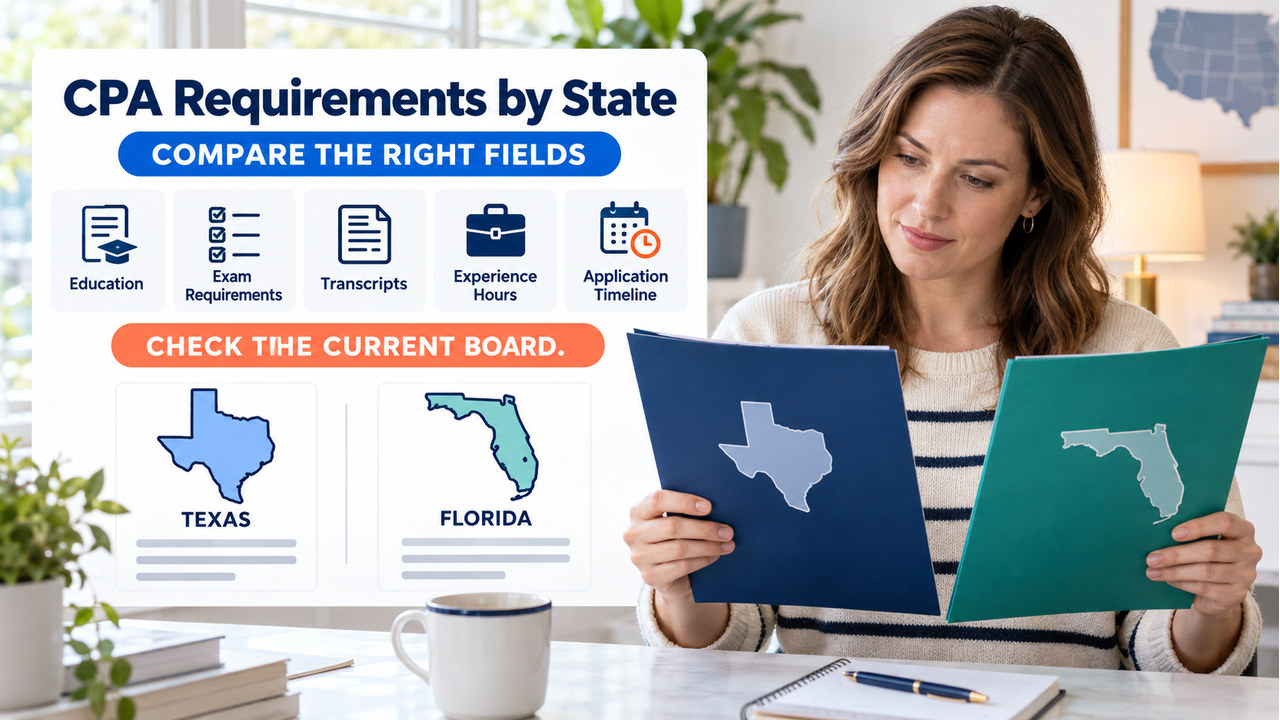

Quick answer: cpa requirements by state are not controlled by one national checklist. Each U.S. state or territory has a board of accountancy and its own rules for education, exam eligibility, work experience, ethics, residency, documents, fees, and application steps. Use the official directory to find the jurisdiction that will own your decision, then verify the current board or authorized-service page before relying on a number or pathway.
As of September 13, 2026, the AICPA state-and-territory directory covers 55 U.S. jurisdictions and warns candidates to confirm changing details with the relevant board. NASBA also separates the place where you sit for the Uniform CPA Exam from the jurisdiction where you ultimately seek a license. This guide gives you a practical comparison method, a dated change log, and a verification checklist. It is a national orientation, not an applicant-specific approval.
CPA Requirements by State: The Short Answer
The board that issues the license controls the final requirements. A search result may show a credit total or pathway, but it is not an applicant-specific answer until it is tied to the correct jurisdiction, stage, effective date, and application instructions.
“Which state has the easiest CPA requirements?” is usually the wrong starting question. A state that looks flexible on education may differ on subjects, experience verification, ethics, residency, or documents. Compare the full decision instead of ranking one number.
Use the AICPA page CPA Licensure Requirements by State and Territory to locate the state or territory entry. Treat the entry as a navigation layer. Follow its board link, read the current rule or applicant instructions, and record when you checked it. That small chain is more defensible than copying a number from a page with no date.
What Actually Changes From State to State?
State comparisons become useful when they compare the same fields. Do not begin by collecting isolated numbers. Begin with the questions below, because each one can change the path from one jurisdiction to another.
| Comparison field | What may vary | What to capture | Who answers it |
|---|---|---|---|
| Education | Total semester hours, degree wording, accounting or business subjects, upper-division work, and license-stage additions. | Transcript, course totals, degree, evaluation if applicable, and rule or form date. | The destination board or its authorized licensing service. |
| Exam eligibility | Required courses, age or residency conditions, application route, score or credit-window rules, and documentation. | Exam application, candidate record, education evidence, and current instructions. | The jurisdiction or exam service named in the current candidate instructions. |
| Experience | Duties, setting, duration or hours, supervision, verifier credential, form, and delivery method. | Role ledger, dates, duties, supervisor details, and signed board form. | The board that decides whether the work meets its current definition. |
| Ethics and identity | Ethics course or exam, timing, identity documents, background materials, and residency questions. | Completion record, valid ID, disclosures, and the board’s timing instruction. | The board or named provider in the current application packet. |
| Application | Portal, fee, deadline, transcript delivery, background check, and whether NASBA or the board receives each item. | Current form version, payment receipt, delivery confirmation, and access date. | The application owner shown on the current official page. |
This grid gives you a comparison language. It does not mean that every jurisdiction uses the same labels or sequence. If a state page uses “initial licensure,” “certificate,” “permit,” or another term, copy the board’s term into your notes and do not silently translate it into a different requirement.
How to Read the AICPA State Requirements Directory
Use the AICPA directory as a map, not the final answer. Start with the jurisdiction that may issue your license, follow its board link, and record the board name, applicant page, and access date.
Start with the owner
Open the entry and record the board name, applicant-instruction link, contact route, and any NASBA or licensing-service handoff. The owner field tells you where an ambiguous question belongs.
Read the applicant page, not only the summary
State pages often separate exam eligibility from license application requirements. Open both when needed and capture the current rule, form version, effective date, document route, and any statute or administrative-rule link.
Save a refresh date
Record the access date and any stated effective date. If neither appears, write “date not shown” and ask the board. Search snippets, cached pages, and old posts are discovery clues, not application evidence.
State-by-State Research Method: The Five-Field Card
To compare two possible jurisdictions without mixing their rules, create one State Compare Card per jurisdiction. The card is deliberately small. It forces every conclusion to stay attached to an owner, a stage, and a date.
| Field | Write this question | Evidence or action |
|---|---|---|
| Owner | Which board, service, or approved evaluator owns this decision? | Official page, board contact, and service name. |
| Stage | Is this exam eligibility, exam completion, experience review, or final licensure? | Copy the stage from the current instruction. |
| Rule | What exact credit, course, work, ethics, identity, fee, or form condition applies? | Use the board’s wording and cite the rule or application page. |
| Evidence | What do I already have, and what does the application still request? | Transcript, score record, role ledger, form, ID, receipt, or evaluation. |
| Freshness | When was the source checked, and what event should trigger another check? | Access date, effective date, form version, and next refresh trigger. |
Mark READY only when the source, your evidence, and the application instruction answer the same question. Choose VERIFY for an open interpretation or date. Use REBUILD when the owner, stage, form, or evidence route is wrong. These are private work labels, not board statuses.
“I have 150 credit hours” is incomplete. A useful card names the jurisdiction, degree, subject categories, stage, transcript route, rule date, and remaining question.

Where the CPA Exam Fits in the State Comparison
Exam eligibility and licensure are related but separate checkpoints. NASBA explains that education requirements to sit for the exam differ by state, including specific accounting or business courses and other conditions such as age or residency. That is the exam-stage question: can this jurisdiction find me eligible to sit?
The license-stage question comes later: will the intended board accept my education, experience, ethics, identity, and application? Passing all four sections does not answer that second question automatically. Keep two headings in your working file—exam eligibility and license eligibility—and do not move a document from one column to the other without a current instruction.
The test location does not by itself choose the licensing state. NASBA says scores can be transferred for licensing purposes, but the destination board still applies its current rules. Record both locations and the application service for each item.
For a focused follow-up on the exam-stage file, use our CPA Exam eligibility guide. Keep its scope separate from this state-comparison page.
How Education Requirements Appear on State Pages
Education is rarely only a total-credit number. A board may evaluate the degree, total semester hours, accounting subjects, business subjects, upper-division work, ethics coursework, or a later license-stage addition. Two candidates with the same total can therefore receive different answers because their course categories or degree status differ.
Build an education evidence line from the official transcript, subject totals, degree record, and any accepted evaluation. Add course descriptions separately if requested, and note whether documents must arrive directly from the institution.
When a page says that a model route or a graduate degree may qualify, read the words around it. “May,” “if adopted,” “subject to board review,” and “for exam eligibility” each change the meaning. If your card cannot tell whether the statement applies to exam entry or final licensure, mark it VERIFY.

How Experience and Ethics Requirements Differ
Experience rules can vary in more than duration. NASBA notes that jurisdictions may accept different settings, such as public accounting, industry, government, teaching, self-employment, or part-time work in some circumstances. The word “may” matters. A job title that sounds relevant does not prove that the board accepts the duties, setting, supervision, schedule, or verifier.
Use a ledger for dates, hours or schedule, duties, setting, responsibility, supervisor credential, and the board’s form or delivery method. Ask about mixed roles before leaving a position; relevant work is not automatically accepted work.
Ethics is another field to compare instead of assume. Some jurisdictions require an ethics course or exam, and the timing may be before application, after application, or through a specified provider. Put the exact title, provider, completion date, and submission method on the card. Do not write “ethics complete” when you only know that an ethics course exists.
What the 2026 Pathway Changes Mean by State
NASBA’s December 2025 update describes three model pathways: graduate degree plus one year of experience; traditional 150-hour education plus one year; or bachelor’s degree plus two years, each with the CPA Exam. These are model routes, not a promise that every jurisdiction has adopted them.
NASBA’s pathway page displays a jurisdiction adoption list and was marked current as of July 21, 2026. Use it to find a change, then open the jurisdiction’s law, board notice, effective date, and application instruction. The board’s current rule controls.
A safe change check has four questions: Has the jurisdiction enacted the route? When does it become effective? Which license category does it cover? Does the current application accept the route yet? If one answer is missing, keep the card at VERIFY. A model-law announcement or map color cannot replace a board-owned answer.

Which States Does NASBA Licensing Serve?
NASBA’s current licensing page is useful because it shows when NASBA Licensing Services is the service owner for a jurisdiction. As checked on September 13, 2026, the page lists Colorado, the Commonwealth of the Northern Mariana Islands, the District of Columbia, Georgia, Maryland, Montana, New Hampshire, Puerto Rico, and the U.S. Virgin Islands for CPA licensing services.
The same page reports a new CPA Portal licensing system effective August 3, 2026 for listed service routes. Treat this as a workflow update, not a universal change in substantive requirements; confirm the destination board and current portal instruction.
Service ownership can also be narrower than a reader expects. A NASBA service page does not mean that the jurisdiction has identical education, experience, ethics, or mobility rules to another jurisdiction on the list. Copy the service owner into the Owner field, but copy the substantive requirement only from the current jurisdiction instruction.
When You May Need an Academic Credential Evaluation
Some candidates still need a separate education review after passing the exam. NASBA says an Academic Credential Evaluation may be required when license-stage education was not met when the candidate was found eligible to sit; if it was met then, that route does not require an ACE Application. The board’s instruction controls.
As of the page checked for this article, NASBA lists ACE service for Indiana, Maine, Massachusetts, New Jersey, Tennessee, Utah, and Washington State. That is a seven-jurisdiction service list, not a national rule. For any other destination, follow the board’s own education-review instruction.
On your card, separate three facts: what the transcript shows, what the evaluator reports, and what the board accepts for licensure. An evaluation translates or assesses education; it does not itself issue the license. Record the destination, purpose, provider, direct-document route, and whether a second board review remains open.
How International Candidates Should Compare States
International candidates should add document routing to the five-field card. Ask whether evaluation is needed for exam eligibility, license-stage education, or both. NASBA International Evaluation Services provides a route for international credentials, but the destination board still applies its own rule.
Keep foreign education and foreign experience on separate cards. The document path for a transcript does not answer whether a board accepts work performed in another country, which supervisor may verify it, what translation is required, or whether the experience form can be delivered electronically. Put those questions in the owner and evidence fields rather than filling them with a hopeful “yes.”
Before paying, confirm the approved provider, direct-document route, translation and identity requirements, current fee, and portal. Save the official URL and access date. If an old forum post conflicts with the board instruction, treat the conflict as a board question.
State Change Log: What to Refresh Before You Apply
A small change log keeps this topic from becoming stale. Use it at the beginning of a comparison and again immediately before payment or submission. The “owner” column tells you where the next refresh belongs.
| Item to refresh | Current reference point | Owner | Refresh trigger |
|---|---|---|---|
| Directory entry | AICPA state-and-territory directory checked September 13, 2026. | AICPA directory, then destination board. | Before choosing or comparing a jurisdiction. |
| Pathway map | NASBA map marked current as of July 21, 2026. | NASBA for discovery; board law and notice for the decision. | A new law, rule, effective date, or pathway announcement. |
| Licensing handoff | NASBA Licensing page reports a CPA Portal system change effective August 3, 2026. | NASBA Licensing or the board named by the application. | After passing the exam or when the portal instruction changes. |
| Application packet | Form version, fee, portal, deadline, transcript route, and verifier instruction. | The board or authorized service receiving the file. | Immediately before payment, submission, or a long wait between steps. |
Do not delete old entries from the log. Mark them historical and add the new source, date, and effective date beside them. That gives you a visible reason for changing an education plan or using a different form.
CPA Requirements by State Verification Checklist
Use the checklist below for one selected jurisdiction. If the first item you cannot support is the owner or effective date, stop there; the remaining conclusions are provisional.
After the card is complete, send only the unresolved question to the responsible board or service. A short question with a jurisdiction, stage, source date, and attached evidence is easier to answer than a message asking whether you qualify “in general.”
Common Mistakes When Comparing CPA Requirements by State
Choosing a state from one credit number
A total-hour figure is one field, not the whole application. Pair it with degree wording, subject categories, stage, effective date, and source owner.
Treating the model pathway as a state law
NASBA’s model pathways help candidates understand possible routes. A jurisdiction still needs its own enactment or rule change, and the effective date may not match the announcement date.
Using the test center as the license owner
The place where you sit for the exam can be different from the jurisdiction where you seek a license. Put the two decisions in separate fields and confirm the transfer or application route.
Assuming a service list means identical rules
NASBA may serve several jurisdictions, but service ownership does not erase differences in education, experience, ethics, residency, or forms. Read the named jurisdiction’s instruction.
Using an old form because the URL still works
A page can remain online after a portal, fee, deadline, or verifier changes. Record the form version and access date, then refresh before submission.
CPA Requirements by State FAQ
Do all states require 150 semester hours?
Do not assume that. NASBA’s current guidance describes variation in exam and license education requirements, and its model-pathway material describes more than one route. Check the intended jurisdiction’s current education categories and effective dates.
Which state has the easiest CPA requirements?
There is no reliable national “easiest state” answer for every candidate. The relevant choice depends on your intended practice, education record, experience, documents, and the board that will own the license. Compare the five fields instead of optimizing one number.
Can I take the CPA Exam in one state and get licensed in another?
It may be possible to sit for the exam in one jurisdiction and seek a license in another. NASBA separates those decisions and explains that scores can be transferred for licensing purposes. The destination board still decides its own license requirements.
Do international candidates use the same requirements as U.S. candidates?
They may need additional document evaluation, translation, direct-record delivery, or experience verification. Keep foreign education and experience separate, and ask the destination board which provider and purpose it accepts.
Does passing all four exam sections complete licensure?
No. Passing the exam is a major milestone, but the board may still need license-stage education review, experience, ethics, identity, fees, and a complete application. Reopen the current destination-board checklist after the final score.
Are renewal and continuing education part of initial requirements?
They are usually maintenance questions after licensure, although the exact cycle and conditions vary. Do not mix a renewal page into an initial-application card; use the board’s current renewal instruction when that stage arrives.
Key Takeaway
The safest way to handle cpa requirements by state is to compare source owners and decision stages before comparing numbers. Open the AICPA directory, identify the board or authorized service, record Owner, Stage, Rule, Evidence, and Freshness, and use the current board page to resolve the first open question. Treat model pathways, service maps, evaluations, and exam results as useful pieces of a file—not as a substitute for the jurisdiction’s current licensing decision.
When you are ready to move from requirements to exam preparation, continue with our current CPA Exam format guide or CPA Exam study guide. Keep the state comparison card beside your study plan so a change in the board rule does not get lost in your exam notes.
Official sources for this guide: AICPA state and territory requirements directory; NASBA How to Get Licensed; NASBA Pathways; NASBA new licensure pathways and mobility; NASBA Licensing; NASBA International Evaluation Services; AICPA CPA Exam Blueprint hub; NASBA CPA Exam FAQ.