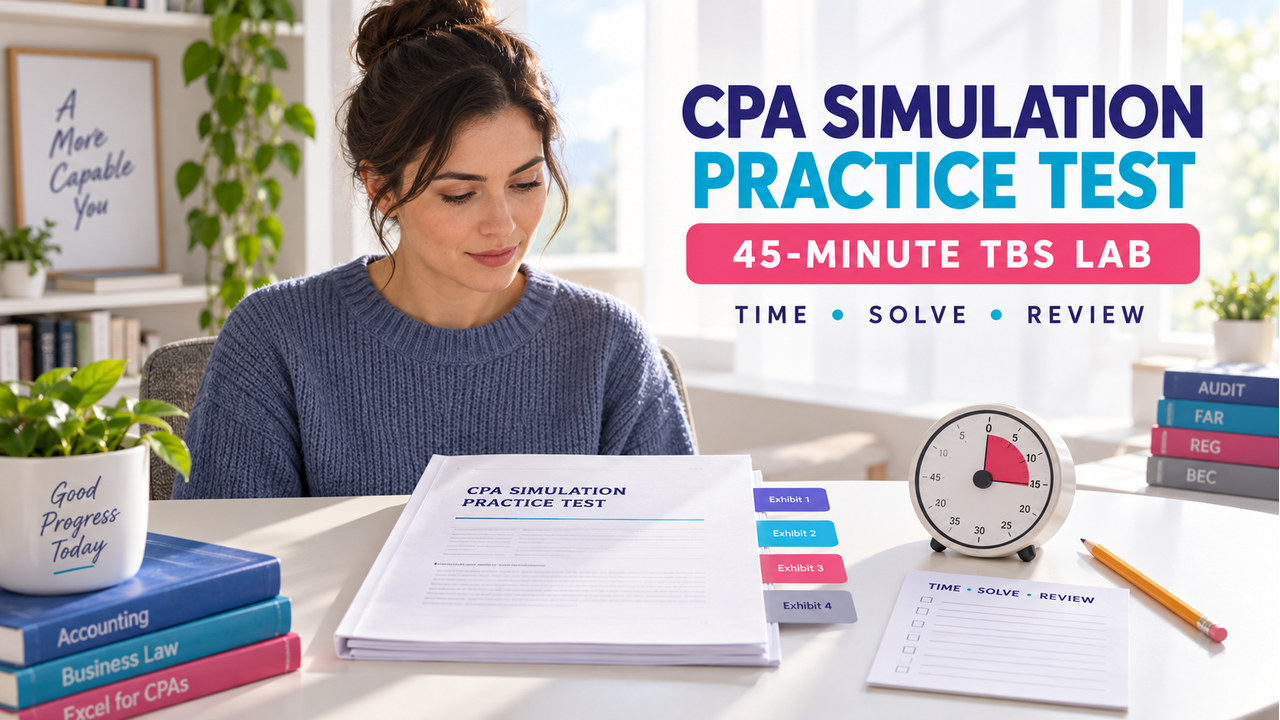

Quick answer: A useful cpa simulation practice test is more than a countdown. It gives you a defined response cell, a bounded exhibit set, an original fact pattern, and a review rule that tells you what to do after the timer ends. The mini-assessment below uses four original stations and a study-only rubric; it is not a released exam item, a readiness score, or a substitute for the live AICPA materials.
First, use the AICPA Blueprint and sample-test resources for current sections, tasks, and software familiarity. Meanwhile, keep Harborline facts separate from candidate administration advice. The goal is narrower: practice reading, evidence, calculation, explanation, and transfer in one repeatable 45-minute loop.
Continue with our CPA Exam Study Guide.
What a cpa simulation practice test should measure
A timed simulation should create useful pressure, not theatrical pressure. Therefore, define what counts before you start. For this lab, the target is a clean chain from prompt to evidence to work to explanation. Instead, use the timer to expose where the chain slows down; it is not there to manufacture a dramatic percentage.
Use a cpa simulation practice test to control response cells
First, read the requested output. A cell may ask for one amount, one evidence pair, one classification, or one control conclusion. If you answer a nearby question, a fast calculation still misses the task. Write the requested unit in one line before opening every exhibit.
Use a cpa simulation practice test to connect evidence and work
Next, name the record that controls the answer. Then show the smallest defensible calculation or decision rule. A correct number with an unsupported record is a review signal, just as a sound exhibit choice with a sign error is a different signal. In practice, the test is useful only when both the answer and its path remain visible.
Use a cpa simulation practice test to measure transfer
After the attempt, change one material fact and predict the direction of the answer before recomputing. For example, increasing selling costs should move amount realized and a linked gain line, while leaving adjusted basis fixed in the bounded case below. That second pass tells you whether the first answer was reasoned or merely remembered.
Build your 45-minute cpa simulation practice test
Before starting, use one clock, one packet, and one review sheet. Set aside 45 minutes: 3 minutes to set the boundary, 7 minutes to scan, 25 minutes to solve, 5 minutes to check, and 5 minutes to log. Adjust the split after two attempts.

1. SET — reserve the time box
Next, write the start time, stop time, and section tags on the review sheet. Put the phone away and use an analog timer or a visible clock. This mixed-skills lab is not one section score. Instead, use the same time boundary to compare your own attempts.
2. SCAN — inventory the exhibits
Then, spend the first scan looking for the requested output, date boundary, units, and controlling record. Mark each exhibit: contract, cutoff report, sale memo, or access log. Meanwhile, ignore decorative background facts until a response cell calls for them.
3. SOLVE — answer the narrow cell
Afterward, work one cell at a time. State the formula or evidence rule, substitute only the supplied figures, and choose the narrow answer. If a task stalls, leave a short gap note and move on. A visible gap is easier to repair than an undiagnosed packet.
4. CHECK — test the path
Finally, check units, signs, date direction, and whether the evidence actually proves the requested line. Then read the closest distractor and write why it fails. For example, gross proceeds may be a real fact while amount realized requires a stated selling-cost subtraction.
5. LOG — preserve the first divergence
Finally, record time used, confidence, first wrong step, and next review block. Do not erase the first attempt before opening the rationale. Comparing your initial path with the explanation is the study asset a bare answer key cannot provide.
Original Harborline mixed-skills mini-assessment
Next, work the following case as original editorial practice. Harborline Studio Services is a fictional business used only to create a bounded packet. The broad tags—FAR, AUD, REG, and ISC—are orientation labels, not official codes. Reopen the current Blueprint if you need a section-specific task statement.
Case file: the packet contains a Service Contract, a Receiving Cutoff Report, an Equipment Sale Memo, and an Access Removal Log. Close instructions say to use whole dollars, listed facts, and the requested cell.
Case facts: Harborline collected $24,000 for a 12-month service contract beginning December 1; one month was performed by December 31. The receiving cutoff report shows the last pre-count receiving report as 418 and the first post-count report as 419. The Equipment Sale Memo gives original cost of $60,000, a stated improvement of $10,000, accumulated depreciation of $22,000, gross proceeds of $58,000, and selling costs of $3,000. The Access Removal Log shows a termination ticket at 3:00 p.m., account disablement at 3:20 p.m., and no later login event.

Question 1 — Revenue cell
Tested skill: calculate the performed portion of a stated annual contract. Difficulty: foundational calculation. Original practice: yes. Prompt: Under the case’s one-month assumption, what amount belongs in the earned-service line for December?
- A. $2,000
- B. $12,000
- C. $24,000
- D. $26,000
Reveal answer 1 and reasoning
Answer: A, $2,000. Divide the stated $24,000 annual contract by 12 months, then recognize one performed month: $24,000 ÷ 12 = $2,000. The closest distractor is C because it repeats the collected amount without applying the one-month boundary. Next action: write the time unit beside every contract amount before moving to the next cell.
Question 2 — Cutoff evidence cell
Tested skill: select the evidence pair that brackets the count date. Difficulty: foundational evidence selection. Original practice: yes. Prompt: Which record pair should you retain first when testing the receiving cutoff around the count?
- A. Reports 418 and 419, because they bracket the count boundary
- B. The annual sales forecast and a vendor brochure
- C. Report 418 alone, without the first subsequent report
- D. The access-removal log because it has exact timestamps
Reveal answer 2 and reasoning
Answer: A. The last pre-count and first post-count receiving reports create the narrow boundary the prompt asks you to inspect. The forecast and brochure do not prove receipt timing; report 418 alone lacks the after-boundary comparison; and the access log belongs to a different control. Next action: label each exhibit with the single response cell it can prove.
Question 3 — Asset-sale cell
Tested skill: compute amount realized and linked gain from supplied figures. Difficulty: foundational linked calculation. Original practice: yes. Prompt: Under the Close Instructions, what are amount realized and gain?
- A. $58,000 and $6,000
- B. $55,000 and $7,000
- C. $48,000 and $10,000
- D. $70,000 and $22,000
Reveal answer 3 and reasoning
Answer: B, $55,000 and $7,000. First, adjusted basis is $60,000 + $10,000 − $22,000 = $48,000. Next, amount realized is $58,000 − $3,000 = $55,000. Finally, gain is $55,000 − $48,000 = $7,000. A is the closest distractor because it subtracts the improvement and depreciation path incorrectly; C stops at basis and never computes the sale side. Next action: keep the basis and sale formulas on separate lines.
Question 4 — Access evidence cell
Tested skill: choose evidence that connects a termination event to access removal. Difficulty: foundational control evidence. Original practice: yes. Prompt: Which evidence path best supports the conclusion that the terminated account was disabled?
- A. Termination ticket at 3:00 p.m. plus IAM disable log at 3:20 p.m. and no later login event
- B. A quarterly access review prepared three months later
- C. A policy document with no user-specific event
- D. A service contract showing the employee’s department
Reveal answer 4 and reasoning
Answer: A. The ticket establishes the triggering event, the IAM log shows the action, and the absence of a later login supports the bounded conclusion stated in the prompt. B may be useful for a different review, but it does not tightly connect the termination time to the disable event. Next action: write trigger, action, and follow-up evidence in that order.
Score the cpa simulation practice test without fooling yourself
Use a 16-point study rubric: each response cell can earn one point for scope, one for evidence, one for work, and one for explanation. The total is a study index, not a scaled score, percentage conversion, or readiness determination. Therefore, a lower total is not a verdict; it is a prompt to identify the first broken link.
First, check scope: did you answer the requested unit? Next, check evidence: did you name the record that controls it? Then, check work: did you show the formula or decision path? Finally, check explanation: did you reject the nearest distractor or state the boundary? A correct choice can still lose a study point if the path is unsupported.
Read the cpa simulation practice test pattern, not just the total
First, if scope points are missing across several cells, spend the next block rewriting prompts in your own words. Next, when evidence points are missing, build a one-line exhibit map before calculating. For missing work points, redo the formulas with units and signs. Finally, if explanation points are missing, write one sentence about the closest distractor. This pattern is more actionable than chasing a single number.
Review the first wrong step
After the delayed reveals, compare your first attempt with the answer path. Mark the earliest divergence, not the most embarrassing final number. A scope gap happens when the response cell was misread. An evidence gap happens when the wrong exhibit controlled the line. A calculation gap happens when the inputs were right but the sign, unit, or sequence was wrong. A choice gap happens when the closest distractor was never tested. A transfer gap appears when the original answer is remembered but a changed fact breaks the chain.
Next, run the single changed-fact retry: increase Harborline selling costs from $3,000 to $6,000 while keeping original cost, improvement, and depreciation fixed. Meanwhile, adjusted basis remains $48,000. As a result, amount realized becomes $52,000, and gain becomes $4,000. The changed input belongs to the Sale Memo, so it should move the sale-side subtraction and linked gain line, not the basis line.
Schedule the next block
When the first gap was scope, schedule a short prompt-rewrite block. Next, if it was evidence, remap the four exhibits without solving. For a calculation gap, repeat Question 3 with a fresh set of numbers. When it was choice, write why each distractor fails. Finally, if it was transfer, change one selling cost again and predict the direction before you calculate. In contrast, do not repeat the whole 45-minute test immediately; isolate the repair first.
FAQ for cpa simulation practice test
Is this a released CPA Exam simulation?
No. The Harborline facts, prompts, choices, calculations, explanations, rubric, and retry are original editorial practice. Instead, use the current AICPA Blueprint and sample-test resources for current scope and software familiarity.
Should I treat 16 points as a passing score?
No. The 16 points describe the completeness of your review path in this lab. They do not represent a reported score, a percentage correct, or a prediction about readiness. Use the missing dimension to choose the next block.
How long should I wait before reviewing answers?
Keep the reveals closed until the time box ends or you have recorded a deliberate gap note. Then compare the first attempt with the rationale. An answer shown before the attempt tests recognition; a delayed answer tests the path from prompt to evidence and work.
Can I use a laptop for this practice test?
You can adapt the worksheet to your own study setup, but this article’s visual and timing plan does not require a device. If you need current software familiarity, use the official AICPA sample-test route and read its current instructions before test day.
Where should I verify current CPA process details?
Use the current AICPA resources, NASBA, the applicable state Board, and the appropriate testing-center resource for candidate administration, eligibility, scheduling, and licensing. Reopen them when jurisdiction or guidance changes.
Sources and refresh note for cpa simulation practice test
Current scope and task statements: AICPA CPA Exam Blueprints. Interface familiarity: AICPA sample tests. Score boundary: AICPA scoring and pass rates. Candidate FAQ: AICPA CPA Exam FAQ. Candidate process: NASBA CPA Exam. Checked September 17, 2026. The Harborline case, four response cells, timing loop, rubric, distractors, and retry are original editorial study content. Reopen the live official pages and refresh the workbook’s Semrush US fields before publication.