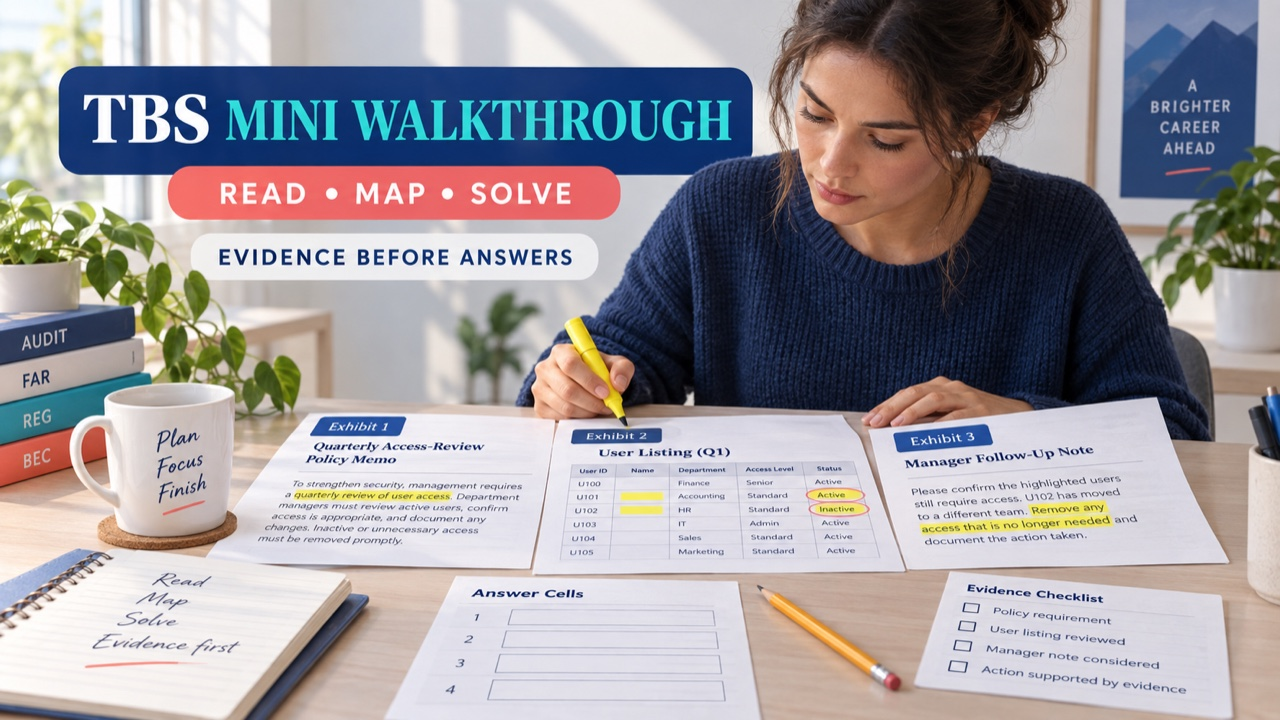

Quick answer: First, cpa task based simulations become more manageable when you treat them as a chain of answerable decisions: read the requirement, map the exhibits, tag the controlling fact, complete one answer cell, and verify the instructions. This page gives you one original AUD document-review mini-simulation, delayed answer reveals, and a transfer retry. It is editorial practice, not released exam content.
In addition, the AICPA Blueprint is the boundary for what may be tested. It organizes each section by Area, Group, and Topic, and includes task statements, skill levels, references, item types, and score weighting. Each section has five testlets: the first two contain multiple-choice questions, and the next three contain task-based simulations. This page lists the TBS pattern across testlets 3, 4, and 5 as AUD 2/3/2, FAR 2/3/2, REG 2/3/3, BAR 2/3/2, ISC 1/3/2, and TCP 2/3/2. Recheck the live Blueprint for your testing window.
For a broader preparation path, continue with our CPA Exam Study Guide.
What cpa task based simulations Actually Test
However, a TBS is not a multiple-choice question. It gives you a requirement, exhibits, and answer cells that may ask for a selection, number, entry, edit, or conclusion. The useful skill is deciding what the task asks, which evidence can answer it, and how to leave a clear path from fact to response.
The AICPA scoring page says scores use a 0–99 scale and are not percentages correct. It describes weighted MCQ and TBS components, with 50/50 weighting for Core and Discipline sections except ISC at 60/40. Therefore, a TBS record should show which cell or evidence decision broke down; five correct cells are not a scaled score.
Before opening a crowded exhibit set, look for four signals:
- Task verb: identify, calculate, select, correct, reconcile, or conclude tells you what kind of response is expected.
- Answer form: note whether the cell needs a number, an option, a debit-credit pair, a document edit, or a short conclusion.
- Evidence boundary: list the exhibit, date, entity, assertion, or population that controls the cell.
- Instruction guardrail: check rounding, sign, reuse limits, blank responses, and whether the item asks for the best or most direct answer.
A Five-Step cpa task based simulations Workflow
1. Read the requirement before the exhibits
First, start with the stem and answer cells. Write the task in plain language, such as “show whether the quarterly review operated” or “identify the unresolved exception.” This keeps a realistic email or policy memo from becoming the purpose. If the stem has two verbs, split them into two decisions.
2. Map each exhibit to a possible use
Next, scan the titles first. Mark each exhibit as policy, population, transaction, calculation, external evidence, or follow-up. You are not memorizing the pages; you are building a route. The policy defines the control, the user listing supplies the population, and the follow-up note may show what changed.
3. Tag the controlling fact
Then, underline the date, amount, assertion, status, or qualifier that changes the answer. A policy can show design while a dated review record shows operation. In a numeric task, the period and unit may matter more than a decorative label. Write one evidence statement before choosing.
4. Solve one answer cell at a time
Meanwhile, complete the cell with the clearest evidence path, then move on. Uncertainty in one cell need not stop the whole simulation. For a number, show the formula and unit; for an option, compare the closest distractors; for a document edit, read the full sentence and supporting exhibit first.
5. Verify the response format
Finally, before leaving, confirm every required cell has a response, numbers follow rounding instructions, entries use the correct columns, and “no change” or blank options are handled as directed. The AICPA sample test helps with software familiarity; it is not scored and does not determine readiness.

Original AUD Document-Review Mini-Simulation
Meanwhile, the following case is original editorial practice. It uses an audit-control situation for exhibit triage, but it is not a distributed CPA Exam task. Attempt each answer before its reveal and answer only what the cell asks.
Case file: Northstar Ledger quarterly access review
Tested skill: evaluate whether evidence supports the operation and follow-up of a quarterly logical-access review. Assumptions: the company requires a manager to review active-user access each quarter; the review should identify unnecessary privileges; the system owner keeps the review record; and the question asks for the narrow conclusion supported by the file. Difficulty: foundational document review with a transfer step.
Exhibit A — Policy memo: Meanwhile, each quarter, the system owner sends an active-user listing to the department manager. The manager dates the review, marks exceptions, and sends removal requests to the access administrator. The policy does not prove that a review happened.
Exhibit B — User listing: Next, J. Rivera is active with an April 5 sign-off. M. Chen left on March 31; a removal ticket is dated April 7. The shared “Service-AP” account is active, has no owner, and has no review conclusion. K. Patel is active, has an owner, and has manager initials beside the role.
Exhibit C — Manager note: Finally, the manager says the April 5 review covered the population, agrees Chen’s access was removed, and asks the system owner to identify an owner for Service-AP. The note is dated April 8.
Answer cell 1: Which evidence best supports that the review operated?
Tested skill: distinguish control design from operating evidence. Assumptions: the answer must show the reviewed population, reviewer, date, exception handling, and follow-up. Difficulty: foundational evidence selection.
Original practice item: Which evidence bundle most directly supports operation of the quarterly review?
- The policy memo alone
- The dated user listing with manager review marks, exceptions, and related follow-up records
- A vendor brochure describing role-based access
- A screenshot of the login page
Reveal the answer and explanation
Answer: B. Therefore, the listing and linked records connect the control to a population, reviewer, date, and response. Meanwhile, the policy shows design, the brochure describes a product, and the login screenshot does not show a quarterly review. Next action: write “population + reviewer + date + response” before deciding whether evidence proves operation.
Answer cell 2: Which record is the unresolved exception?
Tested skill: locate an exception that lacks an accountable follow-up path. Assumptions: an active account must have a named owner and a review conclusion; the question asks for the item still unresolved after the manager’s note. Difficulty: foundational evidence triage.
Original practice item: Which user record should remain open for follow-up?
- J. Rivera, because the account is active
- M. Chen, because the employee left during the quarter
- Service-AP, because it is active without an owner or review conclusion
- K. Patel, because the manager used initials instead of a full signature
Reveal the answer and explanation
Answer: C. Meanwhile, Service-AP has no accountable owner or review conclusion. In contrast, Chen’s removal has a dated ticket and manager agreement; Rivera and Patel have review evidence. Next action: circle the status that violates the stated control instead of choosing the most dramatic fact.
Answer cell 3: What follow-up would close the exception?
Tested skill: select remediation evidence that addresses the exact exception. Assumptions: the open issue is an unowned active account; a useful response must show accountability and a dated disposition. Difficulty: foundational application.
Original practice item: Which follow-up package best closes the Service-AP exception?
- A new general password policy with no account-level review
- A named owner, documented access decision, and dated approval or removal ticket tied to the account
- A second copy of the original user listing
- A statement that the account is old and probably harmless
Reveal the answer and explanation
Answer: B. Thus, it names an owner, records the decision, and leaves dated approval or removal evidence. Instead, a policy does not close this row, a duplicate listing adds no response, and reassurance is not evidence. Next action: match each remediation request to its exception and name the document that proves completion.
Answer cell 4: Which conclusion is supported?
Tested skill: state a narrow conclusion without overstating the evidence. Assumptions: the file supports the April review for the attached population, shows Chen’s removal, and leaves Service-AP unresolved. Difficulty: foundational judgment.
Original practice item: Which conclusion fits the three exhibits?
- The entire access environment was secure throughout the year
- The April review operated for the listed population, but the Service-AP exception required follow-up
- The policy alone proves every quarterly review operated
- The manager’s note replaces the user listing and all supporting evidence
Reveal the answer and explanation
Answer: B. Overall, it stays within the date, population, and exception evidence. However, A and C generalize beyond the file; D discards the population and review marks. Next action: write the period and population before using broad words such as “all” or “always.”
Answer cell 5: What changes if the review date is missing?
Tested skill: identify the evidence gap created by one changed fact. Assumptions: all other exhibits stay the same, but the manager’s April 5 date is removed; the question asks what must be obtained before concluding that the review operated in the quarter. Difficulty: foundational transfer.
Original practice item: What is the most direct missing evidence?
- A second vendor brochure
- A new login screenshot
- A dated record or system timestamp showing when the manager reviewed the stated population
- A larger user listing from a different quarter
Reveal the answer and explanation
Answer: C. Removing the date changes the operating-period evidence, so restore a dated review record or reliable timestamp for the same population. Therefore, the other choices do not repair that gap. Next action: change one fact in a future TBS and identify which evidence path—not answer letter—must change.
Review cpa task based simulations After the Attempt
Afterward, review the path, not just completed cells. Record the first choice, confidence before the reveal, exhibit used, controlling fact, and earliest gap. Label the gap task for a misread requirement, evidence for a wrong exhibit, rule for a failed control application, calculation for a formula or unit error, or transfer when one changed fact breaks the reasoning.
Then, use the record to choose the next block: retest a changed fact when correct and confident; restate the rule when correct but uncertain; find the assumption behind a distractor when wrong and confident; and return to the task verb and exhibit map when wrong and uncertain.
Transfer cpa task based simulations to a New Fact
Next, transfer practice keeps the skill stable while changing one material fact. Remove the manager’s date, give Service-AP a named owner, or change removal evidence to an approval record. Then ask the same questions: what supports operation, which exception remains open, and what narrow conclusion is supported?
However, do not change three facts at once. One change shows whether the reasoning moved because of the controlling evidence. In other sections, keep the task stable, change one amount, period, assertion, or instruction, and explain why the cell changes.
- Task gap: rewrite the requirement as one decision before reading exhibits.
- Evidence gap: build a two-column note: exhibit and fact it can prove.
- Rule gap: state the control or accounting relationship in one sentence.
- Calculation gap: write the formula, unit, period, and rounding instruction first.
- Transfer gap: change one material fact and defend the new response in one paragraph.

FAQ: cpa task based simulations
What are cpa task based simulations?
In practice, they are case-based exam tasks that ask you to apply knowledge through requirements, documents, exhibits, calculations, entries, options, or edits. The exact mix changes by section, so use the AICPA Blueprint for your testing window.
How many cpa task based simulations are in a CPA Exam section?
Therefore, the AICPA Blueprint lists the TBS distribution by testlet: AUD 2/3/2, FAR 2/3/2, REG 2/3/3, BAR 2/3/2, ISC 1/3/2, and TCP 2/3/2 for testlets 3, 4, and 5 on this page. Reopen the live Blueprint before relying on the counts.
Are the questions on this page official CPA Exam tasks?
No. Instead, the Northstar Ledger case, exhibits, choices, explanations, and transfer variation are original editorial practice. Use the AICPA sample test for its own software-familiarity purpose and the current Blueprint for scope.
Can cpa task based simulations predict my CPA score?
No. Therefore, keep a study record of answer cells, confidence, evidence, and gaps. The AICPA states that the sample test is not scored or a readiness determination, and a home practice set is not a scaled exam score.
Where should I verify process details?
Finally, use NASBA and the applicable state Board for eligibility, applications, fees, accommodations, jurisdictions, and licensing. This walkthrough explains study behavior, not candidate administration.
Sources and Refresh Note for cpa task based simulations
Current scope, testlets, and TBS counts: AICPA CPA Exam Blueprints. Sample-test purpose and software familiarity: AICPA sample tests. Score boundary: AICPA scoring and pass rates. Administration FAQ: AICPA CPA Exam FAQ. Candidate process: NASBA CPA Exam. Checked September 17, 2026. The workflow, Northstar Ledger case, exhibits, five answer cells, explanations, and transfer retry are original editorial study content. Reopen live official pages and refresh the workbook’s Semrush US fields before publication.