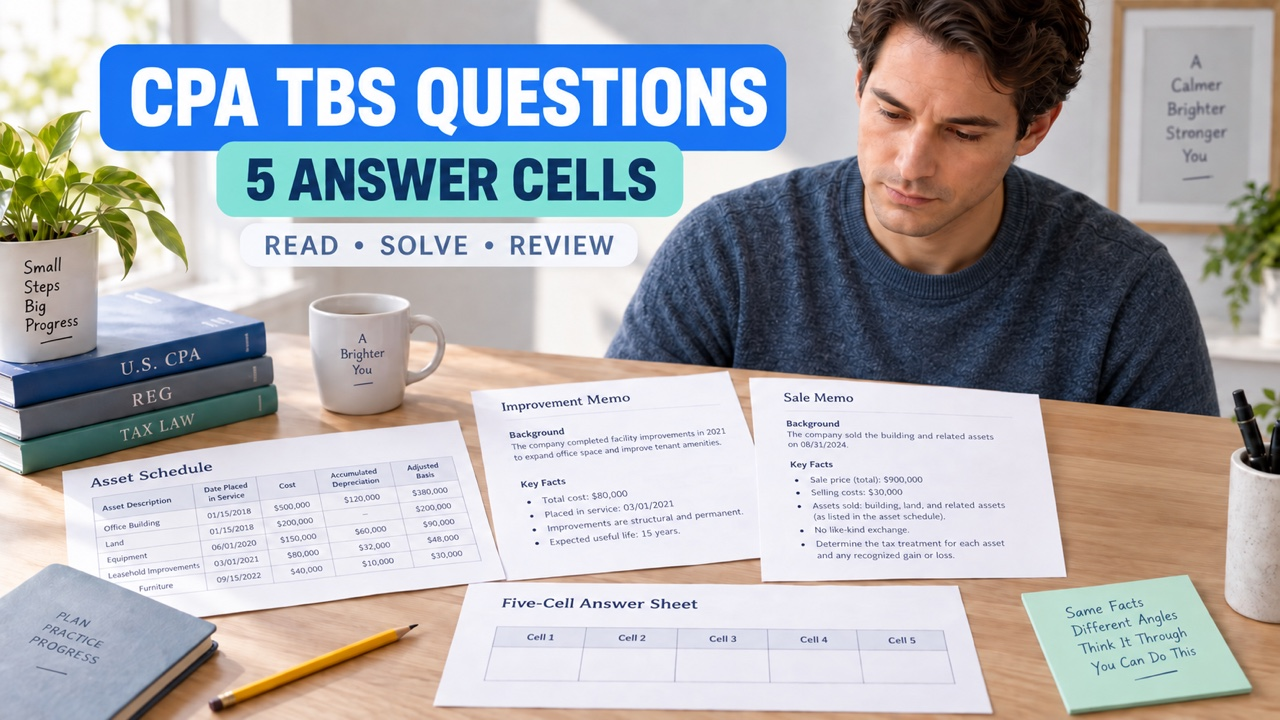

Quick answer: Useful cpa tbs questions and answers should expose the path behind the answer. First, start with the requested response cell, map the record that can prove it, calculate only from the supplied assumptions, explain the nearest distractor, and name the next review action. The REG lab uses one case file and five linked cells; it is editorial practice, not official exam content.
For current boundaries, use AICPA resources to confirm the Blueprint, section terminology, task statements, sample-test software, and score boundary. In addition, keep this page separate from candidate administration advice. Therefore, the case facts are intentionally bounded so that you can study the reasoning path without pretending that five correct cells equal a reported score.
Continue with our CPA Exam Study Guide.
How to read cpa tbs questions and answers
First, read the requested output before reading every exhibit. Meanwhile, a TBS can contain realistic names, dates, schedules, and memos, but the response cell usually asks for one narrow result. For example, it may request a classification, a number, an evidence choice, or a short conclusion. For that reason, the answer format tells you which facts deserve priority.
Use cpa tbs questions and answers to name the deliverable
First, write the requested unit in your own words. For example, “adjusted basis in whole dollars” is different from “gain on sale.” Likewise, “which record controls the calculation” is different from “which record supports the whole client file.” As a result, the distinction prevents a true but irrelevant fact from becoming your answer.
Separate case assumptions from outside rules
Next, list what the case supplies and what it does not supply. If the close instructions say to use only the listed cost, improvement, depreciation, proceeds, and selling-cost figures, freeze those inputs. However, do not import an unstated exception just because a real tax engagement could contain one. Instead, solve the stated practice problem and record the boundary.
Use answers to expose a path, not to create a score
After an attempt, compare your first line with the explanation. A wrong final number may come from the wrong record, a sign error, a unit error, or a changed assumption. In contrast, an answer that is correct for the wrong reason still deserves a review note. Still, the AICPA scoring resource explains why a small editorial set cannot be converted into a percentage or readiness prediction.
Use cpa tbs questions and answers with the ASK MAP CALCULATE CHOOSE CHECK workflow
Before opening a reveal, run five short actions: ASK what the cell requests, MAP the record that controls it, CALCULATE only the necessary line, CHOOSE the narrow answer, and CHECK the assumptions and units. As a result, this sequence turns a large packet into a series of auditable decisions.

1. ASK: name the deliverable
First, underline the verb and the unit. “Compute,” “select,” “classify,” and “identify” lead to different response shapes. Then write the cell in one line before you scan the exhibits. If the cell asks for gain, do not answer with gross proceeds; if it asks for evidence, do not answer with a conclusion that has no record behind it.
2. MAP: assign each exhibit one job
For example, an asset schedule may establish original cost and depreciation, while a sale memo may establish proceeds and selling costs. Meanwhile, a close instruction can limit which facts are allowed. In contrast, a background email may explain context without controlling the requested number. Naming each record’s job keeps evidence and narrative from blending together.
3. CALCULATE: write the smallest defensible line
Then, once the controlling inputs are fixed, write the formula with signs and units. In the lab below, adjusted basis uses cost plus the stated improvement less the stated depreciation. Then, amount realized uses gross proceeds less the stated selling costs. Finally, gain uses amount realized less adjusted basis. Therefore, order matters because each later cell depends on the earlier line.
4. CHOOSE: reject the closest distractor
In practice, a strong answer explanation names the tempting alternative. Usually, a distractor is not random; it may omit selling costs, subtract depreciation in the wrong direction, or use gross proceeds where amount realized is requested. Therefore, explaining the nearest miss shows whether you understood the case rather than guessed the right number.
5. CHECK: freeze the boundary
Before you move on, verify the supplied assumptions, answer unit, arithmetic sign, and record used. In addition, label the first place your path diverged. Therefore, that label is more useful than a single correct-count total because it points to the next study block.
Original REG cpa tbs questions and answers case
First, work the Northline Studio Design LLC case as original editorial practice. Specifically, Northline Studio sells one piece of production equipment. Next, the packet contains an Asset Schedule, an Improvement Memo, a Sale Memo, and Close Instructions. Finally, the case gives every amount needed for the five cells below. Do not add a current-law exception, a jurisdiction rule, or a fact that the packet does not state.
For clarity: the equipment’s original cost is $72,000. Here, the Improvement Memo identifies a capital improvement of $8,000. Meanwhile, the Asset Schedule supplies accumulated depreciation of $30,000 through the sale date. On the sale side, the Sale Memo states gross proceeds of $65,000 and selling costs of $5,000. Finally, the Close Instructions say to report whole dollars and use only these figures.

Question 1 — Identify the controlling basis facts
Tested skill: select the records and facts that control the adjusted-basis line. Difficulty: foundational evidence triage. Original practice: yes.
Prompt: Which evidence path should you use before computing adjusted basis?
- A. Asset Schedule for original cost and depreciation, plus Improvement Memo for the stated capital improvement
- B. Sale Memo alone because it contains the final transaction
- C. A general description of the equipment without the dated amounts
- D. A future budget because it may show replacement cost
Reveal answer 1 and reasoning
Answer: A. For this cell, the basis line needs original cost, the stated improvement, and accumulated depreciation. Together, the Asset Schedule and Improvement Memo supply those facts directly. The Sale Memo is important later for amount realized, but it does not establish every basis input. The description and future budget do not prove the supplied historical amounts. Next action: write the three basis inputs beside the answer cell before doing arithmetic.
Question 2 — Compute adjusted basis
Tested skill: compute adjusted basis from the supplied cost, improvement, and depreciation. Difficulty: foundational numeric entry. Original practice: yes.
Prompt: What adjusted basis is supported by the Northline Studio case?
- A. $34,000
- B. $42,000
- C. $50,000
- D. $110,000
Reveal answer 2 and reasoning
Answer: C, $50,000. Use the stated formula: $72,000 + $8,000 − $30,000 = $50,000. The $34,000 distractor subtracts depreciation from original cost and omits the improvement. Meanwhile, the $42,000 distractor treats depreciation as if it were the only adjustment. Finally, the $110,000 distractor adds all inputs. Next action: show the improvement as a positive line and depreciation as a negative line on your next basis calculation.
Question 3 — Compute amount realized
Tested skill: compute the sale-side amount from supplied proceeds and selling costs. Difficulty: foundational calculation. Original practice: yes.
Prompt: What amount realized is supported by the Sale Memo?
- A. $5,000
- B. $60,000
- C. $65,000
- D. $70,000
Reveal answer 3 and reasoning
Answer: B, $60,000. Start with gross proceeds and subtract the stated selling costs: $65,000 − $5,000 = $60,000. The $65,000 distractor stops at gross proceeds, while $70,000 adds the cost instead of subtracting it. The $5,000 choice uses the cost alone. Next action: write “proceeds minus selling costs” before selecting the sale-side answer.
Question 4 — Compute gain from the linked cells
Tested skill: compute gain from the amount realized and adjusted basis already supported by the packet. Difficulty: foundational linked calculation. Original practice: yes.
Prompt: What gain is supported under the Close Instructions?
- A. $10,000
- B. $15,000
- C. $18,000
- D. $110,000
Reveal answer 4 and reasoning
Answer: A, $10,000. Link the prior cells: $60,000 amount realized − $50,000 adjusted basis = $10,000 gain. The $15,000 distractor subtracts adjusted basis from gross proceeds and therefore ignores selling costs. Meanwhile, the $18,000 distractor adds the improvement to a sale-side result without completing the chain. Finally, the $110,000 distractor adds rather than compares the amounts. Next action: check that your gain line uses the prior answer cells, not a fresh guess from the story.
Question 5 — Identify the line that moves after one fact changes
Tested skill: trace one changed input through the linked case. Difficulty: foundational transfer. Original practice: yes.
Prompt: If selling costs change from $5,000 to $8,000 while every basis fact stays fixed, which answer pair should move?
- A. Adjusted basis becomes $47,000 and gain stays $10,000
- B. Amount realized becomes $57,000 and gain becomes $7,000
- C. Original cost becomes $75,000 and gain becomes $13,000
- D. Depreciation becomes $27,000 and amount realized stays $60,000
Reveal answer 5 and reasoning
Answer: B. Adjusted basis stays fixed at $50,000. The changed sale line is $65,000 − $8,000 = $57,000, so gain becomes $57,000 − $50,000 = $7,000. The other choices move a basis input that the prompt did not change, or leave the sale line unchanged. Next action: write the unchanged cells first, then recalculate only the affected sale and gain lines.
Review cpa tbs questions and answers without chasing a score
After the reveals, record more than correct or incorrect. For each cell, save your first answer, confidence before the reveal, controlling record, formula line, closest distractor, and first wrong step. For example, a correct gain with an unsupported basis path calls for evidence review, while an incorrect gain with correct inputs may call for a sign or linkage review. As a result, the log points to a repair rather than a vague score.
Classify the gap in cpa tbs questions and answers
If the gap is scope, rewrite the response cell. If it is evidence, identify the record that should have controlled the line. When it is calculation, show the signs and units. For a choice gap, explain why the nearest distractor fails. Finally, for a transfer gap, change one input and rerun the same chain. This classification gives the next block a clear purpose.
Run a changed-fact retry for cpa tbs questions and answers
Next, repeat only the changed-fact task. First, keep original cost at $72,000, the improvement at $8,000, and depreciation at $30,000. Next, change selling costs from $5,000 to $8,000. However, the basis remains $50,000, while amount realized moves to $57,000 and gain moves to $7,000.
Explain what stayed fixed
Because the new fact belongs to the Sale Memo, it does not rewrite the Asset Schedule or Improvement Memo. Therefore, the evidence path stays stable through adjusted basis. Only the sale-side subtraction and its linked gain line change. In practice, this is the distinction between transfer skill and memorizing the original $10,000 result.
Before you close the case, state the next review block in one sentence. If you have an evidence gap, remap the memo. With a calculation gap, redo the two affected lines. If the gap is transfer, change one new selling cost again and predict the direction before computing. As a result, the retry becomes a diagnostic tool rather than another isolated question.
FAQ for cpa tbs questions and answers
Are these official CPA Exam questions?
No. The Northline Studio facts, records, choices, calculations, distractors, and explanations are original editorial practice. Instead, use the current AICPA Blueprint and official sample-test resources for current boundaries and software familiarity.
Why delay the answers?
Instead, delayed reveals preserve the core of a TBS attempt: deciding what the cell asks, locating the controlling evidence, and writing a defensible line. An answer shown too early becomes a reading exercise instead of practice.
Can five correct cells predict my CPA score?
No. This is a study record, not a scaled score, percentage-correct conversion, or readiness determination. Use the first wrong step and confidence note to choose the next review action.
Where should I verify current CPA process details?
Use the current AICPA resources for exam boundaries, NASBA or the applicable state Board for candidate administration and licensing, and the appropriate testing-center resource for scheduling. Reopen those pages when the jurisdiction, testing window, or software guidance changes.
Sources and Refresh Note for cpa tbs questions and answers
Current scope and task statements: AICPA CPA Exam Blueprints. Interface familiarity: AICPA sample tests. Score boundary: AICPA scoring and pass rates. Candidate FAQ: AICPA CPA Exam FAQ. Candidate process: NASBA CPA Exam. Checked September 17, 2026. The ASK → MAP → CALCULATE → CHOOSE → CHECK method, Northline Studio case, questions, choices, rationales, distractors, and retry are original editorial study content. Reopen live official pages and refresh the workbook’s Semrush US fields before publication.