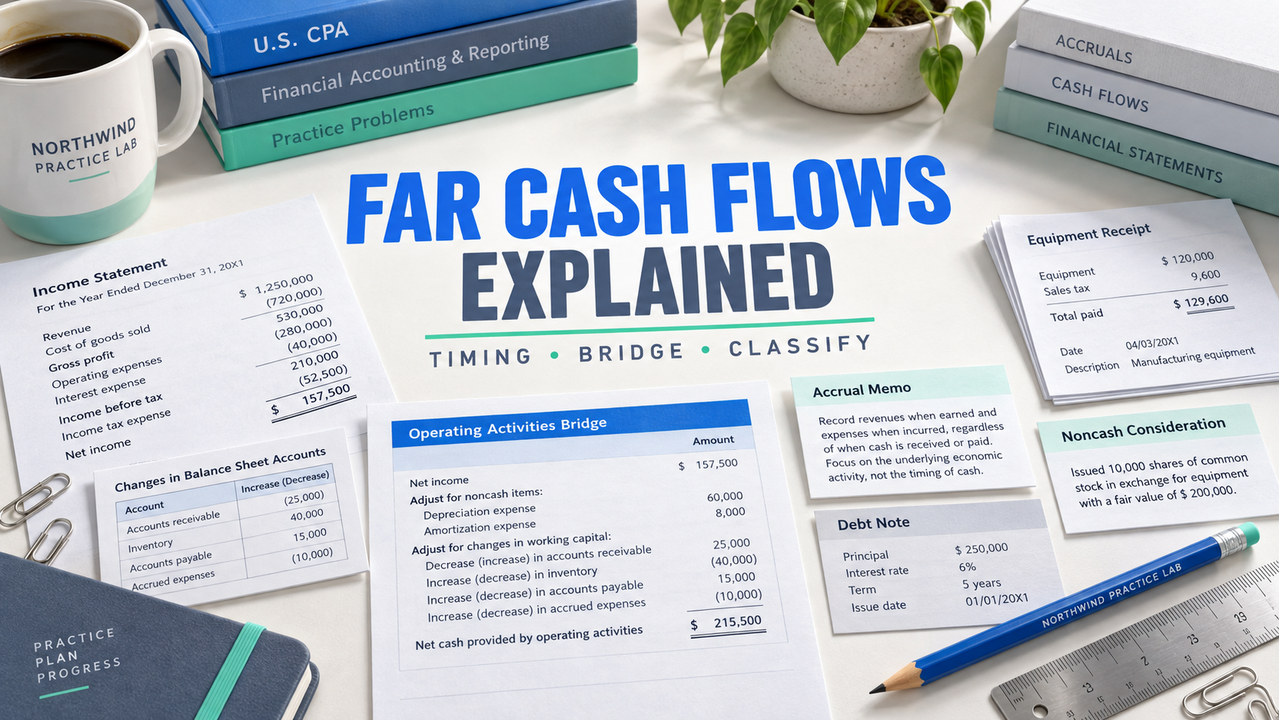

Direct answer: If you searched for far cash flows and accrual accounting explained, start with one bridge: accrual accounting tells you when the rules record income or expense, while cash-flow reporting asks when cash moved and which activity lane explains it. Name the starting amount, label each balance change’s cash effect, then classify equipment, debt, dividends, and noncash consideration by purpose.
Editorial review note: Written by the CPA Exam Prep study-content team and reviewed for accounting terminology, internal consistency, and learner usefulness. The facts and answers are original editorial material, not published test content.
Use this page as a concept lesson and short practice lab. The AICPA Blueprint and current Accounting Standards Codification define the live boundary; this article simplifies the numbers to show the causal chain. For a broader study path, see the FAR review hub.
Far cash flows and accrual accounting explained: start with the bridge
Use this far cash flows and accrual accounting explained framework in four moves: start, time, sign, classify.
Accrual accounting and cash accounting answer different questions. Accrual accounting records the economic event when the reporting rules say it belongs in the period. Cash reporting asks what actually entered or left the bank during that period. A customer invoice can increase revenue and accounts receivable before collection. A supplier bill can create an expense or inventory cost before payment. Depreciation can reduce income without a current-period cash payment. The bridge exists to reconcile those different clocks.
For an indirect operating-cash exercise, keep four labels visible: starting amount, timing adjustment, cash effect, and activity lane. Net income is the starting amount only when the prompt asks for the indirect operating bridge. A balance change is not automatically a cash flow by itself; translate its direction into a cash effect. Equipment and debt may change cash but belong outside operating cash. A share-for-land exchange may carry value without cash consideration.
The reliable sequence is recognize → check timing → sign the adjustment → classify the purpose → verify the total. Write the words before the numbers: “receivable increased, so cash is lower than accrual income” and “equipment purchased for cash, so investing outflow.”
Build the accrual-to-cash bridge for far cash flows and accrual accounting explained
Before attempting a calculation, state the assumptions. This lesson uses the indirect method for operating cash, treats the listed balance changes as period-over-period movements, keeps taxes and interest outside the simplified example unless stated, and separates investing, financing, and noncash facts from the operating bridge. Those assumptions are teaching controls, not a substitute for the current standard when a real reporting question has more facts.
Step 1 — Recognize the starting amount. Start with net income when the requested output is indirect operating cash. Do not start with revenue, ending cash, or total assets just because those numbers are prominent in an exhibit.
Step 2 — Check timing. Ask whether the income-statement amount already involved cash. Add back an unpaid accrued expense in a simplified bridge when it reduced income without a same-period payment. A paid expense is not rescued by its label; the payment status controls.
Step 3 — Sign the cash effect. An increase in accounts receivable generally consumes cash because customers have not yet paid for recognized revenue. An inventory decrease releases cash. An accounts-payable increase provides cash because the company has postponed payment. A prepaid-asset decrease releases cash previously paid. State the effect in words, then calculate.
Step 4 — Verify the lane. Equipment purchases are investing in this teaching case. Borrowing, principal repayment, and dividends are financing. A noncash exchange is not entered as a cash inflow or outflow merely because the asset has a fair value. Keep a separate note for the applicable noncash presentation or disclosure.

Bridge checkpoint: If the total looks plausible but you cannot point to the starting amount, cash-status fact, sign reason, and activity purpose for every line, the bridge is not finished.
Original Northwind bridge practice set
Tested skill, assumptions, and difficulty: This practice set tests the link between accrual recognition and cash-flow presentation. Use the indirect method for operating cash, read each change literally, keep investing and financing outside CFO, and treat the share-for-land exchange as noncash because Northwind paid no cash for it. Difficulty is moderate: the arithmetic is short, but each answer depends on a different controlling fact. Attempt each prompt before opening its reveal.
Northwind Medical Supplies reports net income of $64,000. Depreciation expense is $6,000. Accounts receivable increased by $3,200; inventory decreased by $4,800; accounts payable increased by $2,100; and prepaid insurance decreased by $700. The company paid $18,000 cash for equipment, borrowed $12,000, repaid $4,000 of principal, and paid $2,500 of dividends. It acquired land by issuing shares directly to the seller; Northwind paid no cash for the land. A separate memo says Northwind accrued a $4,200 warranty cost but left it unpaid at period-end.
The simplified operating bridge is: $64,000 + $6,000 − $3,200 + $4,800 + $2,100 + $700 = $74,400. The investing lane is −$18,000. The financing lane is +$12,000 − $4,000 − $2,500 = +$5,500. The share-for-land exchange is a noncash fact under the stated assumptions, so it does not enter those cash totals.

Tasklet 1 — Separate recognition from payment
Original practice prompt: The $4,200 warranty cost reduced Northwind’s net income but remained unpaid at period-end. In this simplified indirect bridge, what adjustment should you make, and what fact would stop that adjustment?
Reveal Tasklet 1 answer and reasoning
Answer: Add back $4,200 under the stated exercise because the cost reduced accrual income without a same-period cash payment. If Northwind paid the $4,200 before period-end, the same fact would not support an unpaid-accrual add-back. The distractor adds the amount simply because someone calls it an expense; check cash status first. First review action: do a paid-versus-unpaid drill using three short memos.
Tasklet 2 — Build the operating bridge
Original practice prompt: Using the listed facts and the indirect method, calculate Northwind’s operating cash before any unlisted items. Show the starting amount and every adjustment.
Reveal Tasklet 2 answer and reasoning
Answer: CFO is $74,400: $64,000 net income + $6,000 depreciation − $3,200 receivable increase + $4,800 inventory decrease + $2,100 payable increase + $700 prepaid decrease. The distractor is $64,000, which treats accrual net income as if it were cash. Another distractor is $66,800, which adds depreciation but ignores working-capital timing. First review action: recompute the same bridge from a blank worksheet and write a sentence beside each sign.
Tasklet 3 — Explain each working-capital sign
Original practice prompt: Which of the four listed balance changes release cash, and which consume cash relative to the indirect starting amount? Explain the direction instead of listing only plus or minus.
Reveal Tasklet 3 answer and reasoning
Answer: The inventory decrease, accounts-payable increase, and prepaid-insurance decrease release cash relative to accrual income, so add them in this bridge. The accounts-receivable increase consumes cash, so subtract it. The distractor is “all assets subtract and all liabilities add,” which ignores whether the balance moved up or down. First review action: translate each sign into a sentence before touching a calculator.
Tasklet 4 — Classify the cash activity by purpose
Original practice prompt: Place the $18,000 equipment purchase, $12,000 borrowing, $4,000 principal repayment, and $2,500 dividend payment into the appropriate activity lanes. What is the net financing amount?
Reveal Tasklet 4 answer and reasoning
Answer: The equipment purchase is a $18,000 investing outflow. Borrowing, principal repayment, and dividends are financing; together they equal +$5,500. The distractor is to put every cash movement in operating because each one changed the bank balance. First review action: sort ten transactions by economic purpose, then explain why the bank movement alone is not the lane.
Tasklet 5 — Keep noncash consideration outside cash
Original practice prompt: Northwind issued shares directly to acquire land. Northwind paid no cash. Should you enter the land’s value as a cash investing outflow, and what changes if the seller receives cash instead?
Reveal Tasklet 5 answer and reasoning
Answer: Do not enter the land’s fair value as a cash outflow when Northwind gives shares and pays no cash. Record the applicable noncash investing and financing presentation or disclosure under current guidance. If the seller receives cash, the consideration becomes a cash investing outflow under the changed facts. The distractor is to treat fair value as proof that cash moved. First review action: practice a two-column “cash paid / value transferred” comparison.
Classify far cash flows and accrual accounting explained by purpose
Once the operating bridge is stable, move to the transaction’s purpose. Operating cash reflects short-cycle activity adjusted for timing differences. Investing cash reflects purchases or sales of long-lived resources or investments. Financing cash reflects borrowing, principal repayment, owner distributions, or capital contributions. Exact presentation can depend on the guidance and facts, so treat this map as a learning scaffold.
Northwind’s equipment purchase is not an operating adjustment simply because depreciation later appears in net income. The $6,000 depreciation add-back reverses a noncash expense inside the operating bridge; the $18,000 equipment payment is a separate investing outflow. Likewise, the $12,000 borrowing and $4,000 principal repayment are not netted into net income. They explain the financing lane. The $2,500 dividend is also financing in this exercise.
The noncash boundary is a separate question: what changed hands, and what consideration moved? Land can have a measured value while cash paid remains zero. Write “cash paid = $0” when the facts say shares were issued directly. If a later fact changes the consideration to cash, change the cash-flow conclusion without rewriting the operating bridge. That is the discipline tested by the retry.
Use a three-line check before finalizing: cash amount, economic purpose, and presentation boundary. If one line is missing, do not hide the gap by combining totals.
Review far cash flows and accrual accounting explained: choose the next drill
Review the first broken link rather than counting only correct totals. A Tasklet 1 miss signals an accrual-timing gap. When Tasklet 2 fails, check the starting amount or bridge construction. For Tasklet 3, practice balance-change direction in words. If Tasklet 4 fails, sort by purpose before calculating. A Tasklet 5 miss calls for separating value transferred from cash consideration.
Use this compact record after the reveals: first broken link (recognition, timing, sign, lane, or noncash); evidence (which fact controlled it); repair verb (label, translate, calculate, classify, or compare); and next block (five to ten minutes on that same skill). It is not an official exam result and should not be read as a readiness prediction.
Retry far cash flows and accrual accounting explained after one changed fact
Change one fact: Northwind pays the $4,200 warranty before period-end instead of leaving it unpaid. Keep net income, depreciation, receivables, inventory, payables, prepaids, equipment, debt, dividends, and the share-for-land consideration fixed. This changes only the unpaid-accrual adjustment. Do not change the $74,400 bridge by reversing an unrelated working-capital sign, and do not move equipment into operating.
The purpose of a controlled retry is to prove that you can update the linked output rather than repeat a memorized answer. Mark the changed fact, name the line it touches, and list the facts that stayed fixed. If your explanation changes more than the warranty line, schedule an accrual-status drill. If the warranty line is isolated but the sign language is unclear, schedule a bridge-sign drill.
Far cash flows and accrual accounting explained: FAQ
Why does net income need a cash-flow bridge?
Net income follows accrual recognition, while operating cash follows cash timing. Receivables, inventory, payables, prepaids, depreciation, and unpaid accruals can make the two amounts differ. The bridge explains the difference under the method and assumptions the question gives you.
Should every expense be added back?
No. First identify why the expense changed income and whether the facts show a cash payment. Depreciation is noncash in this teaching case; an unpaid accrued cost has a different timing explanation; a paid operating cost should not receive an automatic add-back.
Is a share-for-land exchange a cash outflow?
Not when Northwind gives shares and pays no cash. Separate the value transferred from cash consideration, then follow the applicable current presentation or disclosure guidance. If cash replaces shares, the changed fact can create a cash investing outflow.
Can this practice set predict my CPA score?
No. It is a local diagnostic for the stated bridge and classification skills. Use current AICPA, NASBA, state Board, and testing-center resources for scope, candidate administration, and readiness information.
Sources and refresh note
Current tested-content boundary: AICPA CPA Exam Blueprints. Format and software boundary: AICPA sample tests. Technical refresh: FASB Accounting Standards Codification. Candidate-process routing: NASBA CPA Exam FAQ. The team checked these pages September 22, 2026. Reopen current guidance when the entity, method, reporting date, activity presentation, noncash disclosure, or candidate-process detail changes. The Northwind facts, questions, answers, reasoning, and retry are original editorial study content.