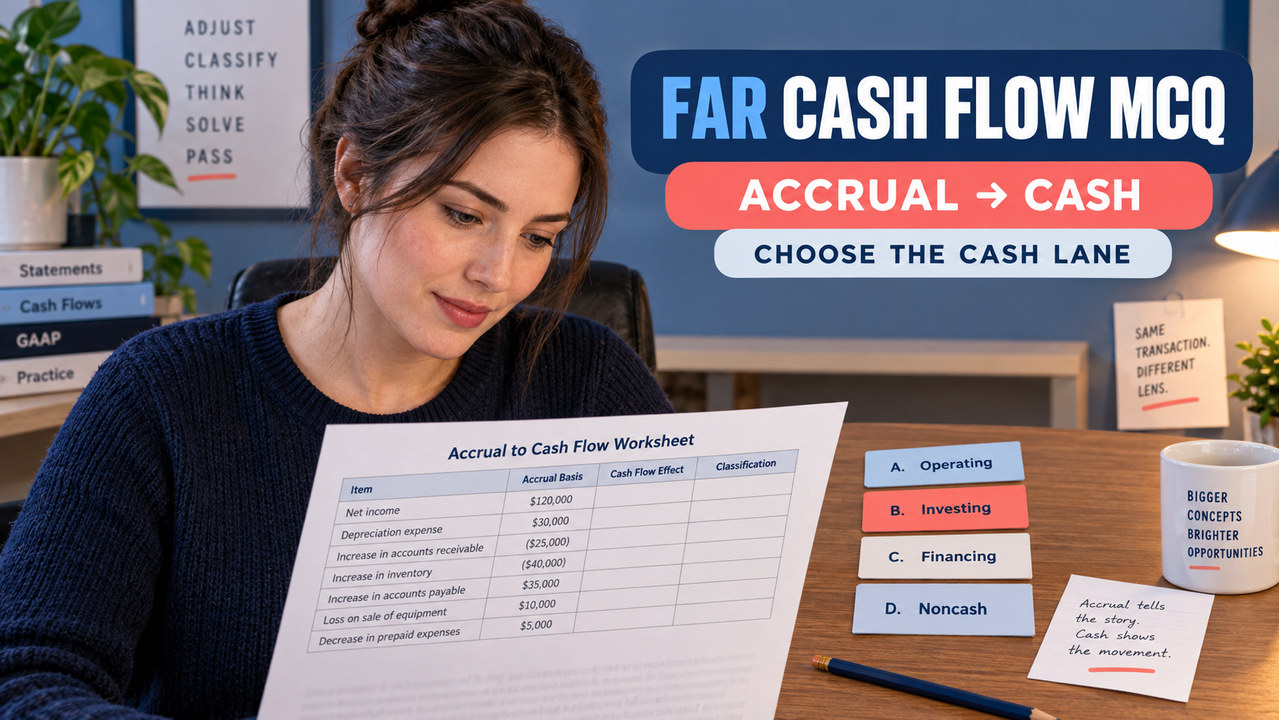

accrual accounting multiple choice practice becomes easier when you stop treating every number in a cash-flow fact pattern as interchangeable. The quickest route is to bridge the accrual starting point, adjust for the right working-capital signs, identify the activity lane, and separate cash from noncash events. This page gives you that method before four original questions.
Quick answer: for accrual accounting multiple choice practice, start with the requested output, write the relevant accrual fact, apply only the adjustment the method calls for, and label the result operating, investing, financing, or noncash. Then explain why the closest distractor used a different amount, sign, or activity. These are original editorial exercises, not official exam items or a readiness score. For broader context, use the CPA FAR review hub.
Accrual accounting multiple choice: what these questions are testing
Tested skill: connect accrual accounting facts to cash-flow outputs without confusing profit, balance-sheet changes, asset cost, debt balances, or noncash consideration. Assumptions: the examples use simplified calendar-year nongovernmental entities, short calculations, and no unusual tax, industry, or effective-date exception. If a changed fact introduces a different reporting scope, reopen the applicable current guidance.
Difficulty: moderate. The arithmetic is intentionally short; the challenge is choosing the correct lane before you calculate. A multiple-choice distractor can contain a real amount and still be wrong because it belongs to another statement, another date, or another activity category.
Use four questions in order. First, identify the starting accrual result or transaction. Second, adjust only for the fact that changes cash or classification. Third, name the destination: operating, investing, financing, or noncash. Fourth, write one sentence rejecting the nearest distractor. That sentence is more useful than marking a letter and moving on.
Keep the official boundary clear. The AICPA CPA Exam Blueprint resource controls current scope language, and the AICPA sample test is useful for software and format rehearsal. Neither source turns the original amounts below into official content.
Accrual accounting multiple choice: build the cash-flow bridge
Use accrual accounting multiple choice as a routing exercise before it becomes an answer-letter exercise. Before looking at the choices, create a four-line scratch bridge. Set the accrual starting point on line one. Next, place noncash adjustments and operating working-capital changes on line two. Then, mark the transaction’s destination on line three. Finally, record the noncash checkpoint and rejected distractor on line four.
Cash-lane checklist
- Start: write net income, expense, revenue, asset cost, debt proceeds, or the transaction stated by the prompt.
- Adjust: add back noncash expense when using an indirect operating method; reverse a working-capital increase or decrease with the correct sign; isolate cash paid from total asset cost.
- Classify: operating generally follows the entity’s operating cash activity, investing follows long-lived asset purchases or sales, and financing follows borrowing, repayment, equity, or distributions under the stated presentation assumptions.
- Check: ask whether cash actually moved. A note issued for equipment can change assets and liabilities without creating cash at the exchange.
For working capital, write the direction before the number. A decrease in accounts receivable usually increases operating cash because more of the recorded revenue has been collected than remains outstanding. An increase in accounts payable usually increases operating cash because expense has been recognized while some cash payment is still deferred. Another increase, this time in inventory, usually reduces operating cash because cash is tied up before the cost is reflected in expense. The sign is a bridge instruction, not a new revenue or expense.

Do not let the visual order replace the fact pattern. When equipment cash paid is requested, do not answer with the equipment’s recorded cost. For a financing-cash prompt, do not substitute a liability balance. If the question asks whether a transaction is noncash, do not count a note or exchange as if cash had moved.
Accrual accounting multiple choice: original FAR cash-flow questions
Practice rule: in accrual accounting multiple choice work, attempt every item before opening the answer reveal. For each one, write the controlling fact, the amount, the activity lane, and the closest rejected distractor. The items are original editorial practice and are designed to test the combined cash-flow and accrual-accounting skill.
Question 1: indirect operating cash flow
Juniper Labs reports net income of $112,000. Depreciation expense is $14,000. During the year, accounts receivable decreases by $8,000 and accounts payable increases by $5,000. Under a simplified indirect-method presentation, what is cash provided by operating activities?
- $85,000
- $117,000
- $139,000
- $153,000
Question 2: cash paid for equipment
Redwood Studio buys equipment for $80,000. It pays $48,000 in cash and signs a note for the balance. Which answer best describes the cash-flow effect at the purchase date?
- $80,000 operating outflow
- $48,000 investing outflow and a separate noncash financing fact
- $32,000 investing outflow
- No cash-flow effect because part of the purchase used a note
Question 3: borrowing and repayment
Harborline borrows $70,000 in cash and repays $15,000 of principal during the same period. Ignore interest and other facts. What is the net financing cash flow?
- $55,000 inflow
- $85,000 inflow
- $55,000 operating inflow
- $15,000 financing outflow only
Question 4: noncash equipment acquisition
Cedar Peak acquires equipment with a fair value of $40,000 by issuing a note directly to the seller. No cash is paid at signing. Which treatment best fits the stated facts?
- Record a $40,000 investing cash outflow
- Record a $40,000 financing cash inflow and investing outflow
- Record the equipment and note, but treat the exchange as noncash at the acquisition date
- Ignore the equipment because no cash moved
Reveal the cash-flow answers
Attempt all four original questions first. Write the starting amount, adjustment or payment, activity lane, and nearest distractor before opening the answers.
Reveal the answer
Answer: Juniper CFO is $139,000; Redwood equipment cash paid is an $48,000 investing outflow; Harborline financing cash flow is a $55,000 inflow; Cedar Peak is a noncash $40,000 equipment acquisition with no cash at the exchange.
The answer separates accrual profit from working-capital changes, cash paid from asset cost, financing cash from note issuance, and noncash recognition from cash movement.
Accrual accounting multiple choice: read the distractor
Question 1 is C, $139,000: $112,000 net income + $14,000 depreciation + $8,000 from the receivable decrease + $5,000 from the payable increase. The first distractor subtracts both working-capital changes. Choice B adds depreciation but reverses the net working-capital effect. A final distractor adds an amount that the facts do not support. The controlling fact is the sign of each operating balance change.
Question 2 is B. Although the total equipment cost is $80,000, cash paid is only $48,000, so the cash outflow is investing at $48,000 under the simplified facts. The note for the remaining $32,000 is a separate noncash financing fact. One distractor uses the unpaid balance as if it were cash; another erases the cash that actually moved.
Question 3 is A, a $55,000 financing inflow. Borrowing adds $70,000 and principal repayment subtracts $15,000. One distractor ignores repayment. Another sends debt proceeds to operating. A final distractor reports only the outflow and misses the earlier borrowing. The key is to net cash events in the requested financing lane rather than read the ending debt balance as cash flow.
Question 4 is C. The exchange records the equipment and note, but cash did not move at signing. One option invents an investing cash payment. Another double-counts the same noncash exchange as two cash events. A final option ignores a real asset and liability. The noncash fact should remain visible for the applicable disclosure analysis.

For accrual accounting multiple choice review, the nearest distractor is often attractive because it uses a number that appears elsewhere in the same question. Mark the number’s label before calculating: accrual, cash, carrying amount, proceeds, repayment, or noncash consideration. Then ask whether the prompt requested an amount, a destination, or a disclosure. This small naming step prevents a correct number from answering the wrong question.
Accrual accounting multiple choice: choose the next review block
After accrual accounting multiple choice practice, do not respond to one miss by opening a much larger random question bank. First identify the earliest broken lane, change one fact, and rerun the same route. When Question 1 was wrong, practice two working-capital sign changes while saying “cash up” or “cash down” before doing arithmetic. For Question 2, separate total asset cost, cash paid, and noncash consideration in a three-line schedule.
When Question 3 was wrong, write borrowing, repayment, and ending liability as separate facts before netting financing cash. For Question 4, draw a cash column and a noncash column and place the note issuance only in the latter. A ten-minute retry is enough to test transfer. Should the changed fact break the route again, return to the first lane rather than adding volume.
Use the current FASB Accounting Standards Codification when entity type, reporting date, presentation method, disclosure scope, or effective date changes. The FASB Codification overview explains the role of the Codification as a research entry point. These sources set technical boundaries; they do not replace the visible reasoning trail in a practice attempt.
Accrual accounting multiple choice FAQ
Is net income the same as operating cash flow?
No. Net income is an accrual starting point when the indirect method is requested. Noncash items and operating working-capital changes bridge it to cash provided by operating activities. The exact presentation depends on the applicable current guidance and stated facts.
Why can debt increase without the same cash inflow?
A note can be issued for equipment or another noncash transaction. The liability increases, but cash did not move for that part at issuance. Separate cash proceeds, repayments, and noncash issuance before classifying the result.
Should four correct answers become a readiness score?
No. Use the result as a diagnostic, not as an official readiness score. Record the first broken lane, the controlling fact, the rejected distractor, and the changed-fact retry. That record chooses the next review block more reliably than a small percentage alone.
When should I reopen technical guidance?
Reopen current guidance when the entity, reporting date, cash-flow method, materiality, transaction scope, disclosure threshold, or effective date changes. Use the current Blueprint for scope and the Codification for technical conclusions rather than forcing a simplified classroom shortcut to answer a different fact pattern.