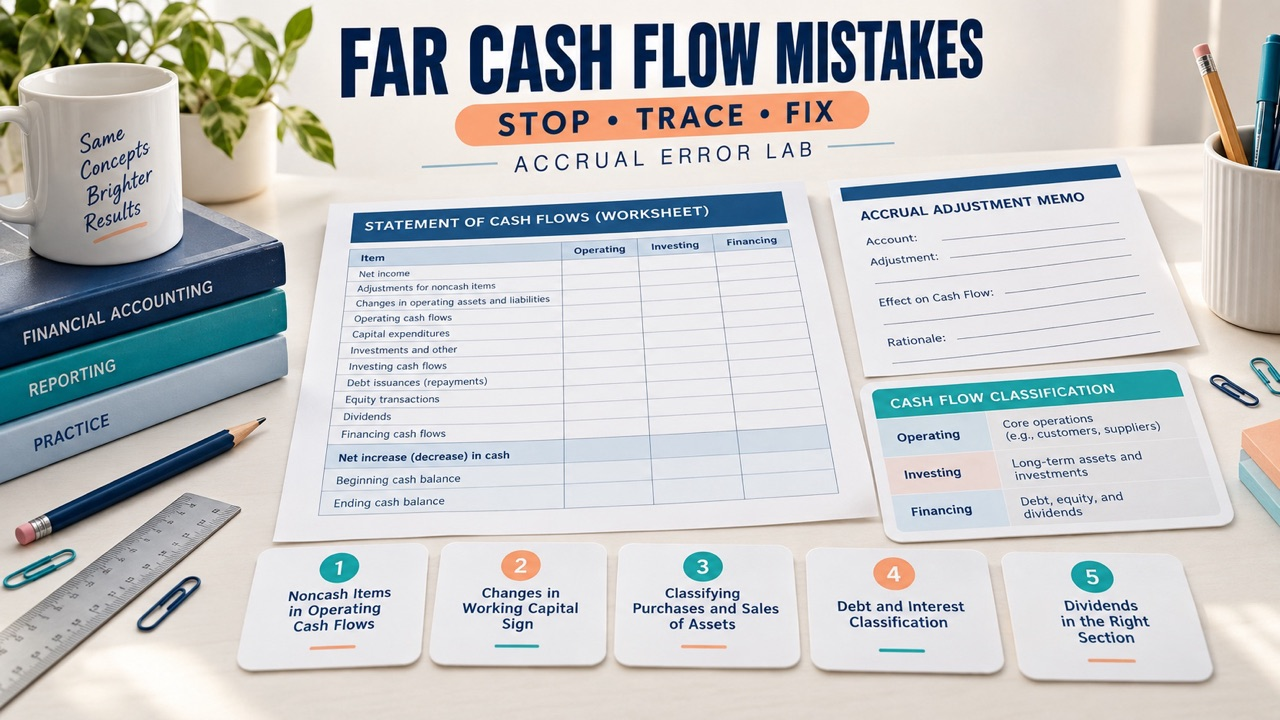

Quick answer: The safest way to fix far cash flows mistakes is to trace the first broken link instead of rereading every rule. Lock the requested output, identify the controlling fact, show the sign or calculation, place the transaction in the correct activity lane, and then change one fact for a focused retry. This original FAR packet is built for the search need behind far cash flows and accrual accounting common mistakes; it is editorial practice, not a released or provider-owned question set.
For current tested-content boundaries, read the AICPA CPA Exam Blueprints and the AICPA sample tests. They establish scope and format boundaries; they do not turn this local attempt record into an official score or readiness prediction.
For a broader preparation path, continue with our CPA Exam Study Guide.
How far cash flows mistakes repeat in accrual tasks
Most errors begin before the arithmetic. A learner may start with revenue instead of net income, subtract a decrease in accounts receivable, add an expense that was already paid, or place an equipment purchase in operating activities. Each move can look familiar while answering a different question from the one on the page.
Use a short evidence chain: requested output → controlling fact → work → classification → answer memo. It keeps accrual measurement separate from cash movement and makes the first wrong step visible.
Start with far cash flows mistakes
Circle the verb and noun in the requirement. “Compute cash provided by operating activities” calls for a bridge and a total. “Identify the activity” calls for operating, investing, financing, or noncash treatment plus a reason. “Explain the adjustment” calls for the direction, the fact that caused it, and the boundary of the simplified assumption. A correct number in the wrong response field is still an incomplete answer.
Separate cash facts in far cash flows mistakes
Net income is an accrual starting point. A depreciation expense can reduce profit without using current-period cash. An unpaid warranty expense can require an add-back in a simplified indirect bridge, while a paid warranty invoice is already a cash event. A share-for-land exchange can have a fair value and no cash flow. Write “cash paid,” “cash received,” or “no cash” beside each fact before choosing a lane.
This practice set assumes a calendar-year nongovernmental entity and an indirect operating bridge. When entity type, reporting date, presentation, disclosure scope, or accounting guidance changes, reopen the current FASB Accounting Standards Codification.
Use the STOP TRACE SIGN CLASSIFY RETRY method for far cash flows mistakes
This five-step loop prevents changing every number after one line goes wrong.
1. STOP: lock the deliverable
Write the requested output at the top of the page: CFO, adjustment, activity lane, noncash disclosure, or explanation. Add the period and unit. If the prompt asks for cash provided by operations, do not answer with net income or a balance-sheet change by itself.
2. TRACE: copy only the controlling facts
Build a small source list. Use the income statement for the starting profit and expenses, balance-change notes for working-capital direction, the transaction memo for paid or unpaid status, and the contract or debt note for activity classification. A visible source fact is stronger than a memorized slogan because it tells you which rule applies.
3. SIGN: show why each adjustment moves
Under a simplified indirect bridge, an increase in accounts receivable consumes cash, while a decrease releases cash. An inventory decrease releases cash; an accounts-payable decrease consumes cash. An unpaid expense that reduced net income is added back if the exercise asks for the indirect bridge and the amount is not already a cash payment. Write the reason beside the sign.
4. CLASSIFY: keep cash and noncash lanes separate
Equipment paid for with cash is an investing outflow. Borrowing and principal repayment are financing facts. A share issuance used to acquire land is not a cash receipt or payment merely because the land has a fair value. If the task asks for a noncash disclosure, answer that request instead of inventing a cash-flow line.
5. RETRY: change one fact
After reviewing an error, alter only the fact that caused it. Change unpaid to paid, increase to decrease, cash consideration to shares, or a purchase to a principal repayment. Keep all other facts visible. If the whole answer changes, identify which lines were actually linked before accepting the revision.

Original Harborline FAR cash flows and accrual practice set
This is an original FAR practice packet. Harborline Components reports $72,000 of net income. Depreciation expense is $8,000. Accounts receivable increased by $4,500, inventory decreased by $6,200, accounts payable decreased by $2,000, and prepaid insurance increased by $1,300. The simplified question asks for the operating bridge before the separate tasklets below. Ignore tax effects, unusual presentation choices, and later-period complications.
Write five fields before attempting: REQUEST, SOURCE FACT, WORK, CLASSIFY, and MEMO. Each item is original editorial practice. Attempt first, then open the reveal.
Tasklet 1 — Do not choose the wrong starting amount
Original practice prompt: Compute cash provided by operating activities under the stated simplified indirect-method assumptions. Show the starting amount and each sign-changing balance fact.
Reveal Tasklet 1 answer and rationale
Answer: $78,400. The bridge is $72,000 net income + $8,000 depreciation − $4,500 receivables increase + $6,200 inventory decrease − $2,000 accounts-payable decrease − $1,300 prepaid-insurance increase = $78,400. The strongest distractor is $72,000 because it treats accrual profit as if it were cash. The repair is to write “indirect bridge starts at net income” before touching working-capital signs.
Tasklet 2 — Do not reverse working-capital signs
Original practice prompt: Which two balance changes release cash, and which two consume cash in the bridge above? Explain the direction rather than listing only the accounts.
Reveal Tasklet 2 answer and rationale
Answer: Inventory decreased by $6,200, so it releases cash and is added. Accounts receivable increased by $4,500, so it consumes cash and is subtracted. Accounts payable decreased by $2,000 and prepaid insurance increased by $1,300; both consume cash and are subtracted. The distractor is applying the same sign to every asset or every liability without asking whether the balance moved up or down. The repair is to write the cash effect in words before adding the number.
Tasklet 3 — Do not add an unpaid accrual twice
Original practice prompt: Harborline included a $5,400 warranty expense in net income, but the amount remained unpaid at period-end. What adjustment belongs in the simplified indirect bridge, and what changes if the $5,400 was paid before period-end?
Reveal Tasklet 3 answer and rationale
Answer: Under the stated exercise, the unpaid warranty expense is added back by $5,400 because it reduced net income without a same-period cash payment. If the amount was paid before period-end, do not keep an unpaid-accrual add-back merely because the expense name remains. The distractor is adding $5,400 to the $78,400 bridge after also treating the same payment as an operating cash outflow. The repair is to label the fact unpaid or paid before choosing the adjustment.
Tasklet 4 — Do not put every cash transaction in operating
Original practice prompt: Harborline paid $26,000 cash for production equipment, borrowed $45,000, and repaid $15,000 of principal. Identify the cash amount and activity lane for each requested transaction.
Reveal Tasklet 4 answer and rationale
Answer: The equipment purchase is a $26,000 investing outflow. The borrowing and principal repayment are financing facts; together they create a $30,000 net financing inflow before any interest question. The distractor is folding both amounts into the operating bridge because cash left or entered the bank account. The repair is to write the transaction’s economic purpose—long-lived asset or capital structure—beside the amount.
Tasklet 5 — Do not confuse fair value with cash
Original practice prompt: Harborline acquires land with a fair value of $30,000 by issuing shares directly to the seller. No cash is paid. What is the correct treatment, and what changes if the seller receives $30,000 cash instead?
Reveal Tasklet 5 answer and rationale
Answer: The share-for-land exchange is a noncash investing and financing transaction that belongs in the applicable disclosure treatment, not as a $30,000 cash-flow line. If the seller receives $30,000 cash, the consideration becomes a cash investing outflow under the stated facts. The distractor is using fair value as proof that cash moved. The repair is to write “cash paid = zero” before choosing the classification.

Review the five far cash flows mistakes
Review the first broken field, not only the final total. A wrong starting amount is a scope error. A wrong working-capital sign is an adjustment error. An unpaid expense treated as paid is an accrual-status error. An equipment payment or debt movement placed in operating is a classification error. A share-for-land exchange treated as cash is a cash-versus-noncash error.
Starting-amount error: match the prompt verb
If you began with revenue, gross profit, or a bank balance, return to the requirement. This packet starts the indirect method with net income; keep that line separate from later adjustments.
Sign error: attach a reason to the direction
Do not memorize “assets subtract” as a complete rule. The change matters. A receivable increase means revenue has not yet become cash, while an inventory decrease releases a prior investment. A payable decrease uses cash. State the cash effect in words, then apply the sign.
Far cash flows mistakes: ask whether cash moved
The warranty fact changes the adjustment because unpaid expense and paid expense are not the same evidence. A note that says “expense recorded” does not answer the cash question. Look for the payment status and the period. If the amount already appears as a cash payment in the requested bridge, do not add it back again.
Far cash flows mistakes: classify purpose
Equipment is a long-lived-asset purchase, while borrowing and principal repayment describe financing. Classification is not determined by whether the amount is large, appears near net income, or was mentioned in the same exhibit. Write the lane beside the purpose before combining any totals.
Noncash error: split value from consideration
Fair value measures the land in the fact pattern, but the stated consideration is shares. No cash was paid. A different consideration changes the treatment, which is why the retry should alter only that one fact. Keep “fair value” and “cash paid” on separate lines in the evidence map.
Use the record below after your reveals:
- First broken field: REQUEST, SOURCE FACT, WORK, CLASSIFY, or MEMO.
- Error tag: starting amount, sign, accrual status, activity lane, or noncash boundary.
- Next block: one five-minute verb drill, sign worksheet, cash-status comparison, classification sort, or changed-fact retry.
Retry far cash flows mistakes with one changed fact
Change only the warranty fact: Harborline pays the $5,400 before period-end instead of leaving it unpaid. Keep net income, depreciation, receivables, inventory, accounts payable, prepaid insurance, equipment, debt, and the land exchange unchanged. The tasklet’s accrual adjustment changes because the payment status changed; the original $78,400 bridge should not be rewritten with a new inventory sign or a new equipment lane.
Explain what stayed fixed
The amount remains $5,400. The affected concept remains the warranty line. The changed controller is cash status, not the income amount, reporting period, or activity purpose of the other transactions. If you changed the equipment classification or the share-for-land treatment, you changed more than the retry allowed.
Schedule the next block from the first gap: an accrual-status drill, bridge worksheet, or classification sort. A local attempt record is more useful than a bare percentage.
FAQ for far cash flows mistakes
What is the most common cash-flow mistake?
Starting with the wrong requested output is often the most expensive mistake because every later sign can look internally consistent. Write the verb, amount, period, and unit before calculating.
Does every expense get added back in an indirect bridge?
No. The adjustment depends on why the expense affected net income and whether the stated facts show a cash payment or a noncash item. Use the exercise’s assumptions and current guidance rather than applying a blanket label.
Is a share-for-land exchange an investing cash flow?
It is an investing and financing transaction in substance, but the stated share consideration means no cash was paid. Follow the applicable noncash disclosure treatment and do not enter fair value as cash.
Can this five-task result predict my CPA score?
No. It is a local diagnostic. The AICPA sample test is designed for format and software familiarity, and current exam or candidate-process questions should be checked against the live AICPA, NASBA, state Board, and testing-center resources.
Sources and refresh note for far cash flows mistakes
Current tested-content boundary: AICPA CPA Exam Blueprints. Format rehearsal: AICPA sample tests. FAR format reference: AICPA retired FAR task-based simulation. Technical refresh: FASB Accounting Standards Codification. Candidate-process routing: NASBA CPA Exam FAQ. These official pages were checked September 22, 2026. Reopen current guidance when the stated facts, entity, method, reporting date, presentation, or disclosure scope changes. The Harborline facts, questions, answers, rationales, error taxonomy, and retry are original editorial study content.