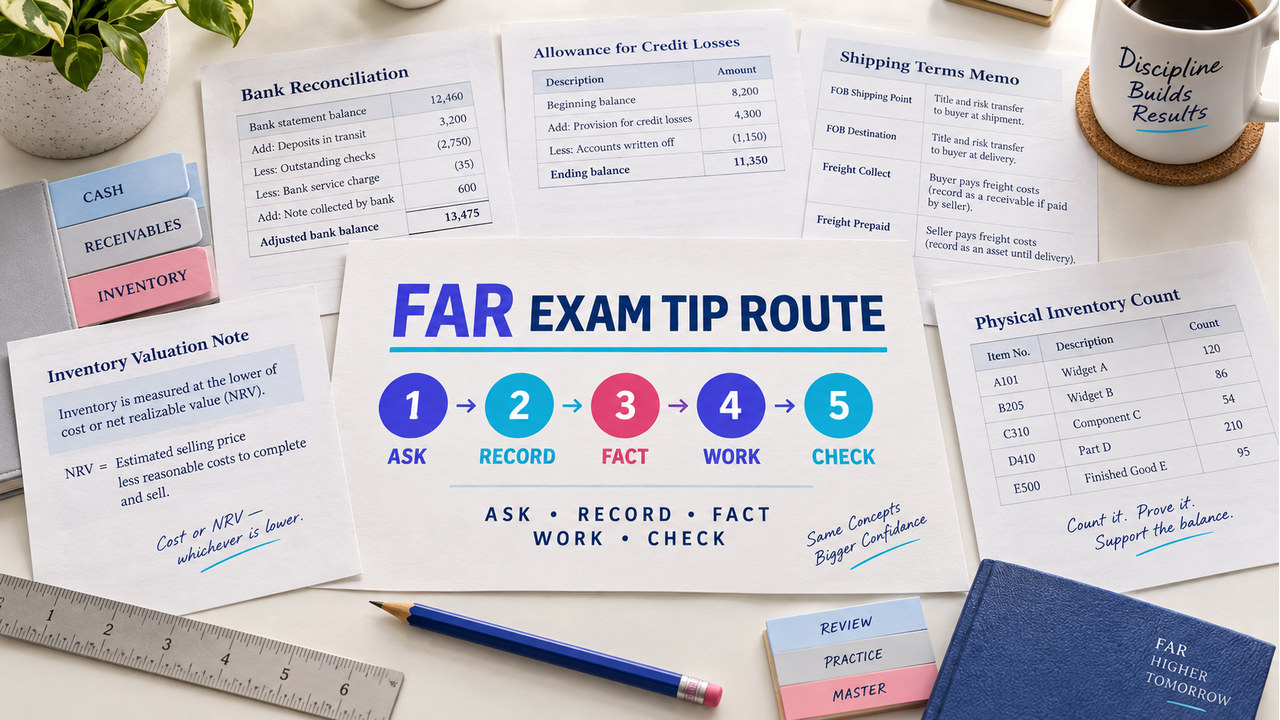

Direct answer: The most useful far cash receivables and inventory exam tips are a repeatable five-step routine: read the requested output, identify the evidence record, circle the controlling fact, calculate or classify only after that, and write the next check. Cash, receivables, and inventory questions look different, but each one rewards the same discipline. In particular, a bank statement, an allowance schedule, a shipping term, a measurement comparison, and a physical count each answer a different question.
Editorial review note: This page was checked by the CPA Exam Prep study-content team for terminology, arithmetic, internal consistency, source boundaries, and learner usefulness. The examples, prompts, answers, distractors, and review aids are original editorial practice, not provider-owned exam content.
This far cash receivables and inventory exam tips lesson uses simplified facts for practice. The current AICPA Blueprint and current accounting guidance define the live boundary. Use the FAR review hub for broader routing, and reopen authoritative guidance when a live fact pattern adds an assumption that is not stated here.
far cash receivables and inventory exam tips: five high-speed checks
These tips are designed for compressed fact patterns. First, write what the question actually asks: adjusted balance, expense movement, inventory inclusion, write-down, or investigation amount. Next, name the record that can answer it. Then, mark the fact that controls the result. Finally, show one equation or classification sentence and state what you would check if the result looks wrong.
First, underline the output. An adjusted balance is not the same as a book adjustment, and an investigation amount is not automatically a final accounting treatment.
Next, match the evidence to the task: bank statement, ledger, allowance schedule, shipping memo, valuation note, or count sheet.
Then, look for the boundary: timing, ending target, ownership term, measurement benchmark, or physical evidence.
Finally, write the smallest equation or classification that another reviewer could reproduce. Do not let a familiar number choose the lane.
As a final check, if you miss, name the next evidence check: reread the bank side, rebuild the allowance movement, reread the term, confirm the measurement basis, or verify the count cutoff.
Therefore, the routine prevents a common exam error: performing correct arithmetic on the wrong evidence lane. Meanwhile, it keeps the explanation short enough to use under time pressure. A good answer should identify the trigger, show the output, and reject the nearest distractor.
Use far cash, receivables, and inventory exam tips under time pressure
Before solving, write five labels in the margin: ASK, RECORD, FACT, WORK, and CHECK. For cash, ASK may be the adjusted balance, RECORD separates the bank statement from the books, and FACT identifies deposits, checks, fees, or interest. Meanwhile, for receivables, RECORD points to the allowance schedule, while FACT identifies the opening and ending balances. Finally, for inventory, FACT may be a shipping term, a benchmark, or a verified physical count.
Next, resist two tempting shortcuts. First, do not treat every amount in the paragraph as an adjustment to the same account. Second, do not answer a value question with a count explanation or an ownership question with a date-only explanation. In contrast, a concise lane label tells you what to leave out. This is why the CHECK field matters: it makes the omitted distractor visible.

Original far cash, receivables, and inventory exam tips practice set
Attempt each case before opening the explanation. First, write the five labels. Then, record the requested output and the nearest distractor. The cases below are independently authored and use different numbers from other pages; they are practice only.
Case 1 — Reconcile the bank side before posting the books
Question: The bank statement shows $72,640. Deposits in transit are $4,180, and outstanding checks are $3,250. The books show $73,455 before a $95 bank fee and $210 of bank interest. What adjusted balance should both sides support?
Reveal Case 1 answer and reasoning
Answer: $73,570. First, the bank side is $72,640 + $4,180 − $3,250 = $73,570. Meanwhile, the book side is $73,455 − $95 + $210 = $73,570. Deposits in transit and outstanding checks are timing items on the bank side; the fee and interest change the books. The distractor is to post all four items to the ledger.
Case 2 — Separate allowance movement from the ending target
Question: Gross receivables are $246,000. The allowance has an opening $5,750 credit balance, and the required ending credit is $11,900. What expense movement and net receivables follow?
Reveal Case 2 answer and reasoning
Answer: $6,150 expense movement and $234,100 net receivables. First, the movement is $11,900 − $5,750 = $6,150. Therefore, net receivables are $246,000 − $11,900 = $234,100. The ending target is a balance-sheet destination, while the expense is the movement needed to reach it. The distractor is to report $11,900 as the expense.
Case 3 — Let the ownership term control the inventory date
Question: Goods costing $12,480 were shipped FOB shipping point on December 31. Goods costing $8,760 were shipped FOB destination on December 31 and arrived on January 4. Which goods belong in the buyer’s December 31 inventory under the stated facts?
Reveal Case 3 answer and reasoning
Answer: include the $12,480 FOB shipping point goods and exclude the $8,760 FOB destination goods. The shipping term is the controlling fact in this simplified case. The date is the same in both sentences, so it cannot distinguish the outcomes. Circle FOB shipping point or FOB destination before deciding whether the buyer owns the goods at the reporting date.
Case 4 — Do not turn a measurement comparison into a count issue
Question: Under the simplified comparison supplied for this exercise, recorded inventory cost is $66,300 and the stated NRV is $64,980. What write-down and ending amount follow?
Reveal Case 4 answer and reasoning
Answer: a $1,320 write-down and $64,980 ending inventory. The difference is $66,300 − $64,980 = $1,320. This is a value lane because the evidence is cost compared with a measurement benchmark. Do not invent a physical shortage merely because the prompt says inventory; the correction sentence should name the cost-versus-NRV comparison.
Case 5 — Investigate the record-to-count gap before choosing treatment
Question: The perpetual record supports $39,820 at cost, while the verified physical count supports $39,560 at cost. No ownership or measurement complication is supplied. What amount should you investigate first?
Reveal Case 5 answer and reasoning
Answer: investigate a $260 shortage. The count is $39,820 − $39,560 = $260 below the record. Check count accuracy, receiving and shipping cutoff, unrecorded movement, and shortage support before selecting a final treatment. The distractor is to label the gap as a valuation adjustment without a value fact.
Review far cash, receivables, and inventory exam tips by lane
After the reveals, score the decision path rather than only the number. A correct number with the wrong lane is provisional because a changed fact could break it. Mark each case as timing, target, term, value, or count. Each label should change your next ten-minute block.
Reread the bank statement and separate timing items from book adjustments.
Write opening balance, movement, ending target, and net balance on separate lines.
Circle the ownership wording before relying on the shipment date.
Rebuild the cost-versus-benchmark comparison and state the basis.
Preserve the record-to-physical difference and verify cutoff evidence before choosing treatment.
When the result is 0–2, rebuild the five labels and repeat the two weakest cases. For a 3–4 result, change one fact in the weakest lane. At 5, transfer the method to a mixed packet without reopening the same answer key. These are local study routes, not score bands or readiness claims.

Retry far cash, receivables, and inventory exam tips after one changed fact
Change only Case 2’s opening allowance. Keep gross receivables at $246,000 and the required ending credit at $11,900, but change the opening credit from $5,750 to $4,250. Net receivables remain $234,100 because the ending target did not change. Expense movement becomes $11,900 − $4,250 = $7,650.
The retry checks whether you understand movement logic or merely memorized $6,150. Similarly, a second retry can change only the bank fee in Case 1, only the shipping term in Case 3, only NRV in Case 4, or only the physical amount in Case 5. Preserve every other fact and write a new correction sentence. If more than one fact changes, the retry no longer diagnoses the original error.
Research and refresh note
Use the current AICPA CPA Exam Blueprints to orient tested scope. Use the AICPA sample tests for format orientation, not for copied content. For a live accounting conclusion, consult the FASB Accounting Standards Codification. The NASBA CPA Exam FAQ is the appropriate place to refresh administration questions.
These cases hold several facts constant so the skill remains visible. A real entity may require additional work on reporting date, shipping terms, allowance methodology, cost-flow assumptions, measurement rules, or cutoff evidence. Reopen the live sources before reusing a fact-specific example after a scope or guidance change.
Next action: Recopy ASK, RECORD, FACT, WORK, and CHECK. Attempt Case 1 without notes, then write the one fact that would change your answer before opening the reveal.
FAR cash, receivables, and inventory exam tips FAQ
What should I write first in a cash reconciliation question?
First, write the requested output and separate the bank statement from the books. For example, deposits in transit and outstanding checks usually affect the bank side; fees and interest usually affect the books under the stated facts.
Why is the allowance target not automatically the expense?
In practice, expense is the movement from the opening allowance balance to the required ending target. Therefore, net receivables use gross receivables less the ending target.
What controls inventory ownership at a reporting date?
Under a simplified practice case, read the stated ownership term before relying on the shipment date. A live fact pattern may require additional research.
How do value and count questions differ?
Similarly, a value case compares recorded cost with a stated measurement benchmark. Meanwhile, a count case compares a record with physical evidence and begins an investigation.
What if I get the number right but cannot explain it?
Keep the point provisional, label the missing controlling fact, and retry one case after changing one fact. The goal is a defensible path, not a lucky number.