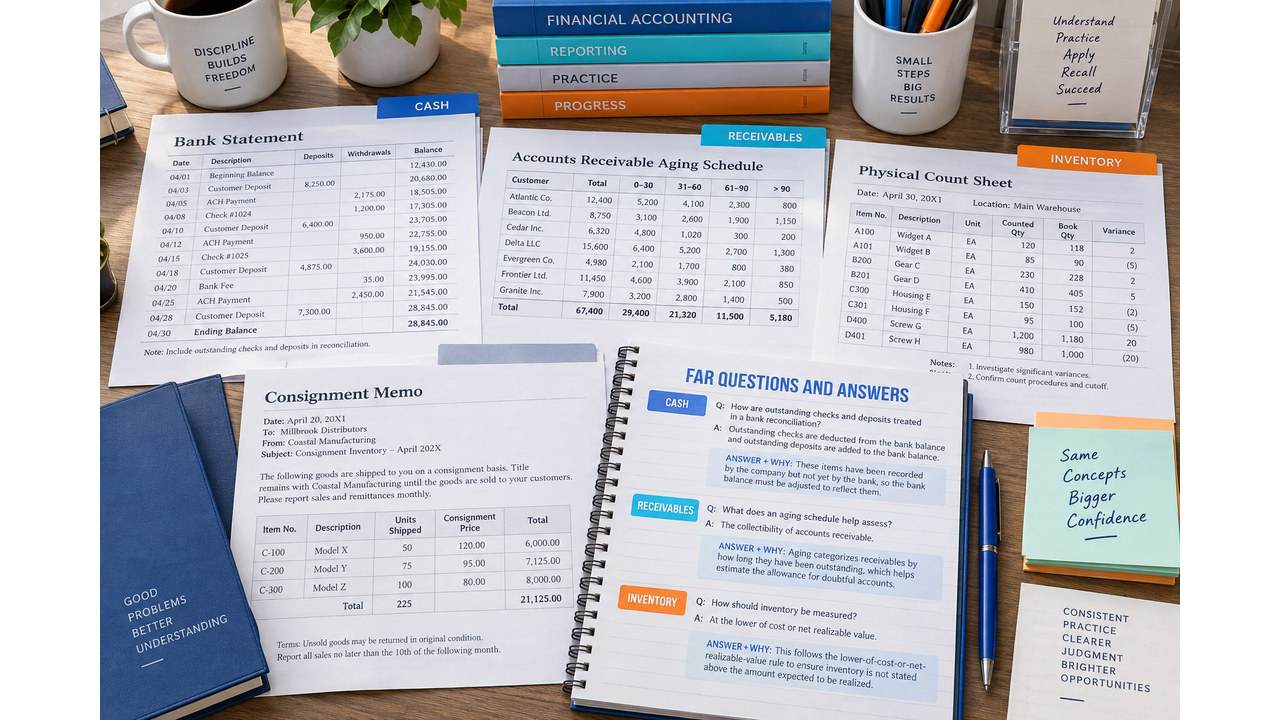

Direct answer: First, the most useful way to study inventory questions and answers is to explain the decision after choosing it. Next, name the evidence source, mark the date or ownership term, state the rule, calculate only the amount the prompt supports, and then explain why the nearest distractor loses. That sequence works across cash, receivables, and inventory questions.
Editorial review note: In addition, this page was checked for terminology, arithmetic, internal consistency, and learner usefulness. The fact patterns, answer choices, rationales, visuals, and retry are original study material.
These FAR questions use simplified assumptions so one reasoning decision stays visible. Meanwhile, the current AICPA Blueprint defines the exam boundary, while the FASB Codification remains the place to reopen when a real fact pattern changes the reporting date, cost-flow assumption, allowance model, or shipping term. For broader routing, visit the FAR review hub.
Inventory questions and answers: use an answer-and-rationale ladder
A correct letter without a reason is fragile. Use five fields before you decide that an answer is secure.
- Question: First, restate what the prompt asks for: adjusted cash, expense, ownership, ending amount, or variance.
- Answer: Next, choose the amount or classification and write its unit, owner, date, or direction.
- Evidence: Then, identify the bank statement, ledger, aging schedule, shipping memo, count sheet, or valuation input that controls the choice.
- Rule: After that, write only the rule supplied or required by the simplified facts.
- Distractor: Finally, name the nearest wrong option and the single field it gets wrong.
As a result, this ladder prevents a familiar number from doing all the work. It also gives you a review verb: reconcile, target, cut off, compare, or verify. If the answer is wrong, the broken field tells you what to practice next.

Cash questions and answers: separate bank and book evidence
For cash questions, a bank reconciliation compares two records of cash at one date. Deposits in transit and outstanding checks normally explain timing on the bank side. In contrast, bank fees, NSF items, and interest commonly require book-side entries because the entity has not recorded them. The answer is not “add every number to both sides.” Instead, the answer is the pair of adjusted balances that agree after each item is placed on the correct evidence lane.
Why the answer must show both sides
When a question gives both a bank balance and a book balance, calculate both even if one side looks faster. Therefore, the second side is a check on signs and classification. If the adjusted balances differ, inspect whether an item was applied twice, left off, or put on the wrong side before changing the rule.
Receivables questions and answers: compare the allowance target
Similarly, an aging analysis gives a required ending allowance, not automatically the current-period expense. Compare the target with the allowance balance already recorded. If the existing balance is a credit, the expense is the additional movement needed to reach the target. If the existing balance is a debit, the movement crosses zero and the expense is larger. Finally, net receivables subtract the required ending allowance from gross receivables under the stated simplified method.
What the nearest allowance distractor usually does
However, the common distractor records the target as if it were a brand-new expense and ignores the opening balance. Write the opening balance, target balance, and direction of movement on separate lines. The rationale should show the movement, not merely repeat the final target.
Inventory questions and answers: separate ownership, quantity, and valuation
In contrast, inventory questions often look alike because all use the word inventory, but they can ask three different things. Ownership asks who owns the goods at the reporting date. Quantity asks what the physical or perpetual record supports. Valuation asks whether the recorded amount follows the measurement rule supplied by the prompt. A correct answer in one lane does not answer a question in another.
Consignment and shipping terms answer ownership questions
For example, possession is not ownership. Goods held for another party on consignment remain with the owner, even when they sit in a warehouse. Shipping terms also control cutoff: read the term and delivery date before deciding whether the buyer includes goods in ending inventory. Therefore, do not turn a physical-location fact into an ownership answer without the term.
Count differences answer quantity questions
Likewise, a verified physical count below the perpetual record identifies a quantity difference under the simplified facts. It does not, by itself, prove that goods in transit are excluded, that consigned goods are owned, or that cost should be written down. Keep the three lanes visible in the rationale.
Original FAR cash, receivables, and inventory questions and answers
Study boundary: these five items are original practice material, not official test content or a score prediction. Attempt each prompt before reading its answer and rationale. Then identify the nearest distractor and the first broken field.

Question A — Reconcile bank timing and book activity
Question: The December 31 bank statement shows $88,600. A deposit of $4,250 is in transit, and checks totaling $2,850 are outstanding. Book cash is $89,645 before recording a $65 service charge, a $120 NSF item, and $540 of bank interest. What adjusted cash balance should both sides show?
Answer A and rationale
Answer: $90,000. The bank side is $88,600 + $4,250 − $2,850 = $90,000. The book side is $89,645 − $65 − $120 + $540 = $90,000. The nearest distractor adds the deposit to the books or subtracts the outstanding checks from the books. The broken field is the evidence source, so the repair verb is reconcile.
Question B — Move an allowance from an existing credit
Question: Gross accounts receivable are $242,000. The allowance has a $3,100 credit balance, and the aging analysis requires a $10,600 credit ending balance. What bad-debt expense and net receivables should the learner report?
Answer B and rationale
Answer: $7,500 expense and $231,400 net receivables. The required adjustment is $10,600 − $3,100 = $7,500. Net receivables are $242,000 − $10,600 = $231,400. The nearest distractor records $10,600 of expense and ignores the existing credit. The broken field is the opening balance, so the repair verb is target.
Question C — Exclude consigned goods from the owner’s count
Question: A warehouse holds goods costing $12,800 that the entity is displaying and selling for a supplier on consignment. The supplier still owns the goods at December 31. Should the entity include the $12,800 in its ending inventory?
Answer C and rationale
Answer: No, exclude the $12,800. The entity has possession but not ownership. Under the simplified facts, the supplier includes the goods and the warehouse holder does not. The nearest distractor treats physical custody as proof of ownership. The broken field is the owner, so the repair verb is cut off.
Question D — Compare cost with a higher NRV
Question: A non-LIFO, non-retail inventory group has recorded cost of $91,300 and NRV of $94,100 at year-end. No other measurement complication is supplied. What write-down and ending amount follow from the stated comparison?
Answer D and rationale
Answer: No write-down; ending inventory remains $91,300. Under the simplified comparison, cost is below NRV, so there is no cost-to-NRV write-down. The nearest distractor writes inventory up to $94,100 merely because NRV is higher. The broken field is the measurement direction, so the repair verb is compare.
Question E — Explain a physical-count variance
Question: The perpetual inventory record supports $47,850 at cost, while the verified physical count supports $46,920. The prompt states no ownership or valuation issue. What amount should the learner investigate?
Answer E and rationale
Answer: Investigate a $930 quantity variance. The difference is $47,850 − $46,920 = $930. Under the stated facts, investigate count accuracy, cutoff, and shortage treatment. Do not change the valuation rule or infer an ownership result. The broken field is quantity, so the repair verb is verify.
Review inventory questions and answers by the first broken rationale
Next, do not record only “wrong.” Record the question, answer chosen, evidence source, controlling rule, nearest distractor, why it loses, confidence before the reveal, and the next ten-minute review block. A Question A miss points to bank-versus-book classification. B points to opening allowance balance. C points to ownership. D points to measurement direction. E points to quantity.
The rationale is the reusable part. For that reason, if you can state the answer but cannot name the field the distractor changed, keep the item in review. If you can name the field but cannot calculate, practice the rule with a new amount. That keeps the next action specific instead of turning five cases into one percentage.
Retry inventory questions and answers after one bank fact changes
Next, change only Question A’s bank service charge from $65 to $140. Keep the statement, deposit in transit, outstanding checks, interest, NSF item, and book cash unchanged. Which amount changes, and which relationship remains intact?
The adjusted bank balance remains $90,000. Meanwhile, the adjusted book balance becomes $89,645 − $140 − $120 + $540 = $89,925. The records now differ by $75 until the book-side adjustment is recorded correctly or another fact is found. The retry changes one book-side fact; it does not change bank timing. Consequently, the repair action is to inspect the book-side evidence rather than rewrite the bank side.
Cash, receivables, and inventory questions and answers: FAQ
Should I memorize the answer or the rationale?
Memorize the decision sequence, not the number. State the evidence source, date or term, rule, and distractor before calculating. A new amount should produce the same reasoning even when the final answer changes.
Why is the allowance target not always the expense?
The target is an ending balance. Expense is the movement from the existing balance to that target. A credit opening balance requires only the additional movement; a debit opening balance requires crossing zero.
Does possession prove inventory ownership?
No. Consignment and shipping terms can separate physical custody from ownership. Read the term, reporting date, and owner before deciding what belongs in ending inventory.
Does a count variance prove a valuation problem?
No. A count variance is a quantity signal under the stated facts. Valuation requires a separate measurement rule, such as the cost-versus-NRV comparison supplied by the prompt.
Sources and refresh note for FAR questions and answers
Use the AICPA CPA Exam Blueprints for current scope and item-type boundaries, the FASB Accounting Standards Codification for current accounting guidance, and the NASBA exam FAQ for current exam-administration questions. These references were checked September 23, 2026. Recheck them before reusing a practice item after a Blueprint or accounting-guidance change.
Next action: Attempt Questions A–E without notes, open the rationales, record the first broken field, and retry Question A after changing only the service charge. Keep the answer ladder visible: question, answer, evidence, rule, distractor.
Sources and update log
- AICPA CPA Exam Blueprints
- AICPA CPA Exam sample tests
- FASB Accounting Standards Codification
- NASBA CPA Exam FAQ
Refresh trigger: Recheck the live Blueprint or Codification when scope, reporting date, ownership term, cost-flow assumption, or allowance method changes.