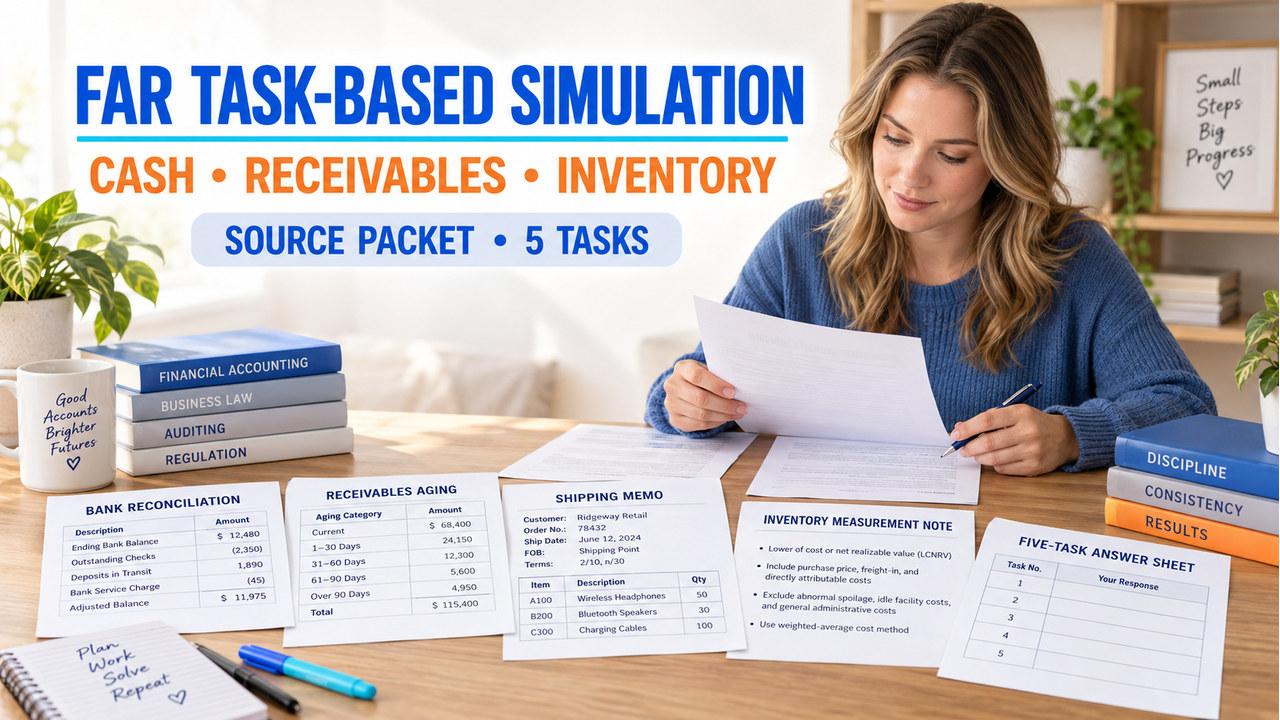

Direct answer: Use far cash receivables and inventory task based simulation as an evidence-first run: open a source packet, identify the controlling fact, research the applicable rule boundary, complete five original task outputs, support each answer, and route the first broken field to a focused retry. The useful result is not a predicted exam score. It is a clear record of whether the miss came from reading, rule selection, calculation, support, or review.
Practice boundary: The cases below are original editorial practice material, not provider-owned question content or official scoring material. Use the current AICPA Blueprint for tested-scope orientation and the FASB Codification for current technical guidance. The simplified assumptions in a practice case do not replace the rule in a live fact pattern.
For a broader preparation path, continue with our CPA Exam Study Guide.
How to use far cash receivables and inventory task based simulation
In practice, the tested skill is not just recalling a cash formula or an inventory definition. It is moving from evidence to a defensible task response across five related current-asset situations. Before you begin, write five fields on a sheet: source, controlling fact, rule or research trigger, answer output, and support sentence. This makes the work look like a small task-based simulation instead of five disconnected multiple-choice calculations.
For this exercise, use only the facts stated in each task. If a real prompt adds a reporting-date issue, shipping term, allowance model, cost-flow method, or measurement complication, stop and reopen current authoritative guidance. For the simplified value case below, use the comparison supplied in the question. For the count case, investigate the difference before deciding what entry or adjustment is appropriate. The difficulty is moderate mixed transfer: each task changes the evidence type, but the same five-field response pattern remains constant.
To keep the run bounded, set aside about 45 minutes. Spend the first five minutes opening and labeling the packet, the next 30 minutes on the five tasks, and the final 10 minutes on support and review. Keep the answer reveals closed until you have written an answer output and one reason. Give yourself a point only when the number or decision, evidence lane, and support sentence all agree. A right number reached through the wrong source is a review signal, not a fully correct task.
Build the far cash receivables and inventory source packet
Before solving, put six pages in front of you: a bank reconciliation, an allowance schedule, a shipping memo, an inventory measurement note, a physical-count sheet, and a blank task-response page. The point is not to decorate a folder. It is to force the same first move you need in a task-based simulation: identify which document can prove the answer before touching the numbers.
Bank, allowance, shipping, value, or count record.
Timing, target balance, term, measurement, or cutoff.
Adjusted balance, movement, inclusion, write-down, or shortage.
One sentence naming the fact that makes the answer hold.
First, for the bank record, separate items that belong to bank timing from items that belong to the books. Next, for the allowance record, separate the opening balance from the required ending target. Then, for the shipping memo, circle the term before reading the arrival date. Finally, for the measurement note, label the comparison as value rather than quantity. For the count sheet, preserve the difference as an investigation item until the supporting records are checked. As a result, these labels keep a familiar number from pulling you into the wrong task lane.

Run the far cash receivables and inventory task path from evidence to support
Use the same five moves on every task. First, read the source record and underline the reporting date or term. Second, research only the rule boundary that the fact triggers; do not browse broadly when the prompt already supplies a simplified assumption. Third, decide which amount, inclusion, or investigation result the task asks for. Fourth, support the answer with the controlling fact and a short calculation. Fifth, review the nearest distractor and write the field that would change if one fact changed.
As a result, this sequence also gives you a useful stopping rule. When you cannot name the source, the task is not ready for calculation. Once you know the source but cannot name the rule trigger, research the boundary. When the rule is clear but the number is wrong, check the sign, opening balance, or comparison direction. Even when the answer is right but the support is vague, keep the point provisional and repair the explanation. A task-based simulation rewards an auditable path, not a lucky final number.
Original far cash receivables and inventory task-based simulation
Before opening the rationale, attempt each task. On your response page, write the requested output, the evidence lane, and the nearest distractor. Every amount and fact pattern below is independently authored for practice. They are designed to rehearse the work pattern, not to predict a result.
Task 1 — Reconcile the cash evidence
Question: The bank statement shows $84,620. Deposits in transit total $3,180, and outstanding checks total $2,040. The books show $85,670 before a $125 bank fee and $215 of bank interest. What adjusted balance should both sides support?
Reveal Task 1 answer and logic
Answer: $85,760. On the bank side, $84,620 + $3,180 − $2,040 = $85,760. The book side is $85,670 − $125 + $215 = $85,760. However, the nearest distractor is to post deposits in transit and outstanding checks to the books. Therefore, the support sentence is: “Bank timing items adjust the bank side; the fee and interest adjust the books.”
Task 2 — Move the allowance to its target
Question: Gross receivables are $318,000. The allowance has a $9,400 credit balance, and the required ending credit is $18,750. What expense movement and net receivables follow?
Reveal Task 2 answer and logic
Answer: $9,350 expense movement and $299,250 net receivables. The movement is $18,750 − $9,400 = $9,350. Next, net receivables are $318,000 − $18,750 = $299,250. The nearest distractor records the full ending allowance as expense and forgets the opening credit. Therefore, support the result by naming the target balance first, then the movement needed to reach it.
Task 3 — Decide ownership from the shipping term
Question: Goods costing $9,750 were shipped FOB shipping point on December 31. Goods costing $14,600 were shipped FOB destination on December 31 and arrived January 3. Which goods belong in the buyer’s December 31 inventory under the stated facts?
Reveal Task 3 answer and logic
Answer: include the $9,750 FOB shipping point goods and exclude the $14,600 FOB destination goods. The stated term controls the ownership trigger. The nearest distractor uses the shipment date for both lots. Your support sentence should explain why the term, not the date alone, determines the buyer’s December 31 inclusion.
Task 4 — Separate measurement from count
Question: Under the simplified comparison supplied for this exercise, recorded inventory cost is $68,400 and NRV is $66,950. What write-down and ending amount follow?
Reveal Task 4 answer and logic
Answer: a $1,450 write-down and $66,950 ending inventory. The difference is $68,400 − $66,950 = $1,450. However, the nearest distractor treats the case as a physical count because it sees an inventory amount. The source is a measurement note, so support the answer with the cost-versus-NRV comparison and preserve the stated simplification.
Task 5 — Investigate the count difference
Question: The perpetual record supports $52,640 at cost, while the verified physical count supports $52,115 at cost. No ownership or value complication is supplied. What amount should you investigate first?
Reveal Task 5 answer and logic
Answer: investigate a $525 shortage. The physical amount is $525 below the record. Check count accuracy, receiving records, cutoff, and shortage support before choosing a final treatment. The nearest distractor turns a quantity difference into a valuation conclusion. The support sentence should keep count evidence separate from measurement evidence.
Research and support far cash receivables and inventory task answers
For that reason, research should be narrow and traceable. When the task asks what is in scope for the CPA exam, begin with the current AICPA Blueprint rather than a dated summary. If the facts require an accounting conclusion beyond the simplified exercise, reopen the relevant FASB guidance. For an administration question, use the current NASBA FAQ. Together, these sources establish boundaries; they do not turn the original cases into official questions.
For each task, write a support sentence in this form: “Because the source is ___ and the controlling fact is ___, the task output is ___.” Add the calculation only when a calculation is required. This sentence exposes a weak answer quickly. For example, a learner who writes “the date controls” for the shipping case has not yet shown the term. A learner who writes “subtract the allowance” without naming the required ending target may have skipped the movement step.
Likewise, do not invent missing facts to make the packet feel complete. If a real prompt leaves out a term, reporting date, cost-flow assumption, or measurement premise, record the missing fact and mark the task for review. That is a stronger simulation habit than forcing a familiar rule onto an incomplete source record.
Route the far cash receivables and inventory task based simulation result
Score one point only when the task output, evidence lane, and support sentence are all correct. For a 0–2 result, rebuild the source packet and redo the two weakest evidence lanes. For a 3–4 result, target the first broken field with a changed amount or term. Finally, a 5 result means transfer the method to a new mixed packet without reopening the same answer key. These are local study routes, not official score bands or a pass prediction.

Log the first far cash receivables and inventory simulation break
When a task is wrong, do not reread every current-asset chapter. Record the task, source document, changed fact, research trigger, selected answer, support sentence, nearest distractor, first broken field, and next ten-minute action. The first broken field may be source selection, rule trigger, sign, opening balance, ownership term, measurement direction, or count cutoff. Also write what document would prove the repair. That final line turns a broad error into a bounded review.
Controlled retry after far cash receivables and inventory task based simulation
Change one fact in Task 2 and keep the rest of the source packet fixed. Change the opening allowance from a $9,400 credit to a $7,900 credit, while gross receivables remain $318,000 and the required ending credit remains $18,750. Net receivables still equal $299,250, but expense movement becomes $18,750 − $7,900 = $10,850. If the net balance changes, you changed the target line instead of the opening movement. Otherwise, if the expense does not change, you ignored the changed fact. This one-fact retry checks whether the method transfers.
Then choose a second retry based on your first weak lane. For cash, change only the bank fee and recompute the book side. Next, change only the shipping term for ownership and explain the inclusion. Then change only the NRV for value and state the comparison. Finally, change only the physical amount for count and investigate the difference. A useful retry changes one variable, preserves the source structure, and requires a new support sentence.
FAR cash receivables and inventory task-based simulation FAQ
Who created these practice tasks?
They are independently authored editorial practice tasks. Use the live AICPA Blueprint and authoritative guidance for current scope and technical boundaries.
What if I get the number right for the wrong reason?
Keep the result provisional, record the first broken field, and retry after changing one fact. A correct number without a controlling source or support sentence is not reliable transfer.
Why keep ownership, value, and count separate?
They answer different questions with different evidence. Shipping terms address ownership, a supplied cost-to-NRV comparison addresses measurement, and a record-to-physical difference begins an investigation. Mixing them creates predictable distractors.
When should I refresh the technical rule?
Recheck official guidance when the Blueprint, reporting date, shipping term, allowance model, cost-flow method, or measurement rule changes. Keep the task path, but update any conclusion that depends on the changed fact.
Sources and refresh note
Use the AICPA CPA Exam Blueprints for current scope. Next, use the AICPA sample tests for format orientation. Finally, use the FASB Accounting Standards Codification for current accounting guidance and the NASBA CPA Exam FAQ for administration questions. These pages were checked September 23, 2026. Reopen them before reusing a fact-specific example after a scope or guidance change.
Next action: Assemble the five source records, attempt Task 1 without notes, write the support sentence, and schedule the next drill from the first broken field rather than from the raw number alone.